You're probably in a familiar spot. You lead the hard projects nobody else wants. You review design docs, unblock the team, mentor newer engineers, and still write a lot of the code that matters. People trust you. Releases go better when you're involved. But the next step isn't obvious.
At that point, “Staff Engineer” can look like a fuzzy title with a bigger paycheck attached. In practice, it's not just the next rung above Senior. It's a different operating model.
That difference matters even more in startups. In a large company, ladders are usually documented. In a startup, titles are often loose, scope changes every quarter, and a Senior engineer can end up doing Staff-level work without the title, pay, or authority that should come with it. That's where a lot of ambitious engineers get stuck. They're already solving broader problems, but they're still being evaluated like a strong team-level executor.
The useful question isn't “Am I senior enough yet?” It's “Am I extending my influence beyond my own team?”
That's the core distinction in the staff engineer vs senior engineer discussion. Senior engineers are judged by the quality and speed of execution within a team. Staff engineers are judged by how they shape direction across teams, reduce technical friction, and connect engineering decisions to business outcomes.
If you want to make that leap, you need more than better coding skills. You need a different scope, different evidence, and a different way of talking about your work. You also need to know when a startup is asking for Staff impact under a Senior title.
A lot of Senior engineers hit the same moment. The team is running well, your systems are stable, and your manager starts hinting that you're “operating at the next level.” Then nothing happens. No clear rubric. No title change. No compensation reset. Just more responsibility.
That's usually the first sign that the jump to Staff isn't about being the best engineer on your team. It's about becoming valuable in a broader, messier way.
Consider two common scenarios. In the first, a Senior engineer owns a critical API migration, coordinates testing, cleans up edge cases, and gets the rollout done without drama. That's excellent Senior performance. In the second, an engineer notices three teams are making incompatible architectural choices, writes the design principles that align them, gets buy-in from tech leads, and prevents a year of expensive rework. That's Staff-shaped impact.
The second engineer might write less code. They might ship fewer visible features. But they amplify the company's impact.
Staff isn't “Senior, but stronger.” It's the point where your main output shifts from code you wrote to outcomes you enabled.
This is why talented engineers sometimes feel disoriented during the transition. The habits that made you successful as a Senior can hold you back at Staff if you cling to them too tightly. If you insist on being the person who personally solves every hard problem, you cap your own scope. If you optimize for local team wins, you can miss organization-wide trade-offs.
In startups, the confusion gets worse because titles lag reality. You may already be the person setting technical direction, negotiating trade-offs with product, and keeping multiple teams aligned. If that's true, the right question isn't whether you deserve a fancier title. It's whether your role definition, evaluation, and compensation reflect the work you're already doing.
A Senior engineer is the backbone of execution. When teams need a difficult project delivered well, they lean on someone at this level to make the technical plan real.

At a healthy company, a Senior engineer usually owns deep execution within a single team or major project. They know the service boundaries, failure modes, deployment risks, and operational history better than almost anyone else around them. If a migration is slipping, a production issue keeps recurring, or a design needs to be turned into an implementable plan, they step in and move it forward.
Their work often includes:
This is the role of the master builder. You don't need to persuade five teams to change direction. You need to make sure your team delivers the right thing, in the right way, with very few surprises.
The hands-on nature of the role shows up clearly in time allocation. Benchmark data from Fellow says Senior engineers typically spend 80% to 90% of their time coding, while Staff engineers spend approximately 20% to 60%.
That tracks with what good teams need from a Senior. The value isn't abstract leadership. It's direct technical execution.
A Senior engineer's calendar usually fills with pull requests, design reviews inside the team, incident follow-ups, implementation planning, and pair debugging. They still influence others, of course, but the center of gravity stays close to the code.
Practical rule: If most of your highest-value work still depends on your personal implementation speed inside one team, you're probably operating as a Senior engineer.
Startups often blur the picture. A Senior engineer might own the backend architecture for a new product line, coordinate with infrastructure, and represent engineering in roadmap discussions. That can sound like Staff work. Sometimes it is. Sometimes it's just what strong Senior engineers do in a small company where everyone wears extra hats.
The distinction comes down to repeatable scope. If your impact is still concentrated in one team's delivery, even if the project is important, you're likely in Senior territory. If you're consistently defining technical direction across groups and shaping how other senior engineers work, you're moving into a different role.
The Staff role starts when influence becomes your job.
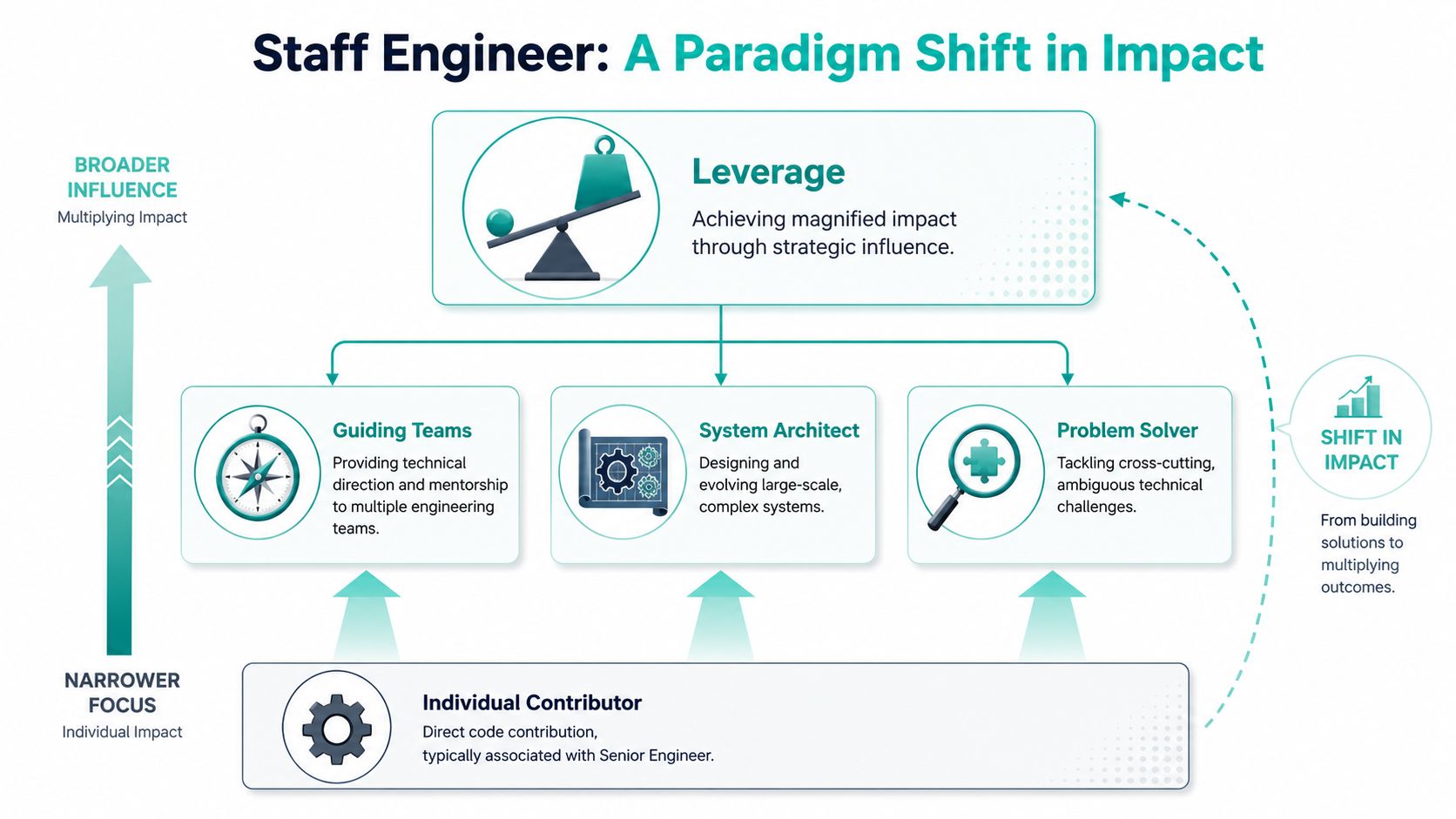
The clearest difference in the staff engineer vs senior engineer conversation is scope of impact. Fonzi's breakdown of the role puts it plainly: Senior engineers own deep execution within a single team, while Staff engineers own technical outcomes spanning multiple teams, systems, or business domains.
That sounds simple, but it changes almost everything.
A Staff engineer spends less time asking, “How do we build this service correctly?” and more time asking, “Should these teams solve this as separate services at all?” They resolve cross-team dependencies, set architectural direction, and make sure technical choices line up with what the business is trying to achieve.
A Senior engineer is often handed a problem to solve. A Staff engineer often identifies the problem worth solving in the first place, gets the right people involved, and drives alignment until execution happens.
A Staff engineer isn't measured by being the fastest person in the room. They're measured by whether the room is working on the right problem.
That's why many strong Senior engineers struggle when they first try to operate at Staff scope. They keep reaching for familiar tools. They write the critical path code themselves. They become the bottleneck in architecture decisions. They review everything. That feels responsible, but it doesn't scale.
The better pattern is force multiplication.
At startup scale, impact often shows up in a few forms:
“Influence without authority” is a practical reality. You usually don't manage the teams involved. You can't order anyone to adopt your proposal. You need technical credibility, clear writing, and the ability to align people with different priorities.
Some moves look senior but not staff:
Staff engineers still need technical depth. They just use it differently. Their depth gives them judgment. Their judgment helps the organization make better bets.
The easiest way to clarify staff engineer vs senior engineer is to compare the operating assumptions behind each role.
| Attribute | Senior Engineer | Staff Engineer |
|---|---|---|
| Scope | Owns one team or one major project | Owns outcomes across multiple teams, systems, or domains |
| Primary focus | Delivery, code quality, local technical decisions | Architecture, alignment, cross-team execution, organizational leverage |
| Planning horizon | Near-term execution | Longer-term technical direction |
| Main value | Solves hard problems directly | Ensures the right problems get solved across the organization |
| Communication style | Team-level technical clarity | Multi-audience persuasion across engineering and product |
| Success signal | Features shipped, systems improved, team mentorship | Broader technical outcomes and durable decisions adopted across teams |
DistantJob's comparison makes one of the most important distinctions: Senior engineer concerns typically span 1 month to a quarter, while Staff engineers plan for 1 to 3 years into the future.
That difference affects what you optimize for.
A Senior engineer working on a payments service might improve latency, refactor core modules, and make the next set of launches safer. A Staff engineer looking at the same area might ask whether the company's current payments architecture can support future product lines, international requirements, or platform constraints over the next few years.
Both kinds of work matter. They just answer different questions.
Here's how the split often looks in practice:
Launching a new product surface
Cleaning up technical debt
Handling incidents
If you're trying to judge where you operate today, ask yourself:
Those questions are more useful than title inflation. Plenty of companies hand out lofty titles without changing scope. Plenty of startups do the opposite and keep broad-impact engineers under a Senior label for too long.
The move from Senior to Staff usually marks a real compensation break, not a cosmetic bump.
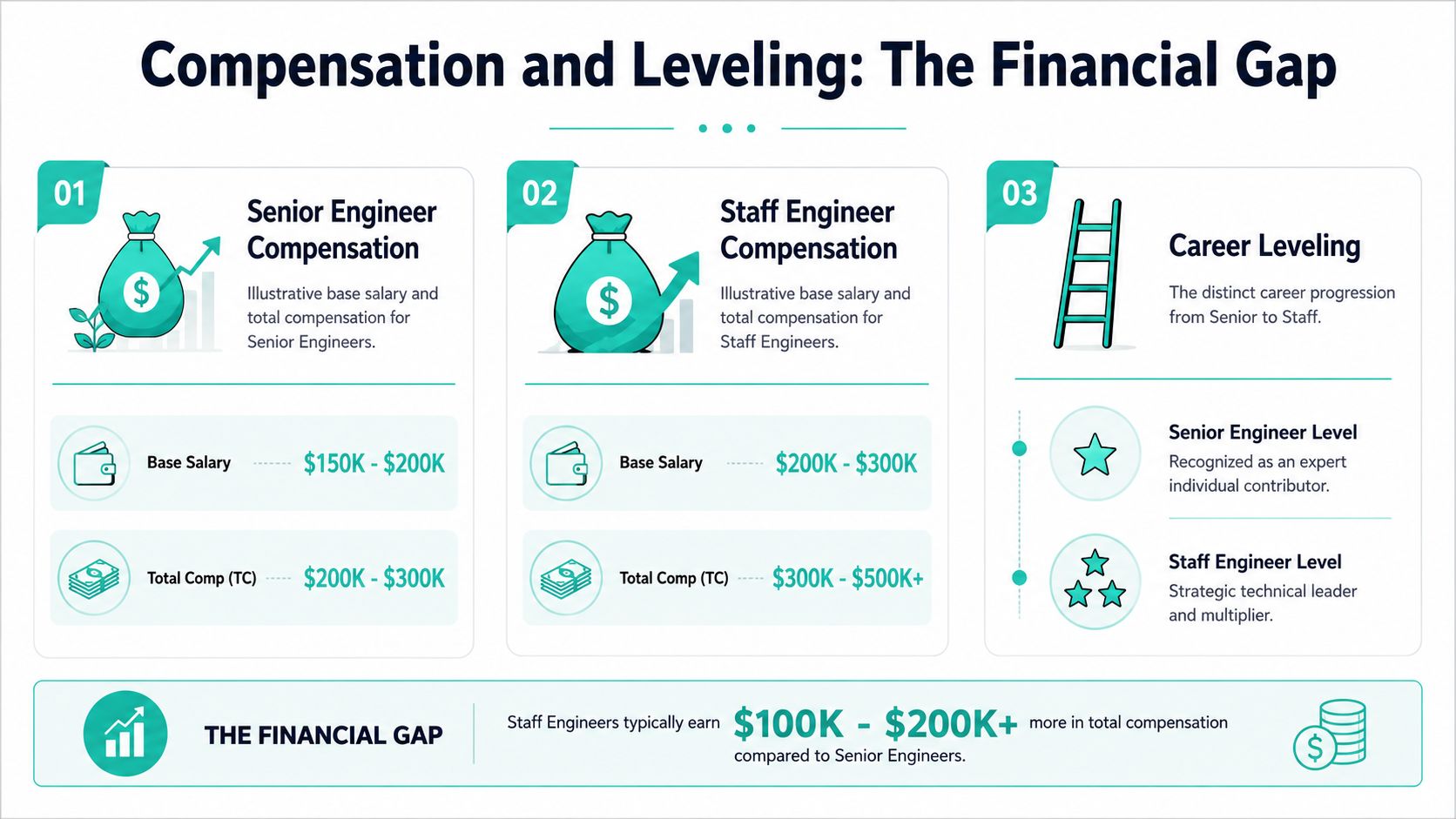
In the U.S. market, CTAIO's compensation data shows that Staff Engineers earn 15% to 30% more in total compensation than Senior Engineers. The same source notes that, at top-tier technology firms, Staff Engineers secure total compensation packages from $350,000 to $450,000 or more, which is a ceiling Senior roles don't typically reach.
That premium exists because companies aren't just paying for stronger implementation. They're paying for broader scope, architectural judgment, and the ability to influence outcomes beyond a single team.
If you want more detail on how engineering pay is structured across levels, this guide to software engineering salary trends is a useful companion.
In startups, compensation often lags reality. The company may need someone doing Staff-level work, but it may not have formal Staff leveling, mature performance rubrics, or a compensation philosophy that recognizes broad technical leadership. That creates the classic mismatch: one engineer stabilizes architecture across teams, carries design decisions, mentors senior peers, and still gets paid as a high-end Senior.
The mistake many engineers make is negotiating from effort. “I'm doing a lot.” That rarely works.
Negotiate from scope and business risk instead. Show the gap between your current title and the decisions you're already accountable for. Point to the cross-team systems you influence, the recurring problems you've solved at the organizational level, and the technical direction other engineers now depend on.
When a startup wants Staff-level output under a Senior label, push for clarity in three areas:
If the company wants you to carry organizational technical risk, your package should reflect organizational impact.
That conversation is especially important in high-growth startups. Broad technical leadership can matter a lot before the org chart catches up.
The interview loop for Staff should feel different because the job is different.
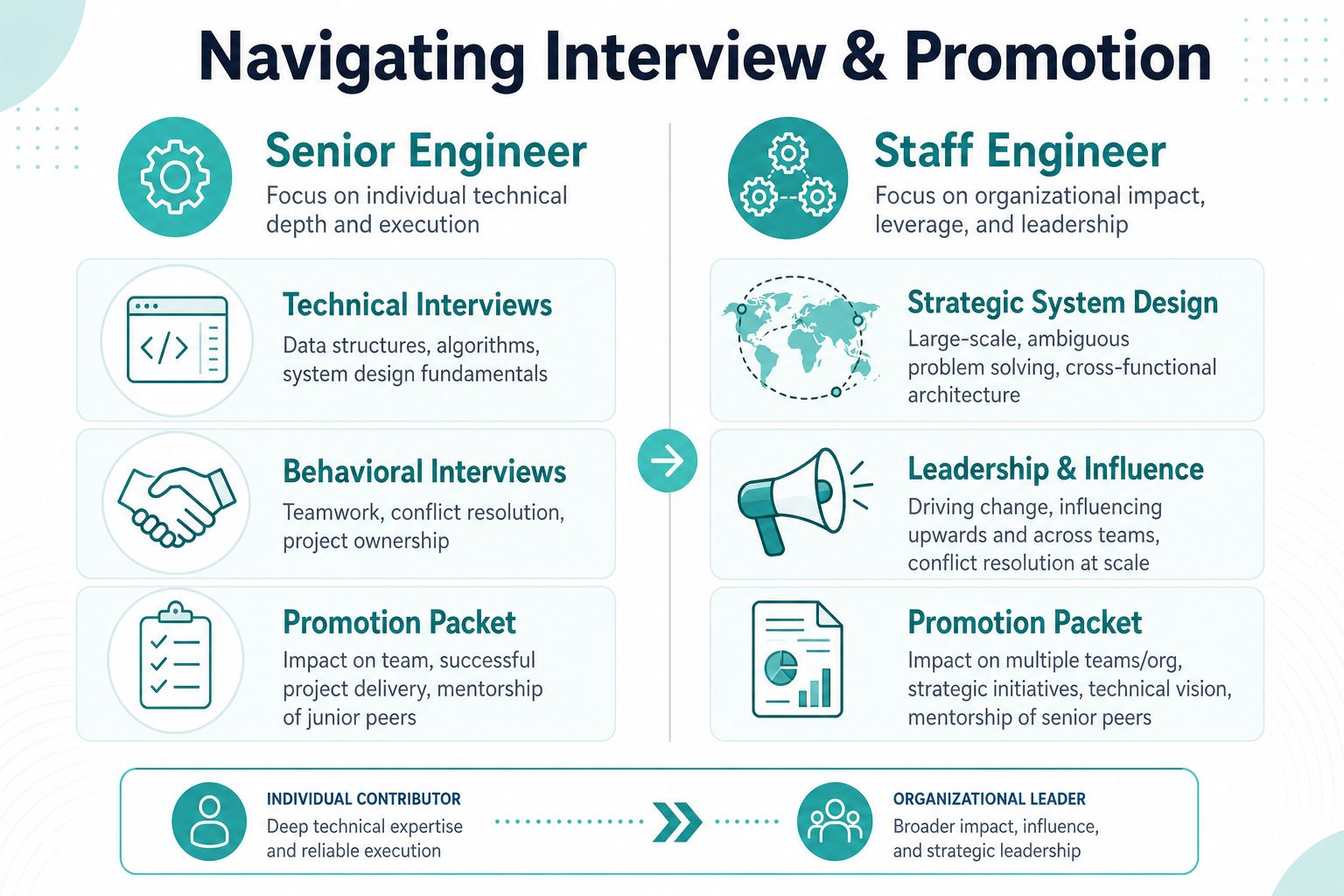
At the Senior level, most companies focus on coding ability, local system design, execution history, and team-level ownership. At Staff, they should test for architecture judgment across domains, leadership without formal authority, and your ability to move a complex initiative through disagreement.
That gap gets messy in startups. Indeed's startup-focused career comparison notes that 68% of Series A startups have no formal Staff role, which means many Senior engineers end up acting as de facto technical leaders without a clean promotion path.
That's why startup interviews can be inconsistent. One company says it wants a Senior engineer, but asks Staff-shaped questions about org design, platform direction, and cross-team influence. Another advertises Staff, but really wants a very strong coder who can lead one workstream.
If you're interviewing, this prep guide on software engineer interview preparation is helpful, but for Staff roles you need extra evidence beyond standard interview drills.
A Senior loop often asks things like:
A Staff loop should ask different questions:
If a company claims to hire Staff but never probes for those areas, that's a signal. Either the role is mislabeled, or the company doesn't know how to evaluate it.
Promotion packets for Staff usually fail when they read like a Senior engineer's brag doc. Long lists of features shipped, services rewritten, incidents handled, and PR volume don't make the case by themselves.
A stronger packet includes:
What works is narrative evidence. Don't just say you “led architecture.” Show the decision, the stakeholders, the disagreement, the trade-offs, and the outcome.
Your packet should prove that the company became more effective because you operated across boundaries, not just because you executed well inside one.
Most engineers don't get blocked on capability. They get blocked on framing.
A Senior engineer's profile often reads like a list of things built. That's fine for Senior roles. It's weak for Staff. If you want to be seen at the next level, your materials need to show influence, not just output.
Here's the shift.
Before: “Built a new billing backend in Go and PostgreSQL.”
After: “Defined the billing architecture used by multiple product teams, aligned service boundaries across engineering, and reduced rollout friction for future monetization work.”
Before: “Led migration from monolith to services.”
After: “Created the migration strategy, sequencing, and decision framework that let several teams move independently without breaking core workflows.”
The second versions do something important. They show scope, alignment, and organizational effect.
You can't fake Staff by changing your LinkedIn headline. You need visible patterns of behavior.
A lot of startup engineers miss the promotion because they wait for permission. The better move is to create evidence first. Build the design doc that aligns teams. Lead the architecture review no one owns. Solve a dependency that keeps slowing product delivery.
If you're shaping your long-term trajectory, this overview of software developer careers can help you think through how to position your next move.
The title matters. The operating model matters more. Once you can show repeated cross-team influence, durable technical direction, and outcomes that extend beyond your own delivery work, the Staff case gets much easier to make.
If you're aiming for startup roles where scope moves fast and titles don't always tell the full story, Underdog.io is worth a look. It connects experienced tech candidates with vetted startups and high-growth companies across the US, with a hiring process built for people who want serious opportunities without turning job search into a second job.