A new engineer opens a pull request on Monday morning and gets three reviews by lunch. One reviewer asks for a helper function, another says the abstraction is unnecessary, and a third focuses on naming while ignoring an untested error path. By Wednesday, the author has made the code harder to understand, the release is waiting on an approval, and nobody can explain which feedback was required.
That isn't a people problem. It's a missing operating system for engineering judgment. Code review standards give a small team a shared definition of “ready,” so speed doesn't depend on which person happens to open the pull request first.
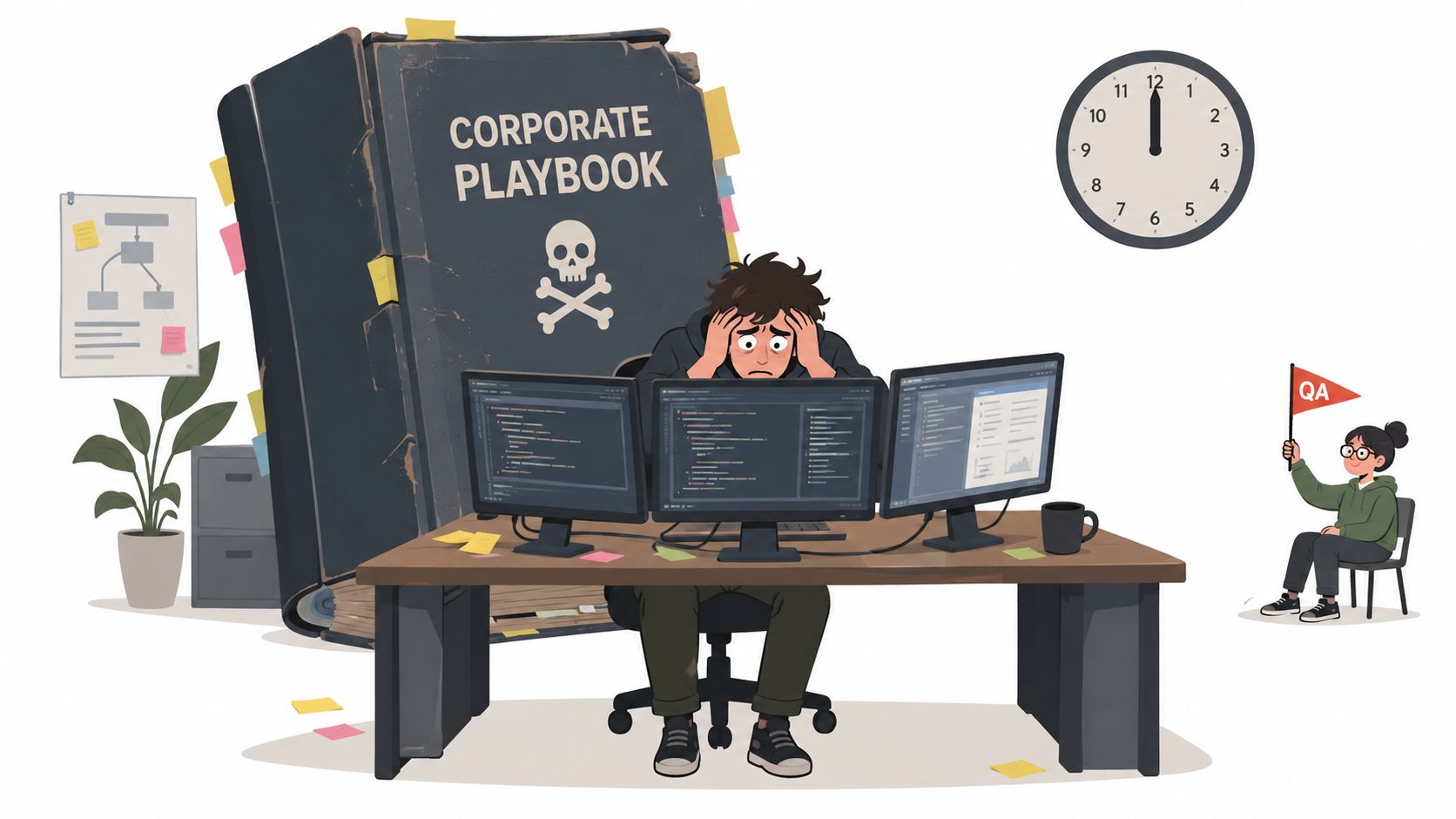
Enterprise review playbooks usually arrive as impressive documents. They define several approval layers, formal sign-offs, specialist reviewers, exception committees, and process language designed for slow release trains. A Series A team shipping weekly doesn't have a dedicated QA department or a deep reviewer pool. It has a handful of engineers switching between product work, incidents, customer support, and hiring.
Borrowing that playbook creates a different kind of risk. A new engineer sees one reviewer approve a broad refactor and another block a small behavior change because the naming doesn't match a personal preference. The author learns to optimize for approval rather than correctness, while senior engineers become the queue everyone waits for.
The useful alternative is smaller and more explicit. Formal review standards trace back to Michael Fagan's 1976 work at IBM, which defined a repeatable sequence of planning, overview, preparation, inspection, rework, and follow-up, requiring up to approximately 3% of total project effort. Startups don't need to reproduce heavyweight inspections, but they can scale down the underlying idea: define what gets reviewed, who reviews it, what evidence matters, and how corrections are closed out. The history of Fagan's inspection process explains why modern merge gates still resemble that older quality model.
Practical rule: A review standard should remove negotiation from routine changes and reserve human debate for decisions that actually carry risk.
The minimum viable version fits on one page. It names review scope, eligible reviewers, approval expectations, change-size limits, response expectations, and the merge gate. It also needs two provisions most startup guides skip: a protocol for AI-generated code and an economic check on whether review activity is improving quality or adding delay.
For teams exploring additional safeguards around GitHub changes, try Vision for safer reviews as a way to think about automated checks without treating automation as a replacement for engineering judgment.
Write the policy in one working session, then test every sentence against a real pull request. If a clause doesn't map to a decision, a tool setting, or an observable outcome, remove it.
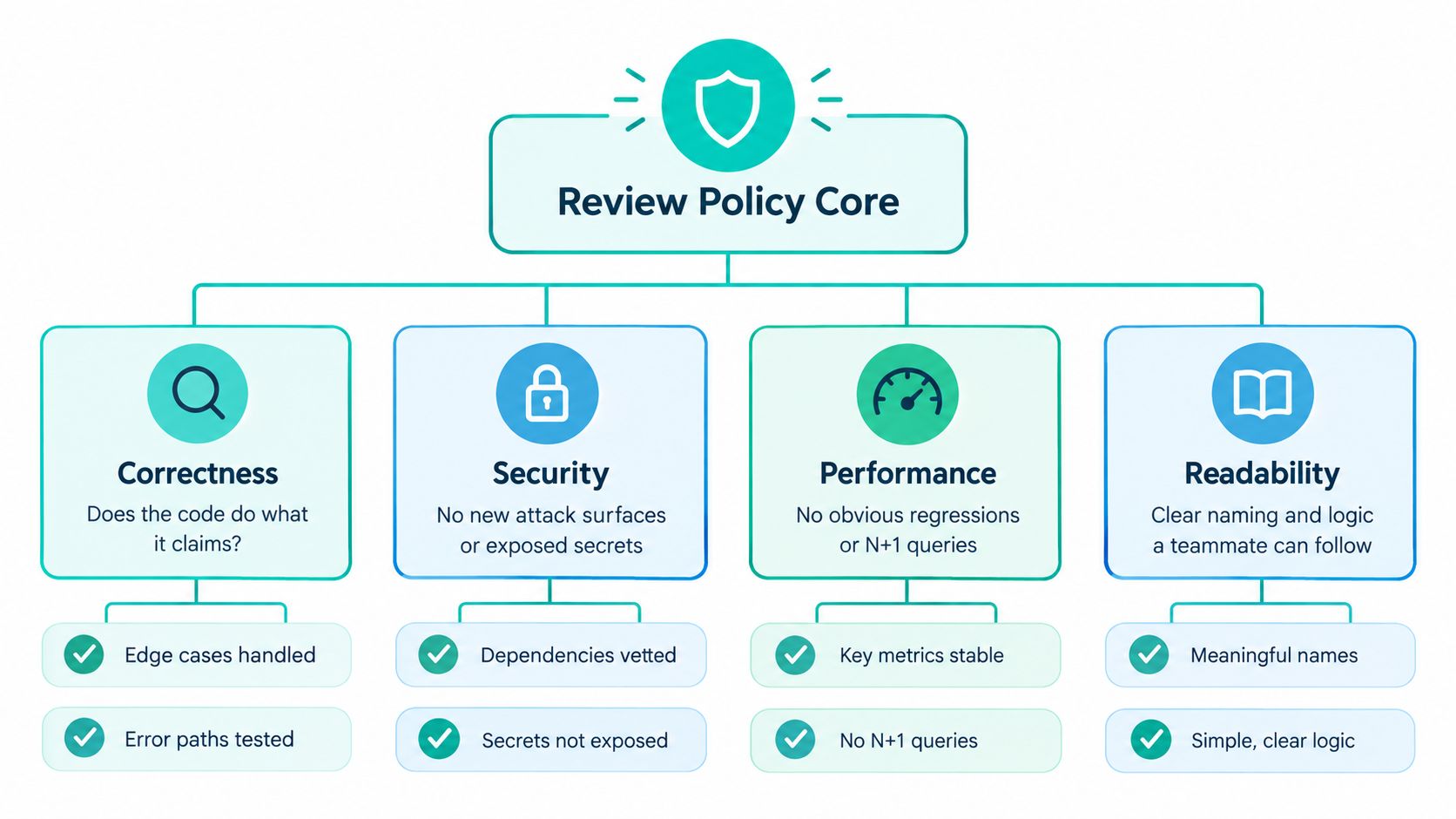
Start with scope. A reviewer checks whether the change does what the issue promises, handles important edge cases, preserves security boundaries, avoids obvious performance regressions, remains readable, and includes adequate tests. That sentence is more valuable than “review for quality” because it tells both author and reviewer where attention belongs.
Microsoft research based on roughly 1.5 million review comments across five projects found that defect finding was the leading motivation for only 44% of managers, while reviews also supported knowledge transfer, team awareness, and alternative solutions. The Microsoft code-review study supports a broader policy. A review that clarifies an API or teaches a teammate about an unfamiliar subsystem has produced value even when it finds no bug.
Use clauses like these:
A four-person team may soften the specialist clause by naming an on-call technical owner rather than requiring two separate people. A forty-person team can enforce ownership files, rotating reviewers, and service-specific approval rules. The principle stays constant: risk determines scrutiny, not hierarchy or habit.
Keep the policy separate from implementation details. The policy says what must happen. The pull-request template, branch protection settings, and CI jobs make it happen. Teams building a broader hiring and engineering foundation can also use engineering team building guidance to clarify ownership before assigning review responsibility.
A good pull request makes the reviewer's job narrow. A dangerous pull request makes the reviewer reconstruct the author's intent while scanning unrelated changes.
| What to check | Author rule | Reviewer rule |
|---|---|---|
| Purpose and scope | State the user problem, affected components, and what isn't included. | Confirm the diff matches the stated scope. |
| Reproduction and behavior | Include reproduction steps or acceptance conditions for behavior changes. | Verify the implementation handles the expected path and meaningful edge cases. |
| Tests | Name the tests run and add coverage for new branches or failure paths. | Look for evidence that tests exercise behavior, not just execution. |
| Visual changes | Add screenshots or a short recording for interface changes. | Compare the result with the intended behavior and check responsive or error states where relevant. |
| Rollback | Describe the rollback, flag, or migration reversal plan when the change can affect production. | Check that rollback is plausible and doesn't leave data or configuration inconsistent. |
| AI assistance | Mark AI-generated or AI-modified code and identify the human author of record. | Apply the additional provenance, intent, security, and dependency checks described below. |
| Diff size | Keep the change focused. Split refactors from behavior changes. | Request a split when unrelated work or excessive files make meaningful review unlikely. |
| Security boundary | Call out secrets, permissions, external input, data handling, and dependency changes. | Treat new attack surfaces, exposed credentials, and authorization changes as danger-zone findings. |
| Public contract | Identify API, schema, event, or client-facing changes. | Check compatibility, versioning, validation, and downstream impact. |
| Merge readiness | Confirm CI status and resolve or explain every comment. | Block only for a defined risk, not personal taste. |
The green path is deliberately boring. A reviewer should be able to understand the purpose, inspect a bounded diff, see test evidence, and make a decision without opening a separate investigation.
The danger zone deserves a different response. A large change may need splitting, but an urgent migration may justify an exception. A missing test may be acceptable for a narrowly documented configuration update, but not for a new authorization branch. Standards work when they force that reasoning into the open instead of pretending every pull request has identical risk.
A policy that lives only in a handbook is a preference. GitHub and CI can turn it into a default.
Begin in GitHub repository settings. Configure branch protection for the default branch with required pull-request reviews, required status checks, and a rule that prevents merging when those conditions aren't met. Use a pull-request template that asks for purpose, related issue, testing notes, risk, rollback information, and a completion checklist. GitHub documents both required review controls and templates that capture this information in the pull request itself. GitHub's pull-request documentation provides the relevant repository controls.
Then map each policy clause to a check:
Don't make every check blocking on the first day. A noisy security or coverage job teaches engineers to bypass the process. Run new checks in advisory mode, remove false positives, document exceptions, then make the high-signal checks required.
A worked example makes the connection concrete. Suppose the policy says, “A change affecting authentication requires a specialist approval and passing security checks.” In GitHub, use ownership rules to route the pull request to the authentication owner, require that approval through branch protection, and make the SAST and secret-scanning jobs required status checks. The sentence in the handbook now has an accountable reviewer and a merge-time enforcement point.
Choose one merge method and document why. Squashing keeps the main branch easier to follow for small product changes. Merge commits can preserve branch history when that history matters. The important control is consistency, because a team can't reliably trace review context when every repository uses a different convention.
AI-generated code often looks finished before anyone has verified what it means. It follows familiar patterns, uses plausible names, and may pass the visible tests while missing an authorization boundary, mishandling an error, or adding a dependency nobody intended to own.
A large study of more than 932,000 GitHub pull requests found that AI-authored pull requests received human review less often than human-authored work, while reviews were frequently dominated by AI agents. Reviewed pull requests typically received only 2–3 comments, which shows why a “reviewed” label doesn't prove deep validation. The study of AI-authored pull requests makes the startup risk clear: polished output can reduce skepticism precisely when the reviewer needs to increase it.
Require the author to disclose AI assistance in the pull request description. The disclosure isn't a punishment or a request to reject generated code. It tells the reviewer to verify intent rather than infer it from fluency.
A policy clause can be simple: “AI-assisted changes must identify the human author of record, describe the assistance used, and receive human verification of intent, tests, dependencies, and security boundaries. Automated review may supplement but cannot replace required human approval.”
Teams evaluating AI-assisted development can use AI coding tools for developers as a starting point for thinking about tool adoption alongside verification discipline.
Comments per pull request is a seductive metric because it's easy to count and almost impossible to interpret. A high number may indicate careful review, a noisy bot, unclear code, or reviewers arguing about preferences. None of those conclusions follows from the count alone.
Analysis of more than 466,000 review comments across 182 open-source projects found that 24% led to author confusion, and unclear comments increased resolution time and discussion length. A separate 2025 study of 4,335 pull requests reported average closure time rising from 5 hours 52 minutes to 8 hours 20 minutes as automated comment volume grew. The research on review-comment understandability supports a stricter conclusion: more feedback can produce less throughput when nobody controls its usefulness.
Track a compact dashboard:
Set service expectations that match capacity. For example, a small pull request can receive a first review within four working hours, while a larger change can have a twenty-four-hour expectation, provided the team documents those thresholds as internal operating targets rather than universal performance claims.
Publish wait time, cycle time, size, and escaped defects weekly. Review comment quality and exceptions monthly. Use retrospectives to improve delivery when the dashboard shows a pattern, not when a single pull request goes badly.
Standards have become delivery drag when first-review time rises, authors split work into artificial fragments, automated findings are routinely dismissed, or engineers seek approvals without reading comments. At that point, remove low-value gates before adding another one.
New engineers shouldn't learn review standards by collecting contradictory comments. Give them the policy, a real approved pull request, and a small change that exercises the complete path.
During the first week, they should run the repository locally, read the template, observe a review, and pair with an owner on a focused change. During the second week, they should open their own pull request, respond to comments, and merge only after the same checks used by the rest of the team pass. A practical employee onboarding approach can help place this workflow alongside product and team context.
Paste a short starter policy into the engineering handbook:
Keep the governance lightweight. Review metrics for fifteen minutes each week, then revise the standard quarterly or after a serious escaped defect. Personal Software Process research found that reviewing at 200 lines of code per hour or less identified nearly two-thirds of design-review defects and more than half of code-review defects, while SmartBear guidance recommends keeping pull requests under 400 lines and inspection speed below 500 lines per hour. The Personal Software Process data and SmartBear's review guidance support treating review capacity as a real constraint, not an inconvenience.
Good standards make the safe path the fastest path.
When a team needs more reviewers, an engineering manager, or a foundational engineer to own the rollout, Underdog.io connects startups with curated technical talent through a focused hiring marketplace. Visit Underdog.io to find people who can strengthen both your delivery capacity and the engineering practices that keep it reliable.