Three engineers built the first version of your product. One owns the backend, another moves between frontend and infrastructure, and the technical founder still reviews the important pull requests. For a while, that arrangement feels efficient. Then the roadmap grows, support issues interrupt planned work, two people unknowingly change the same system, and nobody knows who has the final say.
That moment doesn't mean the team has failed. It means the startup engineering team structure that worked for the first product phase no longer fits the work. Good org design isn't corporate decoration. It determines how decisions move, who owns risk, and whether adding another engineer increases capacity or adds another communication path.
Early startup engineering is usually personal. A technical founder makes architecture decisions, talks directly with customers, writes production code, and decides what gets cut from the sprint. A small group can move quickly because everyone shares the same context. The team doesn't need a formal approval chain when the people building the feature are also the people defining it.
That advantage fades as the product becomes more complicated. One engineer may focus on customer-facing workflows while another handles data, deployment, or reliability. The founder still becomes the default decision-maker, but now every decision competes with hiring, fundraising, customer conversations, and product strategy. Work slows even when everyone is busy.
The problem usually appears through symptoms rather than an org chart:
A useful guide to startup scaling challenges is helpful here because scaling pressure rarely arrives as a single dramatic event. It accumulates through handoffs, delayed decisions, and responsibilities that were never made explicit.
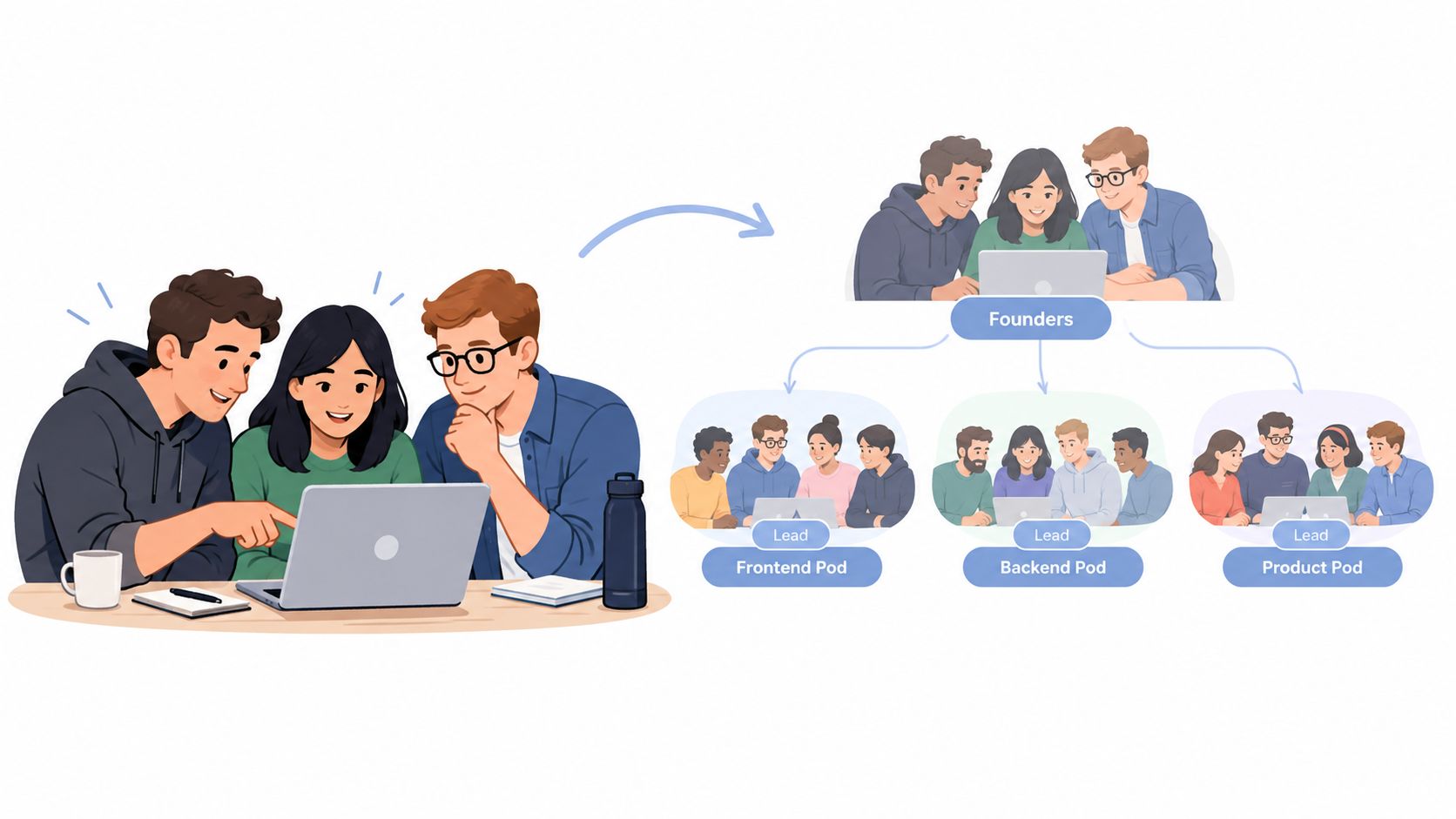
The first structure should be small enough to preserve speed. The next structure should make ownership visible. Later structures should protect teams from excessive dependencies without creating isolated departments that can't deliver a complete customer outcome.
Most startups have at least one technical founder, and that founder typically leads engineering from the seed stage until the organization reaches around 20 engineers, according to Bessemer Venture Partners' engineering scaling guidance. A common early pattern is a compact core group of about 3 to 8 people, before specialization becomes necessary.
That doesn't mean you should hire or reorganize because you crossed a headcount threshold. It means headcount is a useful signal, not a rule. The key question is whether one person can still provide technical direction, coaching, prioritization, and operational attention without becoming the team's narrowest passage.
Practical rule: Add structure when it removes a recurring bottleneck, not when an org chart makes the company look more mature.
A strong startup engineering team structure preserves three things at once: fast product learning, clear technical ownership, and sustainable execution. You don't need a large hierarchy to get there. You need the smallest set of roles and boundaries that matches the work your team is doing.
Think of an engineering organization as a kitchen during a busy service. A tiny kitchen may have three people who can all prep, cook, plate, and clean. A larger kitchen needs stations, but each station still has to coordinate around the meal. Separating responsibilities helps only when the boundaries make delivery clearer.
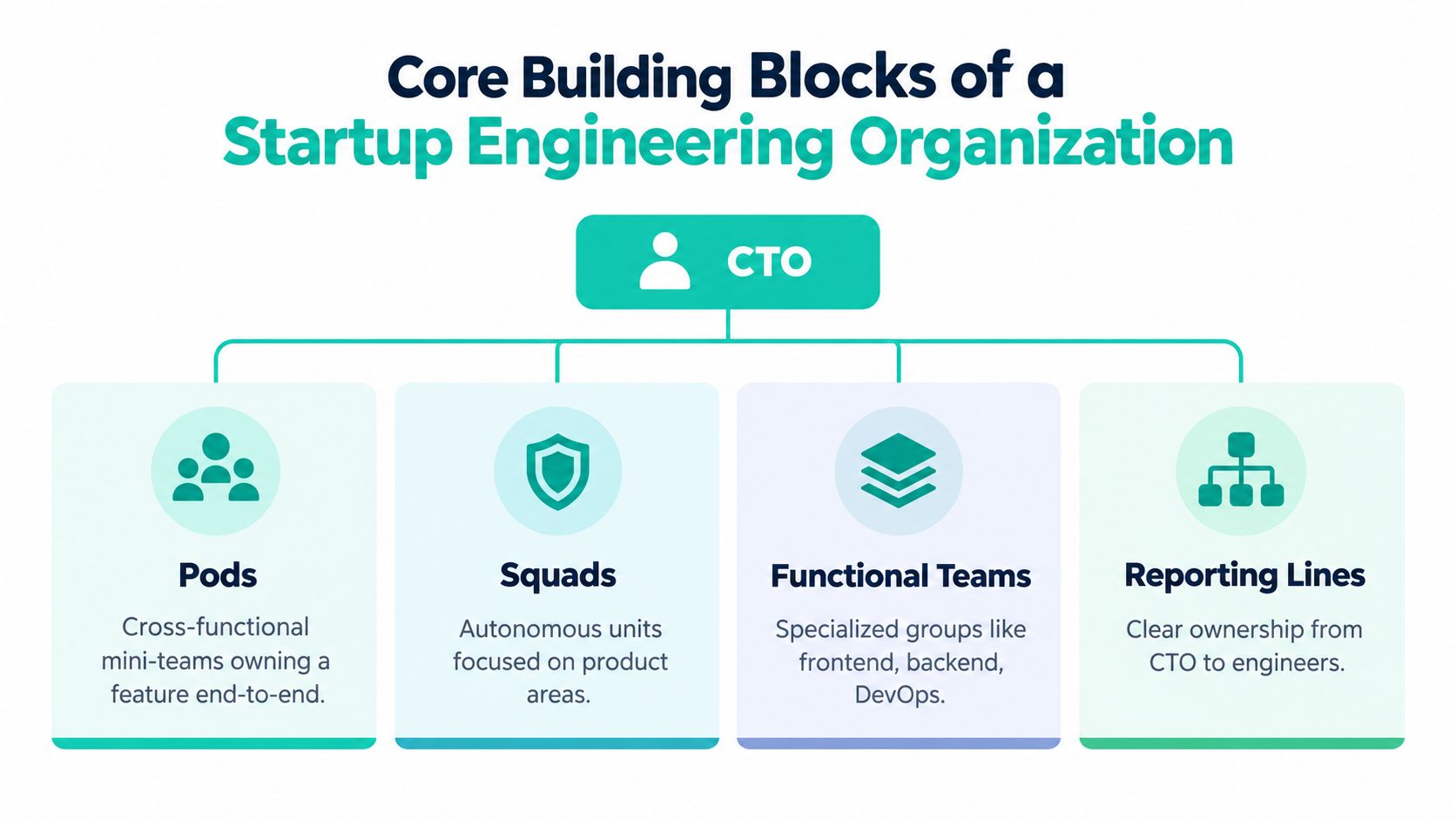
Start with five building blocks.
A pod is a small group that owns a meaningful slice of product work from discovery through delivery. It might include product, design, and engineering capability. The pod isn't merely a collection of specialists. It has a result to achieve and enough context to make many decisions without waiting for another department.
A squad is a similar idea at a broader organizational level. It usually focuses on a product area or customer problem and operates with some autonomy. One startup planning model describes a 25-FTE company as supporting 3 to 4 squads, with engineers in each squad reporting to the same engineering manager for day-to-day oversight, as outlined in this startup organization structure example.
Use the terms consistently inside your company. Whether you call the group a pod or squad matters less than answering three questions:
A functional team groups people by technical discipline, such as frontend, backend, platform, or quality engineering. Functional groups can build deep expertise and consistent practices, but they can also turn every feature into a relay race.
A reporting line answers who coaches, evaluates, and supports an engineer. It doesn't have to match every project dependency. An engineer can report to an engineering manager while working day to day with a product pod led by a product manager and a tech lead.
That distinction prevents a common mistake. Project collaboration and people management are related, but they're not identical. Confusing them creates unclear performance expectations and makes managers accountable for work they can't directly influence.
An individual contributor, or IC, creates technical output without managing people. A tech lead is usually a senior IC who guides architecture, sequencing, and technical decisions for a project or team. A tech lead may mentor others, but that doesn't automatically make the person an engineering manager.
An engineering manager, or EM, owns the conditions in which engineers do good work. That includes coaching, hiring, prioritization support, conflict resolution, delivery health, and communication with product leadership. The EM doesn't need to be the strongest programmer on every project.
The CTO or VP of Engineering sets technical direction and builds the organization around the company's current risks. In a small startup, that person may also be the primary architect and a working engineer. The role changes as the company grows, but the responsibility for making ownership explicit remains.
Span of control means the number of direct reports assigned to a manager. Cognitive load means the amount of domain knowledge and coordination effort a team must hold to make decisions safely.
A team can have an acceptable reporting ratio and still be too complex. If engineers own unrelated products, multiple deployment systems, and several customer commitments, the group may need a boundary even if headcount hasn't changed. The best startup engineering team structure limits the amount of context each person must carry while keeping the team capable of shipping a complete outcome.
Most early-stage companies move through three recognizable patterns. None is universally correct. The choice depends on product complexity, shared infrastructure, customer variation, and how much coordination the founders can still absorb.
| Model | Best Stage | Strengths | Risks |
|---|---|---|---|
| Flat founder-led team | Pre-seed and early seed | Fast decisions, broad context, flexible ownership | Founder bottlenecks, hidden responsibilities, inconsistent coaching |
| Cross-functional product squads | Seed through Series A and beyond | Clear product ownership, fewer handoffs, strong customer focus | Duplicate technical work, uneven standards, dependency problems |
| Lightweight functional groups | Growing Series A and later | Technical depth, shared practices, clearer specialist ownership | Slower feature coordination, departmental boundaries, local optimization |
The flat model works when the product is still changing quickly and everyone needs exposure to the whole system. Engineers can move between frontend, backend, deployment, and customer feedback. A founder can make a decision in minutes because the relevant context sits in a small group.
The weakness is that the founder becomes the team's routing layer. If every architectural question, hiring decision, and priority conflict travels through one person, the team has outgrown the model even if the founder is still technically capable of handling the code.
Keep the team flat when engineers can make decisions without waiting, ownership is visible, and the founder still has enough time to coach and steer. Start changing it when decisions queue behind one person or when engineers avoid ownership because boundaries aren't clear.
Squads organize engineers around customer outcomes. A product manager, designer, and technical lead can shape a feature together, while the engineers build and operate it. This arrangement works especially well when the product has distinct workflows that can evolve with limited coordination.
Remote teams need to be explicit about handoffs, decision records, and working agreements. Practical guidance on cross functional work in remote teams can help leaders avoid assuming that proximity or informal conversation will fill those gaps.
Squads can also create duplication. Several groups may solve similar observability, authorization, or data problems in different ways. A shared platform capability or lightweight architecture forum can address this without turning every decision into a central review.
Functional groups make sense when the company has genuine technical depth to protect. A platform group can own deployment systems, while application engineers focus on customer workflows. A quality function can establish testing practices when product risk demands consistent controls.
Don't create departments merely because larger companies use them. A functional team that has no clear service boundary becomes another queue. The right question is whether specialization reduces cognitive load and repeated work more than it increases coordination cost.
A founder notices the same problem every week: architecture decisions wait for one person, engineers need conflicting answers, and hiring another specialist feels premature. The right role depends on the constraint causing the delay. Before opening a position, identify whether the missing capacity is technical direction, people management, product discovery, delivery, reliability, or narrow specialist knowledge.
The CTO or VP of Engineering sets technical direction and helps the organization change as it grows. Early on, the technical founder often combines that work with implementation. Later, the role shifts toward setting boundaries, improving decisions, and developing other leaders.
A senior IC or tech lead can lead a pod when the main need is technical coordination. They can define interfaces, review designs, coach engineers, and explain technical trade-offs during product planning. This keeps the company flatter and preserves experienced builders in technical work, but the person still needs clear authority and a workload that leaves room for leadership.
A manager fits better when engineers need regular coaching, hiring is frequent, delivery conflicts take up leadership time, or several senior ICs require alignment. Promoting the strongest engineer is not enough. Management involves a different set of responsibilities, including feedback, staffing, and team health.
Startup guidance often places the first engineering-manager hire around 8 to 10 engineers, with teams of roughly 5 to 7 engineers once the organization reaches about 20 engineers, according to this engineering team scaling framework. Use these figures as planning references, not automatic triggers. A company with clear ownership and experienced ICs may delay a manager, while a team facing heavy coaching or coordination needs one earlier.
SignalFire's 2026 State of Talent Report reports that early-stage startups average about 15 engineers per engineering manager, a 34% increase from 2019. The broader technology market is around 12 engineers per manager, up 14% over the same period. Those figures show how senior ICs can absorb coordination in flatter organizations, not that every manager should supervise 15 people.
Set the span from the work required. Count coaching, hiring, planning, technical alignment, and conflict resolution. If those duties leave no time for quality leadership, the team has exceeded the manager's practical capacity.
A lean product team often uses a ratio of one product manager for every 4 to 6 engineers, according to this startup team sizing calculator. Treat that as a planning guide. A complex regulated workflow may require more product attention, while a technically led infrastructure project may need less day-to-day product management.
Designers should join early when usability affects adoption. Bringing a designer in after engineers have built the workflow limits the available choices and can create rework.
Platform, DevOps, QA, and security work do not automatically require permanent departments. Early teams can borrow specialist help for a security review, deployment migration, or testing setup, then return ownership to the product team. Centralizing enabling work can also preserve delivery flow until recurring system ownership justifies a dedicated role.
Smaller teams still need specialist skills. They do not always need each skill represented by a full-time reporting group, as discussed in this analysis of engineering org structures for startups. Choose between a manager-led pod and a senior-IC-led pod based on the work, then borrow expertise when the need is narrow or temporary.
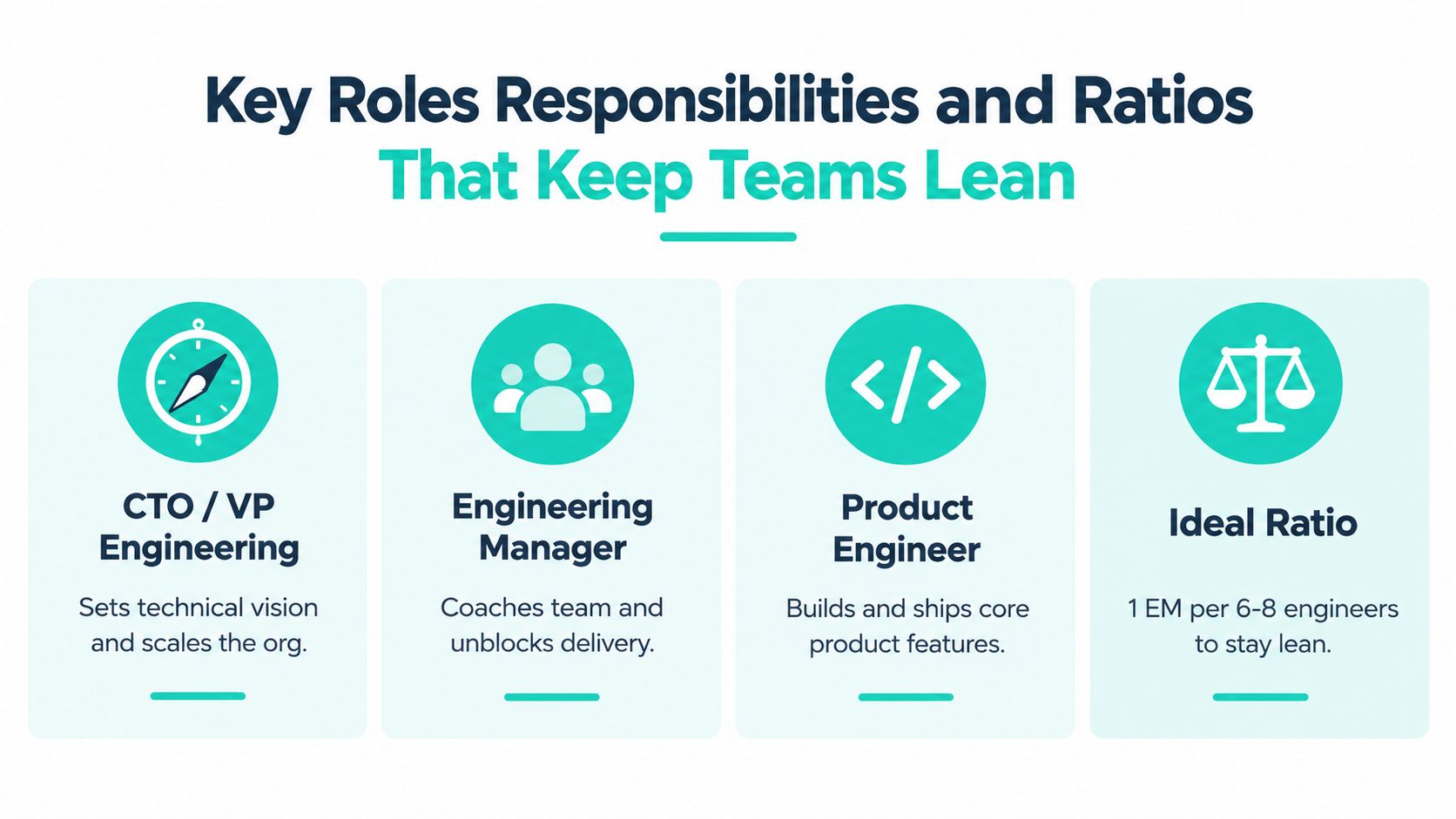
Funding stage is a useful planning lens, not a fixed org chart. Product scope, customer commitments, and technical risk can place a company ahead of or behind the usual pattern. The right question is which structure gives the current team enough ownership without adding coordination it does not yet need.
A pre-seed company may have 2 to 4 engineers out of 3 to 5 total employees, according to startup engineering ratio benchmarks. The technical founder usually sets architecture and priorities. Other engineers work as product-minded generalists, moving across the stack to learn what customers need and turn that learning into product changes.
A simple arrangement usually works:
A separate manager often adds distance before it solves a real problem. Hire another builder when the constraint is product learning or delivery capacity. Borrow specialist support when a narrow risk, such as a security review or deployment migration, exceeds the team's experience. The specialist helps with the defined problem, while an internal engineer keeps ownership afterward.
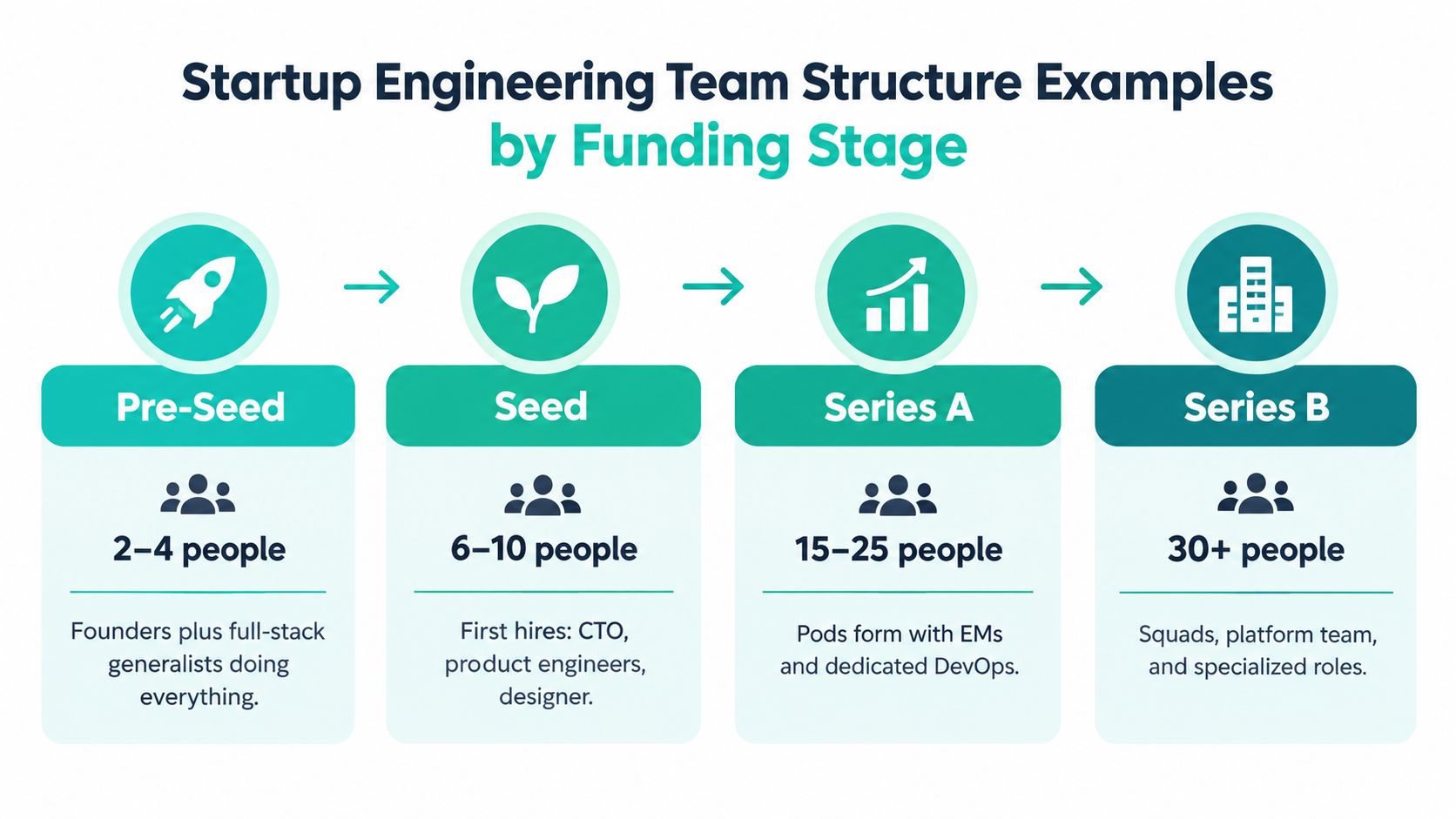
Seed teams are often flat and founder-led, with 1 to 5 people. A growing seed organization may add several product engineers, a designer, and a senior IC who coordinates technical work.
A new title alone does not justify a manager. If engineers still work closely and the main issue is architecture or execution sequencing, a senior-IC-led pod may be enough. That senior IC can set technical direction, review designs, and coordinate delivery while remaining close to implementation.
An EM becomes more useful when hiring, coaching, and delivery coordination consume the founder's time. The choice depends on the bottleneck: a senior IC strengthens technical ownership, while an EM creates capacity for people support and team coordination. Both can be sound choices, but they solve different problems.
For founders raising capital, the structure should support the operating plan rather than copy another company. A practical guide to startup funding from Fundl offers broader context for connecting hiring plans with financing stages.
A Series A example may include 15 to 25 engineers out of 35 to 50 total employees. One possible setup has two or three product pods, with shared access to product and design leadership. Each pod should own a meaningful customer or product outcome, rather than becoming a group of engineers assigned to unrelated tasks.
A fintech or payments company at Series A averaged about 74 total employees in 2021, with engineering representing 40% to 50% of headcount, implying roughly 30 to 37 engineers, according to the engineering headcount benchmark. The variation matters. Compliance, data, and integration work can require a different mix from a consumer product with a simpler operating model.
Reporting lines now need deliberate design. Engineers may report to EMs while working day to day inside product pods. Platform or DevOps work can remain shared until operational demand and system ownership justify a dedicated team.
By Series B, engineering commonly represents about 30% to 40% of headcount, according to the startup engineering ratio guide. Several squads, functional communities, and a platform capability may appear.
The leadership problem shifts from adding capacity to coordinating decisions. Teams can make locally sensible choices that create company-wide friction through inconsistent APIs, reliability practices, architecture, or planning. Shared standards and forums help align those decisions, provided they support delivery instead of becoming another layer of approval.
Hiring should follow the constraint you can name. If engineers are waiting for technical decisions, hire or develop senior technical leadership. If the founder spends the week in one-on-ones and coordination, consider an EM. If customer-facing work is clear but delivery capacity is low, add product engineers before adding another layer of management.
Use this decision sequence before opening a role.
A senior IC-led pod is usually the better choice when the team has strong engineers, technical decisions are the main challenge, and coaching demand remains manageable. An EM is the better choice when people development, hiring, conflict resolution, and cross-team planning have become full-time work.
Platform work deserves the same discipline. Don't build a platform department to make infrastructure look mature. First identify repeated work, fragile ownership, and product teams blocked by shared systems. Then centralize only the capability that benefits from a common owner.
For hiring process details, founders can also use this guide to hiring software engineers to make role definition and evaluation more consistent. A precise role brief should explain the ownership boundary, expected decisions, collaboration pattern, and technical risks. Listing a technology stack alone won't tell candidates what responsibility they would carry.
There isn't one perfect startup engineering team structure. The right design is the smallest arrangement that gives the current team enough speed, ownership, technical judgment, and support.
Audit the organization regularly by asking:
A flat team can become a pod structure. A pod structure can gain managers while senior ICs retain technical leadership. A shared specialist can become a permanent platform or quality owner when the work becomes continuous and strategically important. The evolution should respond to cognitive load and customer risk, not to a desire for a more impressive diagram.
Founders can use this overview of startup organizational structure alongside a current ownership map, hiring plan, and product roadmap. Review them together. If the roadmap assumes independent teams but the org still routes every decision through one technical founder, the plan and structure are already out of sync.
The best next step is practical: map every major product and system, assign one accountable owner, identify the current bottleneck, and choose the next role that removes it. Then revisit the design when the work changes.
Underdog.io connects startup-focused companies with curated engineering and technology candidates through a selective hiring marketplace, helping founders build teams around real ownership needs rather than generic job descriptions. If you're hiring for the next stage of your engineering structure, visit Underdog.io to explore its startup hiring network.