Your code and a killer resume might get your foot in the door, but your body language in an interview is what often seals the deal. The unspoken signals you send—from your posture to your eye contact—broadcast confidence, cultural fit, and how you handle pressure. These are the critical qualities that just don't show up on paper.
In the fast-paced world of tech and startup interviews, hiring managers aren't just vetting your code or your product roadmap. They’re sizing you up as a potential teammate. Can you collaborate? Can you communicate clearly when the pressure is on? Will you be a positive addition to the team?
This is where your body language becomes a crucial data point. For example, a candidate who avoids eye contact when asked about a challenging project might unintentionally signal a lack of confidence in their own story. Someone slouching in their chair could broadcast disinterest, undermining their verbal claims of being "passionate about the role." These subtle, often unconscious, perceptions can shape an interviewer's decision long before they sit down to review their notes.
It’s tempting to write off body language as a "soft skill," but its impact is backed by hard science. The classic Mehrabian model found that words account for only 7% of communication. The rest is conveyed through your tone of voice (38%) and, most significantly, your body language (55%).
For anyone in a startup—where attitude and collaboration are everything—this means your posture and facial expressions are just as important as talking through your experience with Python or React.
Your resume proves you can do the job. Your body language proves you’ll thrive in the role. It bridges the gap between your stated qualifications and your perceived competence, showing you're not just a list of skills but a confident, capable professional.
Think of your body language as the silent operating system running in the background of your interview. It can either support every great answer you give or create conflicting messages that raise immediate red flags for the hiring manager.
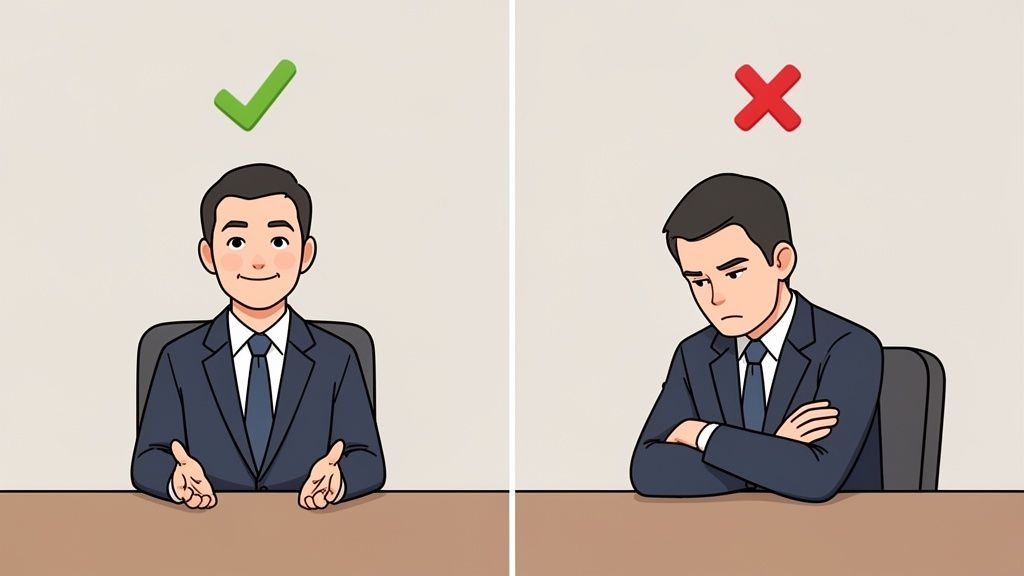
To quickly gut-check your nonverbal communication, here's a simple breakdown of the signals you're sending. Think of it as a cheat sheet to make sure your body is telling the same positive story as your resume.
Remember, the goal isn't to become a robot but to be mindful of the signals you're sending. Authenticity is key, but so is showing up as the confident, engaged candidate they're looking for.
For a deeper dive, check out these 7 Essential Interview Body Language Tips to get more practical guidance and refine your approach.
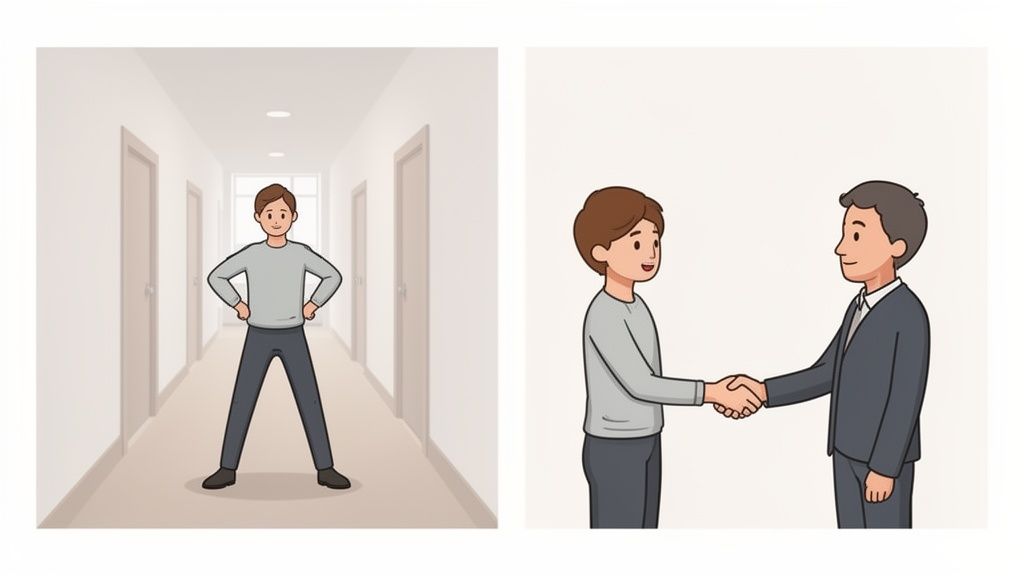
Confidence isn't just a feeling; it's a series of physical signals you send the moment an interview begins—often before you say a single word. From the way you carry yourself in the waiting room to that initial handshake, your body language sets the entire tone.
This isn't about "faking it 'til you make it." It's about consciously choosing actions that broadcast the capable, prepared professional you already are. Get it wrong, and you’ll spend the rest of the interview trying to dig yourself out of a hole. Get it right, and you build instant rapport that gives your answers more weight from the start.
The handshake is your first, and arguably most powerful, nonverbal cue. It’s a direct signal of your confidence, and a good one can positively influence the entire interaction.
The sweet spot is a firm, web-to-web connection—not a bone-crusher, but definitely not a limp fish. It should last about two to three seconds, accompanied by a genuine smile and direct eye contact.
This simple act communicates trust and professionalism right off the bat, laying a solid foundation for the rest of the conversation.
Eye contact is the bedrock of communication. In an interview, it tells the hiring manager you're engaged, listening intently, and confident in what you're saying. The trick is to find the balance between maintaining great eye contact and just... staring.
Aim to hold their gaze for about 4-5 seconds at a time, especially when you're the one talking. This keeps them connected to your message. When listening, it’s natural to break contact by glancing away thoughtfully for a moment before re-engaging.
Actionable Tip: A common mistake is looking down at the floor when you're thinking. To an interviewer, this can read as a lack of confidence. Instead, try looking slightly up and to the side. This subtle shift comes across as thoughtful reflection, not nervousness.
This small adjustment helps you look composed and in control, even when you're tackling a tough question. For more tips on managing your nonverbal signals, check out our guide on how to handle your body language during an interview.
Your posture says a lot about you before you even sit down. Walking in with slumped shoulders can signal low energy or a lack of interest. Standing and sitting tall, on the other hand, communicates presence and self-assurance.
When you enter the room, walk with a purposeful stride—not rushed, but deliberate. Keep your shoulders back and your head up. Once you take a seat, resist the urge to slouch. Sit up straight, using the back of the chair for support if you need it, with both feet planted on the floor.
Actionable Tip: Feeling nervous? Try a "power pose" for 60 seconds in a private space (like a restroom stall) before the interview. Stand with your feet apart and place your hands on your hips. Studies show this can boost feelings of confidence and lower stress hormones, giving you a mental edge before you walk in.
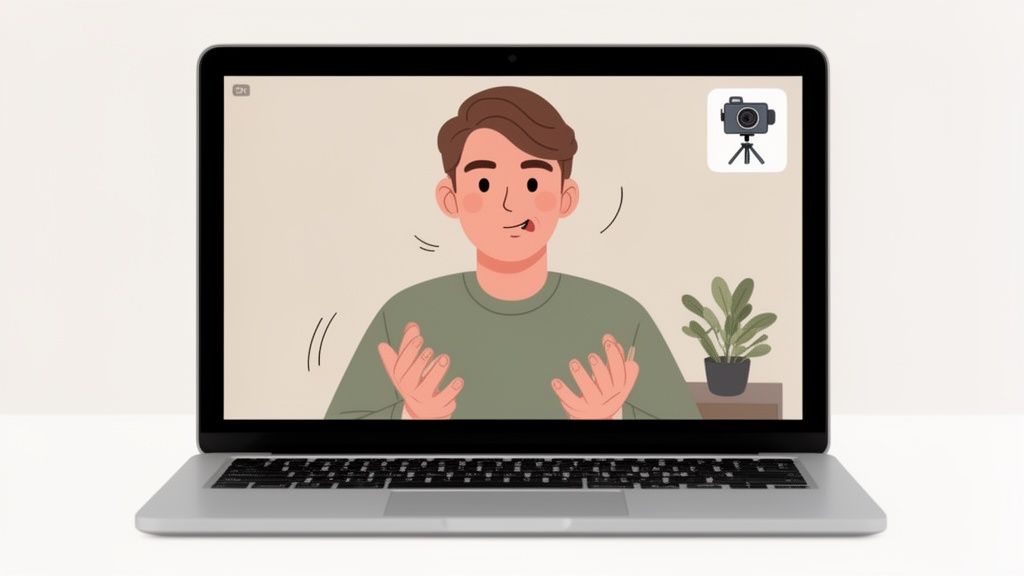
Remote interviews aren't just in-person meetings on a screen; they play by a totally different set of rules. Your digital body language is everything because the screen acts as a filter, magnifying some cues while completely muting others. Getting your on-screen presence right is non-negotiable if you want to project the same confidence you would in person.
Without the benefit of a shared physical space, interviewers have to rely on the limited visual information they get. A bad technical setup or a few unintentional digital missteps can create friction and distract from your actual qualifications, making it crucial to get your virtual environment under control.
Before you even say "hello," your technical setup is already sending a message. A grainy camera or terrible lighting can make you look unprepared. The goal here is to create a clean, distraction-free window into your professional world.
First, get your camera to eye level. Looking down at a laptop camera is unflattering and can subtly signal submission.
Actionable Tip: Stack a few books under your laptop until the camera is aimed directly at your eyes. This simple trick simulates natural, direct eye contact and instantly makes you look more engaged.
Good lighting is just as important. You want your main light source to be in front of you. A simple ring light or even a desk lamp placed behind your laptop can illuminate your face, making sure your expressions are clear and you're not just a silhouette.
In a virtual interview, you're confined to a small box on the screen. This limitation makes every intentional movement incredibly powerful for showing energy and engagement.
Instead of hiding your hands under the desk, bring them into the frame when you're explaining a complex idea. Using open-handed gestures can make you seem more transparent. For instance, when describing a three-step process, you can literally hold up one, two, and then three fingers. This visual cue makes your explanation more dynamic and easier for the interviewer to follow.
Actionable Tip: On a video call, silence can be ambiguous. To show you're engaged while the interviewer is speaking, give a slow, deliberate nod. Leaning slightly toward the screen also sends a powerful signal that you are hanging on their every word. These small actions fill the nonverbal void and prevent you from looking passive.
Maintaining this level of focus can be absolutely draining. For more strategies on navigating the remote hiring world, our guide on succeeding in virtual interviews to hire remotely offers deeper insights for both candidates and companies.
"Zoom fatigue" is very real, and it can sap your energy and flatten your personality over the course of an interview. An interviewer might mistake that energy dip for a lack of interest in the role.
Sit up straight with both feet on the floor to stay alert. Before the call, do a few quick stretches or walk around for a minute to get your blood flowing. During the interview, make a conscious effort to smile when it feels natural and vary your vocal tone.
Actionable Tip: Place a sticky note next to your camera that says "SMILE" or "ENERGY!" It's a simple, physical reminder to keep your engagement levels high when your focus starts to wander.
Your Pre-Call Virtual Environment Checklist
A great interview isn’t a performance; it’s a conversation. The best candidates know how to read the subtle nonverbal cues from an interviewer and adjust their approach on the fly. This single skill can transform a rigid Q&A into a genuine dialogue.
Think of it this way: understanding what your interviewer is really thinking gives you a massive advantage. It allows you to pivot or clarify. By paying attention to their body language, you turn a one-way interrogation into a two-way street.
Interviewers are human, and their body language often gives the game away. You’re not looking for a single tell; you’re looking for patterns that signal their level of interest and engagement.
Here are a few classic cues and what they usually mean:
Of course, you need to be just as tuned in to the negative signals. These are your cues to change tactics.
Recognizing disinterest is your cue to act, not panic. A quick glance at the clock or a sudden shift in posture is valuable data. It’s a signal to re-engage your audience by asking a question, changing your tone, or tying your answer back to a problem they actually care about.
Spotting signs of disengagement—the interviewer glancing at their phone, leaning back with their arms crossed, or giving you short, curt responses—can feel like a punch to the gut. But it's also an opportunity. Use it as a trigger to pull them back in.
If you sense you're losing their attention, try one of these actionable moves:
Technical interviews, especially whiteboarding challenges, come with their own unique body language dynamics. Your ability to read the room is just as important as your ability to write clean code.
As you're working through a problem on the board, keep one eye on your interviewers. Are they leaning in, following your logic? Or are their arms crossed with a skeptical expression? Furrowed brows are a dead giveaway for confusion.
This is your moment to be proactive. Pause your thought process and say, "I'm thinking of taking this approach to handle the edge cases. Does that make sense, or is there another aspect you’d like me to explore first?"
This one move shows you're collaborative, confident, and not afraid to seek clarification—all critical skills for any engineer. You’re not just solving a problem; you’re showing them how you’d work with them.
High-pressure situations demand a whole other level of nonverbal control. A standard one-on-one interview is one thing, but navigating a technical whiteboarding session or facing a panel of senior leaders calls for specialized body language strategies. Your ability to project confidence and collaboration under that kind of scrutiny can be the deciding factor.
In these advanced scenarios, your nonverbal cues aren't just about making a good first impression. They're about demonstrating your thought process and proving you can work effectively within a team.
The whiteboarding interview tests your problem-solving chops and your ability to communicate complex ideas. Your physical presence at the board is a huge part of this performance.
Actionable Tip: Stand to the side of the board, not directly in front of it. This amateur mistake blocks their view and creates a barrier. Standing to the side creates an open, inclusive dynamic. Use open-handed gestures when you point to your solution, as if you're inviting them into the process with you.
When you get stuck—and you will—resist the urge to shrink or turn your back completely to the room. Instead, pause, turn to face your interviewers, and verbalize your roadblock. Say something like, "I'm just thinking through the best way to handle this null pointer. Let me take a second." This projects confidence even in uncertainty.
Holding this confident posture prevents a moment of confusion from looking like a total collapse. It makes you appear thoughtful and in control, not panicked.
Facing a panel can feel like an interrogation. The secret is to transform it into a group conversation using your body language.
The goal is to engage each person individually. When one person asks a question, start your answer by making eye contact with them for the first few seconds. Then, as you continue speaking, deliberately and naturally shift your gaze to include the other members of the panel.
This technique, often called "triangulation," makes everyone feel included. It signals that you value everyone's presence and are a collaborative communicator.
These small actions show you can read a room and manage multiple stakeholders—a crucial skill in any team-based tech environment. For candidates getting ready for these challenging conversations, our guide on software engineer interview preparation offers more valuable strategies.
Whether you're at a whiteboard or in front of a panel, your ultimate goal is to signal that you are a fantastic person to work with.
Avoid defensive postures at all costs. Crossing your arms when you get a tough question can make you seem closed-off. Instead, keep your posture open and nod to show you're actively listening and considering their point.
Actionable Tip: Use an open palm to gesture toward the whiteboard or to emphasize a point instead of pointing with a single finger, which can come across as aggressive. It's a small change, but it makes your communication feel more like a shared exploration than a lecture. By managing these subtle cues, you demonstrate that you're not just a talented individual contributor but a true team player.
Right before you walk into the interview room or click that "Join Meeting" button is your last chance for a quick mental reset. This isn't about cramming—it’s about grounding yourself.
Think of these final moments as your pre-game warmup. A few simple exercises can reinforce all the good habits we've talked about, ensuring your body language screams "confident and capable" from the second they see you.
Give these a shot in the 15 minutes before your interview starts.
This last-minute prep helps bring everything together, whether you're about to step up to a whiteboard or face a panel of interviewers.

Ultimately, you’re not just showing them you can code; you’re showing them you can collaborate, engage, and keep your cool when the pressure is on.
Your final pre-interview check shouldn't be about memorizing rules. It's about grounding yourself so your authentic confidence can shine through. Take a few deep breaths, stand tall, and walk in knowing you're prepared.
Okay, deep breath. Use this quick Do/Don't list as a final mental walkthrough right before you start. It’s your last-minute confidence boost.
You’ve done the hard work to get here. Now, let your body language show them you belong in the room. You got this.
Even with the best advice, interviews are live, unpredictable events. Let's tackle a couple of the most common "what if" scenarios that come up when you're trying to put all this into practice.
Fighting the urge to fidget often just makes it worse. The key is to find a discreet outlet for that nervous energy, not to bottle it up.
Actionable Tip: Plant both of your feet firmly on the floor. Then, out of the interviewer's line of sight, press your toes into your shoes or gently press your fingertips together on your lap. This channels the energy into a small, invisible movement instead of a distracting leg jiggle or pen click. Deep, slow breaths before the interview also work wonders.
On a video call, you have a secret weapon: the off-camera fidget tool. Just make sure it's small, completely silent, and stays out of the frame. The goal isn't to stop fidgeting entirely—it's to channel that energy so it goes completely unnoticed.
While the fundamentals—projecting confidence and showing you're engaged—are the same, the execution can shift. Body language in an interview for a casual startup should lean into collaboration and genuine excitement. Think a slightly more relaxed posture and more expressive gestures.
For a formal corporate interview, you'll want a more composed, traditionally professional posture. The best move? Take your cues from the interviewer. Subtly mirror their energy and level of formality. If they are leaning back and speaking casually, you can relax slightly. If they are formal and upright, match that tone. This shows you’re not just a good candidate, but a great cultural fit.
Authenticity is your most powerful tool. A constant, fixed smile, excessive nodding, or overly dramatic hand gestures can feel insincere and distracting. Your nonverbal cues should support what you're saying, not become a performance. If a gesture feels unnatural, skip it. True confidence comes from being comfortable with yourself, not from imitating someone else.
Ready to land your dream job at a high-growth startup? Underdog.io connects top tech talent with hundreds of vetted companies. Skip the endless applications and let the best opportunities find you. Get started on Underdog.io
Body language is a powerful form of non-verbal communication that conveys your confidence, engagement, and authenticity. Interviewers use these cues to gauge your interest in the role, your comfort under pressure, and your overall cultural fit. Positive body language reinforces your verbal answers, while negative cues can create doubt, even if your words are perfect.
The most impactful cues are: maintaining good posture (sitting up straight, shoulders relaxed), making appropriate eye contact (aim to hold it about 60-70% of the time), offering a genuine smile, and using occasional hand gestures to emphasize points. A slight, occasional forward lean can also show you are actively listening and engaged.
Common mistakes include: slouching or crossing your arms (which can appear defensive or disinterested), avoiding eye contact (which may suggest a lack of confidence or honesty), fidgeting (like tapping a pen or shaking your leg), frequently touching your face or hair, and checking the time or your phone.
For video interviews, you must manage a smaller frame. The key is to look directly at your webcam when speaking to simulate eye contact, not at the interviewer's face on your screen. Ensure your face and upper body are well-lit and centered. Sit close enough to the camera to feel present, and be mindful that small nervous movements are more noticeable on screen.
Absolutely. The goal isn't to be perfectly still, but to project calm confidence. Practice deep breathing before and during the interview to steady your nerves. If your hands tend to shake, rest them calmly in your lap or on the table. Preparing and practicing your answers thoroughly will also boost your confidence, which naturally improves your body language.
The most effective method is to conduct mock interviews. Practice with a friend or record yourself answering common questions on your computer or phone. Watch the playback critically. Pay attention to your posture, eye contact, and any distracting habits. This self-awareness is the first step to making positive changes.
Yes, this is an important consideration, especially in global companies. For example, norms around eye contact, personal space, and hand gestures can vary significantly. While a firm handshake is standard in the U.S., it may be less common elsewhere. If you are interviewing with a company from a different culture, doing a small amount of research can help you avoid unintended misunderstandings.
Active listening is shown through nodding occasionally to show understanding, maintaining soft eye contact with the speaker, and having an open, relaxed posture. Avoid interrupting and wait a moment after the interviewer finishes speaking before you respond, which shows you are processing what they said.