A computer hardware engineer in the United States earned a median annual wage of $161,740 in May 2025, and the occupation is projected to grow 9% from 2025 to 2035, with about 4,100 openings each year according to the Bureau of Labor Statistics occupational outlook. That combination changes the career conversation. This isn't a disappearing niche, but it isn't a generic technology job either. The strongest opportunities go to engineers who can connect silicon, boards, firmware, testing, and the commercial constraints that determine whether a product ships.
The job title covers several distinct paths, from ASIC design and verification to embedded systems, RF, FPGA development, and board-level engineering. Your first decision shouldn't be whether hardware sounds interesting. It should be which layer you want to own, which environment suits your risk tolerance, and whether your portfolio proves you can debug a physical system rather than only discuss one.
A computer hardware engineer turns electrical signals into a working computing system. Board engineering connects power, data, clocks, connectors, memory, and processors. Chip engineering focuses on the logic, timing, interfaces, and internal paths inside the silicon. Those tracks share fundamentals, but they demand different tools and portfolios.
Hardware failures occur below the software abstraction layer. Logs may show that a system failed, yet the cause could be a weak power rail, incorrect pull-up, impedance discontinuity, clock fault, soldering defect, or timing margin that collapses under temperature and load. The engineer must isolate the physical cause, test it, and prove the correction.
A project usually advances through these deliverables:
The job requires electrical engineering discipline and embedded software fluency. In one week, an engineer might write C to initialize a peripheral, use Python to automate measurements, inspect a waveform, revise a power tree, and explain the cost impact to a product manager. Engineers involved in equipment deployment can also use FDM and SLA installation support when lab or production hardware needs reliable configuration.
Hiring rule: A schematic is not a portfolio. Add measured results, failed assumptions, revision history, and a clear explanation of the fix. That evidence shows engineering judgment.
The role suits people who work well within competing constraints. Power, thermal performance, signal quality, component availability, manufacturing yield, schedule, and cost all shape the final design. Choose this career if tracing one electrical detail to a system-level failure sounds satisfying. If you prefer clean boundaries between software and physical systems, the daily work may frustrate you.
Maya starts her morning at an AI infrastructure startup with a probe attached to a prototype accelerator sled. The board failed bring-up overnight, so she checks the power rails before reading the firmware logs. A missing reset transition points her toward a conversation with the FPGA firmware lead, not another isolated hardware experiment.
By midmorning, she joins a short Slack huddle, then works through a JIRA grooming session. The team has to decide which defects belong in the next board revision and which can be handled through firmware. In the afternoon schematic review, Maya pushes back on a power-tree choice that would consume too much of the thermal budget. She owns the board from architecture through validation, and the team expects a new revision on a tight recurring cycle.
That breadth is the startup bargain. Maya sees the full system, speaks directly with firmware and mechanical engineers, and learns how design decisions affect manufacturing and customer deployment. She also absorbs ambiguity, supplier risk, incomplete documentation, and the pressure of making a decision before every question has been answered.
Devon works at a large semiconductor company on one carefully bounded slice of a major SoC tape-out. His morning includes cross-functional meetings with RTL, verification, physical design, packaging, and compliance teams. He spends part of the day reviewing interface requirements and part of it updating documentation that must survive formal signoff.
Devon has deeper tooling, established processes, and access to specialists who can answer narrow technical questions quickly. His work may involve more rigorous verification and a longer feedback loop. Releases are measured in quarters rather than rapid board revisions, and his individual contribution can be difficult to explain outside the specific block he owns.
| Dimension | Startup hardware role | Large semiconductor role |
|---|---|---|
| Scope | Broad ownership across board, firmware, and validation | Narrower ownership inside a large system |
| Pace | Fast revisions and shifting priorities | Formal milestones and longer release cycles |
| Learning | Product judgment and cross-functional breadth | Deep process, tools, and specialization |
| Risk | Funding, supply chain, and role ambiguity | More organizational stability |
| Best fit | Engineers who want visible ownership | Engineers who prefer structured depth |
Neither path is automatically better. Choose the startup if you want scope and can tolerate unfinished systems. Choose the chip giant if you value process depth, specialist mentorship, and predictable execution.
Hiring teams usually evaluate hardware candidates in layers. The first layer is essential, the second makes you useful quickly, and the third determines whether you can take on difficult systems work.
A bachelor's degree in electrical engineering or computer engineering remains the cleanest entry point. You need working comfort with circuit theory, digital design, signals and systems, computer architecture, and electronic measurement. A computer engineering curriculum is especially useful because it combines hardware and software system thinking, a distinction explained in this overview of computer engineering versus computer science.
You should also be able to open an EDA tool and produce work someone else can review. Altium, KiCad, and Cadence are practical names to know. C or C++ matters for firmware-adjacent roles because bring-up often requires understanding how software initializes and stresses hardware.
Candidates begin separating themselves:
Specialists in RF design, high-speed signal integrity, power integrity, thermal modeling, and ASIC flow exposure are valuable because their work sits close to expensive failure modes. Learn the vocabulary of synthesis, place-and-route, timing closure, package behavior, and thermal constraints even if your first role is board-level.
Employers commonly hire for board-level design, RTL and verification, SoC integration, signal and power integrity, and embedded firmware. Coursework that hiring screens often notice first includes digital logic, computer architecture, VLSI, and project-based labs. A strong project can outweigh a polished transcript because it shows how you handle incomplete information. For help avoiding vague academic positioning, review this guide on skills and degrees in technical hiring.
The reliable salary anchor is the national data, not an informal compensation screenshot. The BLS reported $161,740 as the May 2025 median annual wage for computer hardware engineers, alongside 9% projected employment growth from 2025 to 2035 and approximately 4,100 annual openings in that period. The earlier occupational survey reported 82,660 employed workers, a $147,770 mean annual wage, an $81,630 10th-percentile wage, and a $212,770 90th-percentile wage in 2023, as shown by the BLS wage table.
Those figures describe the occupation broadly. They don't justify inventing precise packages for every ASIC, FPGA, embedded, RF, or board role. Compensation depends on specialization, location, seniority, company stage, equity terms, and whether the role owns a product-critical subsystem.
| Dimension | Series B Startup | Large Chip Firm |
|---|---|---|
| Scope | Broad ownership across a product or subsystem | Defined ownership within a large program |
| Pace | Rapid iteration and changing priorities | Milestone-driven execution |
| Cash versus equity | More of the appeal may come from equity and future upside | Compensation is often more structured and cash-predictable |
| On-call burden | Can be substantial during bring-up or customer deployment | Usually governed by established teams and release processes |
| Visa sponsorship reality | Depends heavily on funding, urgency, and company policy | Often supported by a larger immigration infrastructure, but never assume approval |
| Best fit | Scope-seekers with a long-term risk appetite | Stability-seekers who want structured depth |
AI silicon, robotics, and edge infrastructure are creating strategic demand for specialized hardware work, but funding headlines shouldn't replace diligence. Ask who owns the architecture, how much of the design is production-ready, which suppliers are qualified, and what the company expects you to deliver in the first release.
My recommendation is straightforward. Choose a large firm if cash predictability, process, and stability matter most. Choose a well-funded hardware startup if you want broader ownership and can evaluate equity, runway, supply chain exposure, and product risk with clear eyes.
A degree gives you the language of hardware. A portfolio proves you can use it. Students and career-switchers should build evidence in increasing levels of system complexity rather than collecting disconnected tutorials.
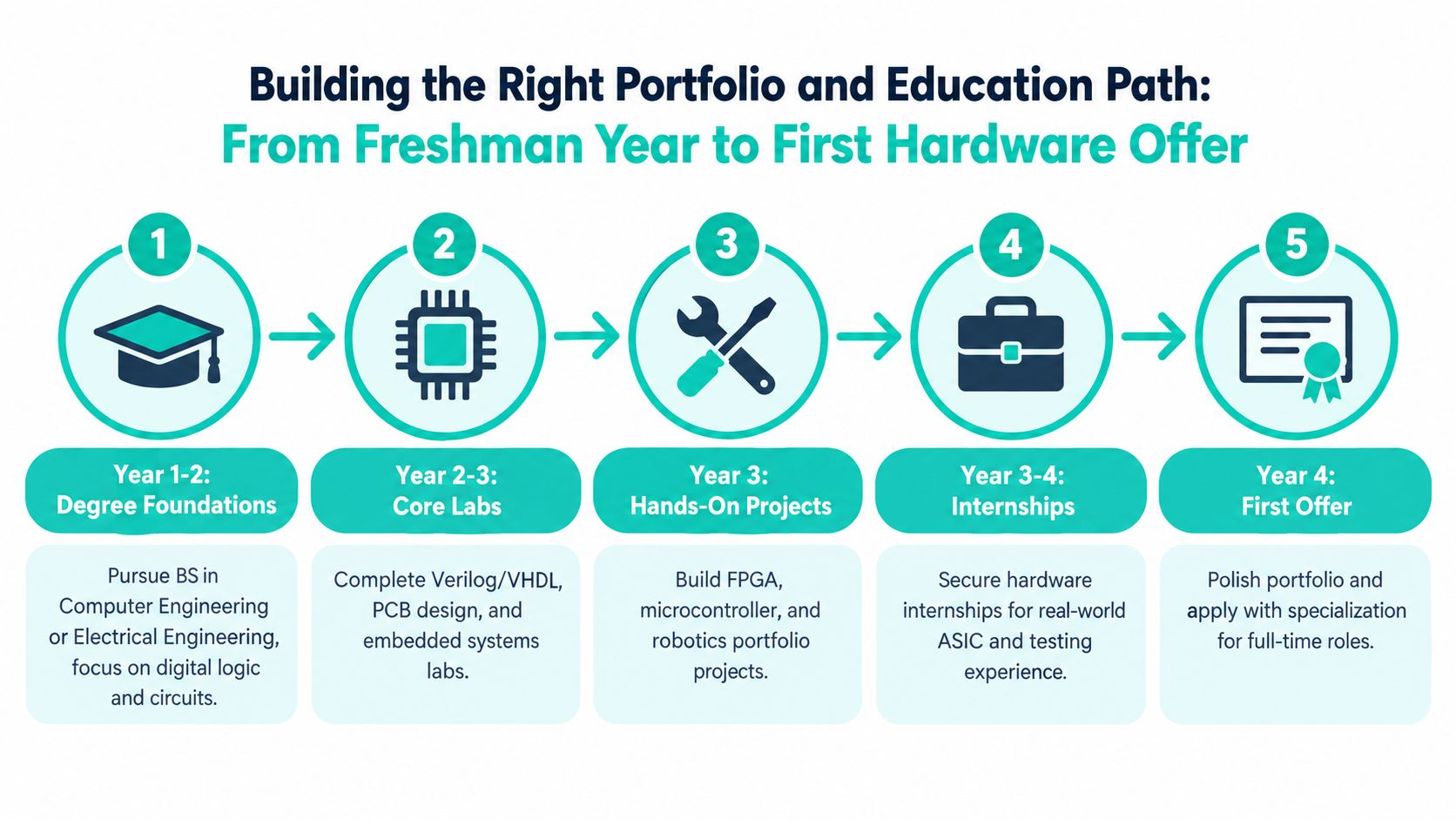
Start with electrical or computer engineering foundations. Computer science coursework can help with SoC roles, especially when it strengthens algorithms, operating systems, and systems programming. The most useful subjects include digital logic, computer architecture, VLSI design, signal processing, embedded C, and a modern HDL such as SystemVerilog or Chisel.
Use a staged project path:
A computer basics curriculum guide can help career-switchers identify foundational gaps before committing to advanced digital design or embedded work. Don't hide behind certificates, though. Certifications tied to Cadence, Synopsys, or Xilinx Vivado can reinforce a targeted path, but they won't substitute for a working design.
A master's degree is increasingly useful for ASIC and silicon roles, while board-level and embedded positions can remain accessible with a bachelor's degree and strong project evidence. Apply that distinction to your target specialization instead of treating graduate school as an automatic requirement.
Your resume should identify your specialization before it lists your education. Write a first line such as ASIC RTL Design, Embedded Firmware, RF Systems, FPGA Development, or Board-Level Hardware. A recruiter should know what role to consider before reading the project details.
Then show proof. Replace “designed a PCB” with the board's purpose, interfaces, tools, test method, and measured outcome. Hardware metrics can include silicon area, clock frequency, power behavior, latency, thermal response, signal quality, bring-up status, or board revision results. Attach GitHub, a personal site, a public datasheet, or a concise project report. For broader resume editing, this resource can help you improve your engineering resume impact.
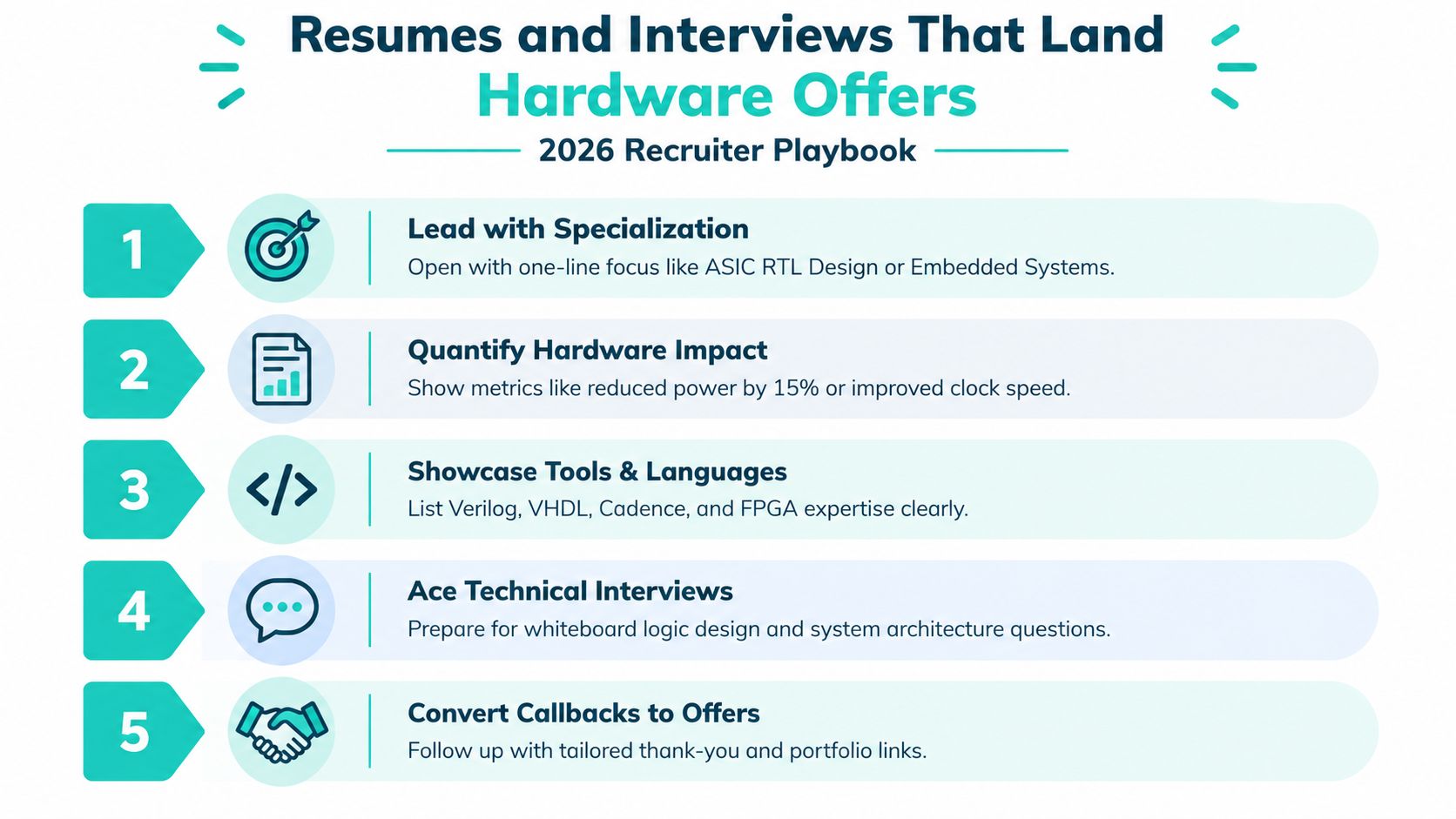
Three to five deep projects beat a long list of shallow coursework entries. Give priority to tape-out work, board bring-up, lab measurements, FPGA validation, verification environments, and projects where you changed the design after finding a real defect.
Interview preparation should follow the work itself:
For behavioral interviews, use STAR stories that expose trade-offs under silicon-cost, thermal, reliability, or schedule pressure. Generic teamwork stories won't distinguish you. A real bring-up failure will. Explain what you believed, what the evidence disproved, how you isolated the cause, and what you changed to prevent recurrence.
Read this practical guide on writing a technical resume, then remove every line that doesn't help a hiring manager predict how you'll perform in a lab or design review.
Interview advantage: Candidates who can discuss a failure without defensiveness usually appear more credible than candidates who claim every project went smoothly.
AI is increasing demand for hardware engineers who can make sound design decisions, validate physical behavior, and resolve conflicts among performance, power, cost, and reliability. It speeds up repetitive work, but it does not replace ownership of the system.
The career signal is specialization. BLS projects 9% employment growth from 2025 to 2035 for computer hardware engineers, with about 4,100 openings per year, according to the BLS outlook data. Treat that outlook as a reason to build differentiated capability, not as protection for every task. Companies still need engineers who can integrate computing systems as demand shifts toward specialized processors and infrastructure.
AI-assisted RTL generation can provide starting points for repetitive logic. Automated place-and-route optimization can compare implementation options. LLM-based specification review can flag inconsistencies, missing assumptions, and documentation gaps. Simulation regression, schematic checks, layout verification, and report generation are also suitable for acceleration.
The engineer still owns the result. Generated RTL may encode a false assumption. An optimized layout may create thermal or signal-integrity problems that the tool's objective function misses. A language model may summarize a specification while overlooking the requirement that determines safe operation.
| Task category | AI exposure | Skill value trend |
|---|---|---|
| Schematic capture and documentation | High for repetitive drafting and review support | Judgment and requirements interpretation become more important |
| Layout verification | High for rule checks and issue triage | Signal integrity and physical-design expertise gain value |
| Simulation regression | High for test orchestration and result sorting | Test strategy and failure interpretation matter more |
| RTL generation | Moderate, especially for boilerplate logic | Architecture, verification, and formal reasoning remain valuable |
| Bring-up and cross-functional debugging | Lower because evidence is physical and context-heavy | Measurement discipline and system judgment gain value |
| Vendor and architecture decisions | Lower because trade-offs depend on business and technical context | Negotiation, risk assessment, and product judgment gain value |
Use AI for preparation, comparison, automation, and review, while keeping human ownership of architecture and validation. The strongest candidates combine domain expertise with tool fluency and use saved time for higher-value technical decisions. Engineers whose work consists only of repetitive drafting face greater replacement risk.
Job-board volume is a poor proxy for opportunity. Hardware hiring is specialized, confidential, and often tied to funding, supply availability, and a narrow technical need. Use a sourcing checklist that filters the company before you invest time in the interview process.
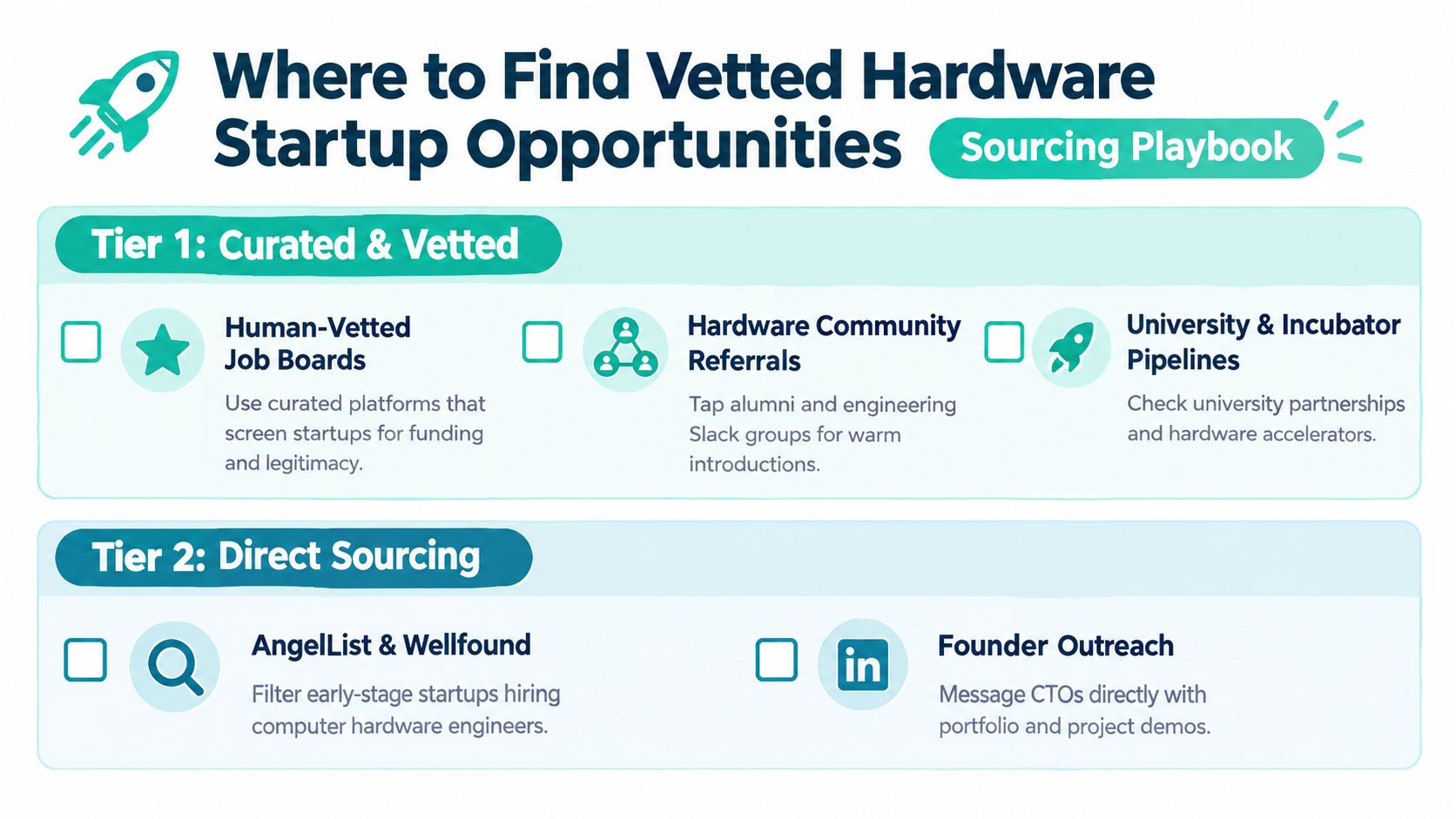
Begin with human-vetted marketplaces such as Underdog.io, Hardware Angels, and technical recruiters who understand chip, robotics, embedded, and infrastructure hiring. These channels can be more useful than mass applications because they narrow the search around specialization and company quality. This engineering job-board guide is a useful starting point for building a targeted channel mix.
Then add direct sourcing:
Check the funding stage, runway, product readiness, customer commitments, equity terms, and supply-chain dependencies. Ask whether the company has qualified alternate components, who owns manufacturing transfer, and what happens if a key part becomes unavailable. Hardware startups can fail for reasons unrelated to engineering quality, so your diligence must cover operations as well as technology.
A curated marketplace should reduce irrelevant applications and help match candidates to roles such as SoC design, verification, physical design, embedded systems, or board engineering. It won't eliminate risk, but it can give you a more focused starting set than job-board spam.
Underdog.io offers a curated hiring marketplace where technical candidates can create one profile and be introduced to vetted startups and high-growth technology companies. If you're targeting a computer hardware engineer role and want a more selective path than mass applications, visit Underdog.io and present your specialization, portfolio, and preferred startup environment clearly.