You're reviewing a job description during lunch, with your manager only a few desks away. A LinkedIn notification appears, and you immediately wonder whether a headline change, profile visit, or recruiter message has exposed your plans. The search feels risky because you're trying to improve your future without destabilizing your present.
A confidential job search isn't a single stealth tactic. It's an operating system for a career transition that may continue for months, using separate devices, controlled disclosures, private conversations, and carefully chosen channels. The objective isn't to disappear. It's to decide who learns what, and when.
The anxiety is understandable. A 2026 privacy survey found that 65% of job seekers worldwide worry their current employer will discover their search, while 52% of U.S. respondents identified coworker discovery as their biggest concern. The same source reports that Huntr's Q1 2026 dataset placed the median time from search start to first offer at 108 days, up 30% from Q4 2025. You can review those findings in the confidential search privacy analysis.
That timeline changes the practical problem. You're not hiding one application for a weekend. You're managing recruiter calls, interview scheduling, follow-ups, resume versions, professional conversations, and potentially several rounds of evaluation while continuing to perform in your current role. A private browser window helps for one moment. It doesn't protect a search that leaves traces across your calendar, devices, profiles, and relationships.
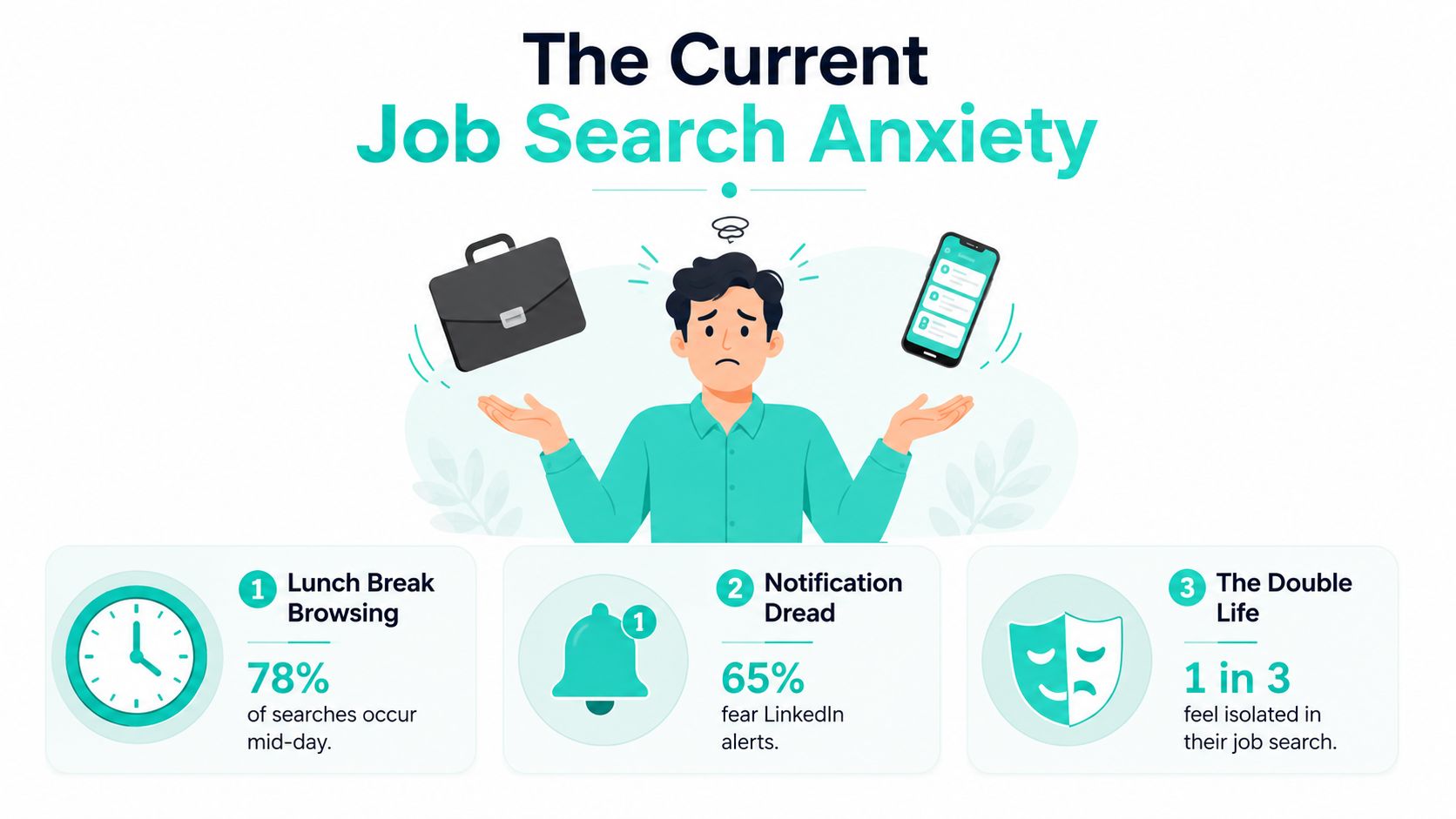
Consider an employed engineer who starts by browsing roles privately, then updates a public LinkedIn headline, accepts a recruiter call on a work phone, and asks a former colleague for a referral through a company-connected account. None of those actions seems dramatic in isolation. Together, they create a pattern that can expose intent.
The historical logic behind discreet hiring helps explain why private channels remain useful. Jackson and Mayleas argued in 1976 that only 10% to 15% of available openings were publicly listed on a given day, while roughly 85% to 90% existed in a hidden market reached through internal pipelines, networks, or agencies, as summarized by this historical overview of the hidden job market. The exact estimate belongs to its historical context, but the underlying mechanism still applies: employers and candidates can connect through intermediaries before a public announcement.
Confidentiality also has a trust dimension. If your search involves sensitive information, resources on bilingual NDAs for businesses can help you understand how formal confidentiality protections are structured. For most candidates, however, the first protection is operational discipline, not legal paperwork.
Practical rule: Treat your job search like a separate professional project with its own equipment, accounts, schedule, and access rules.
Set up the perimeter before contacting anyone. Use a personal laptop or phone, a personal email account, a private network, and recruiter-facing contact details that never touch your employer's systems. Don't use a company laptop during a break, even if the task takes only a few minutes. Company devices, browsers, storage services, and network logs may preserve more context than you expect.
A detailed confidential job search security guide recommends avoiding company time, phones, computers, Wi-Fi, and email, while maintaining a separate personal email and voicemail for recruiter communication. That advice is practical because it addresses the places candidates routinely forget: calendar synchronization, browser history, forwarded mail, shared printers, and cloud accounts signed into multiple devices.
Create the following before sending an application:
| Channel | Risk Level | Mitigation |
|---|---|---|
| Work email | High | Use a personal account exclusively |
| Work laptop | High | Use personal hardware |
| Office Wi-Fi | High | Use a private personal connection |
| Shared printer | High | Print only through personal equipment, or avoid printing |
| Personal device and account | Lower | Keep accounts separate and use private notifications |
| Trusted personal network | Lower | Share only the minimum necessary context |
The most common failure is convenience winning repeatedly. A candidate receives a recruiter message, replies from a work phone, adds the recruiter to a work calendar, and downloads the job description to a company laptop. The search may remain undiscovered, but every step increases exposure.
Keep a simple private log of contacts, dates, and next actions. Store it in a personal account, and avoid naming sensitive employers in notifications that might appear on a locked screen. Confidentiality works best when it becomes routine rather than something you remember only after a close call.
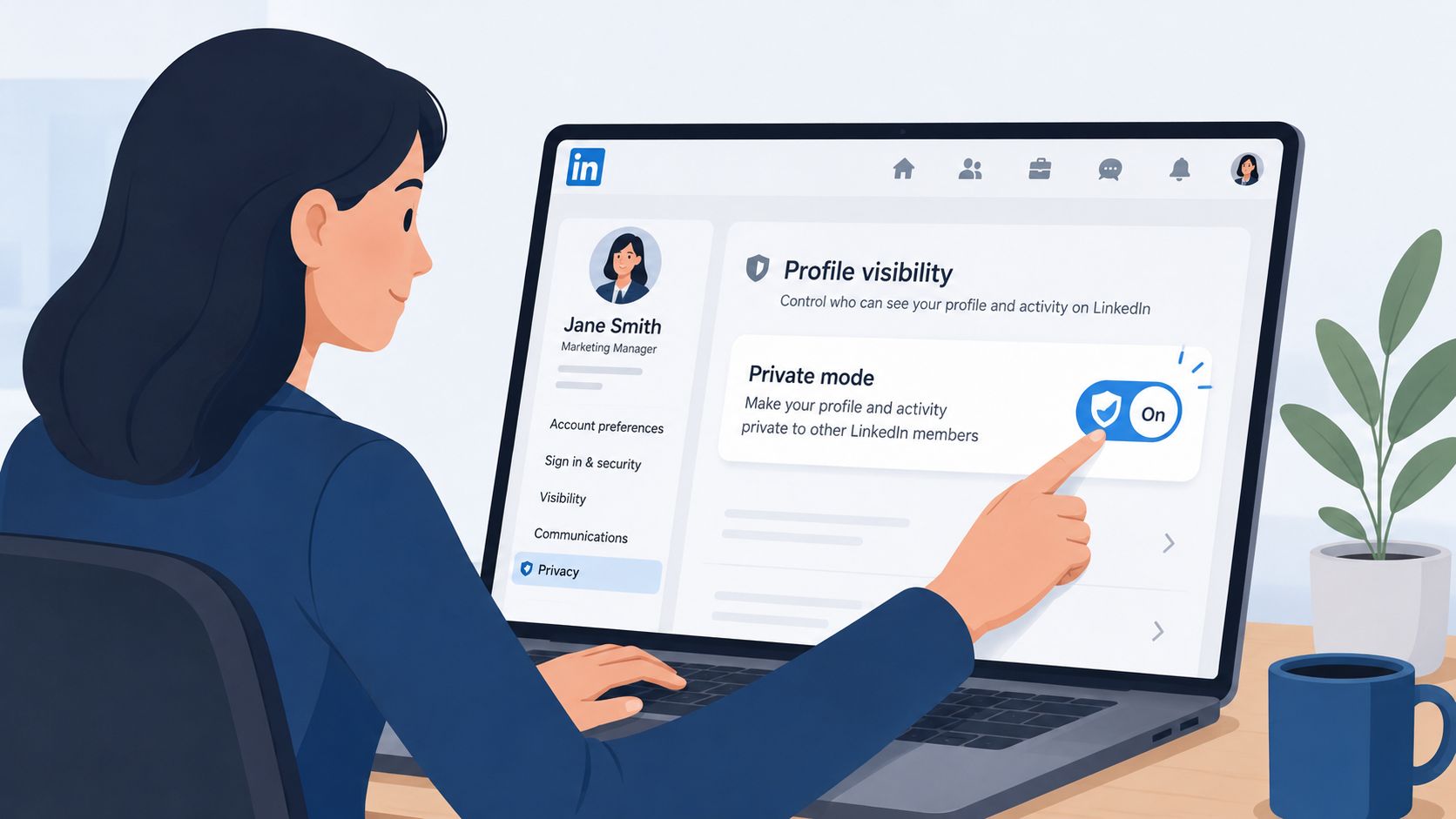
LinkedIn can support a discreet search, but its default behaviors can broadcast activity. Before editing your profile, open your privacy settings and turn off the option to share profile updates with your network. That prevents headline changes, new skills, and other edits from generating unnecessary notifications for colleagues.
Next, review Open to Work. Choose the recruiter-only setting rather than the public green banner. The recruiter-only version limits the signal to relevant recruiter accounts, while the public banner can make your availability visible to people at your current organization. No setting eliminates every risk, so treat it as a reduction in exposure, not a guarantee of secrecy.
Set profile viewing to anonymous or semi-private before researching employers. Browsing hiring managers, company pages, or employees under your identifiable profile can create a visible trail. Then review adjacent platforms:
Your resume needs the same judgment. Research on anonymous resumes found that anonymity does not necessarily increase total interview volume, because the average number of interviews per vacancy did not significantly increase when resumes were anonymous, according to the study summary on anonymous applications. Use anonymization to protect your employment status, not as a promise of more callbacks.
A practical compromise is a staged profile. Early materials can describe your function, technical scope, industry, location at a broad level, and selected accomplishments without naming your employer or reproducing a distinctive project description. Share identifying details only after the recruiter confirms the opportunity, explains who will receive your information, and agrees to the required confidentiality boundary.
For engineers, privacy shouldn't mean neglecting technical credibility. Review what hiring managers look for on GitHub and decide which public work strengthens your candidacy without revealing confidential employer information.
Quiet networking works through controlled access, not broad visibility. You're trying to create enough trusted conversations to discover relevant roles while avoiding a public signal that you're actively leaving.
Labor-market evidence indicates that 56% of job seekers use more than one method to find a job, and employment services employed 4.5 million people in the U.S. in 2023, reflecting the scale of mediated hiring infrastructure, according to multi-channel hidden-market labor evidence. That supports a diversified search, but each channel carries a different confidentiality trade-off.
A curated marketplace can reduce exposure by keeping candidate information limited until mutual interest develops. It suits professionals who want access to startup opportunities without publishing an open application trail. The trade-off is selectivity and less control over which roles appear first.
A specialized staffing firm, such as nexusITgroup.com, can manage early conversations, screen opportunities, and communicate confidentiality expectations before identifying you to a client. This approach works well when your skills fit a defined technical market. The trade-off is that you're relying on the recruiter's judgment, process discipline, and relationship with the employer.
Direct networking offers the greatest human control. A former colleague may know your circumstances and understand which conversations must remain private. Alumni groups, technical communities, and small industry events can also surface opportunities without a public resume submission. The weakness is reach. Personal networks can be valuable, but they're uneven and harder to scale.
| Channel | Anonymity Level | Typical Speed | Best For |
|---|---|---|---|
| Curated hiring marketplace | High during early matching | Selective | Passive tech candidates exploring vetted startups |
| Specialized recruiter | High when confidentiality is agreed early | Depends on role fit | Candidates needing representation and targeted access |
| Direct personal network | Depends on trust | Often conversational | Referrals, market intelligence, and sensitive introductions |
Underdog.io is one example of a curated hiring marketplace that uses anonymous profiles until interest is mutual and connects tech candidates with vetted startups. Candidates evaluating recruiter relationships can also use this guide to working with a recruiter to clarify communication expectations, disclosure timing, and role fit.
Tell every intermediary what “confidential” means to you. Ask whether your resume will be forwarded, whether your current employer can be excluded, when your name will be disclosed, and how interview scheduling will be handled. A recruiter who avoids clear answers is a risk, regardless of how attractive the position sounds.
With personal contacts, use a narrow request. Ask for market context or a private introduction rather than announcing that you're “open to anything.” Specificity helps trusted contacts assist you without turning your search into a conversation they may repeat.
Your first message should establish boundaries without sounding evasive. You don't need to explain workplace politics or provide your employer's name immediately. You do need to communicate your technical scope, the type of role you'd consider, and the confidentiality conditions that make a conversation safe.
The market context makes discretion valuable. A 2026 Express Employment Professionals and Harris Poll survey found 42% of U.S. adults were already job hunting, while 58% said finding work would be harder in 2026, as reported in the survey announcement on 2026 job-search expectations. You're competing for attention, but you shouldn't compete by exposing more than necessary.
Recruiter or marketplace outreach
I'm a currently employed software engineer exploring a limited number of opportunities in backend systems and platform engineering. I'm interested in teams where I can own architecture and delivery, but I need the search kept confidential until there's confirmed mutual interest. Can you share how you handle candidate information and when an employer identity would be disclosed?
Personal referral source
I'm doing private market research on senior engineering roles and would value your perspective on teams working on distributed systems. I'm not asking you to circulate my resume. If you hear of a strong fit, please check with me before making an introduction.
Hiring team after genuine interest
I'm happy to share my current employer and discuss the transition context now that we've confirmed the role is a serious fit. Please keep this information within the interview team and contact me only through my personal email.
Avoid language that promises a departure date before you have an offer. “I'm exploring selectively” is accurate and gives you room to assess the role. Also avoid inventing urgency. Recruiters can work with a candidate who needs discretion, but they can't plan around information that changes from conversation to conversation.
For additional guidance on writing to hiring teams, use this hiring-manager message example. The right disclosure point is usually after the role, team, compensation structure, and interview expectations are clear, and before the employer needs to conduct references or finalize an offer. Reveal information progressively, with a reason attached to each step.
A search with a 108-day median time from start to first offer, as noted earlier, needs a process that protects energy as well as identity. Don't schedule every conversation reactively. Build phases with explicit checkpoints, so a slow response doesn't push you into careless behavior.
Use the opening weeks to create the operating perimeter. Set up personal accounts and devices, redact public materials, review LinkedIn privacy controls, identify trusted contacts, and write your disclosure boundaries. Prepare a resume version that demonstrates outcomes without naming confidential products, clients, or internal systems.
Before outreach, inspect every place your identity appears. Search your own name, review public portfolio pages, check document properties, and confirm that personal contact details don't appear in old resumes. The purpose isn't perfect invisibility. It's removing avoidable signals before the search becomes active.
During the active period, choose a manageable rhythm. Schedule informational calls outside work hours, keep recruiter correspondence in one personal account, and review your digital footprint after meaningful LinkedIn interactions. Record who knows your identity and what they've received.
Use a simple risk checkpoint before each disclosure:
Once an offer is credible, review the practical constraints before resigning. Non-compete enforceability varies by jurisdiction and role, so obtain qualified legal advice rather than relying on a generic internet summary. Read your employment agreement for moonlighting, outside-work, intellectual-property, confidentiality, client-contact, and notice provisions.
Garden leave may affect how you spend a notice period, and some agreements limit work or communication during that time. Treat these questions as routine due diligence. You're protecting your income, reputation, and ability to start cleanly.
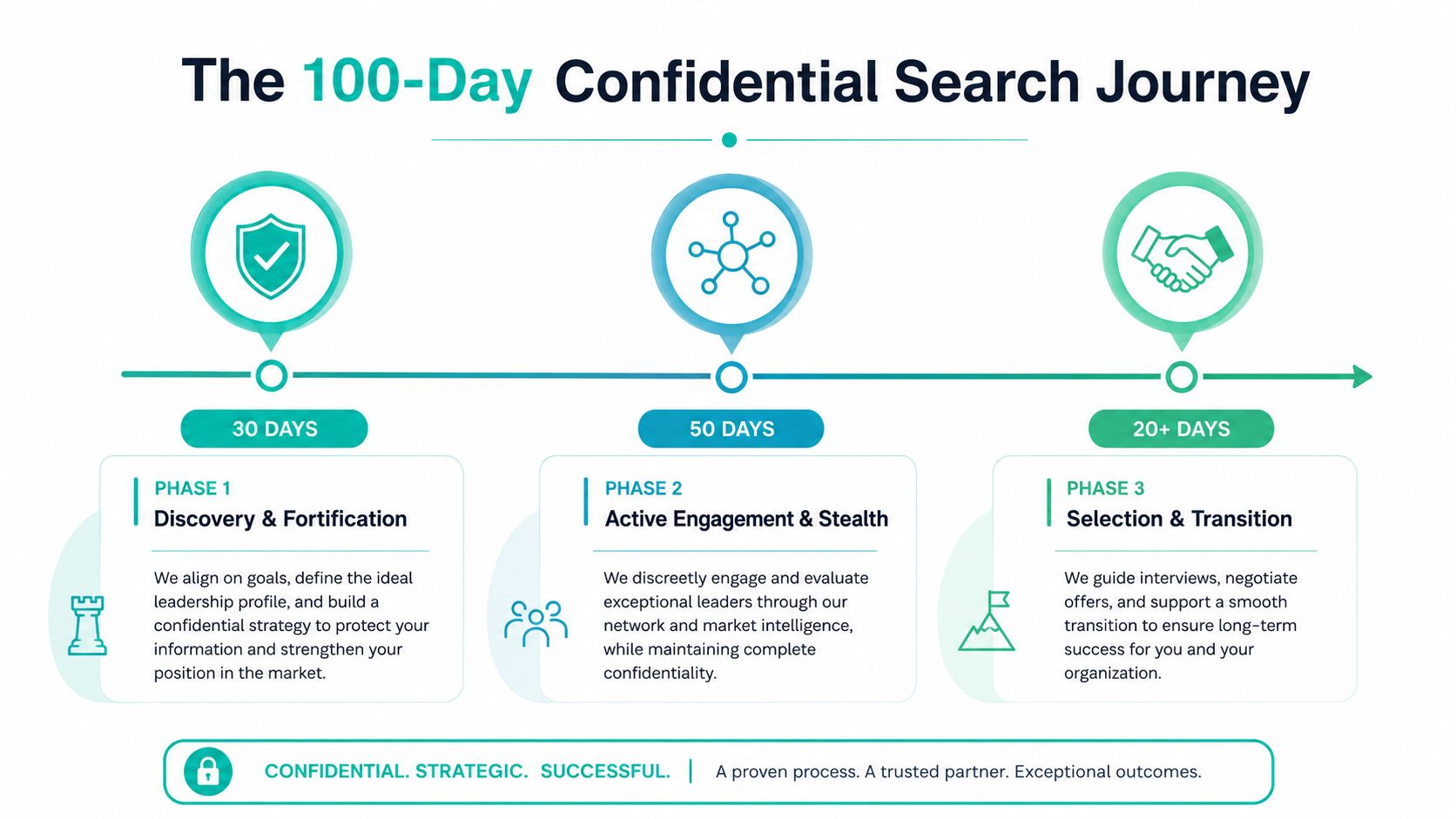
Maintain a backup plan throughout. If a recruiter sends information to the wrong address, a colleague notices unusual activity, or an employer asks for disclosure earlier than agreed, pause the process and reassess. A confidential search should have an exit strategy for the search itself.
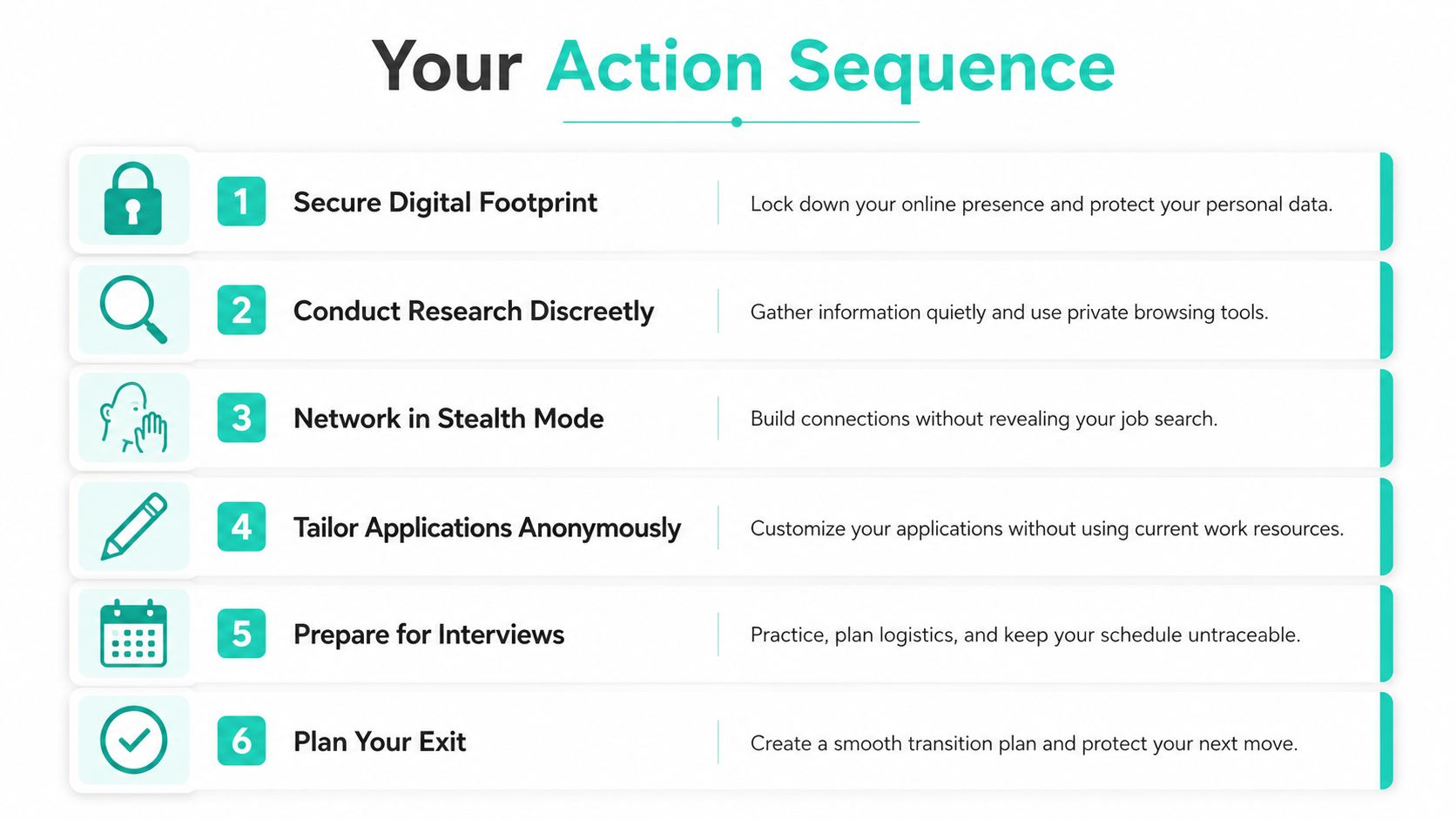
Start with a written sequence, not a burst of anxious activity. The order matters because early exposure can't always be reversed, while a slower preparation period usually costs little.
Review the written offer, employment agreement, restrictions, start date, benefits, equity terms, and notice obligations before announcing anything. Don't resign because a recruiter says an offer is coming. Wait until the terms are documented and you've resolved questions that could change your decision.
A quiet search can feel lonely, especially when you're maintaining performance at work while evaluating a different future. That feeling doesn't mean you're doing something wrong. Confidentiality is a professional boundary, not deception. You're entitled to protect your current income and negotiating position until you have a concrete decision to communicate.
Your final checkpoint is narrative control. Know what you'll tell your manager, close colleagues, professional contacts, and public network, and share each message only after your transition is secure. A well-run confidential job search isn't about hiding your identity forever. It's about choosing the moment and context in which your next move becomes public.
Underdog.io offers a curated, candidate-focused way for tech professionals to explore vetted startup opportunities through anonymous profiles and selective introductions. If you're employed and want to investigate your next role without broadcasting your search, visit Underdog.io and create a private path to relevant conversations.