What makes a founder spend years chasing a model that incumbents often dismiss too late, and what makes that bet worth the risk? The answer isn't hype. It's that market leadership turns over faster now, with the average life of a market leader falling from 33 years in 1965 to 15 years in 2020 in one widely cited indicator, and over 70% of Fortune 500 companies had launched or acquired a disruptive technology venture by 2025 (innovationhublive.com).
That shift changes how founders should think about hiring, capital, product design, and even the shape of the company itself. A disruptive business model isn't just a clever feature or a viral launch, it's a way of reaching customers that incumbents don't want to copy at first, then can't ignore later. If you're building in 2026, the question is no longer whether disruption is happening. It's whether your model can survive long enough to matter.
The first question most founders ask is simple, even if they don't say it out loud. Is it smarter to attack the incumbent, or build something safer and more incremental? The answer depends on whether you're competing in a market where leadership is durable or one where the floor keeps moving under everyone's feet.
That's why disruption matters more now than it did a decade ago. The market itself is less forgiving of slow movers, and the companies that win often start by serving a corner of the market the dominant player has ignored. They don't begin by being bigger. They begin by being easier to adopt, cheaper to try, or more convenient to use.
Practical rule: if an incumbent already serves your exact customer segment well, you're probably building a sustaining improvement, not a disruptive model.
Disruption also changes the founder's operating decisions. Hiring shifts from filling established roles to building roles from scratch. Capital strategy shifts from funding polish to funding learning. The company's structure has to support fast adaptation, because the model usually wins on speed of adoption and unit economics before it wins on brand.
KPMG's survey data makes the scale of that shift easier to see. Global e-commerce spending was expected to rise from $3.5 trillion in 2019 to $6.5 trillion in 2023, and e-commerce platforms were ranked the most disruptive business model by 27% of respondents (KPMG). That's a strong clue that the modern founder is often competing against an ecosystem, not a single product.
By the end of this guide, you should be able to define disruption plainly, spot the patterns it follows, and make better choices about hiring and operating design. That's the true payoff. Once you understand the mechanics, you stop treating disruption like a slogan and start treating it like a system.
A disruptive business model starts at the edge of the market, where the biggest players are usually least interested in competing. The incumbent builds a broad highway for mainstream buyers, expensive to maintain and tuned for the most profitable traffic. The disruptor begins on a smaller road, serving people the larger company ignores, then improves until that side road connects to the main route.
Christensen's framework helps separate disruption from ordinary improvement. In this view, disruptive models usually begin by serving nonconsumers or overserved customers with a simpler, more affordable offer, then move upmarket as the model improves (Christensen Institute). That is different from building a higher-spec product for the same customer at a higher price.
Founders often confuse “better product” with “disruptive model.” Those are different ideas. MIT Sloan Management Review explains that a disruptive business model has to let the entrant compete profitably while pricing at deep discounts, so the innovation is about economics and delivery as much as product design (MIT Sloan Management Review).
That matters because price cuts alone do not create disruption. A company can charge less and still burn cash if the structure underneath it stays the same. Disruption works when the company has a lower-cost way to reach customers and a delivery model incumbents cannot easily copy.
A founder should treat disruption less like invention and more like redesigning the path between buyer and value. The question is not only what you sell, but how you acquire, serve, and retain the customer without copying the incumbent's expensive setup.
ForA Financial describes a disruptive business as one that creates a new market concept inside a crowded marketplace instead of only competing inside the existing field (ForA Financial). That is a useful plain-English way to frame it. The model changes what customers expect to buy, how they buy it, or why they choose it.
Why do some startup models look modest at first, then steadily pull customers away from bigger incumbents? The answer usually is not one clever feature. It is a set of choices that fit together so the business can serve a narrow customer group, keep its economics intact, and become harder to copy as it grows. If one piece is missing, the idea can still look impressive in a pitch deck and fall apart in the market.
The first pillar is a clear target. Disruption theory starts with either a low-end foothold or a new-market foothold, which means the company is aiming at customers the incumbent has ignored, underserved, or priced out. If a founder cannot name that customer precisely, the wedge is probably too broad to work. A job board built for a specific talent segment works better than a generic hiring platform that tries to serve everyone at once.

The second pillar is a structurally lower cost basis. That does not mean “spend less” in a vague sense. It means the business can serve its target customer at a price point the incumbent cannot match without hurting its own economics.
A practical example helps here. A startup that uses self-serve onboarding, lightweight support, and a narrow product scope can often serve a segment a legacy vendor cannot profitably chase. The difference is not just frugality. It is that the startup built its operating model around a simpler job to be done, while the incumbent built around a broader, more expensive service motion.
The third pillar is the value network. Columbia's discussion of disruptive business models shows why the entrant has to align channels, partners, and revenue logic in a way that keeps cost low and access high, because that structure becomes the main barrier to imitation (Columbia Global Centers). A competitor can copy a feature. It is much harder to copy the full set of incentives, distribution paths, and operational habits that make the feature economical.
For founders, hiring choices start to matter. If your model depends on automation, you hire differently than a services-heavy company would. If your model depends on a community or partner network, your early team needs to know how to recruit, manage, and retain that ecosystem. The operating model and the talent model have to fit together, or the economics break.
The fourth pillar is a credible path upmarket. Disruption is not a dead-end niche. The product has to improve enough that customers who once ignored it begin to trust it for more important work. That might mean a basic tool becomes the entry point, then expands into workflow software, analytics, or team-level usage as confidence builds. If the model never moves beyond the first segment, it may still be a useful business, but it is not disruptive in the Christensen sense.
Here is the founder test. If you remove the target customer, the cost basis, or the partner network, does the model still make sense? If it does, the idea is probably too generic. Real disruption depends on all four pillars reinforcing each other, like a chair that only stands when every leg is in place.
Disruptive business models come in patterns, and founders save time when they learn to recognize them. The shapes differ, but the logic is similar. Each one starts by reducing friction for a customer who has been underserved, then uses a specific economic engine to scale.
| Archetype | Core Mechanic | Representative Example |
|---|---|---|
| Platform marketplace | Aggregates supply and demand, lowers discovery and transaction friction | Airbnb |
| Freemium SaaS | Offers a useful free tier, then converts a subset of users to paid plans | Dropbox |
| Subscription direct-to-consumer | Sells recurring access directly, reducing retail overhead and increasing predictability | Dollar Shave Club |
| Asset-light sharing model | Uses existing underused assets instead of owning the full asset base | Uber |
| Ecosystem play | Builds on a developer or partner network so others extend the product | Shopify |
Platform marketplaces tend to win on network effects because every new buyer can improve the offer for every seller, and vice versa. Airbnb did that by turning spare rooms and spare homes into a global inventory without owning the properties themselves. The unit economics improve because the platform doesn't carry the same fixed costs as a traditional hotel chain.
Freemium SaaS wins when the free product is useful enough to attract adoption and the paid version solves a deeper problem. Dropbox used that logic to reduce adoption friction, then monetize collaboration and storage needs that basic sharing couldn't handle. The economics work when the cost of serving the free user stays low enough to support conversion.
Subscription direct-to-consumer models usually win by cutting out layers of distribution and building a direct customer relationship. Dollar Shave Club used a simple recurring offer to challenge a category that relied on retail shelf presence and brand inertia. The appeal wasn't just lower price. It was fewer choices, fewer trips, and less friction.
Asset-light sharing models, like Uber, scale by coordinating existing capacity instead of owning it. That creates flexibility, but it also means the company's operating model has to manage trust, pricing, and supply quality very carefully. Ecosystem plays, like Shopify, win differently. They give partners room to build on top, which increases switching costs as the network deepens.
If you're building in hiring marketplaces, the shape often looks closest to an ecosystem play. A curated example of that logic is Underdog.io, which connects startup talent and hiring teams through a controlled matching layer rather than a raw listing feed. For a related product pattern, see job board software for hiring marketplaces.
Classic disruption theory often reads like a price story. The entrant is simpler, cheaper, and acceptable enough for overlooked customers, then improves until it reaches the mainstream. That still matters, but AI and platform economics are changing the operating assumptions underneath the model.
McKinsey estimated generative AI could add the equivalent of $2.6 trillion to $4.4 trillion annually across industries, while the World Economic Forum projected 44% of workers' skills would be disrupted by 2027 (McKinsey and World Economic Forum). Those figures point to a different kind of disruption. The biggest gains are not just coming from lower prices. They're coming from workflow redesign, automation, and the restructuring of labor itself.
A founder building today can't think only about product features. AI can compress service delivery, reduce coordination costs, and move work from expensive human labor into software-driven systems. That means the model may be disruptive even if the product itself doesn't look radically new on the surface.
The KPMG survey also helps frame the platform side of this shift. Social networking users spent an average of 2 hours and 22 minutes per day in 2018, up 49% from 1 hour and 35 minutes in 2013, showing how quickly platform behavior can scale once network effects take hold (KPMG). The point isn't the exact category. The point is that attention and usage can move fast when the model compounds.
Founder check: if your company depends on lots of manual coordination, ask whether AI should be part of the operating model, not just the product roadmap.
That's why 2026 planning should treat AI-native operations as a baseline. If the model still depends on heavy human coordination for tasks that software can standardize, you may be building a better version of the old system instead of a new one. For a product-led example space adjacent to this shift, the operating logic behind platform software development shows how the platform itself can become the product.
Disruption now is as much about who or what does the work as it is about what gets sold. That's the shift founders need to internalize.
The first hiring mistake disruptive startups make is assuming they need people who've already done the exact job before. They usually need something more flexible. When the model is still changing, the best hires are often the people who can define the role with you, not just execute an old version of it.
That means adaptability matters more than polish. You want people who are comfortable with ambiguity, willing to switch context quickly, and able to make decisions without a thick layer of process. In a disruptive model, the team is building the machine while driving it.
A founder should screen for how candidates learn, not just what they know. Ask for examples of roles they created, problems they solved without a playbook, or moments when they had to work across product, sales, and operations. Those stories reveal whether a candidate can function in a model that's still being invented.
Hiring itself should also reflect the model's logic. Curating quality over volume matters more than spraying job posts everywhere, because a disruptive company usually can't afford long cycles or bad-fit hires. A human-vetted matching process can do more for signal quality than a big pile of keyword-matched résumés, especially when the role changes quickly.
If you're hiring AI talent specifically, Underdog.io's AI engineer hiring page is one example of how a curated marketplace can surface relevant candidates without turning the process into resume spam. The broader point is operational. In a disruptive startup, the hiring funnel should feel like part of the product strategy, not an afterthought.
Candidates who are already employed often want a discreet, low-friction way to explore roles. If you make discovery cumbersome, you lose the people most likely to be worth hiring.
That's why candidate-first experiences matter. Passive talent usually won't tolerate noisy outreach, vague job descriptions, or unclear equity terms. If the company is serious about attracting them, the employer brand has to be transparent about mission, ownership, and the kind of ambiguity the job requires. That doesn't mean over-selling. It means telling the truth early.
The right hiring system supports the business model, not the other way around. The team should be small, fast, and able to shift as the model learns what customers value. That's a founder decision, not just a recruiting one.
A real disruptive pivot starts with one question. Which customer group is getting ignored because the incumbent's model makes them unattractive? If you can't answer that cleanly, stop. You're probably rebranding, not redesigning.
First, map the underserved segment. Be specific about who they are, what they currently do instead, and why the incumbent overlooks them. Then draw the value-network map. List the partners, channels, and payment flows that would let you serve that group at a lower cost than the incumbent can tolerate.
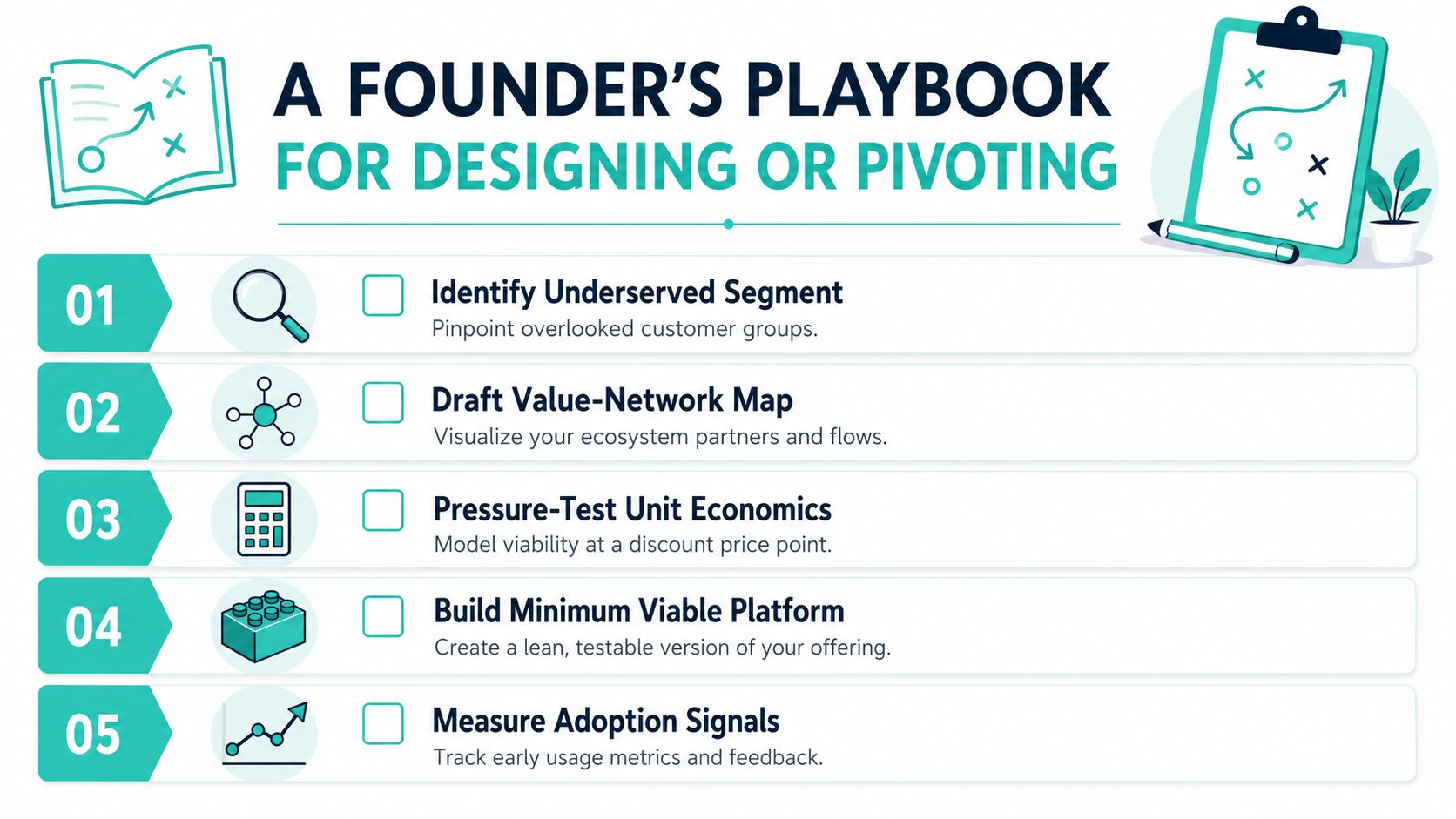
Next, pressure-test the unit economics at the discount price point. If the model only works after you raise prices to incumbent levels, it's not disruptive. Build a thin MVP that proves the delivery path, then instrument the upmarket path so you can see which customers expand usage and which ones stall.
The warning signs are usually obvious. If the company keeps adding features to satisfy everyone, it's drifting toward a sustaining product. If the team can't explain why the incumbent won't fight the new segment immediately, the moat is weak. If the model depends on heroic sales rather than repeatable adoption, the pivot probably isn't real.
Use the quarter to test the system, not just the pitch. The founders who move fastest usually learn that disruption is not a branding exercise. It's an operating choice.
Real disruptors stay close to the customer the incumbent has already written off. Imitators chase the headline, copy the interface, and miss the economics. The durable advantage comes from serving the overlooked buyer with a model the bigger player doesn't want to match.
That's the through-line from theory to hiring to operating design. Christensen's framework explains the foothold. AI explains why the cost structure is changing. Talent strategy explains whether the company can execute long enough to matter.
In 2026, the winners will be the teams that build for constraint, not abundance, and that treat disruption as a company design problem instead of a growth slogan. The startups that last will know exactly who they serve, how they deliver, and why the incumbent won't copy them first.
If you're building a disruptive startup, hiring the right people is part of the model, not a side task. Underdog.io helps startups and tech companies connect with curated talent in a way that fits fast-moving teams and changing roles. Visit Underdog.io to see how a focused hiring marketplace can support the way you build.