In Q1 2026, the median time from starting a job search to receiving a first offer reached 108 days, while 81% of applicants reported applying without receiving any response. A job matching platform can improve that experience, but only when it prioritizes relevance, trust, and human judgment over application volume.
The problem isn't a lack of listings. Candidates can find more roles than ever, and employers can collect more applications than their teams can review. The failure happens between discovery and outcome. A profile may contain the right experience, yet the candidate never reaches a decision-maker, receives no explanation, or spends weeks pursuing roles that were never a realistic fit.
That gap has become the defining issue in digital hiring. The strongest platforms aren't just search engines for vacancies. They act as filters, interpreters, and relationship channels between people whose goals, working styles, and expectations need to align.
The 108-day median time to a first offer and the 81% silence rate point to a broken process, not merely an impatient candidate pool. The underlying figures come from Q1 2026 job-search trends, which also reports that the median time increased 30% from Q4 2025. A candidate can spend months searching, tailoring applications, and completing assessments while receiving no useful signal about what went wrong.
Consider a product manager with experience at a small software company. She applies to roles titled Product Manager, Product Lead, and Growth Product Manager. Each description uses different language for similar responsibilities. One screening system prioritizes a specific tool name, another rejects her because her current employer isn't well known, and a third never surfaces her application because hundreds of candidates applied earlier.
The candidate sees a skills problem. The hiring team sees a volume problem. In reality, both are dealing with a relevance gap, where the platform can't reliably connect capability with the context in which that capability matters.
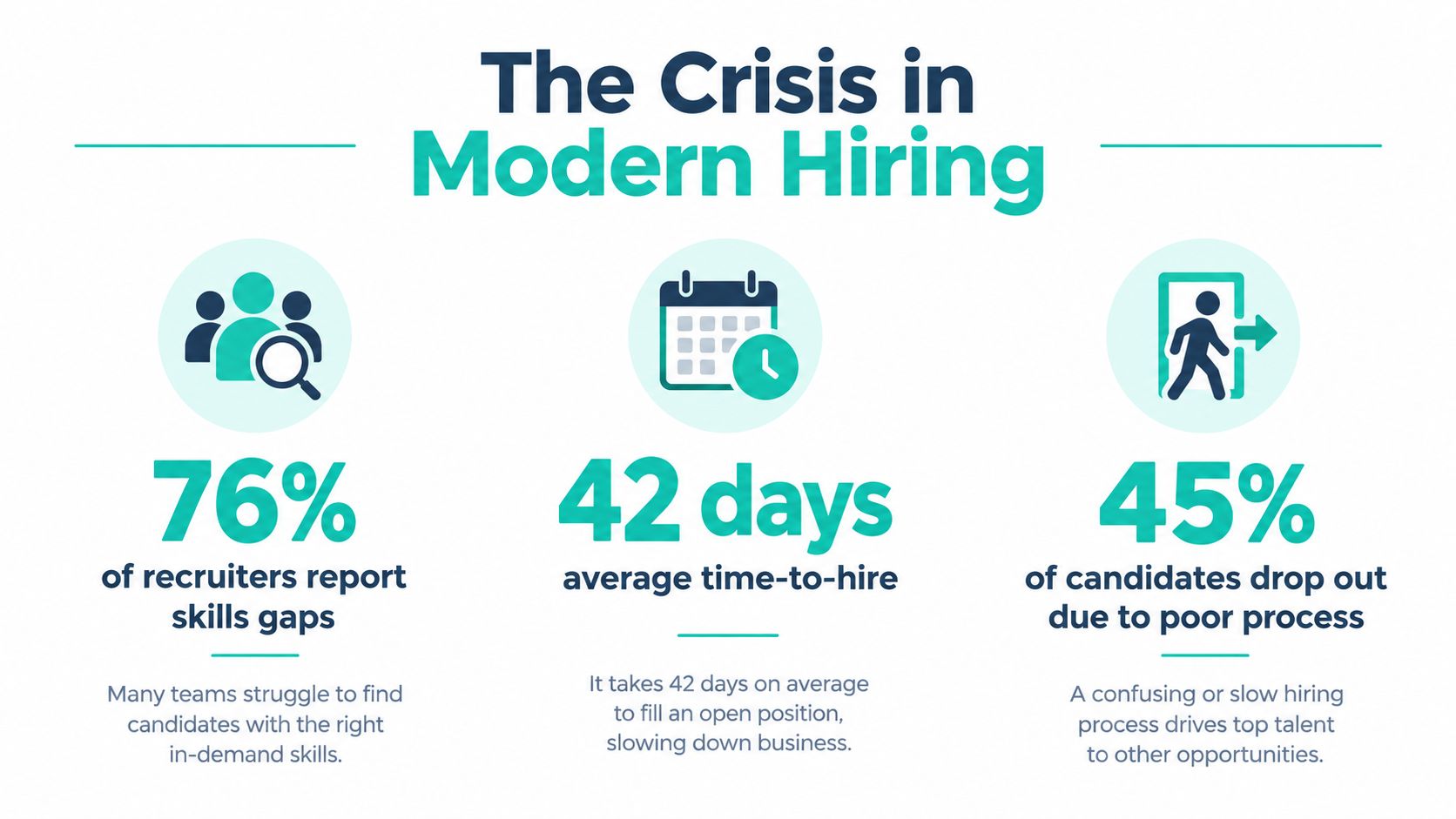
The conventional response is to increase activity. Apply to more jobs, use more keywords, and accept more automated assessments. That approach may create the appearance of progress, but it also moves the cost onto candidates and recruiters without improving the quality of the connection.
For passive candidates, the trade-off is sharper. An employed engineer may be open to the right startup but unwilling to broadcast a job search, expose a resume to unknown companies, or spend evenings completing generic forms. A public job board offers reach, but it often lacks discretion and context.
Practical rule: If a platform measures success mainly by applications submitted, ask how it measures interviews, mutual interest, offers, and post-hire fit.
Recruiters face the inverse problem. More applications don't automatically create a stronger shortlist. They create more screening work, more inconsistent judgments, and more opportunities to miss a candidate who doesn't describe relevant experience in the platform's preferred vocabulary. Candidates researching their own exposure can also benefit from practical resources such as scenarios for account intelligence, particularly when they need to evaluate career-change signals discreetly.
A useful job matching platform should therefore reduce wasted effort on both sides. It should identify meaningful compatibility, create a credible introduction, and provide enough feedback for the system and its users to improve.
Online recruiting began as a digital alternative to the newspaper classifieds. The Online Career Center launched in August 1992, followed by major job boards including Monster.com and CareerBuilder in 1994, according to this history of the online job search. The change was important because candidates could search across locations and employers could publish roles without relying on the circulation of a local newspaper.
A later wave appeared in 2004 and 2005, when Indeed and Simply Hired popularized aggregation. Instead of visiting individual employer sites, candidates could search a larger index from one interface. That model made discovery easier, but it also encouraged platforms to optimize for inventory, clicks, and ranking efficiency.
The modern problem isn't that algorithms exist. Algorithms are useful for organizing large datasets, identifying obvious qualifications, and reducing repetitive work. The problem appears when many employers depend on similar screening logic and the same signals determine who gets seen.
Stanford researchers examined 4,197,168 applications to 1,746 positions at 156 employers and identified evidence of “algorithmic monoculture,” including racial disparities and repeated rejection of similar applicants across firms using comparable systems. The findings are discussed in Stanford's analysis of algorithmic monoculture.
In hiring, a shared model can turn one flawed assumption into a market-wide filter. If a system treats a particular employer, title, school, employment pattern, or phrase as a proxy for quality, candidates who fall outside that pattern may be screened out repeatedly. The platform doesn't need to make an overtly discriminatory decision for the outcome to become systematically exclusionary.
Keyword ranking asks whether a profile resembles a job description. Good matching asks whether the candidate can perform the work, wants the environment, and is likely to succeed with that particular team.
Those questions require context. A startup may need an engineer who has worked through ambiguous requirements, shipped without a large support function, and communicated directly with founders. A broad screening model may see an incomplete match because the candidate's title doesn't align neatly. A human reviewer can recognize that the candidate's operating environment is more relevant than the title itself.
Volume platforms aren't useless. They're effective when the buyer knows exactly what to search for and the candidate's credentials fit established categories. They become weaker when the role is unusual, the company is young, or the best candidate is not actively applying.
Algorithms and human curators address different points of the matching problem. Software can process thousands of profiles quickly. Human review can examine whether a candidate's experience reflects real ownership, whether a career change makes sense, and whether a niche startup role fits the person's working preferences.
The larger risk is algorithmic monoculture. Platforms often rank candidates with similar profile fields, titles, keywords, and application behavior. That approach creates a familiar shortlist, then repeats the same assumptions across every search. Candidates outside the dominant pattern may receive no explanation and no useful response. Silence becomes part of the product experience.
A structural study of 1.2 million hiring decisions on a major online freelancer platform found that experiential learning explained about 87% of the variation in applicants' utility to buyers. Its improved matching policy increased buyer welfare by up to 45% to 47% of gross revenue, as detailed in the research on outcome-driven matching.
The practical lesson is to judge matching quality by what happens after an introduction. Did the candidate reach an interview? Did both sides stay interested? Did the hire succeed? A ranking system that never captures those outcomes keeps optimizing an incomplete view of fit.
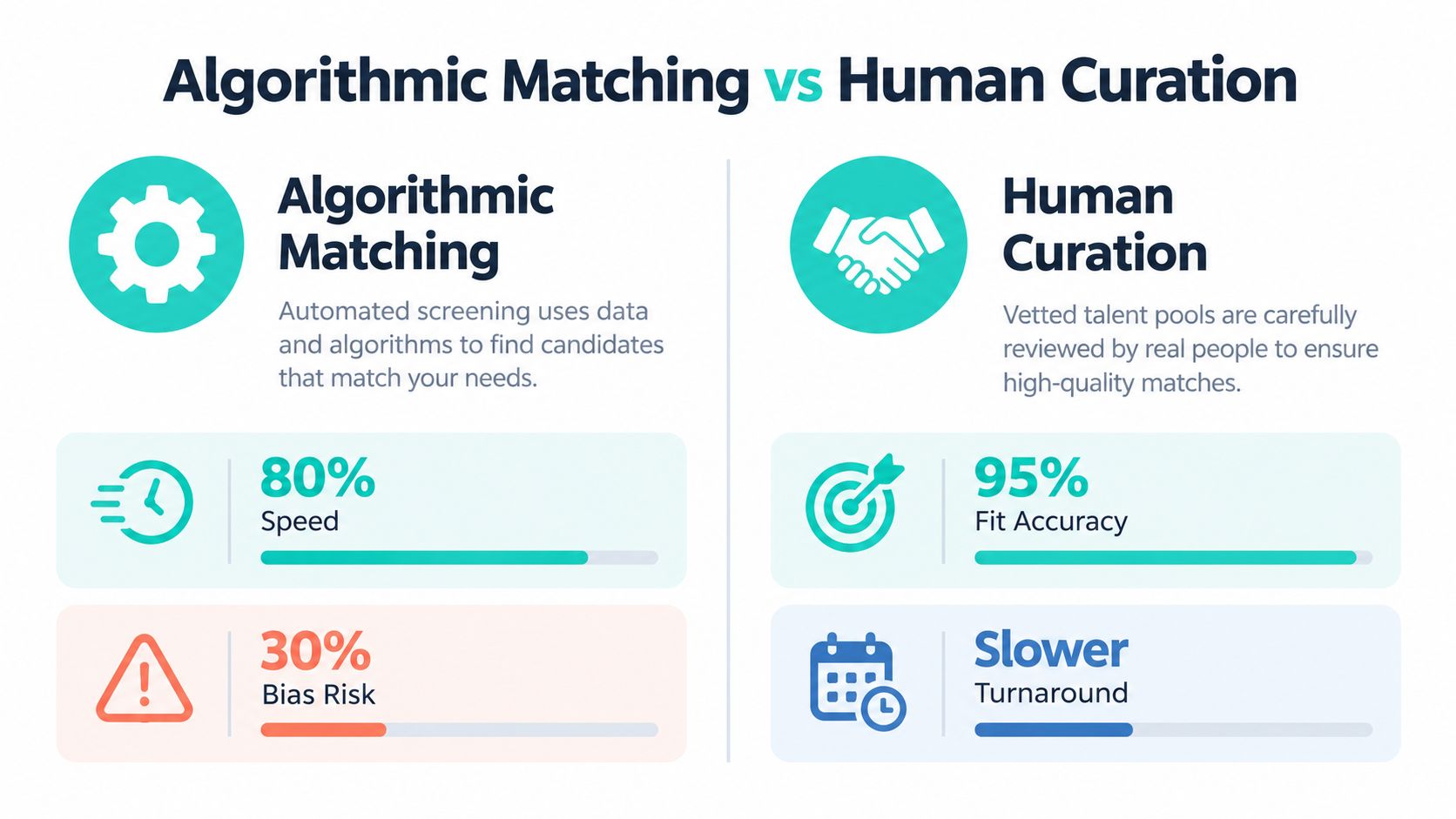
Human curation does not replace technology. It assigns technology to administration and discovery, while reviewers handle judgment where profile data is incomplete or misleading.
| Automated matching | Human curation |
|---|---|
| Compares structured signals quickly | Interprets experience in context |
| Handles broad discovery | Narrows the pool deliberately |
| Can repeat hidden assumptions at scale | Can challenge an unsuitable ranking |
| Works well with standardized roles | Adds value when fit is nuanced |
A curated marketplace model for hiring makes selectivity visible. The model accepts about 5% of applicants through manual review and typically gives candidates 1 to 3 personalized introductions per month, according to the platform's published materials on recruiting tools for high-growth startups and candidate sourcing tools for startups.
That cadence will not suit candidates who want to browse every vacancy. It can suit people who prefer relevant conversations over a crowded inbox. The trade-off is straightforward: fewer opportunities appear, while each introduction receives more deliberate consideration from both sides.
A matching system earns trust when users can understand why a connection was made and what happens when the match misses.
A high-performance job matching platform makes its quality visible through the work it removes from the hiring process. Candidates should spend less time repeating the same information, while employers should review fewer profiles with weaker relevance.
The introduction model is the first test. A platform that sends candidates to another application form has changed the interface, not the hiring dynamic. A mutual-interest process creates a better sequence: the employer reviews a relevant profile, the candidate assesses the opportunity, and both sides decide whether a conversation is worth having.
Look for capabilities that protect attention and privacy:
The model described in the platform's startup recruiting overview combines an anonymous profile, mutual-interest introductions, and manual review. These design choices reduce the personal information candidates must disclose before an opportunity has genuine potential. They also give the platform a chance to reject weak or misleading profiles before those profiles reach hiring teams.
Candidate screening is only half the process. A platform should assess whether a company has a credible role, a defined hiring process, and expectations that match the advertised opportunity. A technically interesting position can still produce a poor match if the hiring manager cannot explain the first priorities, decision rights, or working relationship.
Ask how the platform handles role quality. Does someone clarify vague requirements? Can the employer explain what success looks like early in the job? These checks matter because a well-matched candidate can still decline when the opportunity is poorly defined.
Specialization provides another useful filter. A platform focused on early-stage technology companies may interpret startup experience more accurately than a general job board that treats every employer and role as interchangeable. Focus does not guarantee a hire, but it can improve the conditions for a serious conversation.
The final test is feedback. The platform should record responses from candidates and employers, correct inaccurate information, and learn when introductions fail. A polished interface without that feedback loop remains a static directory.
Job descriptions are shifting toward capabilities rather than fixed career labels. In Q2 2026, 13.4% of saved jobs named at least one AI skill, compared with 10.4% in Q1 2026 and 6.8% in Q4 2024, according to coverage of AI-driven job matching and changing search behavior.
That movement creates an opportunity and a risk. Skills-based matching can surface a person whose title doesn't align with a conventional career path. It can also reduce a complex professional history to a checklist, especially when the platform treats a named skill as proof of competence without considering how the candidate used it.

A founder hiring an early product employee may need someone who can run customer interviews, define a roadmap, work with engineers, and revise priorities after launch. The relevant evidence may sit across several roles and may not appear under the exact phrase used in the vacancy.
Human review helps distinguish a skill that was listed from a skill that was practiced. It can also identify adjacent experience. A data analyst who built internal automation may be relevant to an operations role, even if the candidate hasn't held that title.
The analysis of skills-based hiring is useful for candidates who want to present capabilities rather than rely on degrees or title progression. The practical lesson is to describe the problem solved, the decisions owned, and the constraints managed, not just the software used.
Trust remains a separate issue. The same Q1 2026 research reports that 45% of job seekers were unsure whether they were qualified for the jobs they applied to, while candidates continued to expect little or no response. The AI matching coverage also reports that AI recommendations accounted for 70% of applications on a major platform in 2026, which makes transparency more important, not less.
A discreet platform should tell candidates what information employers see, when identities are revealed, and how interest is expressed. It should let a professional explore without forcing a public declaration. For startup hiring, that confidentiality can bring experienced people into the conversation before they're ready to submit a conventional application.
Startup hiring presents a sales problem that enterprise hiring can often avoid. A young company may offer meaningful ownership, direct access to decision-makers, and the chance to shape a product, yet it may lack the brand familiarity and predictability of a larger employer.
The hiring process must communicate context quickly. Candidates need a clear view of the mission, company stage, team, expectations, and uncertainty involved. Founders need access to people who want that environment, not people whose titles resemble the vacancy.
Traditional staffing firms can add recruiting capacity for a defined technical position. Their model is less effective when a startup needs a tightly targeted introduction to a selective, employed candidate who is unlikely to respond to generic outreach. Broad databases and automated recommendations can create another problem: the same visible profiles surface repeatedly, while niche candidates receive little or no relevant contact.
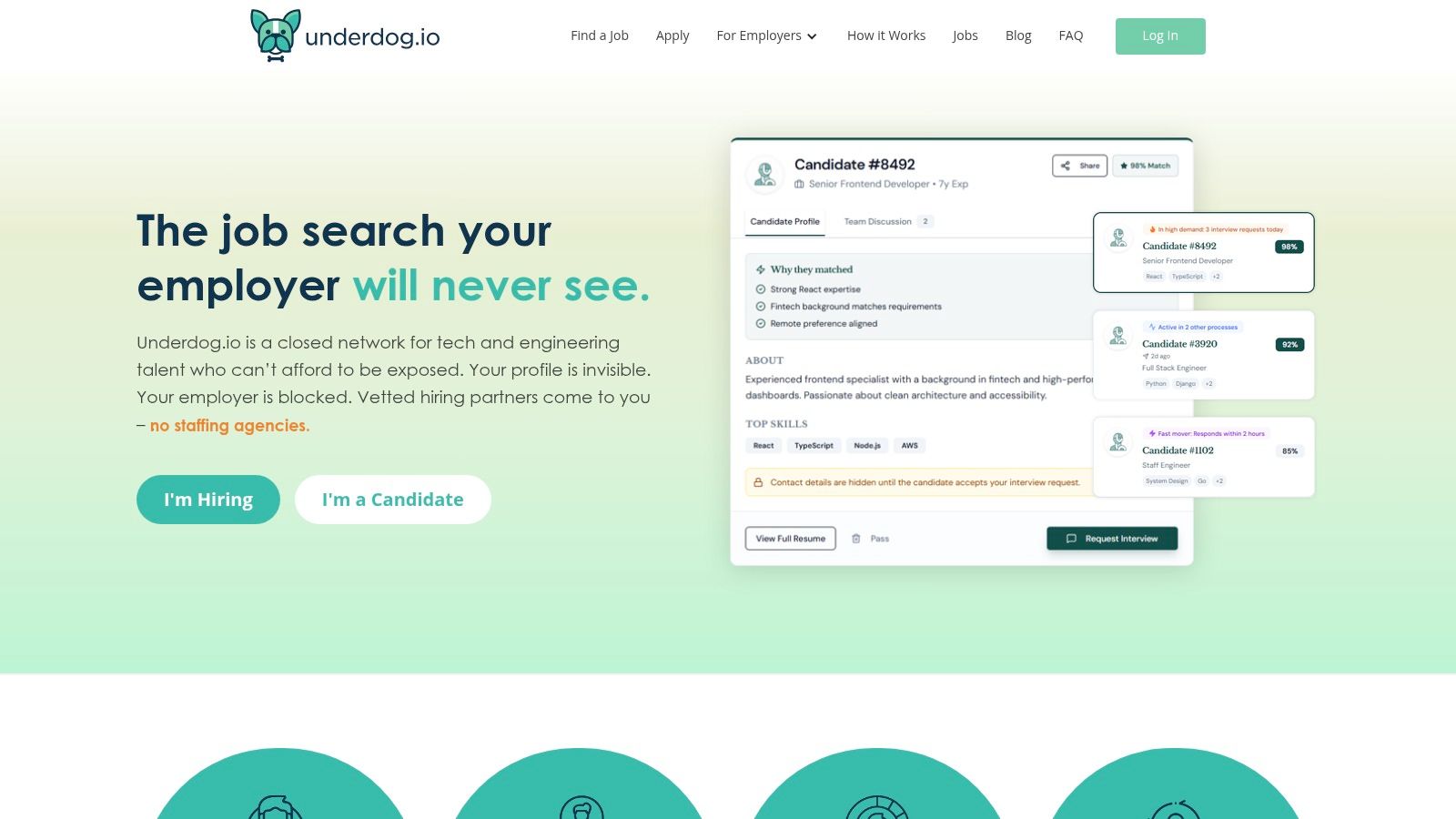
A curated marketplace changes the starting point. Instead of publishing a vacancy and waiting for an unknown applicant pool, the company receives profiles that have passed an initial relevance check. Human curation can challenge the assumptions built into a matching model, look beyond common title patterns, and bring forward candidates who would otherwise remain invisible. The founder still has to assess judgment, execution, and working style, but the first conversation begins with a stronger reason for contact.
The approach also respects candidate attention. Someone interested in startup work may not want every startup role. A carefully selected introduction can connect that person with a company that fits their interests without requiring broad public applications or repeated generic messages.
The published operating model is intentionally limited. Candidates typically receive about 1 to 3 personalized introductions per month. That is not a promise of constant activity. It is a quality-control mechanism that asks whether each introduction deserves the candidate's attention and whether the company has a credible reason to make contact.
For founders: A small, relevant shortlist is more useful than a large database when every interview pulls you away from product, customers, and team leadership.
Curation works best when the employer provides specific inputs. Define the problems the hire will own, the decisions they can make, the conditions that might frustrate them, and the evidence that would indicate success. State the uncertainty plainly. Candidates who can work in an early-stage company can handle ambiguity, but they need to know where it exists.
A platform can open the door, but the company must make the opportunity credible. Clear communication about the product, funding context, team dynamics, compensation structure, and interview process determines whether a relevant introduction becomes a serious conversation. Human judgment then keeps the system from collapsing into algorithmic sameness and candidate silence.
Start with the outcome you want. A candidate seeking broad exposure may prefer an aggregator. A product leader looking for a confidential move into an early-stage company needs stronger filtering, clearer context, and fewer irrelevant conversations. An employer hiring for a specialized role should judge a platform by the quality of introductions, not the size of its database.
Ask these questions before creating a profile or purchasing access:
For a broader explanation of the principles behind talent matching with GENTY recruitment, compare how each service defines fit, verifies information, and supports the decision after the introduction.
A platform that promises unlimited exposure may be optimized for activity rather than relevance. If it sends the same generic role to nearly everyone, hides its screening process, or treats silence as a normal outcome, it hasn't solved the central problem.
Employers should also inspect the workflow behind the interface. A job board software guide can help clarify the difference between publishing vacancies and building a matching process, but the buyer still needs to ask how candidate quality is assessed and how feedback changes future recommendations.
The right platform won't remove the need for judgment. It will direct judgment toward conversations that deserve it. That is the difference between searching harder and matching better.
Underdog.io offers a curated hiring marketplace with a single, 60-second anonymous profile, manual candidate review, and mutual-interest introductions to startups and high-growth technology companies. If you want a more discreet alternative to mass applications or broad outbound sourcing, visit Underdog.io and evaluate whether its selective approach fits your next move.