A third of employees say they've had a poor onboarding experience, while 31% say onboarding ends in a single day and 62% say it ends within a week, according to Enboarder's onboarding statistics roundup. For a startup hiring an engineer, product manager, designer, or operations lead into a complicated role, that timeline is rarely enough.
The practical answer is to treat employee onboarding as a 90-day retention system, not a paperwork queue. The system needs three separate operating rhythms: a manager who creates role clarity, a peer who makes the unwritten rules visible, and an async support layer that helps the new hire find answers without burying them in documentation.
Startup onboarding fails less often because HR forgot a form than because nobody owns the employee's first-quarter experience. Founders focus on closing the hire, the manager assumes an enthusiastic person will “figure it out,” and the new employee receives a laptop, a calendar full of meetings, and a vague instruction to read the wiki.
That approach is especially risky because employees make important fit and retention judgments early. A 2025 to 2026 AIHR roundup of onboarding research reports that 70% of new hires decide whether a job is the right fit within the first month, while 86% decide how long they'll stay during the first six months. The same source says new hires take an average of 6 to 7 months to feel settled in their role.
The first 90 days therefore aren't a ceremonial probation period. They're when a new hire decides whether the company is organized, whether the manager is credible, whether colleagues will help, and whether the role matches what recruiting promised.
A weak program usually has four recognizable traits:
Structured programs perform better because they turn uncertainty into observable progress. Sources summarized by Yomly's employee onboarding statistics report up to 50% higher retention, 50% lower new-hire turnover, and up to 60% productivity gains associated with structured onboarding. Those figures shouldn't be treated as a promise for every startup, but they point to the direction of the trade-off. A little structure protects speed because it prevents avoidable rework.
| Metric | Poor Onboarding | Strong Onboarding |
|---|---|---|
| Program length | Often ends within days or a short initial period | Continues through role assimilation and early ownership |
| Manager role | Available when problems escalate | Sets expectations and holds scheduled checkpoints |
| Social integration | Left to chance | Supported through a buddy and intentional introductions |
| Information flow | Large, scattered document dump | Sequenced, role-specific, and searchable |
| Business risk | Confusion, delayed contribution, early exit | Earlier clarity, contribution, and retention signals |
Practical rule: If the manager can't explain what the new hire should understand, ship, and own by the end of the first quarter, the company hasn't designed onboarding yet.
The seven days before a start date are where a startup can remove friction without consuming much manager time. The operations lead should make the new hire feel expected, not merely processed.
Start with the working environment. Ship the laptop early or stage it in the office with the operating system image and required development tools installed. Provision SSO access before day one for GitHub, Slack, Linear, Notion, AWS, and 1Password, with permissions matched to the role. Engineers shouldn't spend their first morning discovering that the repository, package registry, or deployment dashboard is inaccessible.
Send payroll and equity paperwork digitally, including a clear Friday deadline for completion. Keep the instructions plain, explain which documents require attention first, and give the new hire one person to contact when something doesn't make sense. A checklist is useful only when someone monitors the handoffs behind it.
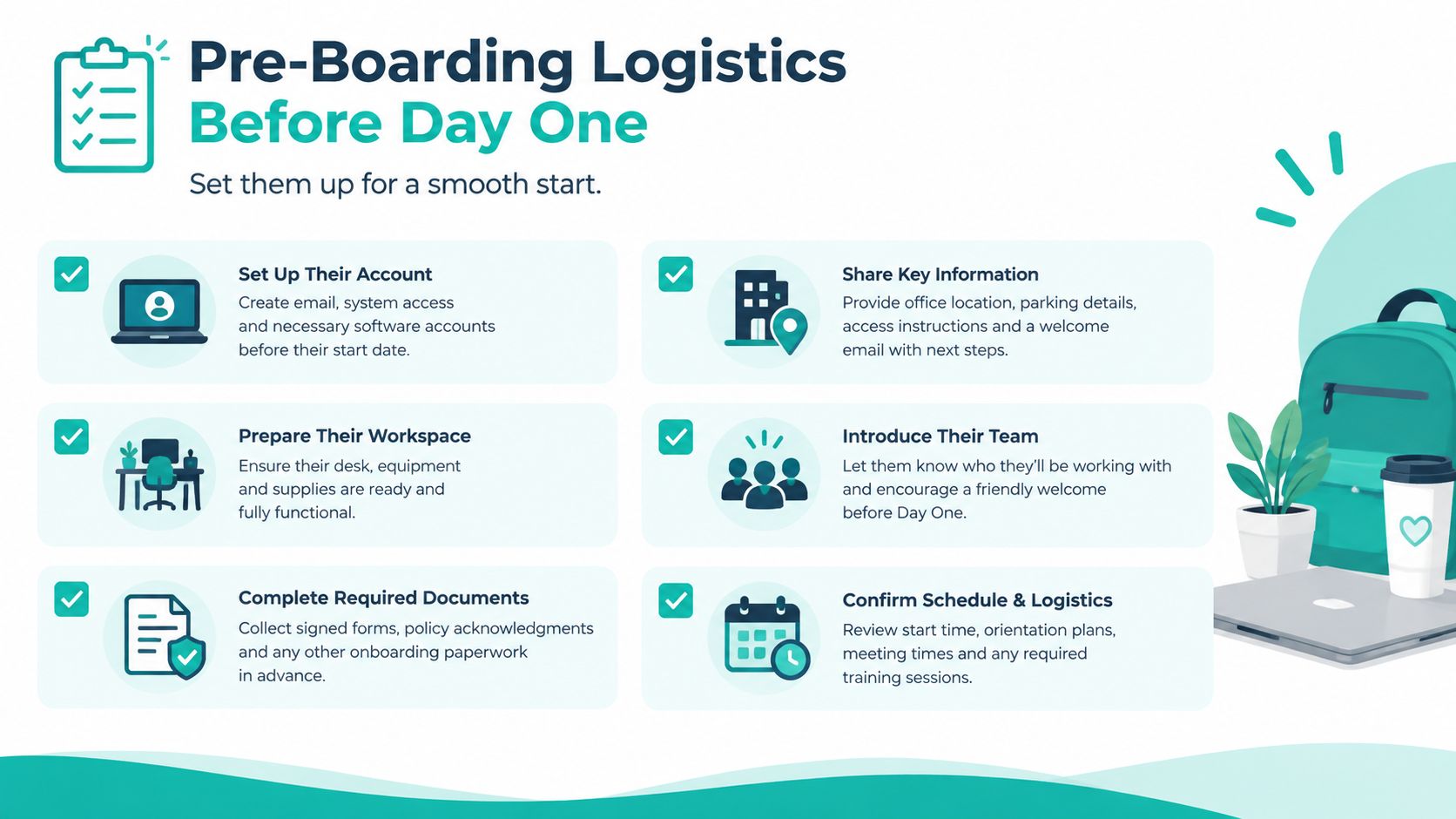
The welcome packet should include:
For customer-facing roles, a practical Overvue sales onboarding guide can help teams think about sequencing role knowledge, systems practice, and early contribution instead of treating training as one large event.
A realistic first week might look like this:
Don't script every hour. Over-scheduling makes capable people anxious and leaves no room to follow useful questions. Ship three dependable deliverables before day one, the laptop, the logins, and the week-one schedule. Save the rest for a conversation with the manager and buddy once the new hire's actual context is visible.
The first day should answer four questions in sequence: Am I expected here? Can I work? Who can help me? Can I contribute? A folder of forms answers none of them by itself.
Begin with arrival and welcome. A short personal note from the CEO or founder carries more meaning than a generic gift bag because it connects the hire to the company's current reality. The message should explain why the person was hired and what the team hopes they'll help change.
Next, assign a buddy for the first three hours. The manager shouldn't be the only guide. The buddy can walk through Slack channels, the deploy pipeline, the team's working conventions, and the practical question every new hire has but may hesitate to ask: how do people get help here?
Keep first-day introductions limited to six to eight people across relevant functions. Each conversation needs a stated purpose, such as learning the customer pain points, understanding the release process, or clarifying how product decisions reach engineering. A long parade of names creates social fatigue and gives nobody a reason to remember the conversation.
The manager's most valuable meeting is a 30-minute explanation of why the role exists. Cover the problem the hire was brought in to solve, what success will look like, what the team already knows, and where assumptions remain uncertain. Don't replace that conversation with a 60-minute product dump. Product knowledge matters, but it becomes useful only after the new hire understands the role's priorities.
End the day with a first small win. An engineer might open a small merge request, a product manager might draft a decision document, or a designer might produce a first version of a workflow. The work should be narrow enough to complete and meaningful enough to reveal how the team gives feedback.
Reserve 15 minutes for a day-one retrospective. Ask what surprised the new hire, what felt unclear, and what's missing from the setup. That feedback is inexpensive, specific, and available before a minor onboarding flaw becomes a trust problem.
A useful ramp has three phases: Learn, Contribute, Own. These labels work because they describe a change in responsibility, not an abstract competency score.
| Phase | New-hire focus | Manager checkpoint |
|---|---|---|
| Days 1 to 30, Learn | Absorb context, understand systems, and complete a small scoped task | Confirm role clarity, access, relationships, and remaining questions |
| Days 31 to 60, Contribute | Deliver independent work with light review | Assess scope, feedback quality, and growing judgment |
| Days 61 to 90, Own | Drive an outcome, recurring process, or meaningful area of responsibility | Confirm sustainable ownership and the next development goal |
The new hire should read the documentation that supports immediate work, shadow customer calls, pair with senior individual contributors, and ship a small fix or deliverable. The manager's job isn't to measure how much content the person consumed. It's to check whether the person can explain the customer problem, the team's priorities, and the path from idea to shipped work.
Hold manager 1:1s weekly during days 1 to 30. Each conversation should cover what the new hire learned, what remains confusing, which relationships need attention, and whether the assigned work is appropriately scoped.
The new hire might own a feature, run a meeting, deliver a defined product project, or take responsibility for a contained operational process. Review should be light but real. A manager who approves every decision creates dependency, while a manager who offers no feedback leaves the person guessing about quality.
Shift to biweekly 1:1s during days 31 to 60. Before each checkpoint, both people should answer:
Ownership means the new hire drives an outcome rather than completing assigned tasks. That might involve mentoring a peer, managing a recurring process, or becoming the clear owner of a customer or product problem. Hold monthly 1:1s during days 61 to 90, while keeping access to help open between meetings.

A structured ramp also protects against premature judgments. A source summarized by FirstHR's onboarding statistics says a structured program can reduce the time needed to reach competence from 8 to 12 months to 4 to 6 months. The startup-specific lesson is simple: define the evidence of progress before deciding that someone is or isn't ramping well.
Work model changes the information a new hire can access accidentally. In-office employees learn from overheard conversations, hallway questions, and visible whiteboards. Hybrid and remote employees need those same signals designed deliberately.
| Ritual | In-Office | Hybrid | Fully Remote |
|---|---|---|---|
| Context sharing | Office conversations and live whiteboarding | Capture in-person decisions for distributed colleagues | Record architecture, customer, and decision context |
| First-week connection | Team introductions and informal meals | Use intentional office days for shared activities | Schedule social touchpoints instead of waiting for spontaneity |
| Technical learning | Pairing at a desk | Combine live pairing with recorded walkthroughs | Use recorded Loom codebase tours and live follow-up |
| Questions | Ambient access to colleagues | Define where questions belong across locations | Give the hire a buddy for non-work questions and async support |
| Manager cadence | Short informal check-ins can supplement 1:1s | Protect equal access for remote days | Make 1:1s longer, more frequent, and more written |
Hybrid onboarding works when teams reserve in-person time for activities that benefit from presence, such as whiteboarding, a team lunch, and an office tour. During distributed weeks, make the default async-first. Written decisions, clear owners, and recorded explanations prevent the remote hire from becoming dependent on meeting attendance.
For a fully remote employee, document what an office-based hire would normally overhear. That includes architecture decisions, customer pain points, prioritization history, and the internal dynamics that affect how decisions get made. Don't document gossip. Do document the reasoning and constraints behind recurring choices.
A daily 15-minute team standup during the first two weeks gives the remote hire a predictable place to surface questions and hear current work. Pair that with Loom walkthroughs of the codebase and a peer buddy who can handle non-work questions, such as where people socialize, how time zones work, or which channels are noisy.
Managers should replace shoulder taps with written feedback and scheduled touchpoints. Teams refining their broader operating model can use guidance on remote work policies to clarify expectations around communication, availability, and collaboration. For the human side of distributed work, resources on tackling remote work burnout can help managers recognize when constant async communication is creating strain rather than flexibility.
A startup doesn't need an enterprise HRIS to identify onboarding risk. A shared spreadsheet can track whether a new hire is gaining access, context, confidence, and responsibility.
The important distinction is between activity and readiness. Training hours completed, documents opened, and meetings attended are easy to count, but they don't prove that the person can do the work or knows where to turn for help.
| Metric | When to Measure | Target | Failure Signal |
|---|---|---|---|
| Time to first commit | Early technical ramp | A small, reviewable contribution | Access, environment, or buddy support is blocked |
| Time to first deliverable | Early role ramp | A defined output appropriate to the role | Scope or expectations remain unclear |
| 30-day onboarding NPS | Weekly pulse through day 30 | Stable or improving confidence | Social or operational friction is increasing |
| 60-day manager satisfaction | Day 60 checkpoint | Manager sees independent progress | The role, scope, or feedback loop needs correction |
| 90-day retention probability | Day 90 conversation | New hire and manager see a credible future | Misalignment may become an exit risk |
If time to first commit or first deliverable is delayed, inspect the technical setup, task scope, and buddy pairing before evaluating motivation. If the 30-day onboarding NPS drops, ask whether the new hire lacks connection, context, or a clear point of contact. If the manager's day-60 assessment is weak, revisit the role definition instead of lowering expectations.
Track the data in one shared sheet with these columns:
The notes column is where the useful information lives. A low score caused by missing AWS access requires a different response from a low score caused by exclusion from product decisions.
For a broader hiring and onboarding measurement system, teams can reference quality-of-hire metrics. The goal isn't to create a dashboard for its own sake. It's to find at-risk hires at day 30, while the ramp can still be repaired, rather than waiting for an exit interview.
For startups with fewer than 100 people, onboarding quality often has more immediate retention value than another culture deck, a polished career-path document, or a small compensation adjustment. Those tools matter, but they can't compensate for a manager who disappears, a team that withholds context, or a new hire who spends the first month unsure what good work looks like.
The early experience compounds in three directions. Early connection makes it safer to ask questions. Early competence makes the role feel achievable. Early contribution gives the new hire evidence that the hiring decision was sound. When all three develop together, the employee can imagine a future at the company instead of merely surviving the first weeks.
A 2025 study summarized in this research record on onboarding and turnover intention found that organizational identification and workplace well-being mediate onboarding's relationship with turnover intention. It also identified differences in how managerial welcome and workplace well-being related to turnover intention across genders. The practical implication isn't to create separate onboarding programs. It's to avoid assuming that one welcome conversation satisfies everyone's need for support, belonging, and managerial attention.
Audit manager cadence. Sample 1:1 notes against the 30-60-90 milestones. Check whether each conversation addressed success, blockers, and needed help. Run the audit across one onboarding cycle, then scale the practice if it exposes missed checkpoints or unclear ownership that managers can correct with a standard template.
Test buddy rotation. Keep the initial buddy through day 14, then compare that arrangement with a rotation that introduces a second peer through day 45. Measure the new hire's questions, connection feedback, and first deliverable progress. Scale the rotation if the second peer expands access to context without creating duplicated guidance.
Use a practical ISU Insurance Services California playbook as an additional reference when reviewing retention practices, but keep the operating system specific to your team. Your onboarding process should evolve from observed friction, not from a static checklist.
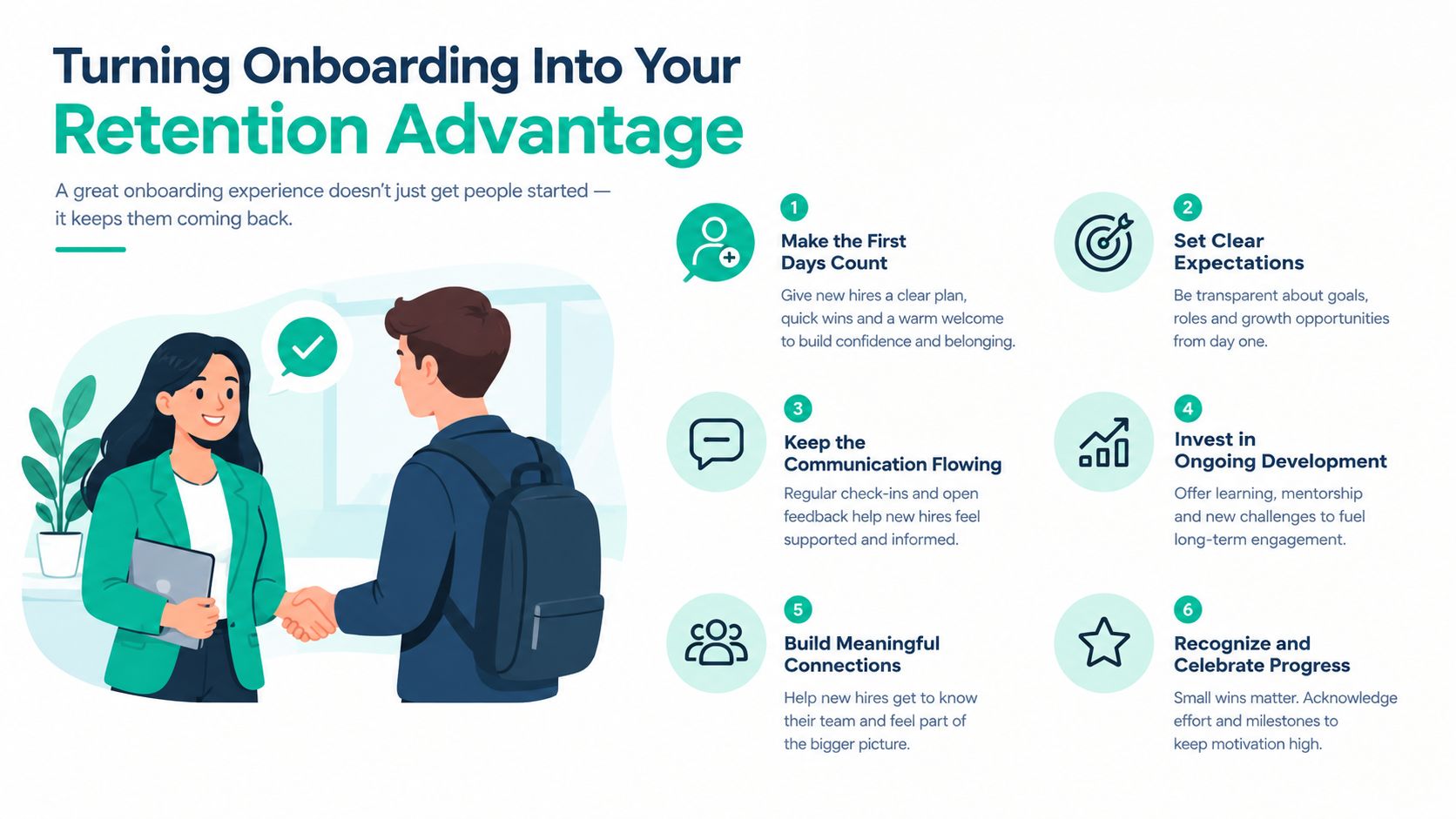
The most defensible retention advantage is the one managers practice every week. Document the rituals, measure whether they produce clarity and contribution, and keep improving the system after day one. Teams that want to connect hiring expectations with a sharper employee value proposition can also review these employee value proposition examples.
Underdog.io helps startups and high-growth tech firms connect with curated engineers, product managers, designers, and other startup talent, while its onboarding playbooks help teams turn a signed offer into a structured first quarter. Visit Underdog.io to explore the hiring marketplace and build a stronger path from candidate match to long-term retention.