You're probably hiring your next engineer while the product is still changing underneath you. One week, the founder is reviewing pull requests, deciding architecture, and talking to customers. The next, three engineers are stepping on the same service, nobody knows who owns production, and every new hire adds another meeting instead of more output.
That's the central problem in startup engineering team building. You aren't adding coding capacity. You're designing a system for making decisions, shipping software, learning from failures, and changing shape without losing speed. The right structure at two engineers can become a bottleneck at twelve, while a structure designed for forty can bury a five-person team in process.
A two-person startup may have one engineer choosing the architecture, shipping features, handling incidents, and answering customer questions. At fifteen engineers, the same arrangement creates queues, duplicated decisions, and unclear ownership. Startup engineering team building differs because each hire changes the coordination system, not just the amount of code the company can produce.
The first rule is direct: hire for the constraint you have now, not the organization you expect to build later. At the earliest stage, hire engineers who can move between discovery, implementation, debugging, deployment, and customer feedback. A narrow specialist can still be the right choice when a defined product or infrastructure problem blocks progress. Before that point, the hire usually adds handoffs while founders retain the integration work.
Range matters more than universal expertise. A small team needs enough coverage to own a product area, make sound tradeoffs, and recover from failures without waiting for another person to translate every decision.
An analysis of ISBSG software benchmark research connected engineering effectiveness with team size, development platform, programming language, and coordination costs. It reported that teams of nine or more were significantly less productive than smaller teams. For a startup, the practical conclusion is clear: add capacity only when the expected output exceeds the communication and coordination work that the new hire creates.
A product has users, constraints, interfaces, failure modes, and feedback loops. An engineering organization has the same operating requirements.
Define the users of the team first. Product managers need predictable delivery. Customers need reliable behavior. Engineers need clear decisions and workable systems. Operations needs explicit incident ownership. If a proposed hire does not improve one of these outcomes, define the role again before opening the search.
Then set the interfaces between roles. Who decides whether a feature ships? Who approves an architectural change? Who owns an incident after deployment? Who speaks with the customer when the system behaves unexpectedly? Unwritten answers turn routine work into founder-dependent coordination.
Practical rule: Every new engineer should make an important product decision easier, not merely add another person who can complete tickets.
Stage determines the right tradeoffs. With two to five engineers, shared context and fast decisions matter most. With five to fifteen, explicit ownership prevents duplicated work and stalled handoffs. With fifteen to forty, managers, interfaces, and planning systems keep separate groups from pursuing competing priorities.
Design each hiring decision around the coordination cost it removes. The team should become easier to steer as it grows, not merely larger.
A two-engineer startup should not copy the structure of a forty-engineer company. The right design is the smallest one that gives people clear ownership without creating meetings, handoffs, or approval queues. As noted earlier, distributed teams average about 8.7 members, close to the point where coordination can start reducing productivity. Treat that figure as a warning about communication load, not as a universal headcount limit.
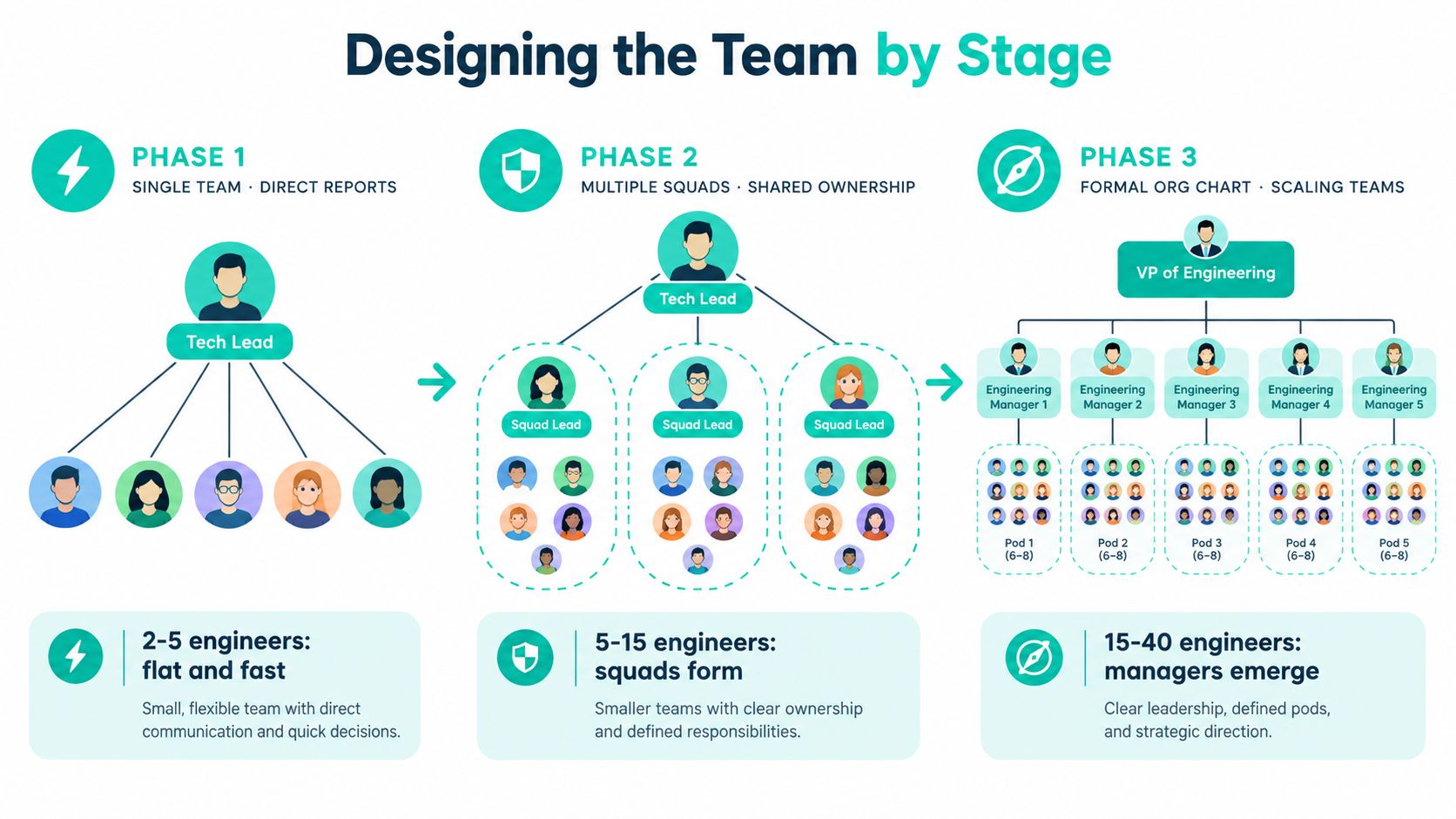
| Stage | Headcount | Structure | Ownership Model |
|---|---|---|---|
| Early product | 2 to 5 engineers | Flat team with one technical decision-maker | Shared context, direct collaboration |
| Emerging product areas | 5 to 15 engineers | Two or three small squads | Explicit product or service boundaries |
| Scaling organization | 15 to 40 engineers | Managed pods under engineering managers | Defined interfaces, delegated ownership |
At 2 to 5 engineers, keep the team flat. Choose one technical lead to resolve architecture and quality disputes, while avoiding a review gate for every pull request. Give each engineer a primary product area, but keep discovery, support, and incident response collaborative. The team is still small enough to make major decisions together. Creating departments at this stage adds labels before it adds capacity.
At 5 to 15 engineers, organize around product boundaries. A payments squad and a customer-workflow squad usually create less coordination than separate backend and frontend groups, because each team can own an outcome from design through operation. Assign each squad a lead for technical direction and coordination. Keep management light, and record the interfaces where one squad depends on another.
At 15 to 40 engineers, introduce engineering managers when one leader can no longer retain useful context across the whole group. Each pod needs a manageable ownership area, a clear priority source, and a defined route for resolving conflicts. Managers should reduce competing requests and protect delivery time, not add status layers.
Software's history supports this progression. A historical account of software engineering traces the shift from individual programming in the 1960s to small teams in the 1970s, larger coordinated projects in the 1980s, and highly integrated systems by the 1990s. As systems became more connected, requirements alignment, documentation, architecture communication, and role clarity became engineering work rather than optional administration.
Write four rules for every squad or pod:
Use this guide to startup engineering team structure as a reference, then adapt it to your product architecture. A copied org chart will not solve unclear ownership. Visible boundaries will. Add a layer only when it removes a specific coordination problem created by the current stage and headcount.
A headcount target is not a hiring plan. “We need five more engineers” says nothing about the work those people will own, the bottleneck they'll remove, or the skills that matter at the current stage.
Start with the next product milestone. Write the capability the company must gain, then identify the smallest role that can create it. If the milestone is a reliable self-service onboarding flow, the first hire may be a product-minded full-stack engineer who can work across the application, analytics, and customer feedback loop. If the milestone is stable enterprise deployment, you may need deeper infrastructure and security experience.
A useful scorecard has three layers:
Keep the first hires generalist-heavy unless the product has a genuine specialist constraint. As the team grows, add specialists when a repeated bottleneck justifies the coordination cost. A specialist should arrive with a clearly bounded problem, not a vague promise to “raise the technical bar.”
A practical hiring plan also includes the founder's available time. If interviews, references, and onboarding already consume the people responsible for product delivery, you may need a specialized partner for access to passive candidates. A firm such as nexusITgroup.com can extend an internal search for specific technical roles, but the hiring manager still owns the scorecard and final decision.
Headcount affects more than engineering. Office planning, equipment, meeting space, and collaboration patterns change as the team grows. Tandem Space's guide to calculating office square footage for a scaling team offers useful context for connecting staffing assumptions with workplace planning.
Use a simple milestone table internally:
| Milestone | Constraint | First role to consider | Proof of success |
|---|---|---|---|
| Ship a core workflow | Limited product capacity | Product-minded generalist | Workflow reaches production |
| Support multiple product areas | Ownership collisions | Squad lead or senior engineer | Fewer cross-team blockers |
| Improve reliability | Operational risk | Infrastructure-focused engineer | Clearer incident ownership |
| Expand customer complexity | Domain depth | Specialist with defined mandate | Fewer recurring domain escalations |
Document the reasoning in a recruitment planning framework. The plan should survive a busy week. If the rationale exists only in the founder's head, recruiting will drift toward whichever impressive candidate appears first.
Technical interviews fail when they test an abstract version of the job. A startup senior engineer won't spend every day solving isolated algorithm puzzles. They'll make tradeoffs, investigate incomplete failures, explain decisions, review other people's work, and decide what not to build.
A strong loop mirrors that reality. For a senior engineer, I'd use four signals: system design, debugging, collaboration, and product judgment. Keep the interviewers independent, then debrief from written evidence rather than charisma.
For system design, ask: “Design the first version of a service that supports our most important customer workflow. What would you build now, what would you defer, and what failure would worry you most?”
A strong answer starts by clarifying the user and operational requirements. The candidate identifies a narrow first version, explains tradeoffs, and names how the system will be observed and changed. A weak answer jumps into infrastructure components without defining the product behavior.
For debugging, give the candidate a realistic failure report: “Customers can complete the first step, but some requests fail after a deployment. Walk me through your investigation.”
Look for a deliberate sequence. Strong candidates narrow the scope, check recent changes, inspect logs and metrics, reproduce the behavior, and communicate the risk while investigating. Red flags include changing several things at once, blaming another team before gathering evidence, or treating rollback as the only possible answer.
For collaboration, ask: “Tell me about a design disagreement where you changed your position. What evidence moved you?”
You're not looking for submission or aggressive debate. You're looking for someone who can separate identity from a technical decision, make disagreement observable, and leave the relationship intact.
For product judgment, ask: “A customer wants a complex feature that would delay a simpler improvement used by many customers. How would you decide?”
The strongest answer considers customer value, strategic importance, implementation cost, reversibility, and learning speed. It doesn't pretend the decision can be made from engineering effort alone.
A take-home should resemble a bounded work sample, not unpaid product development. Give the candidate a small repository or a clearly described scenario, define what you'll evaluate, and allow them to explain what they'd do with more time. Review the approach, tests, tradeoffs, and written communication, not just whether the code runs.
Use a structured interview rubric such as the one described in structured interview techniques for hiring teams. Each interviewer should submit evidence before the panel discussion. The hiring manager should ask, “What did we directly observe?” before allowing impressions such as “not senior enough” or “great culture fit.”
A no-hire decision should identify the missing signal. If the panel can't state what evidence would have changed the decision, the process is measuring instinct rather than readiness.
Onboarding is where a startup decides whether knowledge belongs to the team or to a few exhausted people. A new engineer who spends the first weeks asking where repositories, deployment procedures, architecture decisions, and customer context live will consume senior attention before writing useful code.
GitLab's remote onboarding guidance provides a concrete model. Its handbook contains more than 2,000 searchable pages, its onboarding process takes at least two full weeks, and the third week is reserved for team-specific onboarding and training, as described in GitLab's onboarding handbook. A smaller startup doesn't need that volume. It does need the same principle: make recurring knowledge searchable and turn onboarding into assigned work.
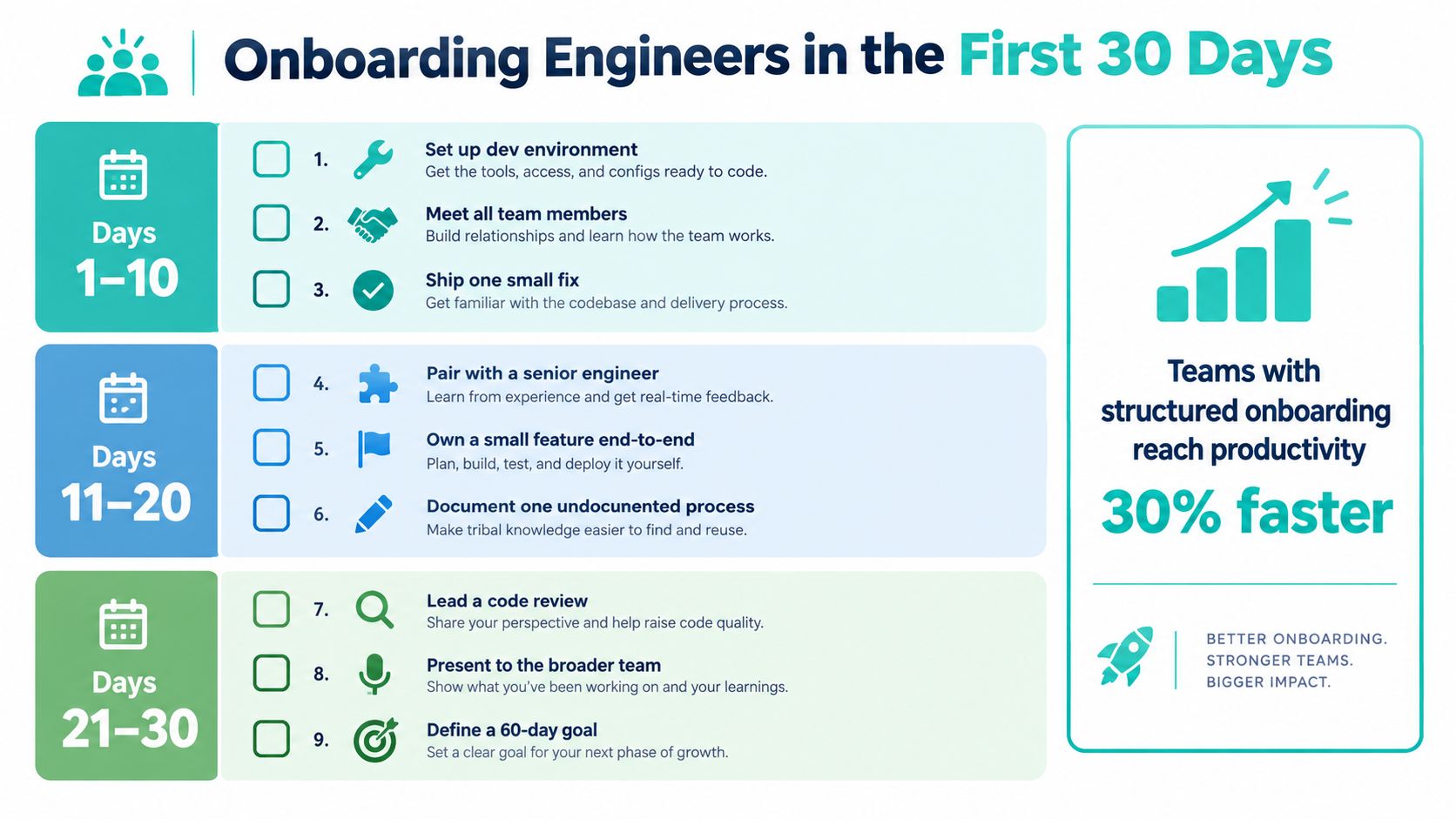
Day 1 should cover accounts, repositories, communication channels, development setup, and the person responsible for unblocking access. Don't make the new hire discover the system through random messages.
On Day 2, introduce the product, customer, roadmap, and team norms. On Day 3, cover security, deployment permissions, incident expectations, and data handling. On Day 4, schedule social introductions and explain how the team makes decisions. Day 5 should include a small Git change, a code review, and a guided production architecture walkthrough.
By the end of this phase, the engineer should have:
During the next phase, pair the new engineer with a senior teammate on a real bug or narrow feature. The senior engineer should explain decisions, not take over the keyboard. Assign one undocumented process for the new hire to improve, because documentation reveals where the team's own understanding is weak.
By Day 30, the engineer should own a small ship-worthy task end to end. That includes clarifying the requirement, proposing an approach, writing tests, opening the pull request, responding to review, deploying safely, and documenting the result.
Create the onboarding issue before the start date. Give every task an owner and due date, then review progress in one-on-ones. A 30-60-90 plan can extend the sequence, but don't postpone contribution until a later milestone. Early ownership builds context faster than passive observation.
Retention doesn't come from snacks or vague promises about culture. Engineers stay when they can see their impact, understand what they own, grow their judgment, and raise problems without being punished for making reality visible.
That requires three systems working together: psychological safety, delivery measurement, and deliberate AI use. Google's team-effectiveness research identified psychological safety, the belief that interpersonal risk-taking is safe, as the strongest distinguishing factor among effective teams. The research also reported that stronger team cultures were less likely to lose members, better able to use diverse ideas, higher in revenue contribution, and twice as likely to be rated effective by executives, as documented in Google's team-effectiveness research.
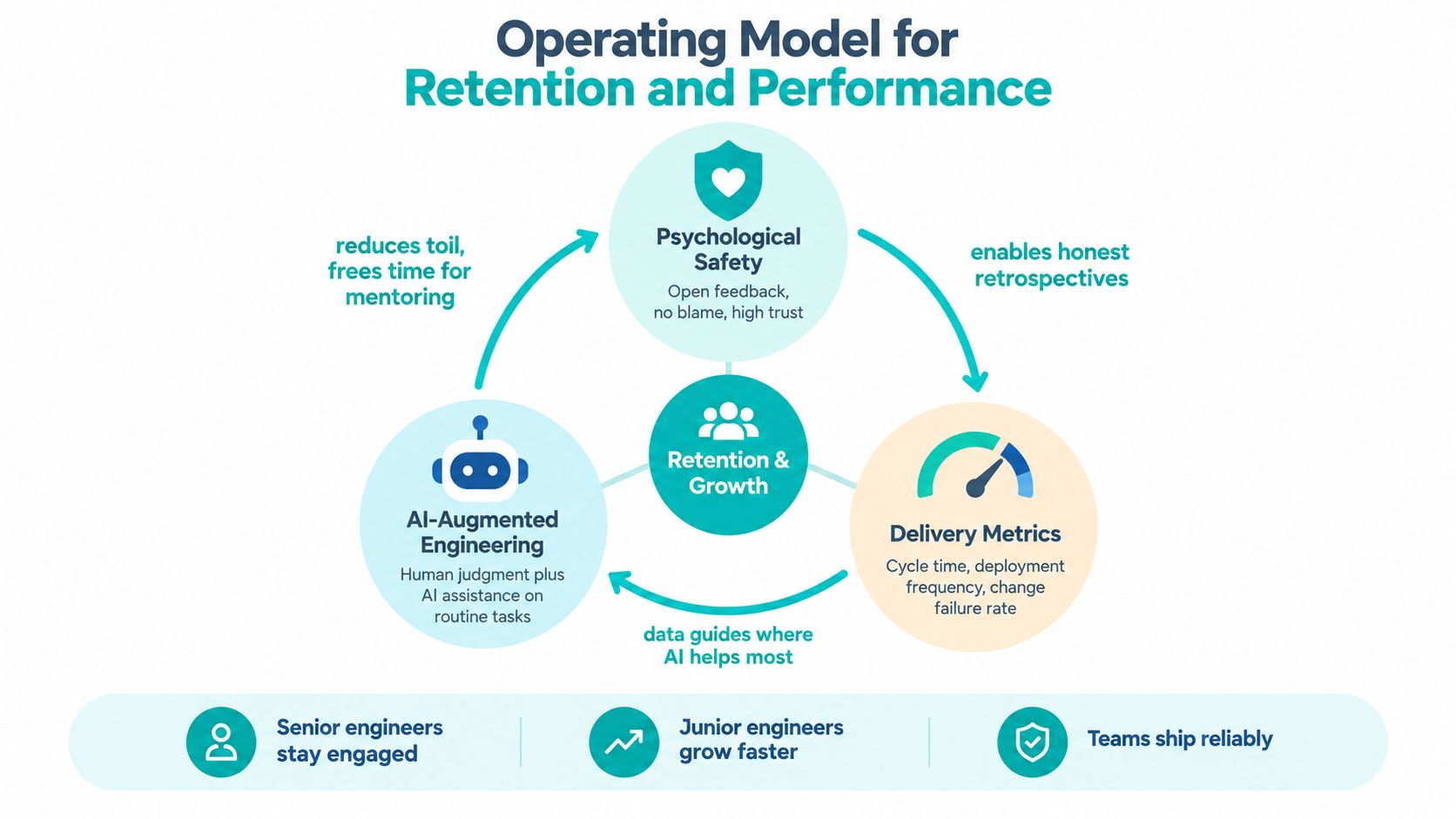
Set norms during onboarding for asking questions, challenging designs, reporting mistakes, and disagreeing with senior people. In design reviews, require a written decision record and explicitly ask for dissenting risks. In retrospectives, investigate system causes before discussing individual blame.
Use one-on-ones to ask whether people can raise bad news without social or career penalties. Track anonymous signals quarterly, including whether team members can admit mistakes, request help, and propose unconventional ideas. A friendly team isn't automatically a safe team. Leaders must model fallibility and visibly close the loop on concerns.
DORA recommends baselining five delivery measures: change lead time, deployment frequency, failed-deployment recovery time, change-fail rate, and deployment rework rate. DORA's metrics guide defines change lead time from code commit to successful production deployment, change-fail rate as deployments requiring immediate intervention such as rollback or hotfix, and rework rate as unplanned production-fix work.
Review trends weekly or biweekly at team level, segmenting by service so averages don't conceal a bottleneck. Improve the limiting constraint. Automate testing when lead time is the problem, strengthen observability when recovery takes too long, and reduce batch size when failures have a large impact.
DORA's research finds that speed and stability are positively correlated, not opposing goals. Don't use story points or lines of code as performance targets. Pair delivery outcomes with reliability, and check that improvement isn't coming from unhealthy overtime.
A 2025 survey of 883 engineering leaders found that 66% had adopted AI tools in production and 59% perceived productivity gains, while 26% couldn't quantify impact and 85% cited a lack of metrics, according to The AI Impact Report. The same report found that productivity gains above 10% were most common among organizations with fewer than five engineers.
Those findings point to an operating gap, not a reason to chase tools. Define which tasks AI can assist with, who reviews output, what tests are mandatory, and which decisions remain human-owned. Let junior engineers use AI for exploration with close review, while senior engineers establish patterns, validate architecture, and improve the team's feedback loops.
The contrarian conclusion is the useful one: AI raises the value of experienced engineers when implementation gets faster. Someone still needs to define intent, identify hidden risk, evaluate system behavior, and coordinate decisions across the product. Coding speed matters less when the team can generate code faster than it can judge whether the code belongs in production.
The highest-impact hires aren't always the most senior people. They're the people who remove the constraint your current stage creates.
The order can change. The principle shouldn't. Tie each role to a milestone, define its ownership boundary, and write the evidence you'll use to evaluate candidates before interviews begin.
Don't delay documentation, decision records, or delivery measurement until the team feels larger. Those habits are cheapest to establish while the group is small. Write down your next three engineering hires this week, the product milestones they support, and the scorecard for each role. Then schedule the first interview before another urgent feature pushes the plan aside.
Underdog.io helps startups connect with curated, pre-vetted engineering candidates across technologies such as Go, Ruby, Python, React, Node.js, and Rust, with role requirements and stack preferences used to support matching. Visit Underdog.io if you want a more focused way to build the next stage of your engineering team.