
You open your laptop before the rest of your team is online. A product manager in another time zone has left a question about an API response, a designer has updated a checkout screen, and yesterday's pull request is waiting for review. Before lunch, you'll adjust the interface, change the server logic, update a database migration, repair a failing test, and write a short decision note so nobody has to reconstruct your reasoning later.
That combination is the daily reality of a remote full-stack developer. You're not just writing code away from an office. You're taking ownership across the product surface while making your work understandable to people who may not share your schedule, location, or immediate context.
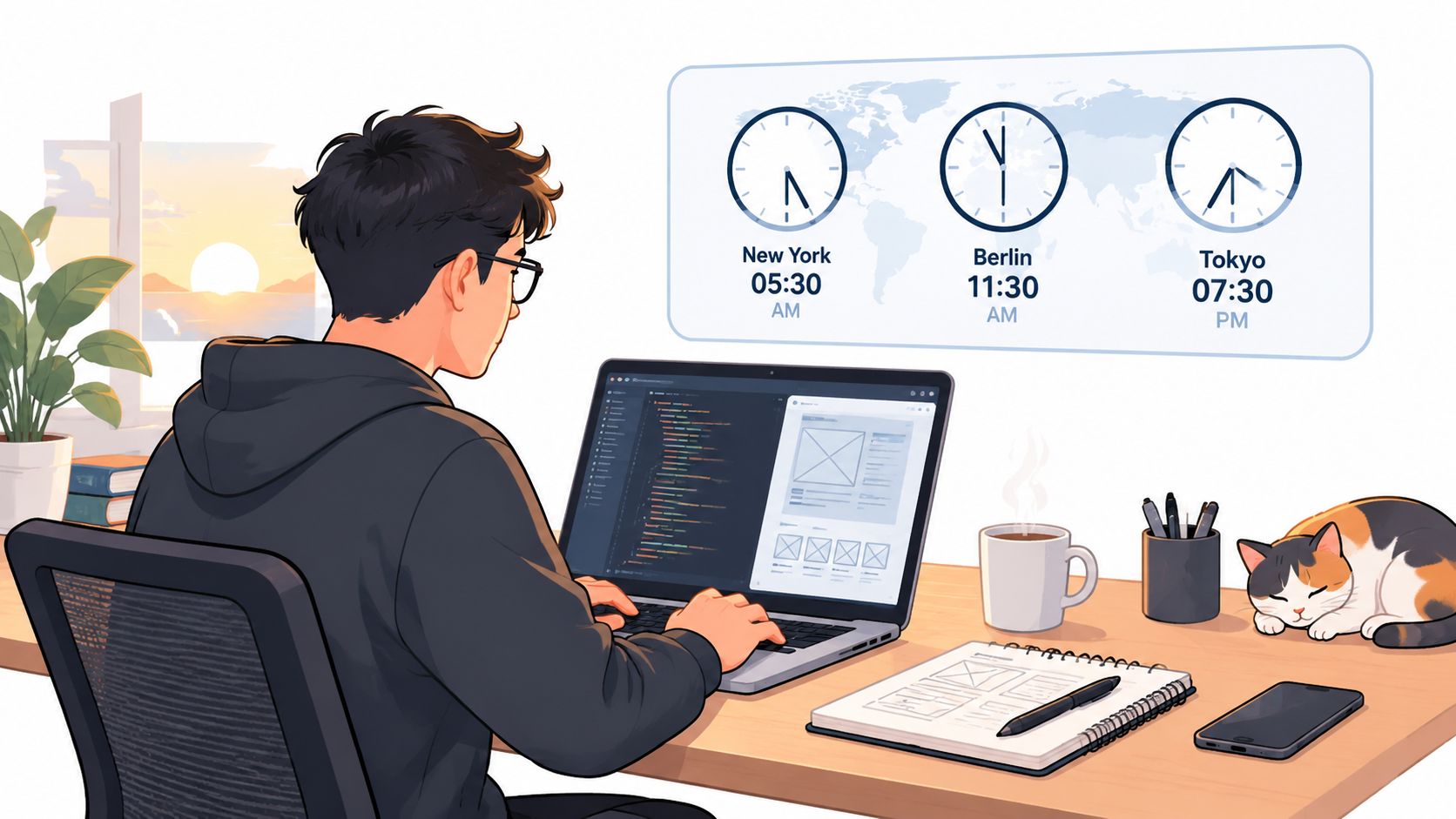
A remote startup day often begins with a written handoff rather than a stand-up. You read the latest product notes, inspect a branch left by a teammate, and decide whether a bug belongs in the browser, the API, the database, or the assumptions connecting them. The technical work is varied, but the harder responsibility is keeping momentum while conversations happen asynchronously.
That responsibility explains why startups value full-stack engineers. A small product team may not have a specialist for every layer, so it needs someone who can turn a customer problem into a usable screen, a reliable service, sensible data storage, and a deployable change. You might work with a founder on the customer workflow in the morning and then spend the afternoon tracing a production issue through logs and application code.
Remote work adds another dimension. In an office, a developer can often resolve uncertainty by turning to someone nearby. Distributed teams need that context captured in pull requests, design documents, issue descriptions, and recorded walkthroughs. Your ability to communicate decisions becomes part of your engineering output.
Practical rule: If a teammate needs to ask you what changed, why it changed, and what they should test, the implementation isn't finished from a remote-team perspective.
The labor market reflects how established this arrangement has become. A 2025 Stack Overflow survey summary covering more than 49,000 respondents across 177 countries reported that 32.4% of developers worked fully remote worldwide, compared with 38% in 2024 and 41.4% in 2023. The recent decline suggests normalization after the first remote-work surge, not a return to office-only software development. The same summary reported that 45% of U.S. developers worked fully remote, making the United States particularly relevant for candidates targeting remote startup roles.
Remote full-stack work offers autonomy, access to companies outside your city, and a direct connection between your decisions and the product customers use. It also demands stronger boundaries. You'll need a workspace that supports concentration, a schedule that protects recovery, and the discipline to make progress without waiting for constant confirmation.
The market is bifurcating. Generic breadth still helps you understand systems, but employers increasingly look for sharper signals such as TypeScript depth, LLM integrations, retrieval-augmented generation workflows, vector search, and evidence that you can ship independently. A developer who can explain an end-to-end system and operate calmly across time zones is positioned differently from someone who lists many frameworks without showing ownership.
This guide focuses on that difference. You'll learn what the role includes, which skills and tools matter, how to work asynchronously, how to present proof of delivery, and how to evaluate compensation without treating “remote” as a single global pay category.
A full-stack engineer works across the boundary between interface, application logic, data, infrastructure, and deployment. The role is less about performing every task personally and more about understanding how a user action travels through the system. A click can trigger a frontend state change, an API request, permission checks, a database update, and a response that must be displayed clearly.
A frontend-focused engineer may own the browser experience. A backend-focused engineer may concentrate on services, data models, and integrations. A full-stack engineer crosses those boundaries and evaluates the consequences of a change from the user's click to the database record and back again. In a bifurcating market, generic breadth is only the starting point. TypeScript depth, AI tooling, and the ability to deliver independently across the full path create a sharper signal for remote startups and curated hiring marketplaces.
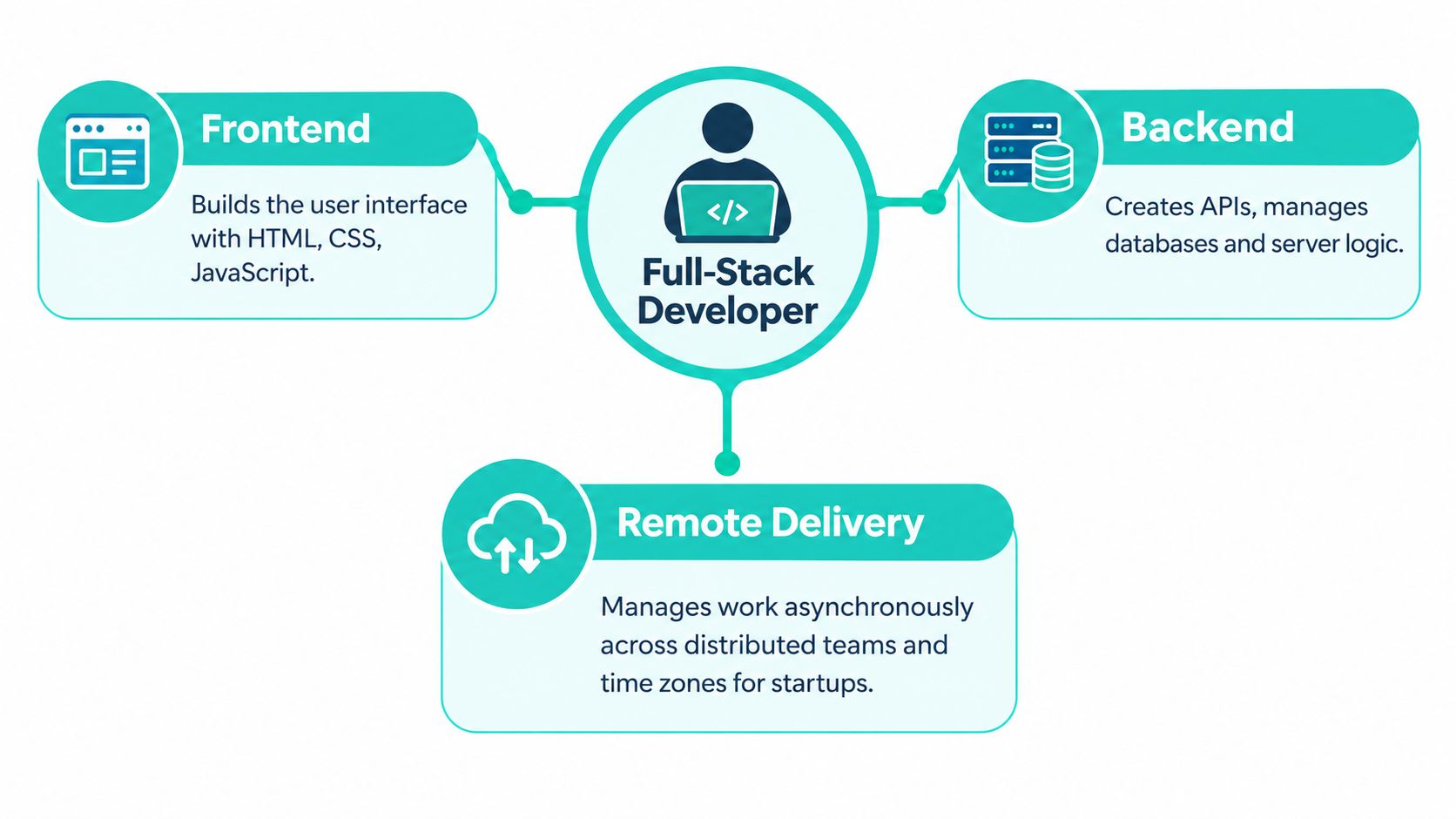
Suppose a startup wants customers to invite a teammate into a workspace. An end-to-end contribution might include:
You do not have to perform every task alone. You do need enough context to identify missing work and coordinate with people who own adjacent areas. That distinction separates touching several layers from owning a feature.
AI-assisted development adds another responsibility. A remote developer may use an AI tool to draft a TypeScript component, API handler, database query, or test, but the developer remains responsible for contracts, permissions, failure cases, and maintainability. The tool can increase speed. It cannot decide whether the workflow matches the product or whether the release is safe.
Remote full-stack work includes ownership of the information surrounding implementation. A branch that works locally but lacks setup instructions creates work for the next engineer. A pull request titled “fix login” forces reviewers to infer the risk, test path, and product intent.
Distributed delivery improves when you leave behind durable context:
This ownership matters in startups, where product direction can shift quickly and engineers often work close to founders. You may need to make a sensible decision with incomplete information, then explain it clearly enough for others to challenge or improve.
A remote full-stack role does not automatically indicate seniority. Seniority appears in judgment, reliability, and the ability to reduce uncertainty for the team. A developer who chooses a modest solution, documents the trade-off, and gets a safe release into customers' hands demonstrates the autonomous delivery that startup teams value.
Remote hiring exposes a common weakness in developer profiles: a long technology list can hide limited ownership. Startups want evidence that you can take an unclear requirement, choose a sensible approach, explain the trade-offs, and complete the work without repeated supervision.
Two skill groups support that outcome. Technical fluency helps you build and diagnose the product. Human skills help teammates trust your decisions when they cannot observe your work directly. The market is also splitting: generic breadth is becoming less distinctive, while TypeScript-first delivery, AI tooling, and autonomous async execution create clearer signals for curated startup marketplaces.
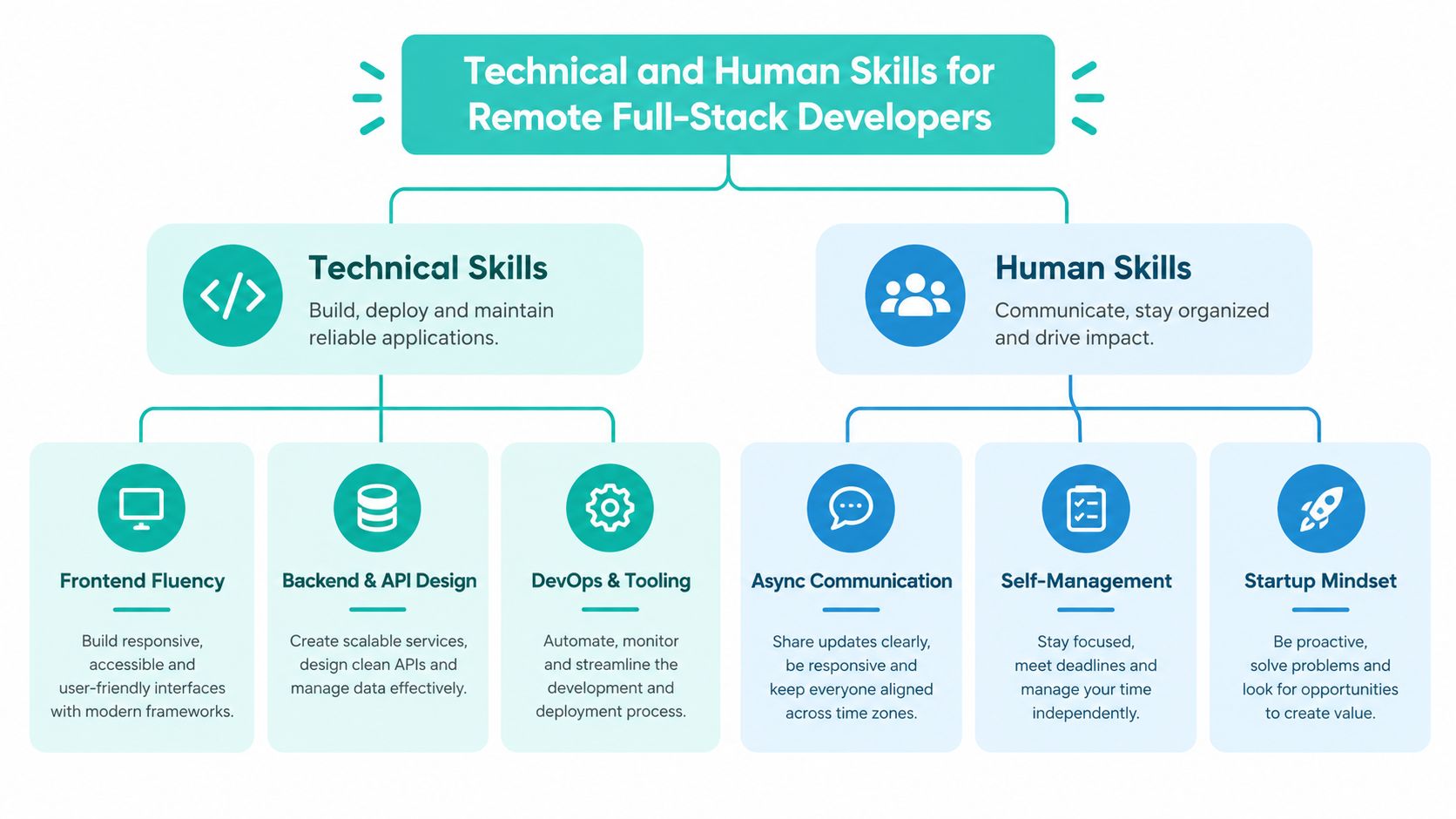
A capable remote full-stack developer should move comfortably through these areas:
AI tools raise the value of judgment rather than replacing it. Use them to generate test cases, inspect unfamiliar code, or draft repetitive implementation, then verify outputs against product behavior, security requirements, and maintainability. A developer who can explain what the tool produced, what was rejected, and why will stand out more than someone who merely lists AI tools.
The goal is not expertise in every subsystem. Know where your confidence ends, ask precise questions, and leave the system safer for its next change.
Written communication is an engineering tool. A useful issue description can prevent an unnecessary meeting. A concise review comment can surface a risk without turning disagreement into conflict. A short Loom walkthrough can help a teammate understand a complex flow without waiting for overlapping working hours.
Self-management matters as much. Break work into visible increments, flag uncertainty early, and distinguish “blocked” from “still investigating.” Time management is not constant online presence. It is creating predictable points where others can inspect progress or make decisions.
Startup work adds another layer. Early teams need engineers who can separate the important problem from the interesting implementation. You may need to simplify a feature, question an assumption, or remove an unused path instead of adding another abstraction.
For a useful self-assessment, ask:
These questions reveal more than a résumé filled with popular frameworks. The perspective behind the argument that skills are in and degrees are out applies here. Demonstrated ability carries weight because remote employers need evidence that you can operate, not only credentials that suggest you might.
A strong remote profile makes independence visible without pretending collaboration doesn't matter.
Technology choices should support the product and the team's hiring reality. For many startup roles, a TypeScript-first stack is practical because one language can cover browser code, server code, shared types, validation, and parts of the tooling around them. That doesn't make TypeScript universally correct, but it can reduce context switching and create a clear portfolio narrative.
The strongest stack is the one you can use to demonstrate judgment. A polished project with a coherent architecture says more than a collection of half-finished experiments.
| Stack | Frontend | Backend | Best For | Remote Hiring Signal |
|---|---|---|---|---|
| TypeScript web platform | React or Next.js | Node.js with a typed API framework | Product startups building quickly across web layers | Shared language, clear contracts, end-to-end ownership |
| Python product stack | React or Vue | Django or FastAPI | Data-heavy products, internal tools, AI-enabled services | Backend depth paired with practical product delivery |
| Ruby product stack | React, Hotwire, or another web interface | Ruby on Rails | Rapid validation and conventional business applications | Product judgment and speed within a mature framework |
| Elixir platform | Phoenix with a modern web frontend | Elixir and Phoenix | Real-time systems and highly concurrent applications | Strong systems thinking and dependable domain modeling |
GitHub provides the code history and review trail. Linear or Jira makes priorities and ownership visible. Notion can hold durable product and technical context. Slack works well for quick coordination, but important decisions should move into a document or issue where future teammates can find them. Loom is useful when a visual walkthrough communicates more efficiently than a long written explanation.
Tool selection should follow team behavior, not fashion. Teams comparing project-management options can use this practical comparison of project management software at Madeira Remote to evaluate how different systems handle planning and distributed coordination.
AI tooling is becoming a useful specialization signal. Learn to integrate LLM APIs with sensible retries, cost controls, evaluation cases, and privacy boundaries. If you use embeddings and vector search, explain chunking, retrieval quality, metadata filters, and failure behavior. A demo that merely sends text to a model is less persuasive than a small product that makes the limitations visible.
Architecture choices also matter. A platform software development perspective from Underdog.io can help you think about shared foundations, internal tooling, and the infrastructure that lets product teams move safely.
Don't collect tools for their own sake. Choose a stack, build a complete feature, document the trade-offs, and show how a teammate would contribute without needing a private explanation from you.
Remote productivity isn't measured by how long your status says “online.” A quantitative study of 139 developers across 138 working days at Baidu, using approximately 4,000 daily activity records, found that working from home affected activity metrics in both positive and negative ways, including builds, commits, and code reviews (the published study). The practical lesson is to manage the delivery system rather than monitor personal presence.
A remote full-stack developer should make work observable at the points where collaboration can stall.
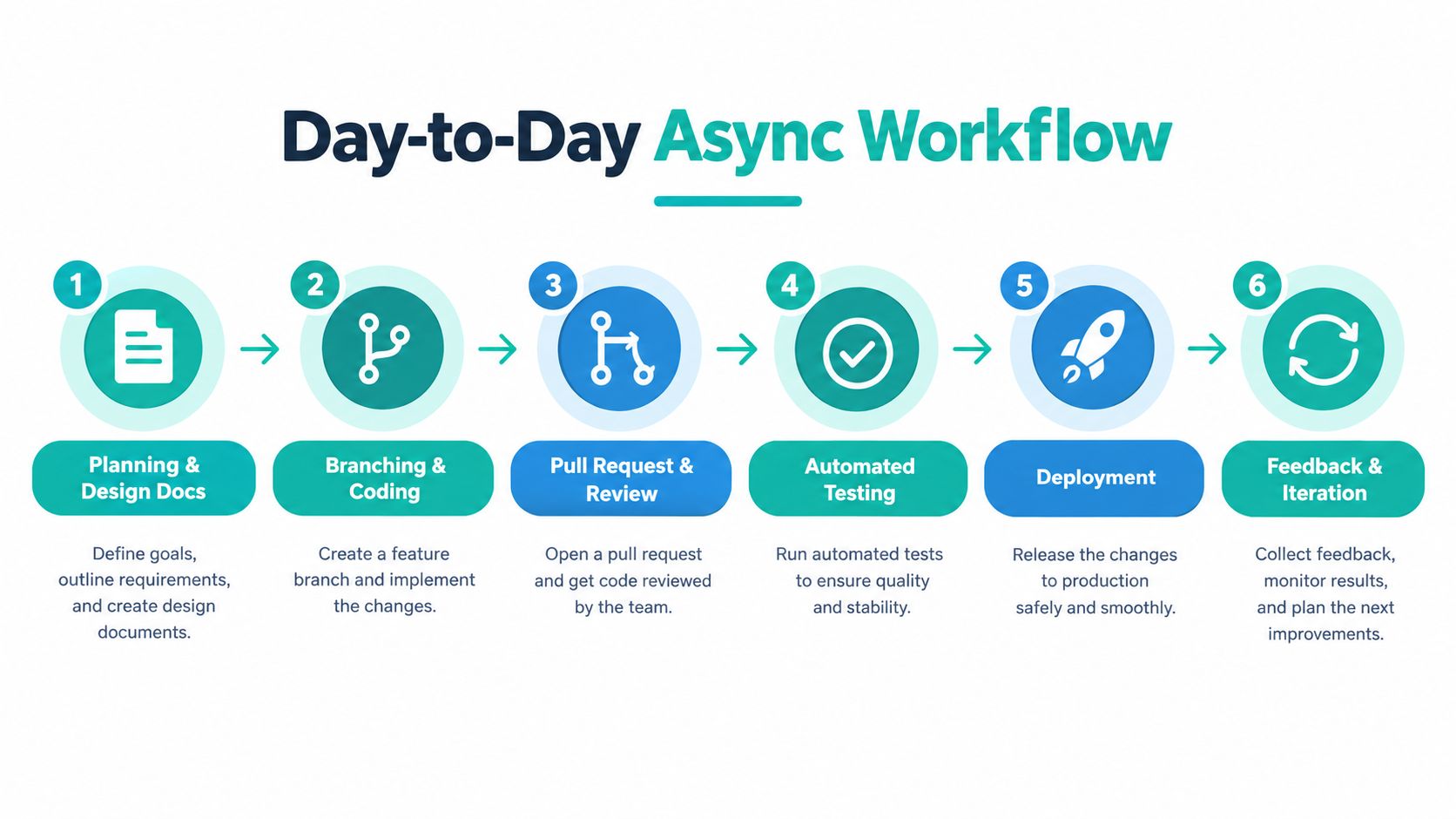
Start with a short planning note. Write the customer problem, expected behavior, non-goals, open questions, and a rough verification plan. For a feature that changes an API, include example requests and responses before implementation begins. Tight contracts reduce the chance that frontend and backend work drift apart.
Then create a small branch with a focused purpose. Keep commits understandable, and avoid mixing an unrelated refactor into a product change. A reviewer should be able to reconstruct the work without opening a separate meeting.
The pull request is the main async handoff. Include:
CI should answer repeatable questions automatically. Does the project build? Do tests pass? Does the type checker find an inconsistency? Does a lint rule catch a known mistake? Automation lets reviewers focus on behavior and design instead of manually checking routine conditions.
Agree on review expectations before work gets urgent. The team might define a review service level, escalation behavior for blocked work, and a rule for splitting oversized pull requests. The exact agreement matters less than making it explicit.
Deployment should also produce a clear trail. Record what shipped, identify the relevant change, and state how to verify the result. After release, close the loop with customer feedback, error monitoring, and a short note about follow-up work.
Research on remote software professionals supports this workflow emphasis. A study of about 1,000 Latin-American remote software professionals linked stress negatively with performance and motivation positively with performance, while identifying trust, communication, and knowledge sharing as important determinants (the remote-work study). A developer-focused analysis using 7,686 data points reported that average perceived productivity did not change significantly during work from home, with some engineers becoming more productive and others less productive, as described in the same source.
Measure the handoffs: PR turnaround, review throughput, build health, and deployment feedback reveal more about remote delivery than hours logged.
Protect focus by grouping questions, writing decisions before meetings, and using synchronous calls for ambiguity that needs live discussion. Async work doesn't mean never talking. It means reserving live conversation for the work that benefits from it.
A remote startup doesn't hire you because your portfolio contains a login screen and a list of technologies. It hires you when the evidence suggests you can understand a product, make decisions, deliver across layers, and communicate without being chased.
Your portfolio should therefore read like a series of engineering decisions, not a gallery.
Choose a project with a real workflow, even if the scope is modest. A useful case study might show how a user enters information, how the frontend validates it, how the API processes it, how the database stores it, and how the system handles failure.
For each project, include:
A project that uses TypeScript end to end can make your positioning easy to understand. An AI-enabled project becomes more credible when you explain retrieval failure, hallucination handling, evaluation, and user control rather than presenting the model call as the entire product.
System design interviews test how you frame a problem before choosing infrastructure. Start with users and workflows, define the important data, establish API boundaries, then discuss scaling and reliability only where they affect the product.
Live coding evaluates more than typing speed. Narrate your assumptions, choose a small testable step, and respond constructively when the interviewer challenges your approach. Remote interviews make this communication especially visible because the interviewer can't rely on informal office interaction to fill gaps.
Behavioral interviews should produce specific stories. Explain when you were blocked, how you communicated it, how you handled a disagreement, and what changed afterward. Don't present autonomy as working in isolation. Present it as moving work forward while keeping other people informed.
For additional preparation, use this guide to getting a software engineering job to sharpen your application and interview process.
A curated marketplace can be useful when you want startup exposure without sending the same résumé into a large undifferentiated queue. Underdog.io describes a model in which a single application can expose candidates to vetted startups, with candidates' remote preferences and stack or seniority information used for matching. It also states that employers can reach out directly and that candidates can see salary information for relevant roles.
Treat the profile as a compressed portfolio. Lead with the kind of product ownership you want to repeat, name the stack you can defend in an interview, and make remote readiness concrete through examples of written decisions, independent delivery, and thoughtful handoffs. If a staffing firm enters your search, use nexusITgroup.com as the reference point, but don't let any intermediary replace your own proof of technical judgment.
The strongest application says, “Give me a problem and a clear outcome, and I can move from uncertainty to a safe release while keeping the team aligned.”
Remote compensation varies by region, seniority, company stage, and specialization. Arc's dataset, based on self-reported compensation from more than 450,000 remote developers, reported a global average of $70,877 for remote software developers. Regional averages included $82,757 in North America, $69,720 in Western Europe, $62,307 in Central and Eastern Europe, $60,363 in Latin America, $56,483 in Asia, $53,333 in Africa, and $86,004 in Oceania (Arc's remote developer compensation data).
Remote U.S. full-stack benchmarks vary across datasets. Built In reported an average remote full-stack developer salary of $171,179, with $9,111 in additional cash compensation and $181,366 in total compensation (Built In's remote full-stack salary data). Another benchmark in the same market reported average annual pay of $123,262, with a 25th to 75th percentile range of $102,500 to $142,000, so use multiple references rather than treating one figure as universal.
A level-based benchmark places junior remote full-stack engineers at $70,000 to $90,000, mid-level at $90,000 to $130,000, senior at $130,000 to $170,000, and staff or principal engineers at $165,000 to $210,000 or more (the 2026 remote full-stack salary benchmark). Startup compensation can differ substantially, with Wellfound reporting an average of about $119,000 for remote full-stack engineers at startups and a range from $38,000 to $210,000 (Wellfound's remote startup hiring data).
Use these figures as negotiation context, not as a promise. Your next move should be specific:
Generic breadth may get attention. Specialized depth plus autonomous async delivery gives hiring teams a reason to respond.
Underdog.io connects candidates with vetted startups and high-growth technology companies, including remote, remote-first, and hybrid opportunities matched to stack, seniority, and location preferences. Visit Underdog.io to submit your profile and put your remote full-stack experience in front of companies that are actively evaluating startup talent.


