Trying to nail down a competitive Java developer salary can feel like hitting a moving target. You might hear that a strong offer should easily top $145,000 in base pay, with total compensation packages pushing past $190,000 once bonuses are factored in. But that's just the headline number.
Your actual earnings are a mix of your specific skills, how many years you’ve been in the game, and, of course, where you're based.
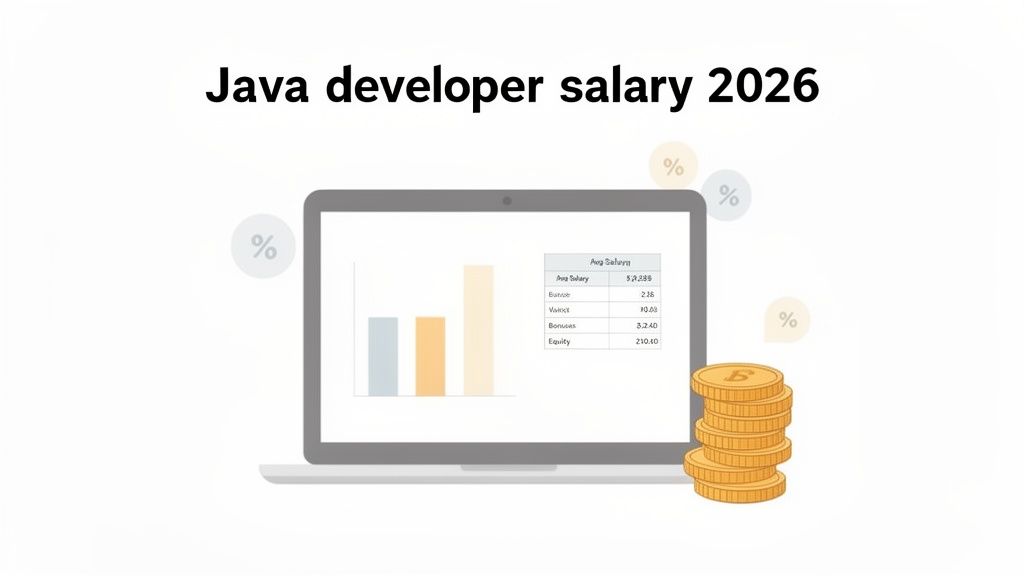
To really understand what makes an offer "competitive," you have to look past the base salary. Think of base pay as the foundation. A truly great offer also includes performance bonuses and—especially in the startup world—a meaningful equity stake. These are the components that build a much larger financial picture.
The latest data from 2026 brings this structure into sharp focus. The median total compensation for a Java developer in the US has climbed to $190,532. That breaks down into a $145,478 base salary with an extra $45,054 in cash bonuses and other perks.
While you'll often see roles advertised in the $90,000–$100,000 range, the reality is much wider, spanning from $87,000 for entry-level positions to over $265,000 for senior talent at high-growth companies. It's a clear signal that the market places a huge premium on experience.
It's helpful to see exactly how pay scales with experience. As developers sharpen their skills and take on more ownership, their market value—and paycheck—naturally follows. Tracking this progression is key to mapping out your career.
The table below gives you a snapshot of what to expect at each stage. Use these numbers as a baseline to see where you stand and what your next financial goal should be.
| Experience Level | Years of Experience | Average Base Salary |
|---|---|---|
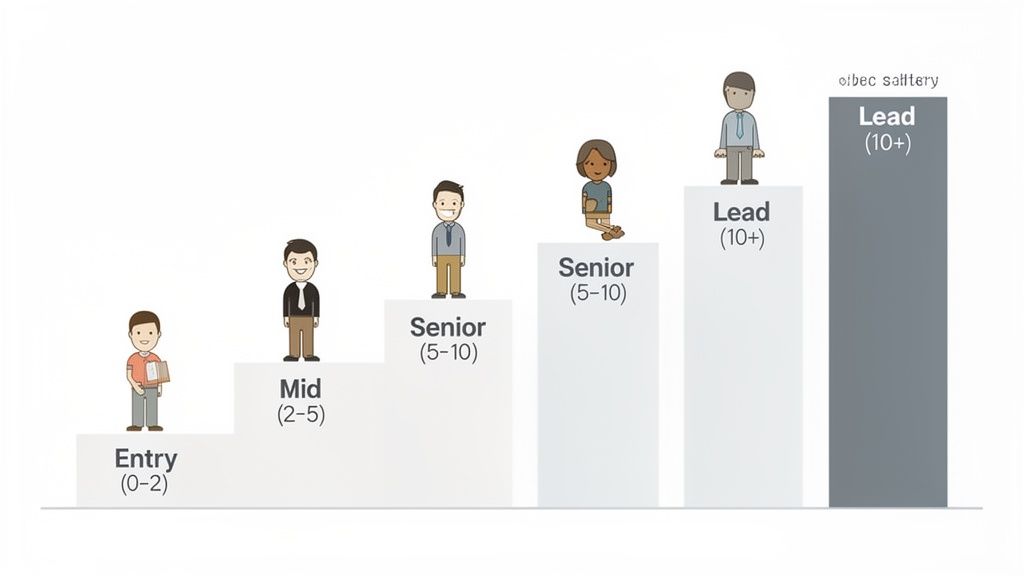
| Entry-Level | 0-2 years | $85,000 - $110,000 |
| Mid-Level | 2-5 years | $110,000 - $145,000 |
| Senior | 5-10 years | $145,000 - $180,000 |
| Lead/Principal | 10+ years | $180,000+ |
Remember, these are just averages for base salary. The right role can push your total earnings much higher.
These figures represent national averages for base salary. Your total compensation can be significantly higher when factoring in bonuses, profit sharing, and stock options.
Of course, knowing the numbers is just the start. To land the best possible package, you need to know how to effectively negotiate your Java developer salary. Having these benchmarks in your back pocket gives you the data and confidence to advocate for what you're worth.
While we're focused on Java here, it's always smart to see how these numbers stack up against the rest of the tech industry. For a broader view, check out our comprehensive guide on software engineering salaries to see how different roles and languages compare.
More than any other variable, your years in the trenches will dictate what you can expect to earn as a Java developer. As your experience grows, so do your responsibilities and your overall impact—and your paycheck should absolutely reflect that.
Think of it like the difference between a line cook and an executive chef. One perfectly executes a single recipe, while the other designs the entire menu, runs the kitchen, and sets the culinary vision for the whole restaurant.
Each career stage brings a different kind of value to the table. If you know what that value looks like, you can not only benchmark your current salary but also map out a clear path to your next pay bump. That knowledge is your biggest asset when you’re looking at a new job offer or walking into a salary negotiation.
When you're just starting out, your job is all about two things: learning and executing. You’ll be assigned well-defined tasks, like fixing a specific bug or building a small, self-contained feature. Your code will be, and should be, heavily reviewed by more senior engineers who are there to mentor you.
At this stage, your value is your potential. Companies are hiring you based on your ability to absorb information, write clean code for the tasks you're given, and become a reliable contributor to the team's goals.
Your main job right now is to build a strong foundation. Success is measured by how well you produce quality code and how quickly you learn. These are the skills that will support the rest of your career.
After a couple of years, you’re no longer just following instructions. As a mid-level developer, you’re expected to solve problems on your own and own larger, more complex features from start to finish. You know the codebase well enough to navigate it confidently and need far less hand-holding.
Your role starts to expand beyond just coding. You'll find yourself:
This is where your Java developer salary really starts to climb. You’re no longer just an investment—you’re a productive, autonomous force who makes the entire team better.
As a senior developer, your perspective shifts from features to systems. Your job is now to guard the architectural integrity and technical direction of major parts of the application. You’re thinking about long-term scalability, maintainability, and performance, not just shipping the next feature.
Your influence now extends beyond your own keyboard to the entire team's engineering standards. Key responsibilities often include:
Your compensation reflects this leap into a strategic role. You’re valued less for the lines of code you write and more for the technical leadership you provide and your ability to elevate the output of everyone around you.
At the very top of the individual contributor track, your impact becomes strategic and crosses team boundaries. As a lead or principal developer, you’re shaping the technical direction for the entire engineering organization. You’re the one they call to solve the most ambiguous, high-stakes problems, and your decisions can set the company’s technical strategy for years.
This role is far less about day-to-day coding. It’s about high-level system design, brokering collaboration between different teams, and having a major say in the company’s core technology stack. You’re a key advisor to engineering leadership and a mentor to other senior engineers.
This career arc is clearly reflected in long-term salary trends. The average Java developer salary has seen steady growth over the last decade, with the biggest gains going to late-career pros who bring this kind of strategic value. You can dive deeper into these numbers by exploring salary data that tracks changes and projects future forecasts.
Once you’ve got the experience, the next biggest lever on your Java developer salary isn't another certification—it's your address. Where you live, whether physically or virtually, can swing your compensation by tens of thousands of dollars.
It’s not just about the number on your offer letter; it's about what that money can actually buy. This is why major tech hubs like San Francisco and New York City consistently command the highest salaries. The sheer density of tech companies creates intense competition for engineers, and when you combine that with a sky-high cost of living, employers have no choice but to pay a premium.
The numbers don't lie. While the average base salary for a Java developer in the U.S. is around $138,886 (with total compensation often hitting $193,653), that’s just a baseline. In a hot market like San Francisco, it’s common to see offers 20-30% higher, with base salaries routinely clearing $170,000. You can dig into more detailed data in this comprehensive salary guide.
For years, the highest-paying Java jobs have been concentrated in a few key cities. Places like San Francisco, New York, and Seattle are packed with an ecosystem of startups and tech giants, all vying for the same pool of experienced engineers.
But there’s always a trade-off. A $180,000 salary in the Bay Area can feel surprisingly tight after you factor in rent, taxes, and daily expenses. That same engineer might feel significantly wealthier with a $150,000 salary in an emerging tech city like Austin or Denver.
Choosing your location is like choosing your playing field. A higher salary in a top-tier city doesn't automatically mean a better quality of life. You have to weigh the total compensation against your cost of living to understand your real earning power.
For developers who are open to looking beyond the traditional coastal hubs, there's a growing landscape of opportunity. Our guide to the best cities for software engineers breaks down several locations that hit that sweet spot of strong salaries, lower costs, and a great tech community.
The right location can dramatically affect how far your salary goes. To put it in perspective, here's a look at how average base salaries for mid-to-senior Java developers stack up across different US locations in 2026.
| Location | Average Mid-Senior Base Salary Range | Notes |
|---|---|---|
| San Francisco Bay Area | $170,000 - $220,000+ | The highest salaries, driven by intense competition and a very high cost of living. |
| New York City | $160,000 - $210,000+ | A close second to SF, with a strong presence of both tech and high-paying fintech companies. |
| US Remote (National) | $140,000 - $190,000 | Highly variable based on the company's pay policy (agnostic vs. tiered). Can offer huge lifestyle benefits. |
| Other Tech Hubs (e.g., Austin, Seattle) | $150,000 - $195,000 | Competitive salaries with a more manageable cost of living compared to SF or NYC. |
As you can see, choosing a remote role or moving to an emerging hub can provide a powerful financial advantage without necessarily sacrificing a top-tier salary.
The explosion of remote work has completely rewritten the rules on salary. Companies aren't just using a single, office-based pay scale anymore. Instead, they've landed on a few different models to figure out what to pay their remote engineers.
If you’re looking at remote roles, you absolutely have to know which model a company uses. It’s a critical piece of the puzzle.
Here are the most common approaches you'll encounter:
For Java developers, this shift has been a game-changer. You now have the chance to land a salary that was once only possible in a major tech hub, all while living somewhere with a much lower cost of living. That difference goes straight to your bottom line, dramatically boosting your disposable income.
Just because you have the same years of experience as another Java developer doesn't mean your paychecks will match. Specialization is what truly separates the top earners from the rest of the field.
Think of it like this: any mechanic can change your oil, but the one who can diagnose a complex engine computer issue for a modern EV is the one who can name their price. The same principle applies here.
Knowing core Java is your foundation—it's the price of entry. But mastering the technologies that companies are betting their future on is what will really drive your salary north. Let's break down the skills that command a serious premium.
If you master one thing to get a higher Java salary, make it the Spring Framework, and specifically Spring Boot. Spring has become the undisputed standard for building enterprise-level Java applications, offering a complete ecosystem for everything from web apps to data and security.
So why does it command such a premium? Because Spring Boot radically simplifies building production-ready applications. It slashes boilerplate code and automates configuration, letting engineering teams build and deploy services faster and more reliably than ever before.
Imagine building a new REST API. Without Spring Boot, you could easily burn days just setting up a web server, wiring up database connections, and managing dependencies. With Spring Boot, you can get a basic API running in under an hour, using just a few annotations.
Employers are willing to pay top dollar for developers who are fluent in Spring Boot. It’s a skill that directly translates to faster time-to-market and higher team productivity—a clear and immediate win for the business.
Today's applications don't just run on a server in a back room; they live in the cloud. That's why deep expertise in a major cloud platform like Amazon Web Services (AWS) or Microsoft Azure has become a non-negotiable for the best-paying Java roles.
Companies don’t just want developers who can write Java. They need developers who can deploy, manage, and scale that code inside a complex cloud environment. This is about understanding the full lifecycle.
This goes far beyond just knowing how to spin up a virtual machine. The real value is in skills like:
A developer who can write a Java microservice and deploy it to AWS using a serverless architecture is exponentially more valuable than one who can only write the code. That full-stack, full-lifecycle understanding is exactly what top startups are hunting for.
The industry-wide shift away from massive, monolithic applications toward a microservices architecture has been a game-changer. Instead of one giant codebase, applications are now collections of small, independent services. And Java, especially paired with Spring Boot, is a dominant force in building them.
But managing hundreds of these little services creates a whole new set of problems. This is where containerization tools like Docker and orchestration platforms like Kubernetes become essential.
A senior developer who deeply understands microservice patterns, Docker, and Kubernetes can architect systems that are more resilient, scalable, and easier to evolve. This skillset is the backbone of modern, cloud-native applications, and it absolutely carries a significant salary premium. Companies see this expertise as a direct way to reduce operational risk and innovate faster.
If you’re coming from a big corporate background, your first startup offer can feel like it’s written in a different language. The conversation quickly shifts from a straightforward salary to a package that includes a critical, and often confusing, component: equity. It’s common to see a lower base salary paired with a significant equity grant, a trade-off that could lead to a massive financial win down the line.
Think of it this way: a traditional salary pays you for the work you do today. Startup equity is your reward for helping build the company's future value. If the startup takes off, that equity could be worth far more than the initial salary you sacrificed. This structure is designed to attract people who are motivated by a mission and want a real stake in the outcome.
But to make that bet, you need to understand how to read the fine print. Equity isn't just a number on an offer letter; it’s a piece of the company’s future, and you need to figure out what that piece might actually be worth.
Equity can feel complicated, but it all boils down to a few key ideas. For most startup employees, equity comes in the form of stock options. These aren't actual shares of stock—not yet, anyway. They’re the right to buy company stock later at a fixed price, called the strike price.
The whole game is for the company’s value to skyrocket. Let's say you're granted options with a strike price of $1 per share. If the company grows and its stock becomes worth $20 per share, you get to buy your shares for that original $1 price. That difference is where the real wealth is created, and it’s the core appeal of joining an early-stage team.
Vesting Schedules: You don’t get all your options on day one. You earn them over time through a vesting schedule, which is usually four years with a one-year "cliff." This means you have to stick around for at least a year to get your first chunk of options (typically 25%). After that one-year mark, the rest of your options usually vest monthly or quarterly.
The skills you bring to the table directly impact the quality of the equity package you can command. Building scalable systems is what drives a startup's valuation, making certain skills particularly valuable.
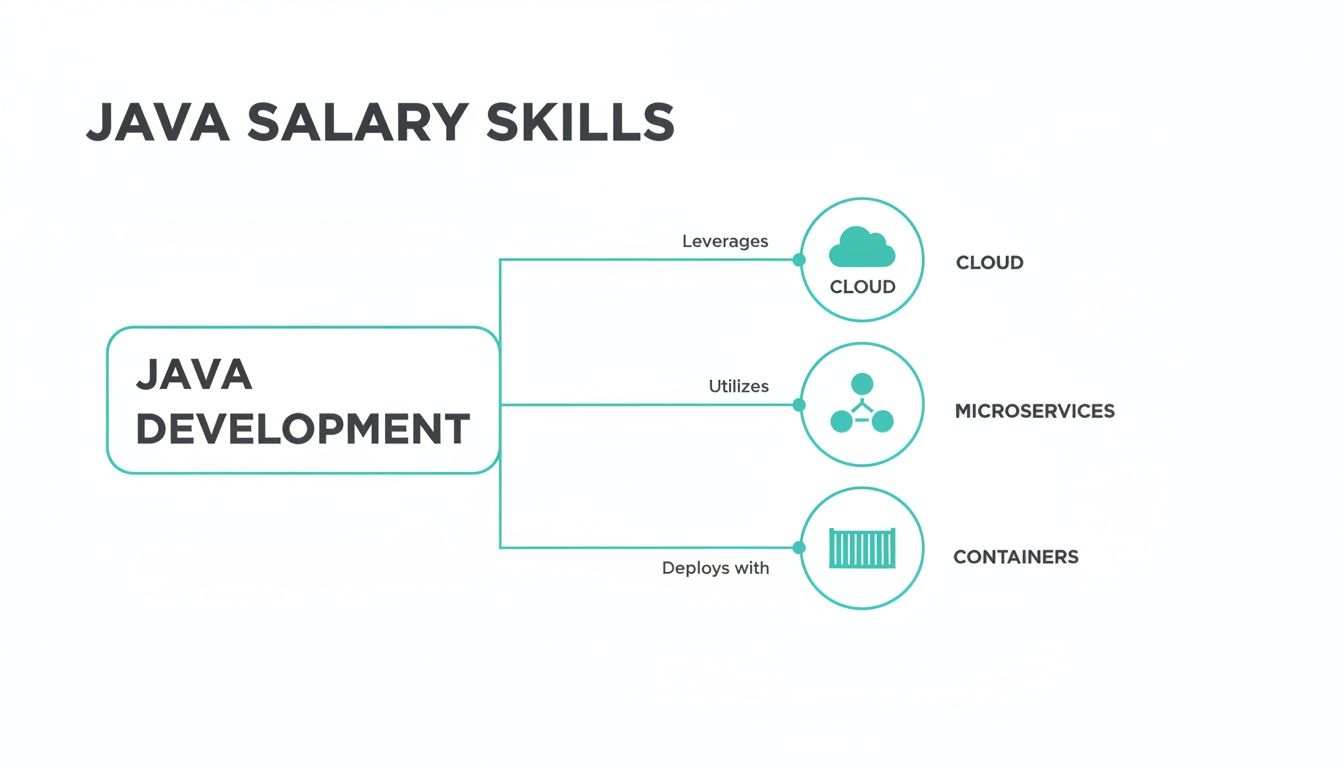
As you can see, expertise in modern architecture—like cloud platforms, microservices, and containerization—is what high-growth startups are looking for to build valuable products.
When a startup hands you an offer, don't get mesmerized by the number of options. To figure out the potential value, you need to ask a few smart questions:
Asking these questions shows you're a serious candidate who knows how startup compensation works. That knowledge is your best tool for deciding if the potential reward is worth the risk. For a deeper look at the numbers, you can learn more about how to interpret startup compensation benchmarks and make a more informed choice.
Negotiating at a startup is a different beast. Early-stage companies are often cash-strapped, so there might not be much wiggle room on base salary. Equity, however, is often a different story. Your goal is to advocate for your long-term value.
Here are a few tips to keep in your back pocket:
By understanding the moving parts of a startup offer and approaching negotiations strategically, you can confidently evaluate opportunities and land a package that aligns with both your financial goals and your belief in the company’s future.
When you're navigating your career, compensation can feel like a black box. We're here to clear things up. This section tackles the most common questions we hear from Java developers, giving you quick, straightforward answers to help you understand your market value.
Short answer: Yes, without a doubt. Java is the bedrock of the tech world, powering mission-critical enterprise systems, countless Android apps, and massive web platforms. Its reputation for being stable and scalable means it's not going anywhere, especially for the systems that businesses truly depend on.
While newer languages often get the spotlight, the demand for skilled Java engineers to maintain and modernize these core systems is incredibly strong. That sustained demand translates directly into high, stable paychecks—particularly for developers who keep their skills sharp with modern frameworks.
Mastering the Spring Framework, especially Spring Boot, is one of the fastest ways to boost your earning potential. Companies are all-in on Spring Boot for building and deploying microservices and web apps quickly and efficiently.
The exact number will vary, but we consistently see developers with strong Spring Boot skills pull in a salary premium of 10-20% over engineers who only know core Java. For a huge number of senior roles, Spring expertise isn't just a "nice-to-have," it's a hard requirement, making it a clear path to the upper salary brackets.
Think of it like this: knowing core Java gets you in the door. Knowing Spring Boot gets you a seat at the table where the highest-impact projects get built. That expertise is a direct line to more responsibility and, ultimately, better compensation.
This one is all about your personal risk tolerance and financial runway. Taking a lower base for more equity is a classic high-risk, high-reward bet. You're betting on the company's future success.
If you're a true believer in the startup's mission and its team, and you can comfortably pay your bills on the lower salary, that equity could turn into a life-changing windfall.
But you have to go in with your eyes open. That equity could also end up being worthless if the startup doesn't make it. Before you even consider it, you need to do your homework on the startup's:
For top talent, the gap has pretty much vanished. A few years ago, remote salaries often came with a "hometown discount," but today's market is different. Skilled remote engineers are a hot commodity, especially in the startup world.
Many forward-thinking companies have switched to location-agnostic pay scales or wide regional pay bands. A top-tier remote Java developer can now earn a salary right on par with their peers in major hubs like NYC or SF, but with the huge financial upside of a lower cost of living.
Ready to find a Java role that pays what you're worth? Underdog.io connects you with hundreds of vetted, high-growth startups that are actively hiring. Create your free profile in 60 seconds and let top companies apply to you: https://underdog.io.