Let's be honest: a gap on your resume can feel like a giant, flashing red light. But in reality, it’s not the career-killer you might think. Most hiring managers, especially in the fast-paced tech and startup world, are far more interested in what you did with that time than the simple fact that a gap exists.
Stressing about an employment gap can feel isolating, but trust me, you're in very good company. The whole idea of a straight, uninterrupted career ladder is quickly becoming a thing of the past.
This is especially true in tech. Between market volatility, widespread layoffs, and a major shift toward skills-based hiring, zig-zag career paths are the new normal. Plenty of incredibly talented people find themselves with unexpected time between jobs. It’s not a sign of failure—it’s just a reflection of how the industry works now.
The most innovative companies and startups get it. They know talent isn’t defined by a perfect timeline. In fact, they often value the resilience, adaptability, and guts it takes to step off the traditional path.
From their perspective, a resume gap can signal a lot of positive things:
Changing your own perspective is the first step. Instead of seeing the gap as a liability you need to hide, you can start framing it as a period of intentional growth. It can be really validating to hear from others who have successfully taken a break. For example, reading about how someone managed to study after time off from education can give you a boost of confidence in your own journey.
For those just starting out, the current market has made employment gaps almost unavoidable. The tech industry has seen a hiring freeze that created a bizarre "experience paradox" for new graduates.
According to SignalFire's 2025 State of Talent Report, hiring for new grads at Big Tech firms has crashed to just 7% of total hires. That's a massive drop of over 50% from 2019 levels. Startups aren't picking up the slack either, with new grad roles making up less than 6% of their hiring. You can dig into more of the findings on the tech talent market in the full report.
This data points to a massive shift: even the most promising new talent is being forced into a gap. It's become a shared experience, not an individual shortcoming.
Ultimately, the gap itself doesn't matter nearly as much as the story you build around it. With the right strategy, you can turn this period from a source of anxiety into a powerful part of your professional narrative.
Think of your resume as a marketing document, not a legal transcript. Its primary job is to tell your professional story in the most compelling way possible. That absolutely includes framing any time off so it doesn't derail the conversation before it even starts. The right formatting choices can skillfully shift a hiring manager's focus from your timeline to your talent.
Instead of a rigid, reverse-chronological list that can put a spotlight on breaks, consider a format that brings your skills front and center. This isn't just a clever trick; it aligns perfectly with the growing trend of skills-based hiring, especially in tech.
This simple flowchart can help you rethink how you approach the gap on your resume.
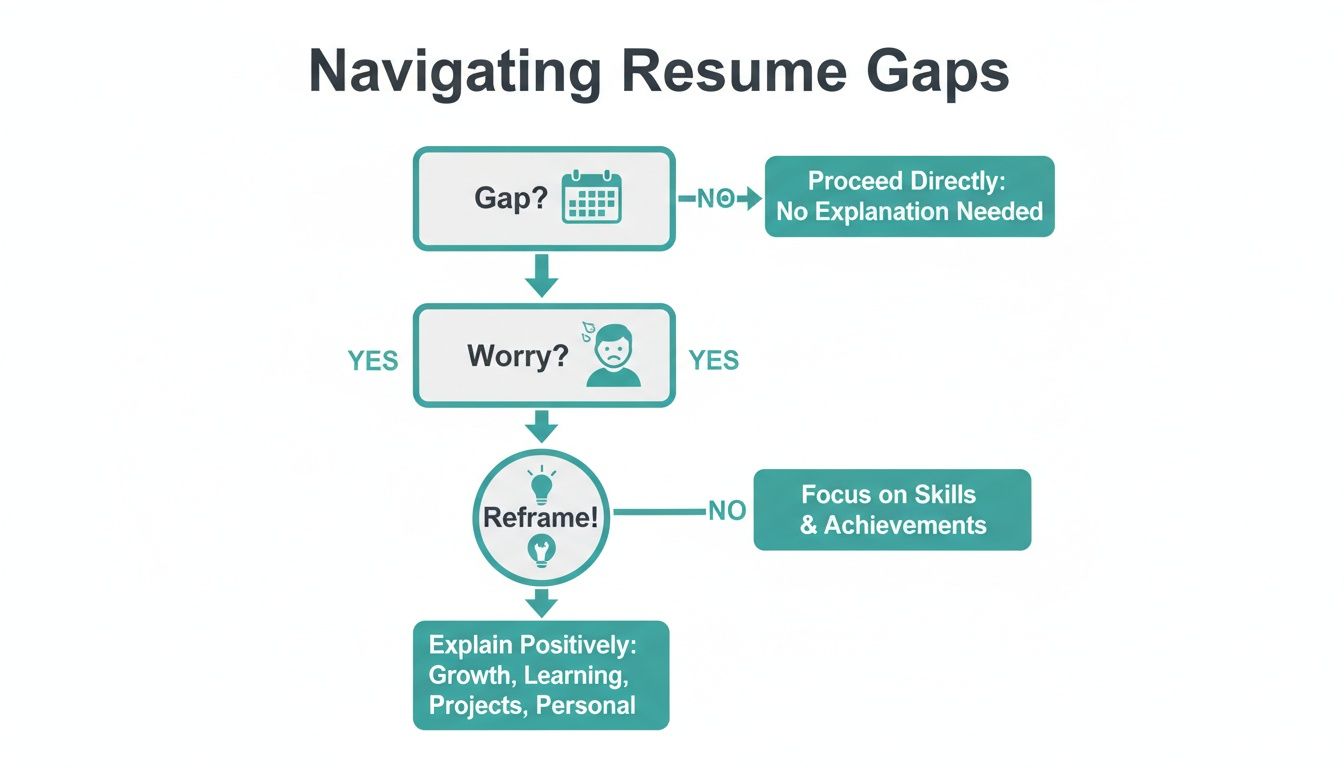
The big takeaway here? A gap doesn't have to be a source of anxiety. View it as a chance to reframe your narrative and show you've been growing, not just waiting.
The standard chronological resume isn’t always your best friend when you have a gap, as it draws immediate attention to dates. Instead, let's look at a few alternative strategies that are highly effective in the tech world.
For a deeper dive into structuring your document for startup roles, our complete guide on how to write a tech resume provides detailed examples and layouts. The hybrid format, in particular, tends to be the sweet spot for most job seekers.
If your time away involved several short-term projects, freelance gigs, or intensive courses, don't list them as separate, choppy entries. That just looks scattered. Bundle them into a single, impressive entry that demonstrates continuous engagement and skill development.
Let’s look at a "before-and-after" for a software developer who took some time off from a full-time role.
Before:
This formatting makes it look like you were just bouncing around. Now, let’s consolidate it into something powerful.
After:
Independent Software Development & Project Work (Jan 2024 - Present)
The reframed entry tells a much better story: you’re a proactive, self-directed professional who was actively coding and delivering results, not just sitting on the sidelines.
One of the simplest yet most effective formatting tweaks is to remove the months from your employment dates. Recruiters spend only seconds on their initial scan, and this tiny change can make a short-term gap nearly invisible.
For instance, a gap from October 2023 to March 2024 can look significant when spelled out.
With Months:
With Only Years:
Using only years is a standard, completely acceptable practice. It minimizes the visual break and keeps the focus on the duration and quality of your experience, not the months in between.
This shift toward showcasing skills and projects isn't just a resume trick; it's where the industry is heading. A staggering 87% of global companies report a widening skills gap, forcing them to pivot to skills-based hiring. Tech resumes are already adapting, with project sections now appearing on over 58% of software/IT resumes. This signals that productive "gap-fillers" are becoming the norm, not the exception.
By making these strategic formatting decisions, you take control of your story. You’re not hiding a gap; you’re highlighting what truly matters to innovative companies: your skills, your initiative, and the value you can deliver from day one.
Your resume gets you past that first six-second scan, but the cover letter and LinkedIn profile are where you really get to tell your story. This is your chance to frame that employment gap, turning a potential question mark into a statement about your resilience, growth, and readiness to jump back in.
It’s tempting to either ignore the gap and hope no one brings it up or, worse, over-explain with way too much personal detail. The sweet spot is a brief, confident statement that acknowledges the time away and immediately pivots back to why you're a great fit for the job.
Your cover letter is the perfect spot to get ahead of any questions about a recent or significant gap. You can dedicate a short paragraph to it, framing the time as a period of intentional action, not just waiting around. The trick is to connect whatever you were doing directly to your value as a candidate.
Here are a few practical examples for different situations:
See the common thread? Each example is positive, concise, and ties the time off to professional value. It’s not an apology; it’s a strategic part of your career story.
Think of your LinkedIn profile as a living document that shows you’re always engaged, even when you’re not formally employed. A profile that just stops dead with an end date is an open invitation for questions. Instead, use its features to show you’ve been active and learning.
Your LinkedIn profile should be a timeline of your professional development, not just your employment history. Pack it with activities that show initiative and a real commitment to your craft.
Start with your professional summary. If you're currently between roles, your headline and summary are prime real estate. For some extra tips on making that section pop, check out our guide on how to write a good professional summary to grab a recruiter's attention.
Here's how to fill in that timeline and keep it looking fresh:
By taking control of your story on your cover letter and LinkedIn, you turn a potential red flag into a green one. You're showing hiring managers you aren’t someone who just waits for things to happen—you’re a resilient pro who actively creates your own opportunities. That's exactly the kind of self-starter mindset that innovative companies are looking for.
You did it. You tweaked your resume, nailed the cover letter, and your LinkedIn profile is looking sharp. Now for the moment of truth: the interview.
Inevitably, the hiring manager will lean in and ask, "So, can you tell me about this period on your resume?" This isn't a trap. It's an invitation to show your character, resilience, and how you solve problems. Your goal isn't to justify the time off, but to connect it to your professional journey and show exactly why you’re the right person for this role, right now.
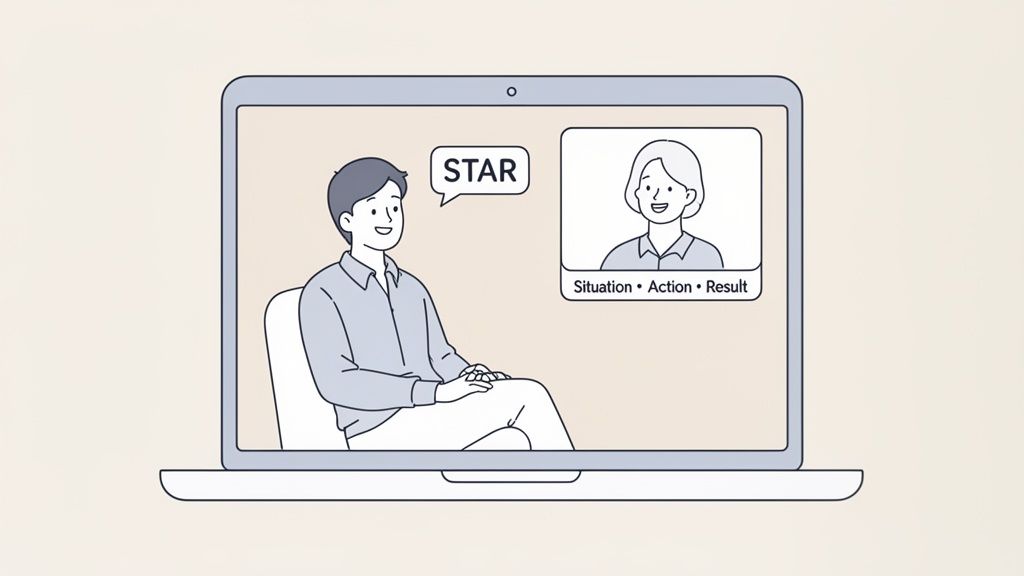
The STAR method (Situation, Task, Action, Result) is a classic interview technique for a reason—it works. It's especially perfect for explaining an employment gap because it helps you build a short, powerful story that highlights positive outcomes instead of giving a vague or defensive answer.
Here’s the breakdown:
This structure flips the script. A passive gap in your resume becomes an active period of growth. You're not just explaining what happened; you're showing how you take initiative and achieve goals, even without a formal job title.
Let's put the STAR method into action for a couple of common situations. The trick is to be honest without oversharing, keeping your answer tight and focused on the professional takeaway.
Scenario 1: Layoff and Upskilling
Scenario 2: Personal Project or Startup Idea
See how both examples pivot back to the company and the specific role? That's the key. It shows you’ve done your homework and are thinking about their needs.
The best explanation for your resume gap is the one that's true for you. Frame your history in a way that feels honest and lets go of any self-judgment. Confidence is just a mix of honesty and self-compassion.
Your first chat with a recruiter is often where the question about your work history pops up. Recruiters are typically focused on logistics and qualifications, so your answer here can be even more concise. Keep it high-level, positive, and professional.
If they ask, you can say something simple like:
"After my last role, I took a few months for professional development, focusing specifically on [mention a key skill]. I'm now actively interviewing and am really excited about this opportunity at [Company Name]."
Your tone and body language matter, too, even over a video call. Our guide on body language in an interview has some great tips for projecting confidence.
The current hiring climate is also working in your favor. Frustrations with AI screening tools are pushing nearly 30% of tech professionals to think about leaving the industry, according to a recent Dice's 2025 Trust Gap report. And with 92% of tech pros believing AI overlooks qualified candidates, recruiters are more aware than ever of the need for a human touch.
Ultimately, being ready for this question does more than just help you get through an interview. It empowers you to own your entire career story—gaps included.
It’s time to stop thinking about your resume gap as a problem you have to defend and start seeing it for what it is: a unique asset.
In the world of high-growth tech companies and scrappy startups, a non-linear career path can actually be a competitive advantage. Founders and hiring managers aren't just looking for another corporate drone. They're searching for people with initiative, resilience, and the ability to thrive without a rigid structure holding their hand.
Your time away from a traditional 9-to-5 is the perfect opportunity to prove you have exactly those qualities. Instead of a blank space, this period can become a powerful testament to your drive and resourcefulness. When you frame it correctly, the gap itself becomes evidence that you're a self-starter.
Startups live and die by the initiative of their teams. They need people who see a problem and start solving it without waiting for a formal assignment or a manager's permission. Your gap is prime real estate to demonstrate this exact mindset.
Think about how you can frame your activities as self-directed projects that produced tangible outcomes. This isn't about just filling time; it's about showing you can create value on your own terms.
Here are a few actionable ways to demonstrate that self-starter attitude:
The key is to treat these activities like real work, because they are. They show you can operate with a high degree of autonomy, a quality that is non-negotiable in most early-stage companies.
Resilience isn't something you learn in a classroom; it's forged by navigating uncertainty. A career gap, whether planned or unplanned, is a real-world test of your ability to adapt, learn, and persevere.
Instead of shying away from the challenges, lean into them. Explain how the experience made you a more resourceful and determined professional. For example, maybe you used the break for significant professional development, like retraining for a new career, which gave you fresh skills and a new perspective.
Your ability to navigate a period without the safety net of a full-time job speaks volumes. It shows you can handle ambiguity and find a productive path forward, which is exactly what startups do every single day.
When you talk about your gap, focus on the problem-solving skills you developed. Did you have to teach yourself a new programming language to finish a project? Did you have to network aggressively to land your first freelance client? These stories are far more compelling to a founder than a list of duties from a corporate job.
When you're talking to a startup, remember that they value a different set of skills. They often care less about your previous job title and more about your ability to wear multiple hats and learn on the fly.
Use your gap experience to prove you fit that mold. Your story isn't "I was unemployed." It's "I was the CEO, product manager, and lead developer of my own professional development."
Here’s how to translate your gap activities into startup-friendly language:
This proactive framing transforms your gap from a passive period into an active demonstration of the exact traits that help early-stage companies succeed. You weren't just waiting for the next opportunity—you were out there creating it yourself.
If you're staring at a gap in your resume, you're not alone. It's one of the most common things tech professionals worry about. Let's tackle the biggest questions head-on with some practical, no-nonsense advice.
Honestly, there's no magic number, but any gap stretching past six months is where hiring managers start to pay a little more attention.
But here’s the real talk: context is everything, especially now. With the tech world going through massive shifts and layoffs, there’s more understanding for career breaks than ever before. The length of the gap matters far less than what you did with that time. A two-year break you spent trying to launch a startup or mastering a new programming language can be a huge asset, while an unexplained six-month gap might raise more questions. It’s all in how you frame it.
Let me be crystal clear: absolutely not. This is a non-negotiable rule.
Your integrity is your most valuable professional asset, and getting caught in a lie is the fastest way to burn a bridge—not just with one company, but potentially with an entire network. Background checks are standard practice, and fudging employment dates is one of the easiest things to catch. It can get an offer rescinded or even get you fired months down the road. Don't do it. Instead of hiding the gap, own the narrative.
A confident, honest explanation will always serve you better than a fabrication that could come back to haunt your career. Lying is a high-risk, zero-reward game.
Yes, you absolutely should. This is one of the single most powerful ways to reframe a career break. Bundling several freelance projects under one cohesive entry is a brilliant strategy to show continuous skill development.
On your resume, create a single entry like "Independent Software Consultant" or "Full-Stack Developer (Project-Based)" and assign it a continuous date range (e.g., 2023 - Present). Underneath, use bullet points to detail your projects just like you would for any full-time role. Make sure to highlight:
This approach instantly transforms what might look like downtime into a period of proactive, self-directed work. It proves you were in the trenches, applying your skills and delivering real-world value.
You are never, ever required to share private details about your health or family in an interview. The key is to keep your explanation brief, professional, and forward-looking. Your goal is to acknowledge the break with confidence and quickly steer the conversation back to your qualifications for the role.
A simple, effective script sounds something like this: "I took some time off to focus on a personal matter, which is now resolved, and I'm really excited to be jumping back into my career full-time."
That's it. From there, immediately pivot by asking a question about the role or connecting one of your skills to the job description. This move shows the interviewer that you’re honest about your past but your focus is squarely on the future and the value you can bring to their team. It respectfully closes the door on the topic without leaving things awkward.
Not necessarily. In today's job market, gaps are more common and understood than ever. What matters more to most hiring managers is how you explain the gap and what you did during that time. A well-framed explanation that shows proactivity, learning, or responsibility can neutralize concerns and sometimes even strengthen your candidacy.
Many common life events are widely accepted, including: pursuing further education or training, caring for a family member or children, dealing with a personal health issue, voluntary leave between jobs, or time spent building a business or personal project. The key is to be prepared to discuss the period honestly and positively.
Consider using a functional or hybrid resume format that emphasizes your skills and achievements upfront, rather than a strict chronological list. You can also list years only (e.g., "2020 - 2022") instead of months for each position to make shorter gaps less noticeable. For longer gaps, you can create a dedicated "Career Break" or "Professional Development" section to describe the period proactively.
Be honest, concise, and positive. Frame the gap as a period of purposeful activity. For example: "I took a planned career break to complete a certification in data analytics, which I've already applied in my recent freelance project." Or, "I needed to be the primary caregiver for a family member. That situation is now resolved, and I am fully ready and eager to return to work." Practice your answer so it feels natural.
You are not obligated to disclose detailed personal medical information. It is perfectly acceptable to state you took a leave for "health reasons" or a "medical leave of absence" and that you are now fully recovered and ready to resume your career. Focus the conversation on your current abilities and enthusiasm for the role.
Absolutely. If you did any paid freelance, consulting, or volunteer work during the gap, list it as professional experience. This demonstrates initiative, keeps your skills current, and shows you remained engaged in your field. Treat it like any other job, listing projects, responsibilities, and outcomes.
The biggest mistake is drawing unnecessary attention to it with an awkward format or by lying. Avoid leaving a glaring, unexplained blank space. Never fabricate employment dates or companies to cover the gap, as this is easily discovered in background checks and will immediately disqualify you. Transparency and confidence are always better.
Ready to stop sending your resume into a black hole? At Underdog.io, we flip the script. With one application, you get your profile in front of hundreds of top, vetted startups looking for tech talent just like you. Let the best opportunities come to you. Sign up for free today