Read Time: 6 min read
Think of Series A funding as the moment a promising local band gets a major record deal. They've already proven their music connects with people through early gigs (the seed stage), and now it's time to produce a full album and launch a national tour.
For your career, this milestone is a critical signal that a startup is shifting from survival mode into aggressive growth mode. Understanding this shift gives you a major advantage in your job search, helping you identify high-potential opportunities and ask the right questions during interviews.
Series A is the first significant, institutional round of venture capital financing a startup lands. It’s the official transition from simply validating an idea to actually building a scalable business. Before this point, a company has likely been scraping by on smaller checks from founders, friends, family, or angel investors during its seed stage.
The whole point of seed funding was to achieve product-market fit. A practical example is a SaaS startup proving that at least 100 businesses are willing to pay a monthly subscription for their software. With Series A, the game changes completely. The company now has a proven concept and is raising serious cash to build out its team, optimize how it makes money, and start grabbing market share.
Before we go deeper, it helps to see where Series A fits into the big picture of a startup's journey.
This table gives you a quick rundown of the major funding stages to put Series A in context.
As you can see, Series A is that pivotal first step into the world of institutional investment, setting the stage for everything that follows.
A company at this stage has officially moved beyond the garage. It has clear traction and a business model that seasoned investors believe can be scaled up effectively.
Here are the key indicators of a Series A-ready company:
This funding round represents the first major institutional investment, typically ranging from $5 million to $15 million. As of Q1 2025, the median Series A funding in the U.S. hit $7.9 million, though you'll see big regional differences. Rounds outside the U.S. often fall between €2 million and €10 million. You can discover more about these fundraising trends and what they mean for the market.
For a tech professional, this means you're joining a company that has passed a major validation test but still offers a massive opportunity for impact before it becomes just another big corporation.

Unlike the seed stage, where money often comes from friends, family, or individual angel investors, Series A is where the institutional players step in. The main investors here are Venture Capital (VC) firms. These aren't just silent partners writing a check; they're professional investors managing massive pools of money, and they take a very active role in the companies they back.
Think of a VC firm as a strategic partner who brings more than just cash to the table. They also offer up their expertise, a deep network of industry connections, and hands-on mentorship. For instance, if the startup needs to hire a VP of Sales, the VC firm will likely introduce them to proven candidates from their network. When a VC invests, it's common for them to take a seat on the company's board of directors, giving them a direct say in major business decisions.
VCs see thousands of pitches but only invest in a tiny fraction of companies. They're looking for more than just a cool idea. They want concrete proof that a business is primed to become a growth machine, which means they’re going to scrutinize every single part of the startup before opening their wallets.
Here’s what’s on their checklist:
A common mistake is thinking Series A is just about having a great product. In reality, it’s about having a great business built around that product—one with predictable revenue, a clear go-to-market strategy, and a team that can execute flawlessly.
When VCs cut a check, the deal comes with specific terms that are critical for any potential employee to understand. The first big number is the startup’s valuation—its total worth as determined by the investors. A typical Series A valuation can fall anywhere between $10 million and $30 million. This figure has a direct impact on the value of any equity you might be offered.
Beyond that, investors don't buy the same kind of stock that employees do. They purchase preferred stock, which comes with special privileges. One of the most important is the liquidation preference. This term essentially guarantees that VCs get their money back first (and often, a bit more) if the company gets sold. Understanding what Series A funding means requires knowing that these terms exist to protect the investor’s capital and fundamentally shape the company's financial structure.
A fresh Series A investment is like hitting the afterburner on a fighter jet. The company's goal snaps from survival to aggressive, rapid expansion. For anyone on the job hunt, this is the moment to pay attention. It triggers a massive shift in how a startup hires and opens a unique window of opportunity.
This new cash isn't just for keeping the lights on anymore. It's a war chest, and it's earmarked for building a machine that can scale. The informal, "wear-every-hat-imaginable" culture of the seed stage starts to give way to something more structured. The focus flips from hiring scrappy generalists to bringing on proven specialists who can build solid, scalable systems for the long haul.
With millions now in the bank, founders move fast to plug the biggest gaps in leadership and execution. This first hiring wave is almost always predictable, targeting roles that directly shore up the product and help capture the market.
This hiring explosion is directly tied to the capital flowing into the market. Back in 2021, for instance, over 5,000 companies raised a staggering $90 billion in Series A funding, which fueled an intense war for talent. While that figure cooled a bit to $70 billion across 4,000 firms in 2022, it perfectly illustrates how investor confidence directly impacts a startup's power to hire. If you're curious, you can explore detailed funding round data to see these trends up close.
A huge cultural shift happens right here. The chaotic "family" vibe begins to evolve. As the team grows, things like formal processes, defined career paths, and real benefits (think health insurance and a 401(k)) suddenly become priorities.
Making the leap from a freshly funded startup to a growing scale-up demands careful handling of people and processes, especially when you're hiring at lightning speed. Many companies look into strategies for HR Outsourcing for Growth to navigate this complex transition. For a job seeker, this is the sweet spot: you’re joining a company that’s professionalizing but still offers a ground-floor shot at making a massive impact.
Getting a job offer from a Series A startup can feel like you’ve just been handed a golden ticket. But before you start celebrating, it’s crucial to look past the base salary and really dig into the details. This isn't just another job offer; it’s an invitation to join a company at a pivotal moment. The company is just starting to shift from a scrappy, all-hands-on-deck team to a more structured organization, and your offer—especially the equity part—is a direct reflection of that transition.
The most thrilling component for many candidates is the equity, which usually comes in the form of stock options. Think of these as a special right to buy a certain number of company shares at a fixed price, known as the strike price. Essentially, you're getting a coupon to buy company stock in the future at today’s much lower price.
But you don’t get all your options the moment you sign the offer. They’re tied to a vesting schedule, which is just a timeline for earning them. A typical setup is a four-year schedule with a one-year "cliff." This means if you leave before your first anniversary, you get nothing. On your one-year mark, however, 25% of your options vest instantly. After that, the rest usually vest in monthly chunks over the next three years.
Figuring out what your equity could be worth is where things get interesting. It’s not about the sheer number of options you’re granted, but what they could translate to in real dollars down the line. Let’s walk through a quick, practical example to make this concrete.
Imagine you're offered 10,000 stock options with a strike price of $1.00 per share. At the time of the offer, the company is valued at $20 million.
This simple math helps turn abstract numbers into a tangible upside. It’s a crucial step in understanding the full picture of your compensation. For a deeper dive, check out our complete guide on how to evaluate a job offer.
This decision tree can help you visualize where your skills and career ambitions might best align within a post-Series A company.
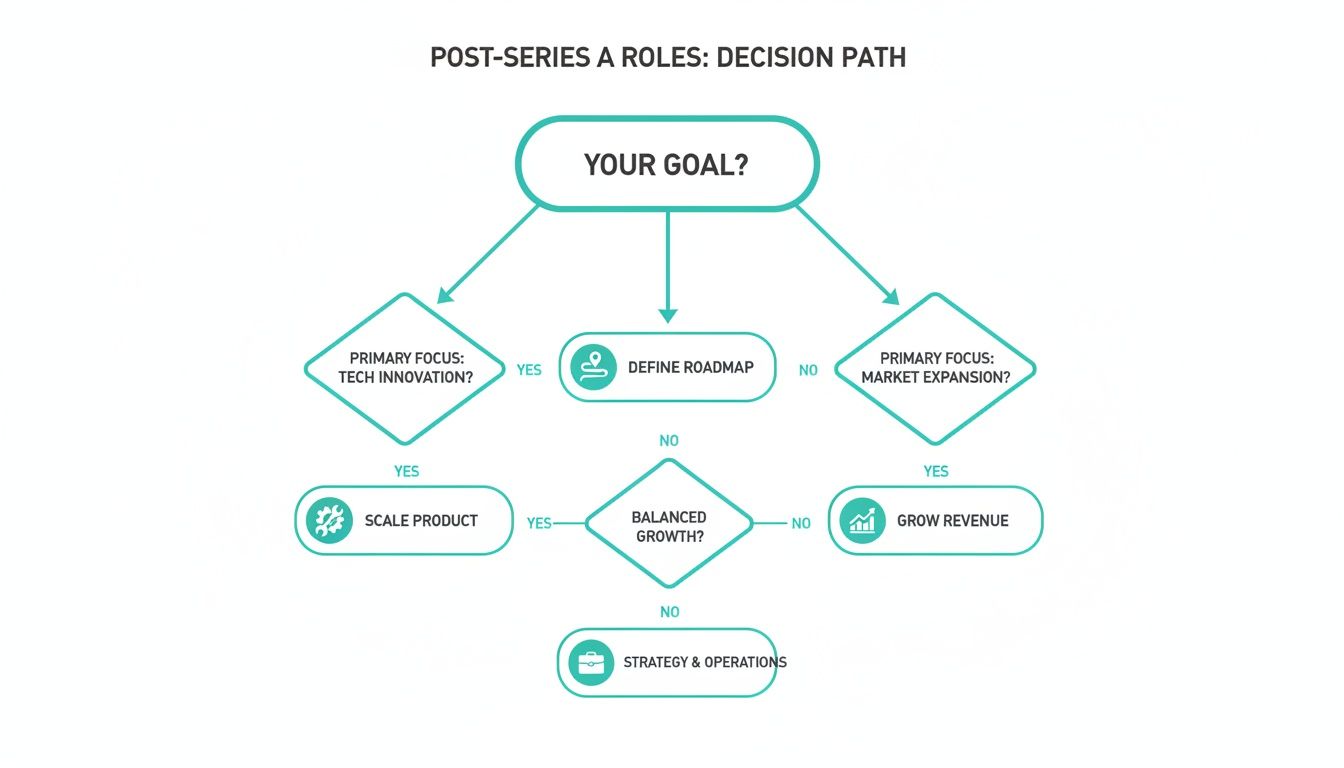
Whether you want to help scale a proven product, get in on the ground floor of defining a new one, or drive the revenue engine, Series A startups are building out specialized teams for all of these paths.
The numbers in your offer letter are only part of the story. The overall health of the business is arguably the biggest factor in your potential success. Since you’re interviewing them as much as they’re interviewing you, use the process to do some digging. Knowing what a Series A round really means for a company will help you spot both warning signs and positive signals.
Here’s a quick checklist to help you size up the opportunity.
This table is a starting point. Your goal during the interview process should be to gather enough information to confidently place the company in the "green flag" column for most of these areas.
Remember, a huge green flag is a leadership team that speaks openly about both their challenges and their grand ambitions. If they dodge questions about financials or seem defensive about their culture, it’s a sign that transparency isn’t a core value—and that’s a critical ingredient for any successful startup journey.
Not every Series A round is cut from the same cloth. While a typical raise lands somewhere in the $5 to $15 million range, we’re seeing a huge uptick in “mega-rounds.” These are startups raising a staggering $50 million or even $100 million right at the Series A stage, a trend especially common in cash-hungry fields like AI and biotech.
For a job seeker, understanding what this kind of funding signals is critical. A startup that just closed a mega-round isn't just getting ready to scale—it's being strapped to a rocket. This massive cash infusion completely rewrites the rules for the founders and for every single person they hire. The expectations are astronomical, and the pressure to deliver is immediate and intense.
Just how common have these deals become? According to Crunchbase data, over 40% of all seed and Series A investment in 2026 went into rounds of $100 million or more. In the U.S. alone, that figure jumps to over half of all funding at these stages.
Jumping aboard a company with a mega-round is a fundamentally different career move than joining a traditionally funded startup. These companies are playing a different game, which comes with its own set of perks and pressures.
For a job seeker, a mega-round signals a company that has both a massive war chest and immense pressure to become a market leader overnight. It’s less about finding product-market fit and more about executing a land grab at hyperspeed.
The experience often feels like a hybrid. You get the velocity and excitement of a startup, but with resources that feel more like a mid-sized company—think higher salaries, better benefits, and more sophisticated tools right from the get-go. But the expectations are just as big. The company is on the clock to grow into its massive valuation, which translates to aggressive deadlines, a relentless focus on growth metrics, and very little room for error.
So, should you join a classic Series A startup or one with a mega-round? The right answer really boils down to your own risk tolerance and what you want out of your next role.
Ultimately, both paths can lead to incredible opportunities. The key is to be honest with yourself about the kind of environment where you truly shine and to line up your ambitions with the right kind of company.
Once a startup secures its Series A, it’s a signal that they’ve proven their vision and are ready to build a real, lasting business. For anyone in tech, this stage is a career sweet spot. It offers that rare mix of high-impact work, growing stability, and the potential for a meaningful financial upside.
This is the moment to join if you want to help shape a product and culture without taking on the extreme, nail-biting risk of a seed-stage company. You get to be in on the ground floor, but a solid foundation has already been poured. You're not just another early employee; you're a foundational team member brought in to solve specific, critical challenges as the company starts to scale.
The real challenge is finding these vetted, high-growth opportunities. Traditional job boards are a mess, flooded with so much noise that it's nearly impossible to tell a scaling rocket ship from a struggling startup. A more targeted approach is essential.
Curated platforms connect you directly with hiring managers at the exact type of scaling companies we’ve discussed. This flips the dynamic, putting your profile in front of decision-makers who are actively building out their core teams post-Series A.
Instead of launching your resume into a black hole and hoping for the best, you get matched with companies that have already passed a crucial funding milestone and need specialists like you. This precision makes all the difference. For more strategies, our guide on how to find startup jobs offers additional actionable advice.
Using a curated hiring marketplace like Underdog.io gives you a distinct advantage. Our team vets every single company, making sure you only see roles at promising, well-funded startups. We connect you with opportunities where you can make a genuine impact, helping you find that perfect fit for your next big career move.
If you’re navigating the startup world, you’ve probably got questions—especially when it comes to funding milestones. Let’s clear up some of the most common ones that tech professionals ask when they're thinking about joining a Series A company.
Think of Series A funding as a full tank of gas for the next leg of a long road trip. Typically, this round is designed to give a startup enough capital—often called “runway”—to operate for 18 to 24 months.
This isn't an arbitrary number. That timeframe gives the company enough breathing room to hit the key growth metrics and milestones it needs to prove it's ready for a Series B round. Actionable Insight: During an interview, ask "What is the expected runway with this funding round?" An answer under 18 months could be a red flag, suggesting high burn or unrealistic expectations.
It’s all about perspective. Joining a Series A startup is definitely less risky than jumping into a seed-stage company. Why? Because a Series A company has already found its product-market fit and convinced serious institutional investors to write a big check. They've proven the concept works.
However, it's still a startup. It carries more risk than a comfortable job at a massive, publicly-traded corporation. The trade-off is huge, though. You get the chance to make a real impact on the company’s direction and, if things go well, your equity could be incredibly valuable. To really get the full picture, it's helpful to have a broad view of understanding different funding rounds and where Series A fits in.
The biggest difference comes down to the primary goal. Seed funding is all about exploration—proving an idea has legs and finding that initial product-market fit. The team is usually small, scrappy, and focused on building a minimum viable product and experimenting like mad.
Series A, on the other hand, is about execution and growth. It answers the question, "what does series a funding mean?" by signaling it's time to pour fuel on the fire. The company uses this capital to scale a business model that’s already working. They’ll optimize the product, hire specialized talent to build out the team, and push hard to expand their customer base. As the company issues more stock to make this happen, it's also a good time to understand how equity dilution works and what it might mean for your ownership stake.
Ready to find your next role at a high-growth, Series A startup? Underdog.io connects top tech talent with vetted companies that are actively hiring. Create your free profile in 60 seconds and let the best opportunities find you. Get started on Underdog.io.