You're probably here because one of two things is happening. Your product team keeps shipping backend capabilities that never quite land with users because the interface is lagging behind, or your startup has reached the point where founders and full-stack generalists can't keep patching the frontend between everything else.
That's usually when hiring gets expensive in hidden ways. A vague role brings in the wrong applicants. A rushed screen lets polished talkers through. A bad take-home drives away the people you wanted. Then the offer stalls because your compensation model doesn't match the market or the kind of builder a startup needs.
When startups need to hire a front end developer, speed matters, but speed without structure usually creates rework. The playbook below is the version that holds up when you care about shipping velocity, budget discipline, and product quality at the same time.
Most startup job descriptions fail because they read like a shopping list. Candidates see a pile of tools, a vague promise about impact, and no real clue about what they'd own.
A strong frontend job description is a marketing document first and a screening tool second. It should tell a developer what part of the product they'll shape, what problems they'll solve, and what “good” looks like in the first few months.

One hiring guide puts it plainly: a strong front-end hiring workflow starts by mapping the role to the exact product surface area it will own, such as new UI development, maintenance, performance work, cross-browser compatibility, or SEO-sensitive rendering, then screening for matching stack skills like HTML5, CSS3, JavaScript, and the framework you use, including React, Angular, or Vue.js, as noted in Toptal's front-end hiring guidance.
That single step fixes a lot of downstream problems.
If your product is a customer dashboard with fast-moving requirements, say that. If the underlying need is cleaning up a brittle design system and improving mobile responsiveness, say that instead. If the role is heavy on SEO-sensitive rendering for a marketing site and acquisition funnel, don't bury that under ten framework bullets.
Here's the difference in practice:
Weak summary
“Seeking a frontend developer experienced in HTML, CSS, JavaScript, React, APIs, testing, and collaboration.”
Useful summary
“You'll own the customer-facing dashboard used daily by operations teams. The first phase of the role focuses on shipping new reporting UI, improving page responsiveness, and reducing friction in high-value workflows with product and design.”
The second version filters for people who want to solve product problems, not just collect another title.
Responsibilities should reflect the startup reality. Don't pretend the role is narrowly scoped if the person will work across design reviews, API edge cases, and release QA.
Use responsibilities like these:
Those bullets attract candidates who care about product craft. They also warn off applicants who only want isolated ticket execution.
Practical rule: If a responsibility doesn't map to an actual recurring problem on your team, cut it.
Founders often overload the requirements section because they're nervous about missing something. That instinct backfires. Good developers know when a list is inflated, and many won't apply if the role sounds unrealistic.
Keep the must-haves tight:
Then place everything else in a second bucket:
If you need help tightening the wording, this guide to writing effective UK job descriptions is useful because it focuses on clarity, scope, and candidate fit instead of template filler.
Startup candidates want signal. They want to know whether they'll be treated like a feature factory or a partner in shaping the product.
A short mission statement works when it's concrete:
We need a frontend engineer who can help turn a functional product into one customers trust and enjoy using. You'll work closely with design, product, and backend engineering to improve the parts of the experience users notice immediately.
That's enough. No slogans needed.
A startup posts a frontend role on a general job board on Monday. By Friday, the inbox is full, the hiring manager is behind, and very few applicants match the product, the stack, or the pace of the company. That pattern is common. Reach is easy to buy. Precision usually is not.
For startup hiring, sourcing works best when it trades volume for relevance early. The goal is to spend recruiter and engineering time on candidates who already show signs they can ship in ambiguity, work across functions, and care about product quality.
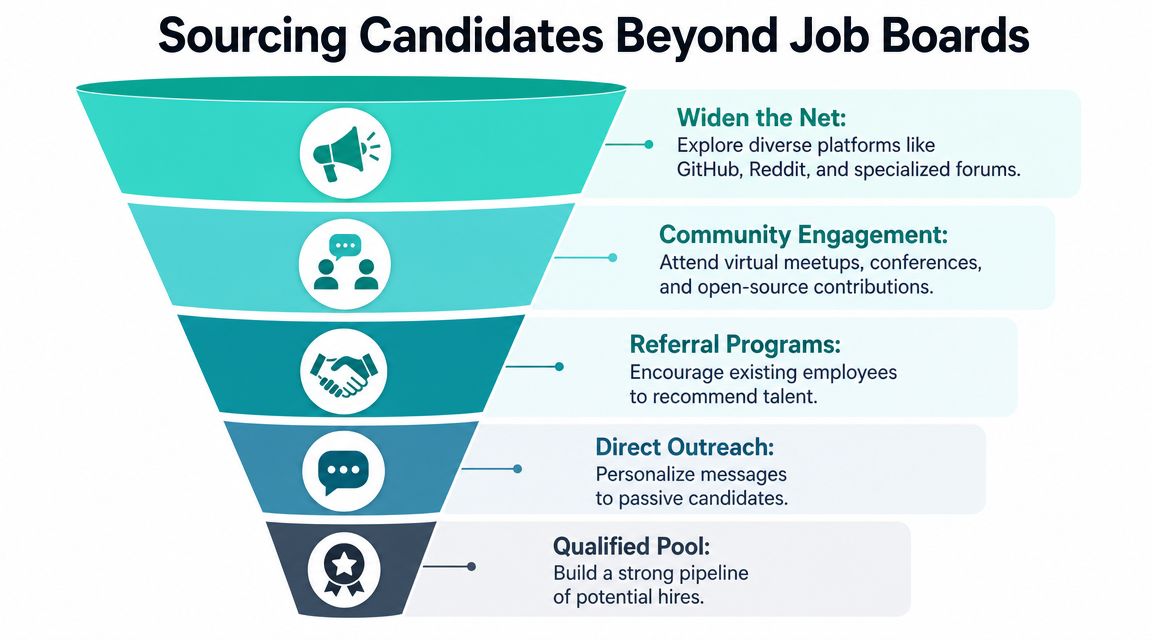
One sourcing channel rarely solves startup hiring on its own. Teams that need to hire quickly without lowering the bar usually combine a few sources, each with a clear job to do.
Team referrals
Referrals often produce the fastest credible conversations. Ask for names with context, not generic intros. “Who have you worked with that shipped UI fast, handled changing requirements, and collaborated well with design?” gets better results than “Know any frontend engineers?”
Niche communities
Strong frontend candidates often spend time where the work is visible. GitHub, framework forums, design engineering communities, and technical Slack or Discord groups can show how someone thinks, writes, and solves problems in public.
Direct outreach
Outbound works when the message is specific. Mention the product surface area, why their background fits it, and what ownership the role carries. Candidates who are not actively applying still respond when the role sounds real and the problem is interesting. This guide to passive candidate sourcing for startup hiring is useful if your team wants a more disciplined outbound process.
Curated talent sources
Curated marketplaces reduce screening load. That matters when the founding team or one recruiter is covering multiple roles at once. The trade-off is narrower top-of-funnel, but the starting quality is often better.
Framework demand still affects hiring speed. For example, the market for frameworks like React, Vue, Svelte is not evenly distributed, so candidate availability changes depending on what your product uses and how strict your requirements are.
That matters in startups because framework experience is only part of the picture. A React-heavy background helps, but it does not guarantee someone can work through unclear specs, spot UX gaps before launch, or keep a fast-moving codebase maintainable. Good sourcing starts with the stack and quickly moves to evidence of product judgment.
A technically capable developer can still struggle in a startup. The failure mode is usually not lack of coding ability. It is mismatch on pace, ownership, or comfort with incomplete information.
Early sourcing should screen for signals such as:
I have found that these filters save more time than another round of resume keyword searching. They also produce a better final slate because they reflect how startup frontend work operates.
Curated startup marketplaces can support that process. For example, Underdog.io operates as a curated hiring marketplace for startup roles, which can help if you want pre-screened candidates instead of a broad top-of-funnel.
Good sourcing should feel selective before the first interview. If too many candidates look vaguely plausible, the channel mix is too loose or the role is still underspecified.
“Strong frontend developer” means almost nothing unless your team defines it. At a startup, the bar usually isn't just visual implementation. It's whether someone can take a product requirement, build a reliable interface around messy real-world constraints, and leave the codebase better than they found it.
That's why interviews need a skill framework, not just gut feel.
A 2026 salary guide from Robert Half describes front-end developers as professionals who translate design mockups into functional code, build responsive and accessible interfaces, optimize performance, and integrate with back-end systems and APIs, as described in Robert Half's front-end developer job overview.
That description matters because it reflects how the role has expanded. Many teams still interview as if they're hiring someone to “make the UI look right,” but the work involved usually spans loading behavior, accessibility, API states, error handling, maintainability, and collaboration with design and product.
The cleanest way to assess frontend skill is to ask a simple question: where can this person hurt or help the product most?
If your startup ships quickly, poor component structure and weak state management create recurring drag. If your product serves a wide range of users, accessibility gaps become product quality issues. If your team depends on rapid iteration, weak communication with designers and PMs will slow delivery even when code quality is fine.
Here's a practical rubric.
| Skill Category | Must-Have Abilities | Nice-to-Have Abilities |
|---|---|---|
| Core web fundamentals | Semantic HTML, modern CSS, solid JavaScript, responsive layouts | Advanced CSS architecture, animation judgment |
| Framework fluency | Hands-on experience in your primary framework, component composition, state handling | Familiarity with multiple frameworks and migration trade-offs |
| Product implementation | Turning mockups into production-ready UI, handling edge states, form behavior, API integration | Design system stewardship, component library planning |
| Performance and quality | Debugging, basic performance awareness, testing discipline appropriate to the role | Deeper profiling, bundle strategy, rendering optimization |
| Accessibility | Awareness of accessible structure, keyboard behavior, readable UI patterns | Formal accessibility review habits |
| Collaboration | Clear communication with product, design, and backend peers | Ability to drive frontend standards across teams |
Framework familiarity matters, but it shouldn't dominate the evaluation. A candidate with deep React experience may still struggle if they can't reason about browser behavior, code organization, or user flows.
That's why I treat framework names as context, not proof. Many hiring teams overweight them because they're easy to screen for. What you want is someone who understands why a UI is built a certain way and can defend trade-offs when requirements get messy.
If your team is still sorting out stack requirements, this roundup of frameworks like React, Vue, Svelte is a useful reference for clarifying what your product architecture needs before you lock the role.
The strongest candidates usually talk about user behavior, maintainability, and constraints before they talk about tools.
Startups love unicorn specs. The result is often a scorecard that punishes good candidates for not also being experts in animation, analytics, accessibility audits, backend architecture, and visual design systems.
That's avoidable. Nice-to-haves should only influence a final decision when two candidates are already strong on the core job. They shouldn't become hidden vetoes.
A frontend hire succeeds when they can ship clean, usable, reliable product work in your actual environment. Everything else is secondary.
Most frontend interviews break down at the same point. The resume screen goes fine, the conversation sounds promising, and then the team uses an abstract coding challenge that has little to do with the job.
That approach filters for interview performance, not job performance.
A more reliable method is a practical simulation. Hiring guidance from Anthropos emphasizes that the strongest technical assessment is one that evaluates how candidates implement real UI behavior, optimize for performance, and communicate trade-offs, while warning against over-weighting self-reported framework familiarity without checking execution quality in a realistic setting, as noted in Anthropos on hiring frontend developers.
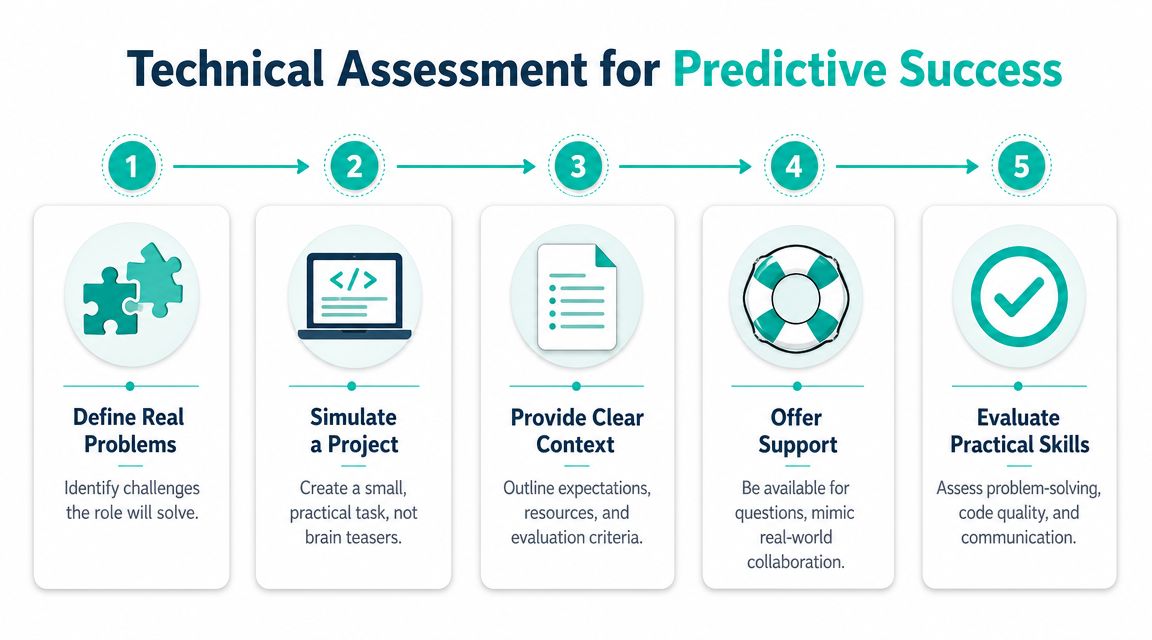
A good assessment looks like a reduced version of the work they'd do on your team.
That could be:
The assignment should be scoped tightly enough that candidates can complete it without turning their week upside down. You're checking judgment, code quality, and communication. You're not testing endurance.
The code review conversation matters as much as the submission. Plenty of candidates can produce acceptable code with enough time. Fewer can explain why they made specific choices and how they'd adapt the solution under product pressure.
Use the follow-up to probe areas like:
Trade-offs
Why did they choose this component structure? What would they refactor with more time?
Product reasoning
How did they think about validation, edge cases, or poor network conditions?
Collaboration signals
What assumptions did they make, and what questions would they ask design or product before shipping?
Maintainability
Is the code organized for future changes or only for initial completion?
One useful companion read is Underdog's guide to interviewing a front-end developer, especially if your interview team needs a clearer set of questions after the technical exercise.
A few patterns consistently produce weak signal.
| Assessment type | Problem |
|---|---|
| Algorithm-heavy whiteboard rounds | Measures a skill many frontend roles rarely use directly |
| Trivia-based framework quizzes | Rewards memorization over implementation judgment |
| Huge unpaid take-homes | Pushes away good candidates with limited spare time |
| Portfolio-only evaluation | Can miss whether the candidate personally owned the hard parts |
Ask candidates to show how they think under ordinary constraints. That's closer to startup reality than any polished coding stunt.
A practical structure looks like this:
That last step is easy to skip and expensive to miss. Frontend engineers spend a lot of time translating between design intent, technical limits, and business priorities. If they can code but can't communicate those trade-offs, the cost shows up after hire.
A candidate can ace the technical work and still fail in a startup. The final round is where you test for the part that rarely shows up in a code exercise: judgment under pressure, clarity with non-engineers, and willingness to own messy problems before they are fully defined.
This stage should feel close to the job itself. If your frontend engineer will spend half their week translating between design, product, and engineering, the interview should test that directly.
Keep the loop small. Four conversations are usually enough, and each one should answer a different hiring question.
The engineering manager or founder should probe ownership, pace, and decision quality. A senior frontend engineer should test code judgment and maintainability. A product manager or designer should focus on communication and requirement handling. If the role is senior, add one leadership conversation about mission fit and comfort with startup ambiguity.
The mistake I see often is overlap. Three interviewers ask broad culture questions, nobody owns the hiring decision areas clearly, and the team finishes with vague impressions instead of evidence.
Strong final interviews focus on moments where trade-offs were unavoidable.
Use prompts like these:
Ambiguity
“Tell me about a time you started building before requirements were fully settled. What did you clarify, and what assumptions did you make?”
Disagreement
“Describe a case where you pushed back on a design or product request. How did you frame the trade-off?”
Speed versus quality
“What have you shipped quickly on purpose? What did you keep clean, and what did you postpone?”
Cross-functional communication
“How do you explain frontend constraints to a designer or PM who wants a different outcome?”
Ownership beyond tickets
“What recurring frontend issue did you choose to fix without being asked?”
Listen for specifics. Good candidates describe the context, the constraint, the decision, and the result. Weak answers stay at the level of values and intentions.
A startup frontend hire needs enough judgment to protect delivery speed without producing months of latent cleanup work.
Run the hiring debrief while interview details are still fresh. Written feedback should come before group discussion when possible. That prevents the most confident person in the room from shaping everybody else's view.
A simple rubric works well:
| Decision area | What to ask |
|---|---|
| Can they do the work | Did they show practical ability in your stack, product constraints, and team setup? |
| Will they improve execution | Do they communicate clearly, handle trade-offs well, and reduce confusion for others? |
| Is this the right level now | Does their experience match the ownership your startup needs in the next 12 months? |
Keep feedback tied to observable evidence. “Strong communicator” is thin. “Explained how they would sequence UI states around API uncertainty, and raised the product risk before talking implementation” is useful.
Offers close faster when the role is defined transparently. Candidates want to know what they are joining, how much ownership they will have, who they will work with, and whether the cash-equity mix makes sense for the risk.
Salary ranges for frontend roles vary widely by market, stage, and level, so calibration matters. If you want a startup-specific reference point, Underdog's overview of front-end developer salary ranges for startup hiring is a practical benchmark for leveling and compensation conversations.
A good offer package usually includes:
Mission matters, but it does not replace a credible offer. If your startup is below market on cash, say that directly and explain why the role may still be attractive to the right person.
Presentation matters too. Teams that care about brand consistency in every candidate touchpoint often borrow ideas from adjacent hiring and marketing disciplines. This expert guide to promotional products is not a recruiting manual, but it is a useful reminder that small details shape how people remember your company.
Once the team decides, move quickly. Good frontend candidates rarely stay available for long, and slow offers lose hires that the interview loop already proved you want.
A frontend hire doesn't create value on the day they sign. They create value when they can understand the product, ship safely, and build trust with the people around them.
That's why onboarding deserves as much design as the interview loop. If your new hire spends the first two weeks chasing permissions, untangling local setup issues, and guessing which frontend standards matter, you've delayed the return on the hire before they've written meaningful production code.
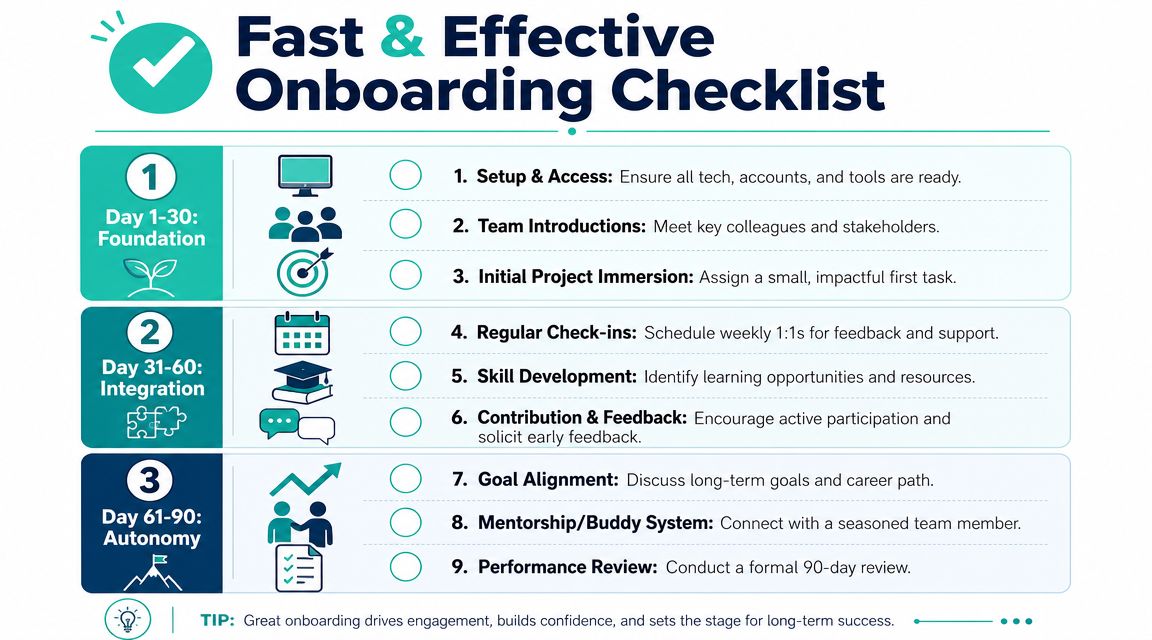
The first month is about orientation and safe contribution.
Use a checklist like this:
Environment readiness
Laptop, repo access, package managers, deployment permissions, analytics tools, design files, and documentation should be ready before day one.
Product context
Walk through the user journey, not just the codebase. Show where customers struggle, where the business cares most, and which frontend surfaces matter right now.
People map
Introduce the designer, product manager, engineering lead, and anyone who reviews frontend work regularly. New hires work better when they know who to ask and why.
First task selection
Give them a small but real piece of work. Good first tasks include a contained UI improvement, a bug with visible user impact, or a modest component enhancement.
The second month is where confidence and pattern recognition start to form.
At this stage:
A startup should also think about belonging, not just productivity. Small touches help, especially in remote teams. If you're building a welcome kit or team swag process, this expert guide to promotional products can be a practical reference for choosing useful items instead of the usual throwaway merch.
By the third month, the new hire should begin operating with less supervision and better product intuition.
Use this review frame:
| Timeframe | Expected outcome |
|---|---|
| First month | Setup complete, team relationships formed, first production changes shipped |
| Second month | Independent execution on scoped frontend work, stronger understanding of product priorities |
| Third month | Ownership of a meaningful area, clearer judgment on trade-offs, contribution to frontend quality standards |
New hires ramp faster when expectations are specific. “Own this workflow by the end of the quarter” works better than “settle in and learn the codebase.”
A formal 90-day review helps close the loop. Discuss what they've learned, where they need support, and what area they should start owning next. That conversation turns onboarding into momentum instead of a one-time checklist.
If you need to hire a front end developer without building a giant recruiting operation from scratch, Underdog.io is one option to consider. It connects startups with curated tech candidates and can be useful when you want a narrower, more relevant pipeline instead of sorting through a high-volume applicant pool.