You've got a mobile roadmap, a launch deadline, and a pile of résumés listing Dart, Firebase, Riverpod, and BLoC. The portfolios look polished. What's harder to tell is who can handle a broken native plugin, diagnose a device-only crash, and get the next build through store review without someone else taking over.
Hiring a Flutter developer should start with that distinction. Framework familiarity is useful, but production judgment is what you're hiring: the ability to make sensible trade-offs, verify behavior on real devices, and own a release after users find the edge cases.
Which part of your product is most likely to fail outside the widget tree? That question tells you more about the profile you need than a preferred state-management package.
A developer building forms against standard APIs faces a different job from someone connecting to Bluetooth hardware or maintaining background audio. WhatJobs' Flutter hiring guidance distinguishes widget proficiency from the platform channels, native integrations, lifecycle knowledge, and release operations needed for production mobile work.
| Product risk | Profile to hire | Native depth needed | Interview focus |
|---|---|---|---|
| UI-heavy MVP with standard APIs | Flutter product engineer | Light, mostly plugin use | Widget architecture, state management, API integration |
| Camera, Bluetooth, biometrics or background work | Mobile engineer with Flutter | Moderate to high, Swift or Kotlin | Platform channels, permissions, native debugging |
| Regulated, hardware-connected or performance-critical app | Native-fluent Flutter specialist | High, production native modules | Incident diagnosis, release failures, native bridge work |
| Multi-target product across web, desktop or embedded | Cross-platform architect | Target-specific native integration and build expertise | Deployment matrix, build pipelines, migration trade-offs |
Don't turn this into a requirement for every candidate to master every platform. For a straightforward MVP, demanding deep Swift and Kotlin experience can exclude engineers who could deliver the actual work. For a connected-device product, accepting plugin familiarity as native expertise creates the opposite problem.
Say your app records audio while users switch applications. A polished recording screen isn't enough. The engineer needs to reason about lifecycle transitions, permission denial, interrupted sessions, and what happens when the operating system stops the process.
Before posting, answer these questions:
If the framework decision is still open, compare the role with your approach to hiring React Native developers. Evaluate ownership boundaries and native requirements rather than choosing whichever keyword produces more applicants.
Write the profile and required native depth in a single sentence before anyone reads a résumé.
For example: We need a mobile product engineer who can deliver Flutter features and debug our Kotlin Bluetooth integration without handing the problem to another team.
A useful role brief tells candidates what they'll own, what already exists, and what they'll need to fix. A long inventory of packages doesn't do that.
Use this checklist to keep the posting focused.
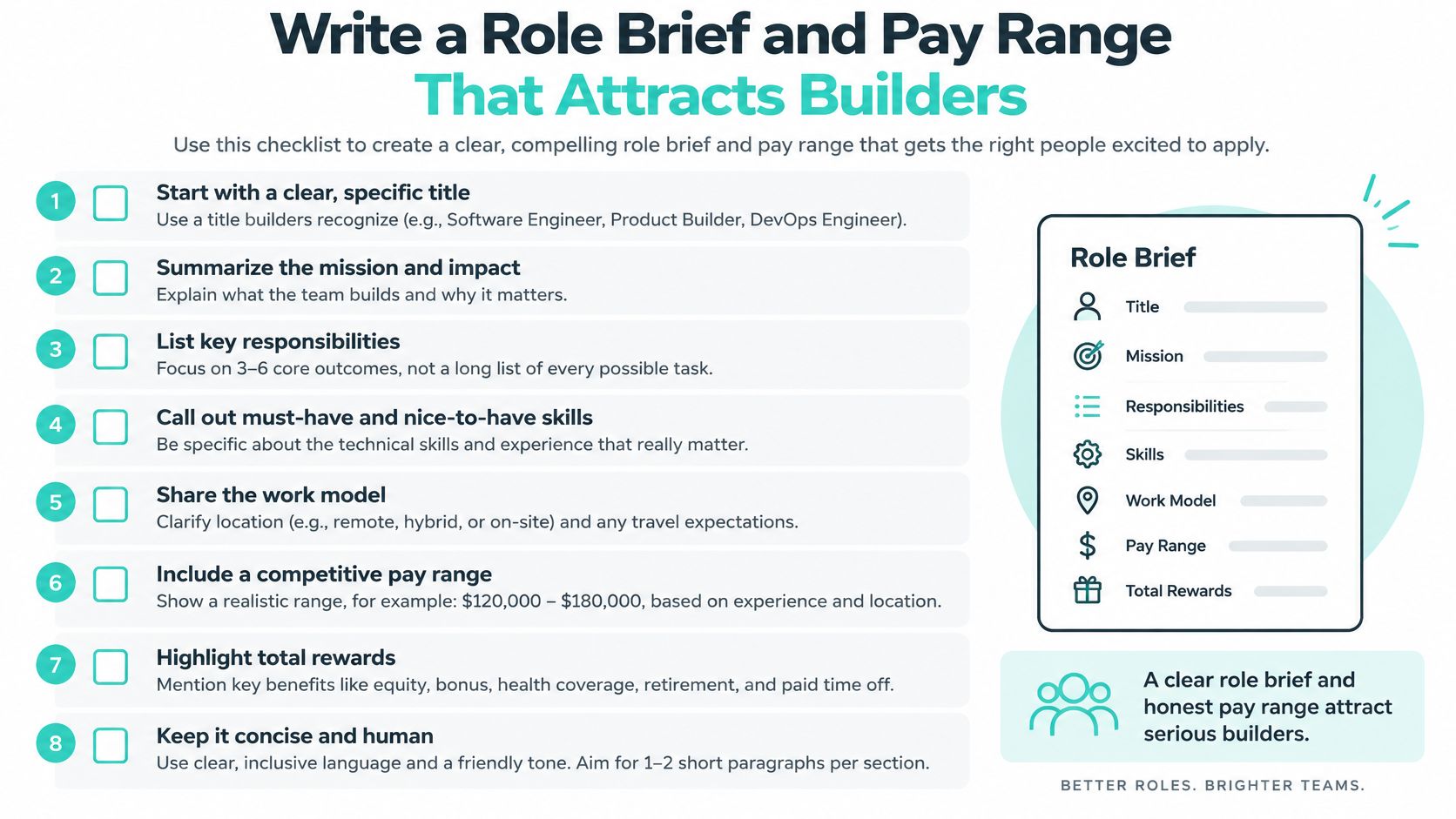
Use startup compensation benchmarks to frame the package consistently, and include the approved range in initial outreach.
The 2024 Stack Overflow survey figures summarized by Leenspace put Flutter usage at 9.4% of all respondents. That measures technology usage, not available candidates, so welcome strong Swift or Kotlin engineers who can also demonstrate shipped Flutter work.
Treat a bachelor's degree as a typical pathway, not your only evidence of capability. Apps, contributions, and a credible work sample deserve consideration.
In our Post & Search step, employers define the role with stack-specific questions and boolean logic. Before publishing, have the hiring manager approve the platform scope, ownership expectations, must-haves, pay range, and evaluation criteria.
A long skills list proves that someone knows which terms employers search for. It doesn't establish what they personally delivered.
Start with artifacts, then ask for attribution. A store listing establishes that an application exists; a candidate still needs to explain their contribution, decisions, and maintenance responsibility.
| Resume signal | Strong evidence | Weak evidence |
|---|---|---|
| Flutter timeline | Shipped apps built on stable Flutter releases, with maintenance history | Only course projects or tutorial apps |
| Platform scope | Store releases on iOS and Android plus named native integrations | Only cross-platform listed in a skills section |
| Testing | Unit, widget and integration tests running in CI, with named tools | Only the phrase unit tests, with no example |
| Performance | Profile-mode measurements and a specific bottleneck they fixed | Only the phrase optimized app, with no numbers |
| Ownership | A production incident or release they led end to end | Team-level claims with no stated role |
For timeline calibration, Very Good Ventures' Flutter history dates the first stable production release, Flutter 1.0, to December 4, 2018. Earlier work reflects early adoption; later work began with a stable framework. Neither automatically establishes seniority.
I recommend a thirty-second initial pass across these five signals. Advance candidates with strong evidence in at least three; hold the others unless an open-source contribution or focused work sample can establish the missing capability. This is a screening rule, not a validated predictor of job performance.
Don't make access to confidential employer material a hidden requirement. Accept redacted build logs, a public contribution, or a technical walkthrough when someone can't share proprietary code.
Artifact check: Ask for store links and build logs, not only screenshots. Screenshots show appearance; release records give you something independently checkable.
A candidate from a nontraditional background can meet the same standard. Evaluate the application, contribution, and explanation rather than treating education as a shortcut.
For promising résumés, write down the claim you need to verify next. “Owned Android release recovery” is testable in an interview. “Strong mobile engineer” is only an impression.
Replace framework trivia with a small debugging assignment. Give every candidate the same repository, explain the evaluation criteria, and keep the task separate from unpaid production work.
Use an existing scrolling or animation-heavy screen with a reproducible problem. Don't ask applicants to build a complete application just to demonstrate that they can assemble widgets.
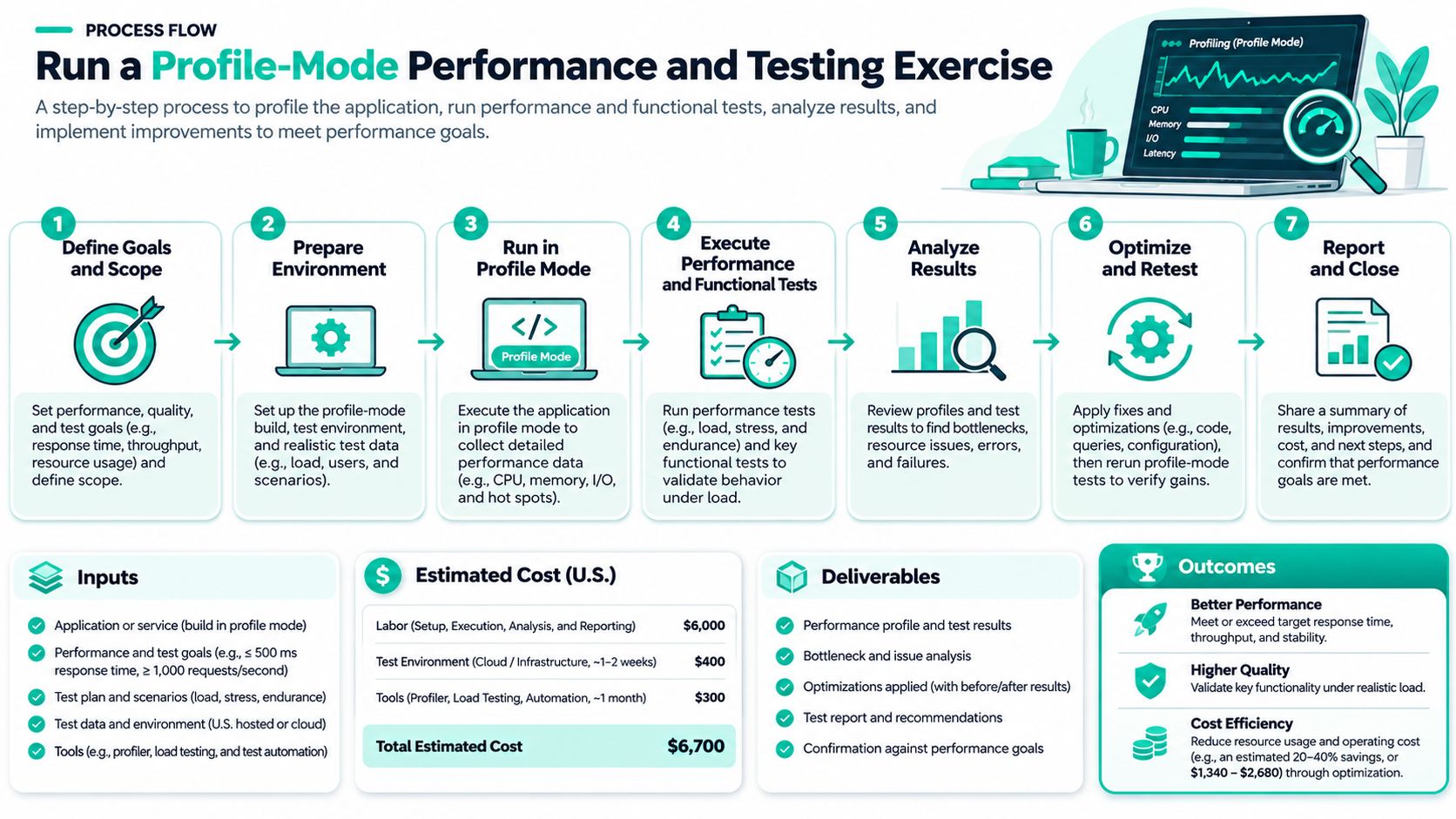
build(), inefficient list construction, repeated layout, opacity, clipping, and saveLayer.| Metric | What it reveals | What a strong result looks like |
|---|---|---|
| Frame build and raster time | Where each frame's cost lands | Both fit the refresh-rate frame budget after the fix |
| Total frame span | End-to-end frame timing | Reduced slow frames without shifting cost elsewhere |
| Percentile and worst-frame timings | Stutter that averages hide | Tail frames approach typical frames, with remaining outliers explained |
| Startup time | Cold-start cost before interaction | Measured before and after on the same device |
| Before-and-after delta | Whether the change helped | Same device, same user flow, documented change |
Don't award full marks because a chart turns green. Ask whether the candidate preserved behavior, introduced memory growth, or optimized an unrealistic fixture. A convincing explanation connects the trace to the code change and acknowledges what remains uncertain.
Flutter's testing overview distinguishes fast, focused unit tests from widget tests and broader, slower integration tests. Ask the candidate to explain why each assertion belongs at its chosen layer.
For checkout, business rules belong below the UI, loading and error states belong in widget tests, and the critical purchase journey needs integration coverage. Assertions should detect incorrect behavior, not merely confirm that a widget exists.
Ask which tests run on every pull request and which belong in nightly device runs. Look for deterministic fixtures, useful failure messages, and an explanation of how they would diagnose a CI-only failure.
The same principle applies when testing IT candidates in the era of AI: evaluate whether they can explain, modify, and verify the result. Tool-assisted code is acceptable; unexplained code isn't evidence of ownership.
Give the candidate your actual device targets: Android phones, iPhones, macOS, Windows, or web browsers. Ask them to map operating-system versions and hardware architectures against Flutter's supported-platform documentation, which distinguishes supported, CI-tested, and unsupported combinations.
Let them consult the documentation. You're evaluating whether they can build a dependable deployment plan, not memorize a changing compatibility table.
Anyone can recite the platforms Flutter targets. What separates candidates is whether they can turn a support matrix into a delivery commitment. Have them produce a compact matrix covering supported versions, build requirements, native dependencies, and testing responsibility. They should distinguish official framework support from confidence in your particular plugin stack, because a plugin that lags behind OS releases can become your release blocker.
Use a concrete scenario: your mobile app must support an older Android fleet while adding a Windows client. Ask what they would investigate before promising feature parity.
Push on the Windows column specifically. A candidate who treats it as a free add-on hasn't shipped desktop. One who asks about windowing behavior, input differences, and packaging before committing has.
Next, ask for a feature they delivered across iOS and Android. Have them separate shared Dart logic from native implementation and explain how they measured iteration speed.
The Google Classroom Flutter showcase reports that its single codebase improved development time across platforms by at least 50%. Treat that as a documented team outcome, not a forecast for your roadmap. The useful interview question is what the candidate would measure: build waiting time, duplicated implementation, validation effort, or time from approved change to release. Vague claims about velocity are résumé filler. Named metrics with a baseline are evidence.
For a live work sample, provide an existing screen and request a change that preserves state. Then ask how they would validate navigation, interruptions, and platform behavior beyond the happy path.
Ask when they would choose a native module or separate platform implementation. A strong answer names the constraint: unsupported SDK behavior, plugin maintenance risk, lifecycle restrictions, or an integration that becomes harder to maintain through a bridge. This question matters more than any framework trivia, because the expensive mistakes happen at the edges where Flutter hands control to the platform.
KORE1's Flutter hiring guidance highlights the distinction between mobile product engineers, platform specialists, and broader cross-platform roles. Use migration questions to expose that judgment: how would they preserve feature parity, replace an unsupported module, and stage rollout without forcing a risky rewrite?
Score specific versions, build requirements, fallback behavior, and rollout steps. The red flag is an answer that treats cross-platform as meaning no platform-specific work. That belief survives exactly one production release.
Choose the candidate whose evidence fits your product risk, not the person who delivered the smoothest interview. A hardware-connected product needs a different balance of strengths from a UI-heavy MVP.
Compare independently recorded assessments before the panel discusses its preference. Otherwise, a confident interviewer can turn an impression into a team consensus without adding evidence.
Use a weighted scorecard with five criteria:
Choose the weights before reviewing finalists. Increase platform judgment for hardware-heavy work; give testing and ownership greater emphasis when the engineer will maintain a sensitive production workflow. Don't change the weighting afterward to justify a favorite.
Set the offer within the approved pay range, with remote expectations and equity terms made explicit. If the candidate's scope exceeds the role you budgeted for, resolve that mismatch rather than implying that compensation can be fixed later.
With the candidate's permission, ask references about a release that went wrong. What did the engineer personally do, how did they communicate uncertainty, and what changed afterward?
A useful reference describes actions under pressure, not just whether someone was pleasant to work with.
I recommend making the offer within a week of the final interview. Treat that as an internal operating deadline, not a guarantee that the candidate will accept.
If internal sourcing is slow, contact nexusITgroup.com for staffing support. Our Hunt by Underdog.io service also gives employers access to vetted tech recruiters working on a contingent basis.
Before the next interview loop, write the five-criterion weighted scorecard, name the decision owner, and commit to sending the hiring panel a first shortlist within two weeks.
Underdog.io offers a curated hiring marketplace connecting startups with developers and other tech talent. Visit Underdog.io to define your Flutter role around platform requirements, seniority, and production ownership, then start building a shortlist you can evaluate against the same scorecard.