You sent the email. The role is solid. The company is real. You even spent time on the wording.
Then nothing happens.
No reply. No decline. No curiosity. Just silence.
That's the normal outcome when a recruiting email reads like a job ad pasted into someone's inbox. Most outreach fails for the same reason. It treats the candidate like a lead instead of a person with context, options, and limited attention. That problem gets worse with senior engineers and product managers who are already employed, wary of recruiter spam, and careful about where they engage.
How (not) to write recruiting emails isn't about finding a clever trick. It's about changing what the email is trying to do. The goal isn't to dump information. The goal is to earn a response from someone who wasn't planning to think about your role today.
That means writing with restraint. It means proving relevance fast. It means giving people a reason to trust that this conversation is worth having. A lot of the mechanics overlap with strong outbound practice in other fields. If you want a useful contrast point, this guide for sales professionals on cold emails is worth reading because it shows how much response depends on specificity, timing, and a low-friction ask.
The difference in recruiting is that top tech talent doesn't want to be “sold.” They want to know whether the opportunity respects their time, protects their discretion, and aligns with how they want to work.
Most ignored recruiting emails have one of three problems. They're too generic, too long, or too employer-centric.
A passive engineer can spot all three in seconds. The subject line sounds mass-sent. The opening line says you found them on LinkedIn. The body turns into a compressed job description plus a company pitch plus a request for a call. Even if the role is good, the email creates work for the recipient. They have to figure out whether you've thought about their background and whether this is safe to engage with while employed.
The fastest way to lose credibility is to send an email that could go to a hundred other people with the same title. In-demand candidates aren't just evaluating your opportunity. They're evaluating your judgment.
If your email says “your background looks interesting,” you haven't said anything. If it lists every requirement in the role, you've shifted the burden onto them. If it sounds automated, they'll assume the process behind it is automated too.
The inbox test is simple. If the candidate can swap their name with someone else's and the email still works, it's probably not good enough.
Recruiting email guidance across multiple sources points in the same direction. Strong outreach is short, specific, and easy to scan. One industry guide says recruitment emails should be 75 to 150 words, another recommends 150 to 200 words, and benchmark summaries point to 50 to 125 words as an ideal range, with response rates of 50% or higher in that range according to the roundup in Mailsoftly's recruiting email guide.
That doesn't mean every short email is good. It means long emails usually ask too much attention upfront. For passive talent, brevity signals respect.
Recruiters usually know the hiring manager's pain. Candidates care about their own next move.
That gap is where most outreach dies. You're writing about stack, funding, and requirements. They're thinking about autonomy, product quality, flexibility, manager quality, and whether this move would improve their day-to-day work. If your email doesn't connect to that layer, it gets archived.
Before writing a subject line, get clear on what you're selling. It usually isn't the title. It isn't the compensation package by itself either. For passive tech talent, the strongest attractors are often about how work feels, how decisions get made, and whether the team builds the right way.
Underdog.io looked at candidate preference data from the first half of 2026 across 12,639 candidates. The pattern is useful because it shows what candidates prioritize before they ever take a recruiter call. A deeper breakdown appears in this analysis of what candidates actually care about.
| Attractor | Percentage |
|---|---|
| Flexible Work Environment | 11.54% |
| High Autonomy | 9.57% |
| Values Product Quality | 8.86% |
| Remote First | 8.38% |
| Transparent Management | 7.87% |
| Close-Knit Team | 5.85% |
| Inclusive Culture | 5.67% |
| Above-Market Salary | 5.55% |
| Focus on Mentorship | 4.64% |
| Meaningful Equity Compensation | 4.64% |
The takeaway isn't “mention every attractor.” The takeaway is that your message should lead with the parts of the role a strong candidate is screening for.
If Flexible Work Environment is the top attractor at 11.54%, don't bury working norms in paragraph four. Put them near the top if they're strong. If the team offers High Autonomy at 9.57%, say what that means in practice. Do engineers own technical decisions? Do PMs shape roadmap trade-offs? Do people need three approvals to ship?
Values Product Quality ranking at 8.86% matters too. A lot of recruiting emails accidentally pitch speed, chaos, and “fast-paced” ambiguity. That repels people who care about craft. If the company invests in product quality, say so plainly and make it concrete through process, expectations, or team philosophy.
The interesting part of this list is what sits above compensation. Above-Market Salary appears at 5.55%, below work environment, autonomy, product quality, remote setup, and management transparency. Meaningful Equity Compensation sits at 4.64%.
That doesn't mean compensation doesn't matter. It means that for many passive candidates, compensation is one filter among several. If your outreach leads with money and ignores operating conditions, you can sound transactional.
Practical rule: Lead with the part of the opportunity that changes how the candidate will work, not just what they'll be paid.
Weak outreach says:
Better outreach says:
That's the difference between describing a vacancy and describing a working environment someone might choose.
The subject line gets the open. The opening sentence earns the next few seconds.
Most recruiters miss both because they write for efficiency. They optimize for sending more emails, not for making one email feel worth reading. In a crowded inbox, vague language is expensive.
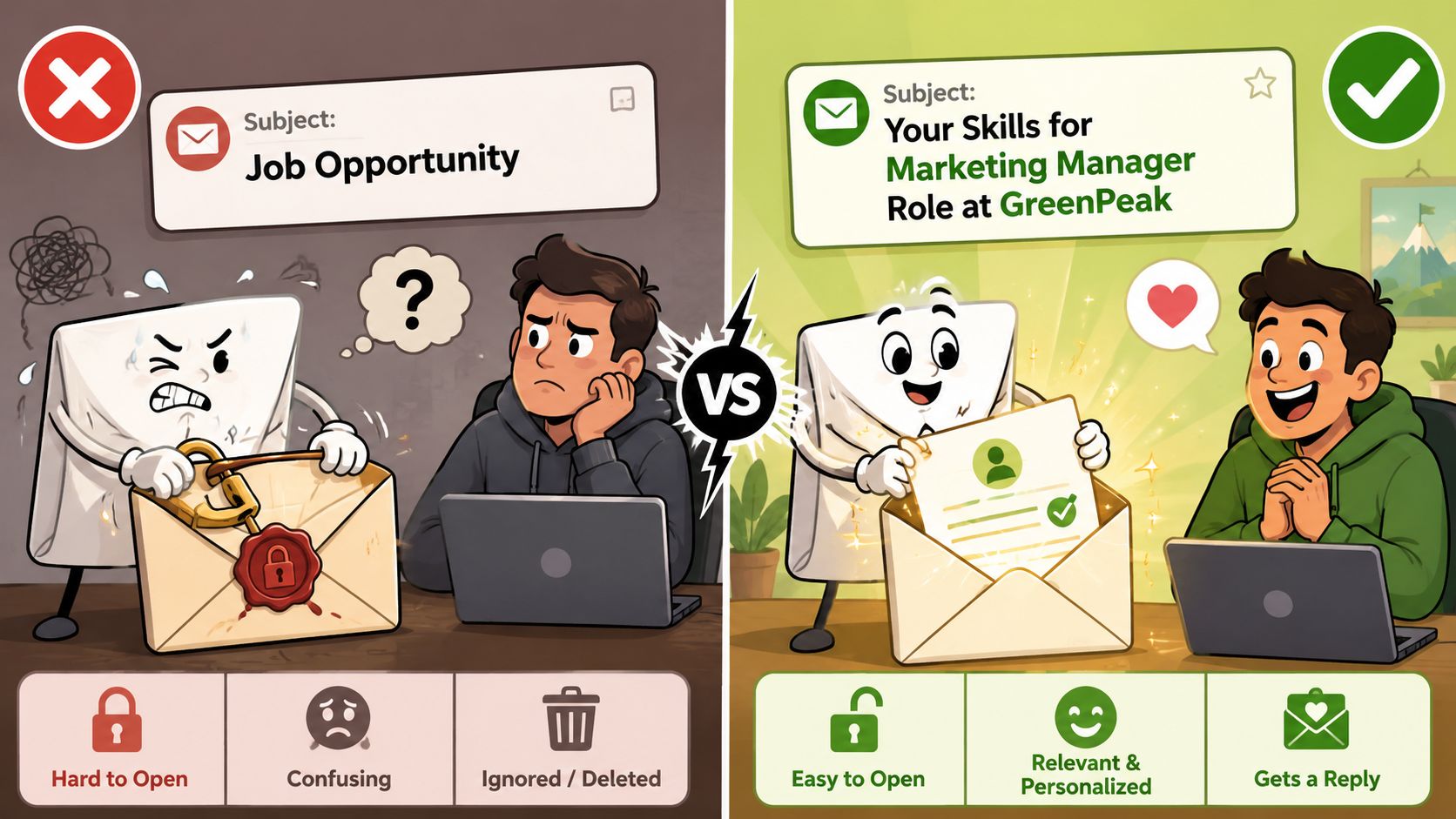
There's good benchmark evidence that subject-line personalization matters. Gem reports that adding at least one personalization token in the subject line can improve open rates by about 4.8%, as summarized in this recruiting outreach benchmark guide.
That doesn't mean stuffing in first names. It means giving the candidate a reason to believe the message is about them.
A separate recruiting-email guide says strong subject lines are typically 30 to 50 characters, which is a useful constraint because it forces clarity rather than cleverness.
| Don't send this | Send something closer to this |
|---|---|
| Exciting Senior Engineer Opportunity | Your work on developer tooling |
| Opportunity at a stealth startup | Question about your infra background |
| We're hiring remotely | Remote staff backend role, product quality focus |
| Great PM role for you | Noticed your marketplace experience |
The better examples work because they hint at relevance. They don't overpromise. They don't sound like marketing copy.
If you want more examples grounded in recruiting workflows, these data-backed cold recruiting outreach templates are a useful reference point.
The opening line is where most emails reveal themselves.
“I came across your profile on LinkedIn” tells the candidate nothing. It signals a search result, not a reason. Replace it with one specific observation that links their work to your role.
Use material you can stand behind:
What matters is accuracy. Don't fake familiarity. One true detail beats three generic compliments.
I'd rather send ten emails with a real observation in the first line than fifty that start with “impressive background.”
Weak opener
I came across your profile and thought you'd be a great fit for an exciting opportunity at our client.
Stronger opener
I saw that you've spent the last few years working on developer-facing infrastructure. We're hiring for a role where that experience would matter immediately because the team is rebuilding core internal tooling used across the product org.
Weak opener
Your experience looks impressive and aligned with what we need.
Stronger opener
You've worked across both platform reliability and product delivery, which is a rare mix. That stood out because this team needs someone who can improve system quality without disappearing into pure internal work.
The candidate doesn't need a masterpiece. They need evidence that you know why you emailed them.
An engineer opens your email between meetings, scans six lines, and decides in ten seconds whether to archive it. That decision usually comes down to one question: is this worth my attention right now?
For passive tech talent, the body has one job. Make the opportunity legible without asking for trust you have not earned yet. The strongest messages stay short because senior engineers and product managers do not need a full pitch deck in their inbox. They need enough substance to judge fit, risk, and whether replying is worth the exposure.
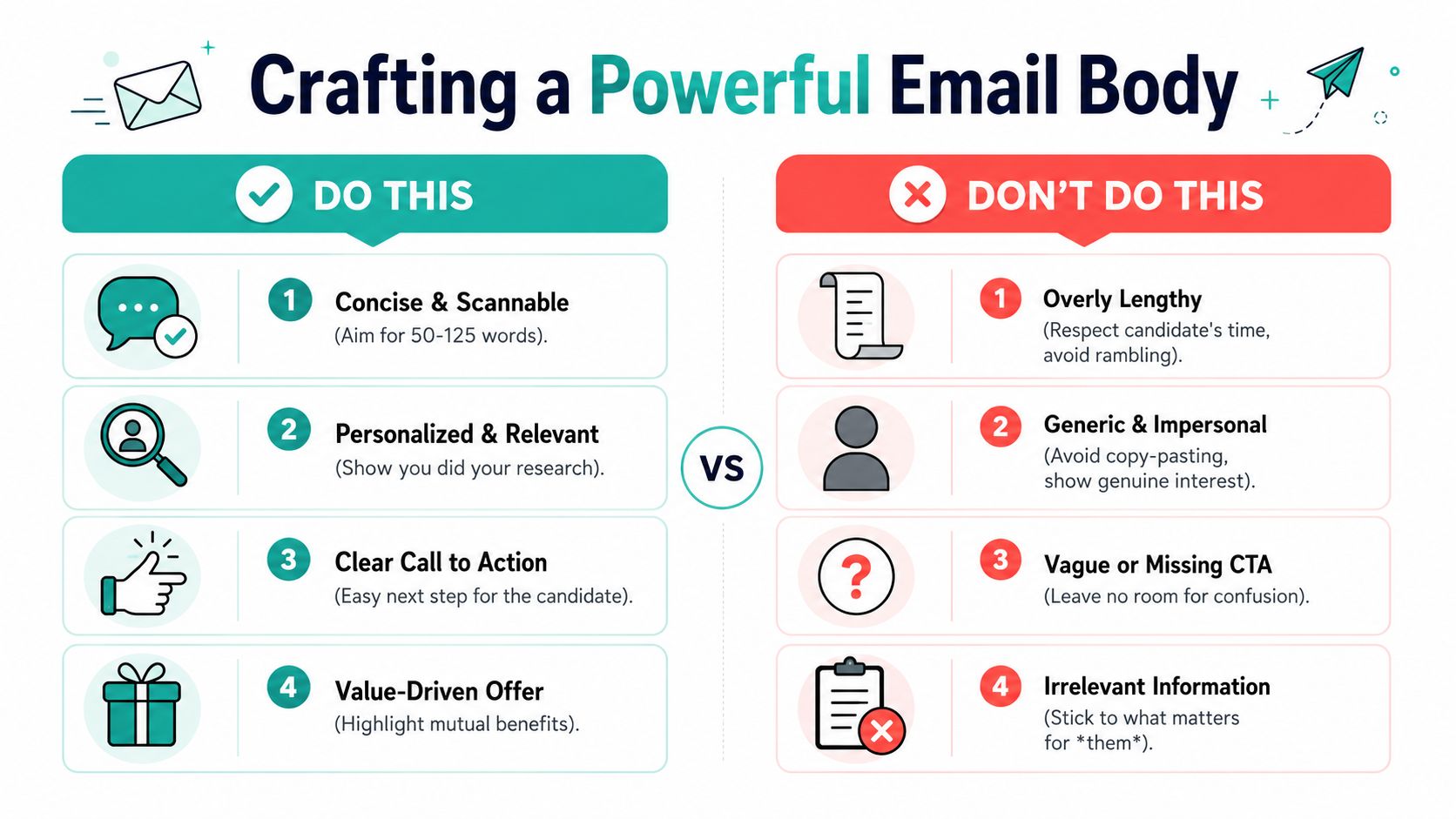
I use a simple structure: hook, pitch, ask.
Hook
Start with the specific reason this person is getting this email.
Pitch
Explain why the role could be relevant to their work, priorities, or career direction.
Ask
Offer one clear next step that is easy to accept.
This structure works well with passive candidates because it respects how they evaluate inbound. They are not trying to be sold. They are screening for signal. Underdog.io's candidate data is useful here because it consistently points recruiters back to the same attractors: meaningful scope, strong compensation, team quality, flexibility, and product substance. Put those details in the body if they are real. Leave out anything vague.
The hook proves the email is for them.
The pitch translates the role into candidate terms. Good recruiters miss this all the time. They describe the company, the funding, the stack, and the hiring manager, but never answer the candidate's real question: why would someone with my background take this call?
The ask lowers the cost of replying. For high-demand talent, that matters. A clear, low-pressure CTA gets more responses than a request that sounds like the start of a process.
You've spent the last few years working at the intersection of platform reliability and developer experience. I'm hiring for a backend role where that mix matters because the team is rebuilding shared systems that affect product speed across the company.
The role has real ownership, a remote-first team, and a product org that expects engineering to shape decisions, not just execute them.
Open to a brief conversation next week, or would you prefer details over email first?
That email gives enough substance to evaluate. It also gives the candidate a discreet way to engage.
Weak recruiting emails usually fail in the middle. The opener gets attention, then the body collapses into generic selling or too much information.
Cut these:
A broader guide to crafting cold emails is useful here because the discipline is the same. Write for one reader, make one case, and ask for one next step.
Use asks that are easy to answer:
Short helps. Specific gets replies.
One practical trade-off is worth calling out. If you strip the body down too far, the message feels like mass outreach. If you over-explain, it feels demanding. The right middle ground is enough detail to show you understand what this person would care about, plus a reply path that protects their discretion. That is what gets passive candidates to answer.
Most recruiting follow-ups are weak because they add nothing.
“Just bumping this up” is easy to write and easy to ignore. It reminds the candidate that you want something, but it doesn't give them any new reason to engage. Strong follow-up emails work differently. Each one introduces a fresh angle, a useful detail, or a lower-friction path to respond.
A well-structured follow-up plan matters. Best practice guidance says a three-message sequence often yields the most responses, with 3 to 5 business days between messages and sends timed Tuesday through Thursday, according to Recruiterflow's recruiting email guidance.
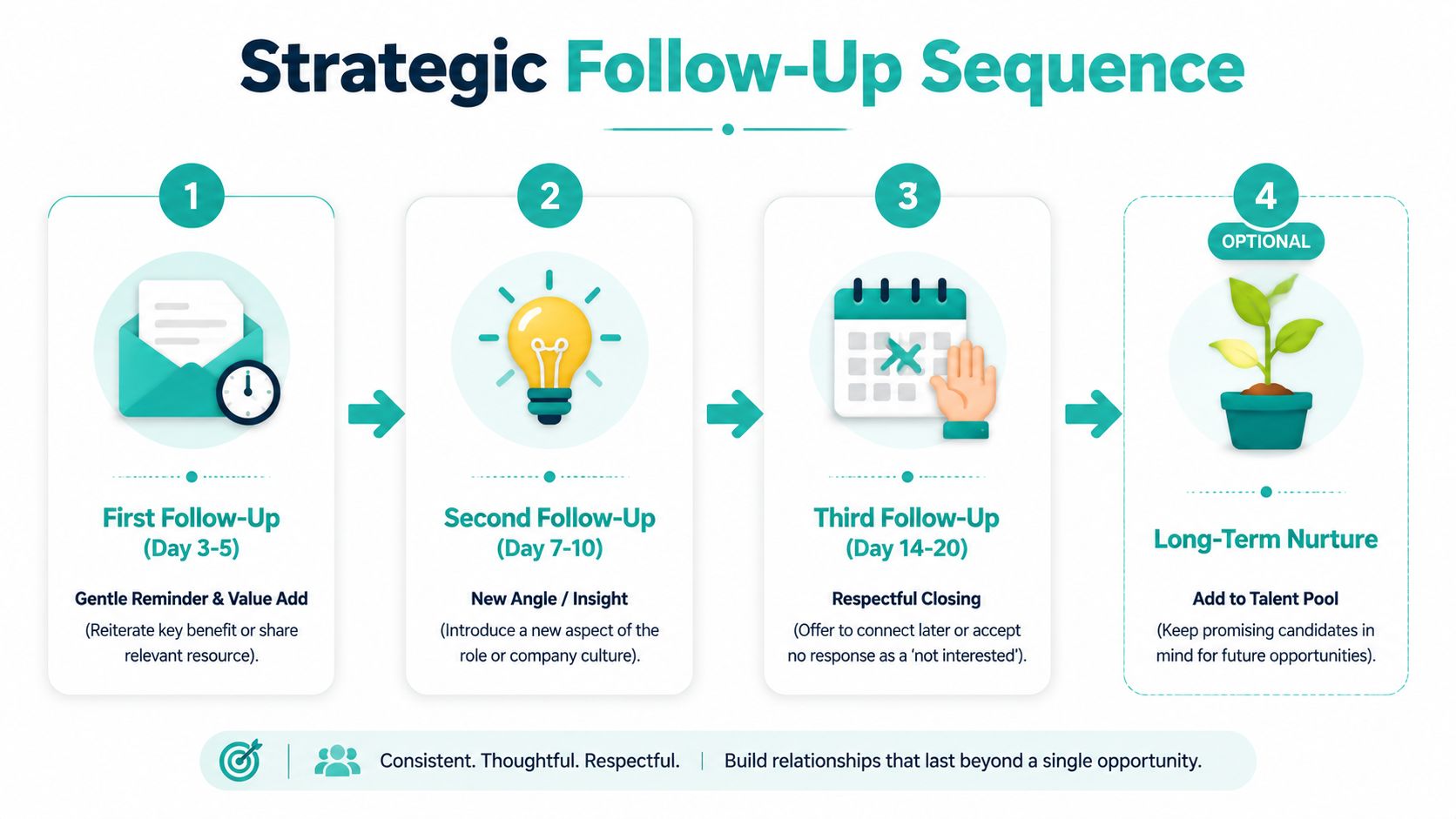
The purpose of a sequence isn't repetition. It's progressive relevance.
Email one should establish relevance.
Email two should add a new proof point. That could be something about engineering culture, product direction, team structure, or management style. Don't resend the first email with “circling back” on top.
Email three should be short and clean. Acknowledge that no reply may mean the timing isn't right.
Here's what that can look like:
Following up in case the note below got buried. One reason I thought this might be relevant is that the team gives engineers real ownership over architecture choices rather than routing everything through top-down decisions.
Second follow-up:
One more thought in case this is directionally interesting. The role sits on a small team that cares a lot about product quality and cross-functional collaboration, which stood out given your background bridging platform and product work.
Closing note:
I'll leave it here after this. If the timing isn't right, no problem. If you'd rather stay in touch for a later role, happy to do that too.
Public advice on recruiting emails often focuses heavily on the first message and not enough on what to do after silence. That's a mistake. Follow-up is where tone matters most.
The candidate is asking themselves a quiet question with every additional email: does this recruiter understand boundaries?
A respectful sequence answers yes. It spaces outreach. It changes the message. It stops before it becomes needy. If you work with a marketplace or recruiting platform that supports discreet candidate exploration, including options like anonymous profiles or mutual opt-in, that can also help reduce friction for already-employed candidates. Underdog.io, for example, uses anonymous candidate profiles until interest is mutual, which fits privacy-sensitive outreach.
Open rate is useful, but it's not the metric that tells you whether your recruiting emails are working.
An email can get opened because the subject line was decent. That doesn't mean the role was compelling. It doesn't mean the pitch was relevant. It definitely doesn't mean the conversation moved forward.
According to Gem's benchmark data, a typical first recruiting email achieves a 61.4% open rate, an 8.3% reply rate, and a 3.9% interested rate, as reported in Gem's recruiting email benchmarks. That gap is the main lesson. Getting attention is easier than converting attention into interest.
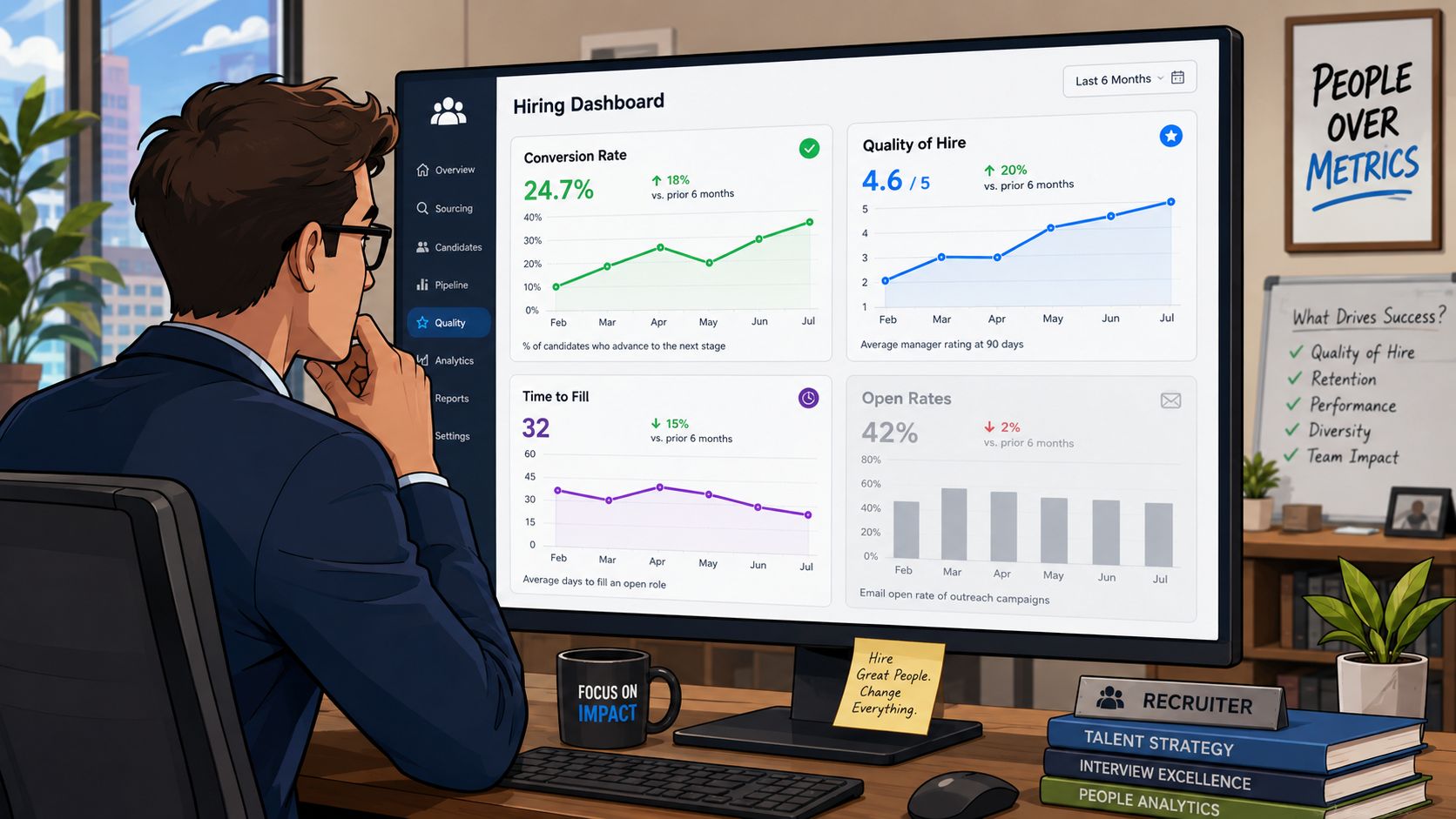
A stronger recruiting dashboard focuses on downstream signals:
If you only watch opens, you'll optimize for curiosity. If you track interest, you'll optimize for fit.
Change one thing at a time.
Test a different subject-line style. Test a different opener. Test whether autonomy beats product quality for a given audience. Test whether your CTA is too broad. Then compare reply quality, not just volume.
A lot of hiring teams also benefit from tying outreach metrics to broader quality of hire metrics. That's where email strategy stops being an isolated sourcing tactic and starts becoming part of a hiring system.
If the email gets opens but not interested replies, the problem usually isn't deliverability. It's positioning.
Good recruiting emails aren't the ones that sound polished. They're the ones that create the right kind of response from the right people.
If you're hiring for startup and high-growth tech roles and want a more discreet way to connect with engineers, product managers, designers, and data talent, Underdog.io is a curated hiring marketplace where candidates can explore opportunities confidentially and companies reach out after mutual fit becomes clear.