You're probably staring at a half-finished resume, a LinkedIn profile that feels too thin, and a long list of courses that haven't turned into interviews. You've applied, gotten silence, and started wondering whether “no experience” means “no chance.” It doesn't. It means the old shortcut, polish a resume, send it everywhere, wait, is broken, and you need a sharper game plan.
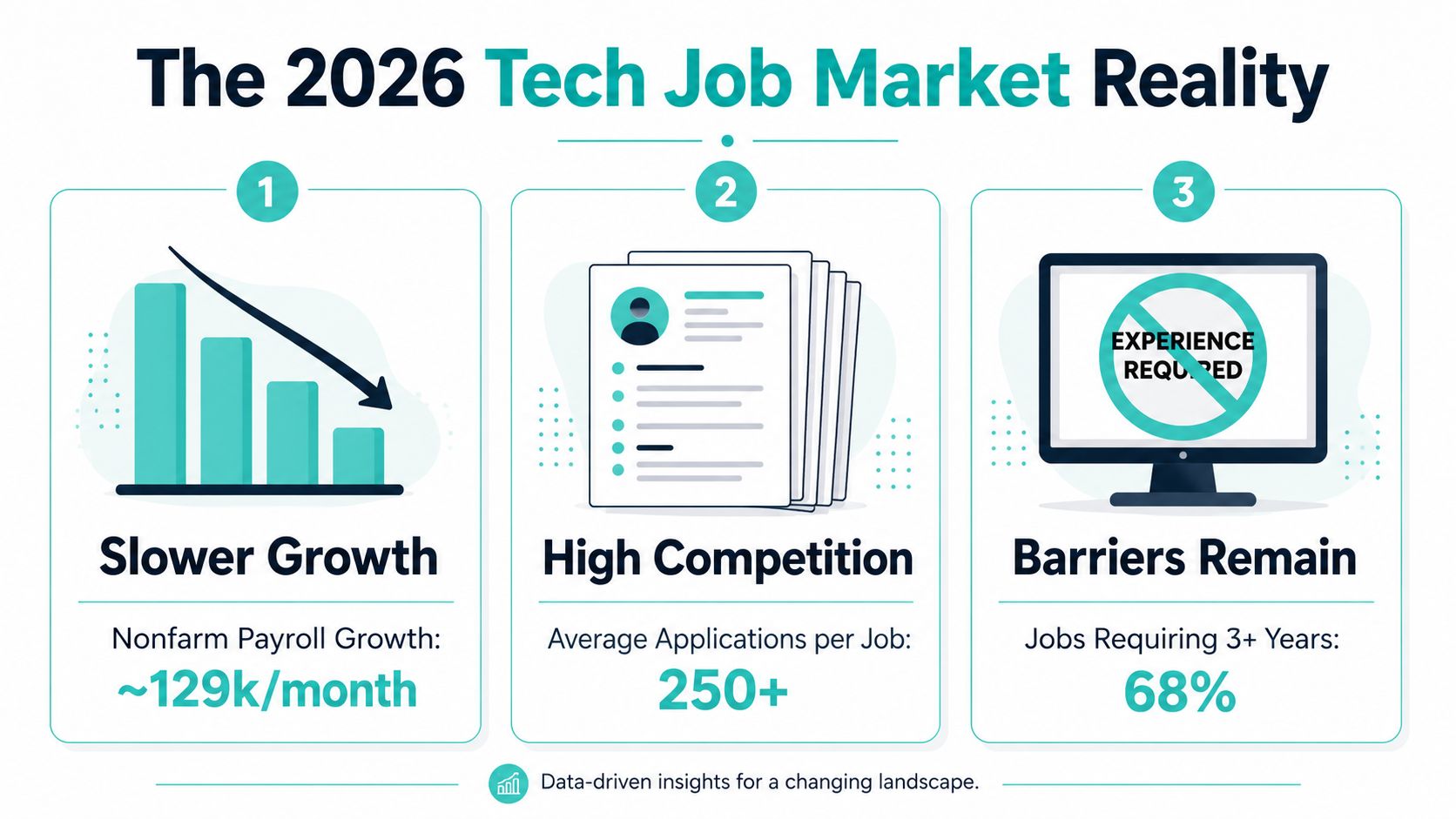
The hardest part in 2026 is the flood of applicants who look interchangeable on paper. Recruiters are sorting through more automated submissions, more recycled resumes, and more profiles that all claim the same thing, so proof of skill now matters more than intent. Tech hiring is still active, but the bar for getting noticed is higher, and the market keeps rewarding candidates who can show actual work, not just interest. Analysts tracking tech hiring trends have also pointed to a slower, pickier environment, which is exactly why generic applications get ignored.
Beginners burn months on tutorials because tutorials feel productive. Hiring managers do not care that you finished a playlist. They care whether you can do the work they need done next quarter.
Start with the job post, not the course catalog. Open 10 job posts for the exact title you want, copy the requirements, and treat the skills that show up in at least 6 of the 10 listings as your curriculum (IE University guide). That keeps you from wasting time on tools and frameworks that do not show up in real openings.
If you have worked in customer support, sales, teaching, operations, or admin, you are not starting from zero. You are starting with adjacent evidence. Employers care about troubleshooting, communication, coordination, analysis, and follow-through, especially in startup hiring where cross-functional adaptability matters.
Practical rule: do not ask, “What tech job can I get with no experience?” Ask, “What role matches the strongest proof I already have?”
A former support rep usually has better odds in IT support, customer success, or operations-heavy roles than in a pure backend engineering role. A teacher often fits training, onboarding, or UX research support better than product management. If you do not map your background to the job, you will compete on the weakest possible terms.
You do not need to explore every tech path. You need to choose one. The common lanes are engineering, product, design, data, and marketing-adjacent work. The right choice depends on where your existing skills overlap with the work, not on which role sounds coolest on TikTok.
Use your own work history to narrow the field, then compare it against current openings on Underdog.io's tech hiring trends. That gives you a practical read on where companies are hiring and what they expect from junior candidates.
If you want a second outside source while you narrow your direction, the research for students hub is useful for comparing roles and pressure-testing what kind of proof each path expects.
A portfolio that only proves you finished a course is dead weight. Recruiters open work that looks like someone built it to solve a real problem, not to impress a bootcamp instructor. Two finished projects are far more useful than six half-baked clones.
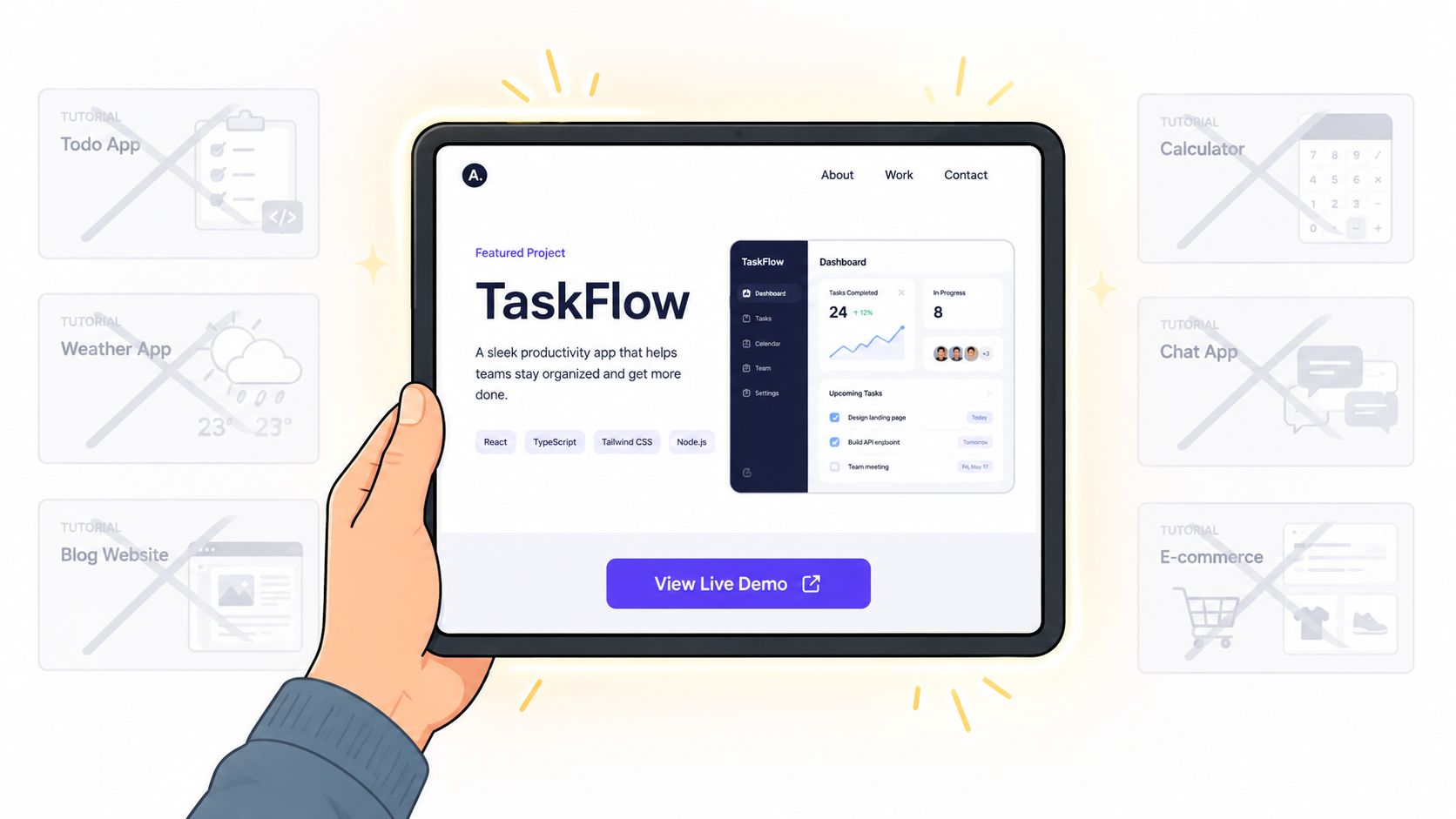
The cleanest benchmark from structured entry-level guidance is two finished projects before you apply (IE University guide). That is not enough to fake seniority, and that is fine. It is enough to show that you can complete work, document choices, and explain tradeoffs.
For engineering, build a small but real API and write documentation that another person could follow. For product, write a teardown of a SaaS product and propose specific improvements. For UX, publish a case study with research, iteration, and a clear design decision trail. For data, ship a public notebook that answers a real business question instead of a toy dataset.
A recruiter does not just scan for code or screenshots. They look for evidence that you understand constraints, can explain your process, and can finish. That is why your project page should answer three questions fast, what problem did you tackle, what did you build, and why did you choose that approach?
Your GitHub matters too, but only if it looks intentional. Clean repository names, readable README files, setup instructions, and a short explanation of tradeoffs do more for you than flashy naming. If your repo reads like a lab notebook, you are leaving the wrong impression.
Strong portfolios do not scream “I studied.” They quietly show “I can ship.”
Do not choose projects because they are trendy. Choose them because they mirror the work in the jobs you want. Pull those 10 target job posts again, extract the recurring requirements, and let the overlap guide your project scope.
That is how you avoid the classic beginner trap, building a weather app, a clone, and another clone. A hiring manager can spot tutorial work in seconds. They can also spot when a project includes actual judgment, such as prioritizing features, documenting limitations, or making a sensible tradeoff.
Beginner coding projects can help you sanity-check what counts as a believable first portfolio piece, but keep the rule simple, if you cannot explain why it exists and what problem it solves, it is not ready.
A portfolio also has to help you pass the first screen, not just the admiration test. Recruiters skim for proof that you can do the work and that you are not spraying generic applications everywhere. Pair the portfolio with a resume that is built for how to beat applicant tracking systems, then make your project descriptions match the role you want, not the course you finished.
Your resume has one job, get a human to keep reading. Your LinkedIn has one job, make that reading feel safer. If both still read like a college grad's first draft, they're costing you interviews.
Most beginners bury their past work because it doesn't say “engineer” or “designer.” That's a mistake. Employers routinely look for transferability, and Pluralsight's method is the right one, pull the job description, list the required skills, then map your existing capabilities to them so your resume speaks the employer's language (Pluralsight).
If you worked in customer support, don't just list duties. Show troubleshooting, ticket handling, escalation judgment, and communication under pressure. If you were in sales, show pipeline discipline, CRM use, objection handling, and process consistency. If you were in operations, show coordination, reporting, workflow improvement, and stakeholder management.
The first screen should tell the reader what you are transitioning into. Use a headline or summary that makes the pivot obvious, not hidden. Write one direct sentence about the role you want, then add proof in the form of projects, certifications, or relevant work history.
That summary should sound like a real person, not a brand deck. Good example, “Career-switcher focused on data analysis, with hands-on project work in Python, SQL, and dashboarding, plus five years of client-facing problem solving.” That sentence is useful because it connects your target role to concrete evidence.
For ATS survival, you also need the format to be boring in a good way. Use standard section headings, avoid charts, avoid text boxes, and keep the language close to the job post. If you want a practical walkthrough of ATS-friendly positioning, the guide on how to beat applicant tracking systems is worth a look because it reinforces the main point, keyword alignment matters when screening is automated.
A 20-minute conversation beats 200 silent applications because it gives a recruiter context that a resume never will. That's why networking works, not because it's magical, but because it compresses signal. One decent informational interview can tell you what the role requires and give you language for the next application.
Do informational interviews like a professional, not a fan. Ask what skills they use, what beginner mistakes they see, and what a strong first project would look like in their team. Then follow up with a short note that references one specific detail from the conversation.
A good network conversation doesn't ask for a job first. It earns a clearer next step.
LinkedIn should reflect that same clarity. Your headline needs the target role, your About section should state the transition plainly, and your Featured section should pin the portfolio pieces that prove you're serious. Recruiters don't need a life story, they need a reason to open the file.
There is no single clean doorway into tech, and pretending there is wastes time. The choice is between paths that trade speed, stability, and proof in different ways. Pick the wrong one for your situation, and you either move too slowly or end up with something too shaky to help you break in.
| Entry Path | Time to First Offer | Signal Strength | Best For |
|---|---|---|---|
| Paid internship | Slower | Strong | People who can afford to build credibility before chasing speed |
| Contract or gig work | Fastest | Mixed | Candidates who need income quickly and can handle uncertainty |
| Apprenticeship or bootcamp with hiring partners | Medium | Structured | Career-switchers who want guided preparation |
| Curated platforms like Underdog.io's curated hiring marketplace | Medium | Stronger than generic boards | Candidates who want fewer, better-matched opportunities |
Most beginners need some mix of these paths. A contract role can buy you time. An internship can prove the switch is real. A structured program can keep you from drifting. A curated marketplace can cut wasted applications and get your profile in front of people who review it.
You do not need to hit every bullet point. A practical guide in the brief recommends applying when you meet only 50% to 60% of a job's listed requirements, then moving fast and broadly, including entry-level apprenticeships and daily applications across job boards and contract channels (tech career guide). That is the right posture. Waiting until you look perfect is how people stay unemployed and overprepared.
Use the more structured cadence from the 2026 roadmap too, 10 jobs per week, split into 3 dream jobs, 4 strong-fit jobs, and 3 volume plays (2026 roadmap). It turns the search into a pipeline instead of a mood.
If you need money now, prioritize contract and gig work. If you can wait, pursue internships or apprenticeship-style paths that give you stronger proof. If you want fewer dead ends, a curated platform is a better use of time than blasting out generic applications.
For candidates who want a single application reviewed by a curated set of startups, Underdog.io's how-it-works page explains the process clearly. Early-career candidates should be direct about the transition, then make the profile easy to scan, with the target role, transferable skills, portfolio, and honest framing all in one place.
Generic job boards are built for volume. Beginners need actual review. That mismatch is why so many strong first-timers disappear into applicant tracking systems before anyone looks at their potential.
Underdog.io accepts only about 5% of applicants after manual review, which means getting in signals that someone has looked at your profile. That matters because a curated funnel carries more weight than a cold resume dump.
The platform is also anonymous until there is mutual interest, which helps protect candidates who are currently employed and exploring. The brief says 85% of candidates are employed, so discretion is not a side feature, it is part of how the marketplace works. For people testing a transition without blowing up their current role, that is a real advantage.
A realistic first interaction does not start with a recruiter asking for ten forms and a personality quiz. It starts with a short profile, a clear role target, and evidence that matches startup hiring needs. The quality of the profile matters more than keyword stuffing because humans are doing the matching.
A candidate with a light resume can still get traction if the profile makes the right things easy to see, target role, transferability, portfolio, and honest early-career framing. You are not trying to sound senior. You are trying to sound credible.
Do not treat curated matching as passive waiting. Treat it like a filter that rewards clarity. The sharper your target role, the cleaner your portfolio, and the more direct your evidence, the better the odds that a human will see fit quickly.
The 60-second application format is useful only if you keep it tight. Say what you want, what you have built, and what adjacent experience you bring. Skip the autobiography. People reviewing startup talent want signal, not drama.
Generic applications force you to compete on volume. Curated platforms force you to compete on fit. That is a better deal for a career switcher, because fit is easier to prove than raw experience when you know how to frame transferable work.
If you want to understand the matching flow, how Underdog.io works shows why the process is designed to reduce noise. The point is simple. Fewer random submissions, more serious review.
When your resume is thin, the interview has to do more work. That's good news, because interviews reward clarity, judgment, and calm reasoning. If you can explain your thinking cleanly, you'll beat candidates who look stronger on paper but can't talk through their work.
The first question is usually, “Tell me about yourself.” Don't give a biography. Give a transition story, your background, what pulled you toward tech, and what you've built to prove it. The second is, “Why tech?” Answer with a real reason tied to the kind of work you want to do.
The third is, “What do you know about our company?” Your research should show up here. Mention their product, their customer, or the problem they solve, then connect it to your interests. That's enough to show you didn't spray and pray.
If they ask about experience, use the project version of STAR, situation, task, action, result. The point is to make your work legible. A project can absolutely support this format if you explain the problem, your choices, and what you learned.
If you get stuck on a technical question, don't freeze. Say what you know, ask a clarifying question, and narrate the next step. Interviewers often care more about reasoning than perfection.
The fastest way to lose an interview is to guess loudly and then defend the wrong answer.
A strong recovery sounds like this, “I don't have the exact answer, but here's how I'd approach it.” That tells the interviewer you can think under pressure. A real-feeling example from the brief is useful here, a candidate bombed a coding question, then walked through the reviewer's comments afterward and still got the offer. The lesson is simple, don't spiral, adapt in real time.
You're not trying to prove you know everything. You're trying to prove you're coachable, structured, and worth developing. That's what junior hiring rewards when the candidate pool is crowded.
Stop trying to do everything at once. The first 90 days should produce proof, not burnout. If you want a tech job with no experience, you need visible progress, not a folder full of half-finished ideas.
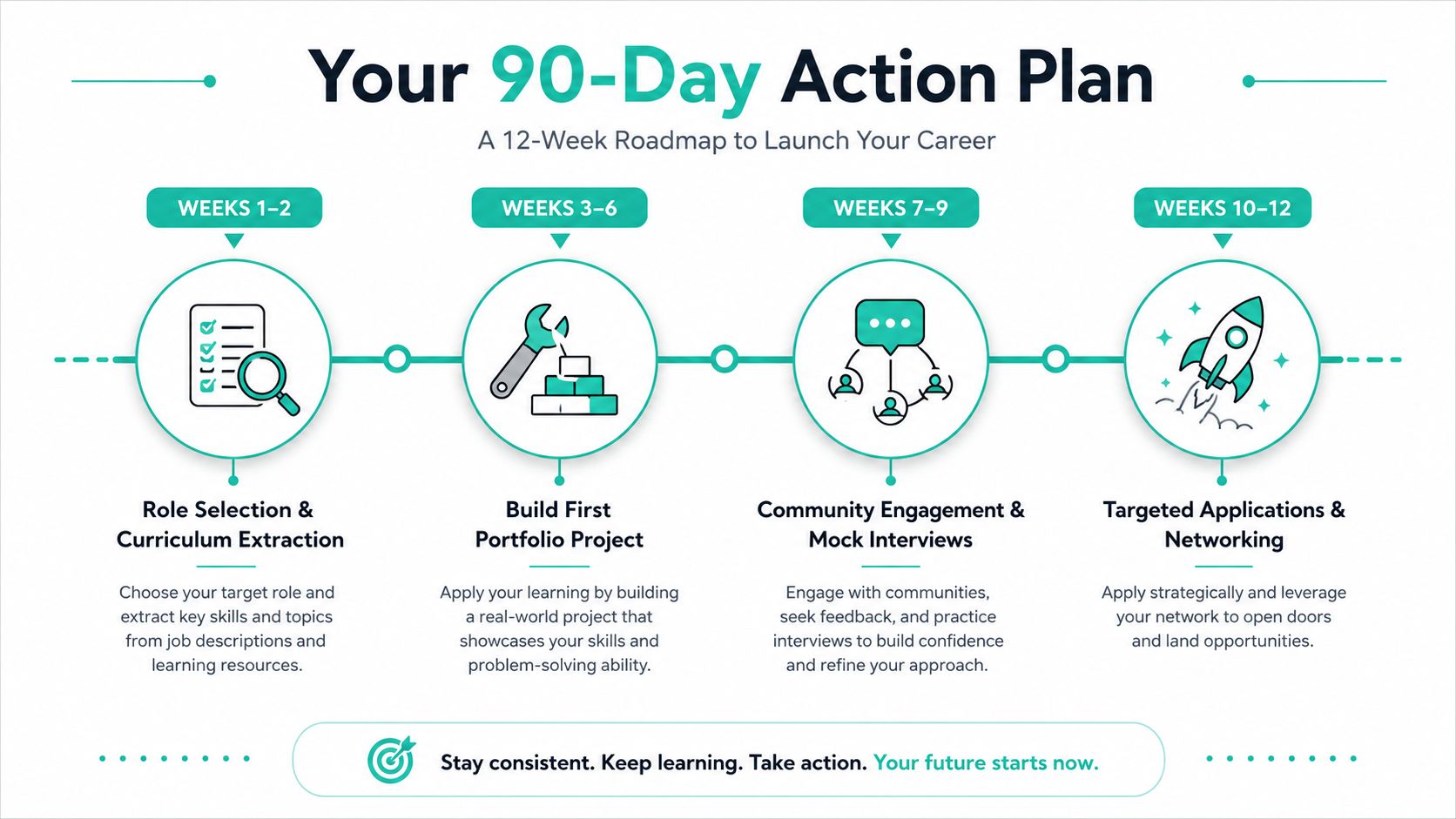
Pick one target role and pull 10 job posts for it. Read them like a recruiter would. Find the recurring requirements, match them against your background, and decide what you are building toward. If your current experience points to support, operations, or analysis, use that. Do not pretend you are starting from zero.
Build your first portfolio project and earn one certification if it helps the role you chose. Keep the project close to real work, not classroom fluff. A good project shows the problem, the choices you made, and the tradeoffs you accepted. By the end of this block, you should be able to walk someone through it without notes.
Finish the second project, add a collaborative or open-source contribution, and polish your resume and LinkedIn. Make your portfolio easy to scan. Recruiters will not dig for proof, so put the proof where they can see it fast. This is the stage where clear positioning starts to beat raw volume.
Apply to 10 jobs per week split into 3 dream jobs, 4 strong-fit jobs, and 3 volume plays. Also schedule 3 informational interviews from your network. Use those conversations to tune your resume language and your target company list. Keep the outreach targeted. AI-assisted applications have made generic submissions cheap, so the candidates who stand out are the ones who pair proof-of-skill with direct contact.
Avoid the big three mistakes: tutorial hell, a generic resume, and only applying to perfect-fit roles.
If you do this right, you finish the 90 days with a working portfolio, a real resume, a few useful contacts, and a repeatable application cadence. That is enough to start getting interviews. Curated platforms matter because they give your proof a place to land instead of forcing you to shout into the void.
If you want a cleaner path into startup hiring, Underdog.io gives you a single application that can put your profile in front of vetted tech companies instead of burying it in generic boards. Use it once your portfolio and resume are tight, because that is when the signal starts to matter. Visit Underdog.io and use it as a focused channel, not a substitute for proof.