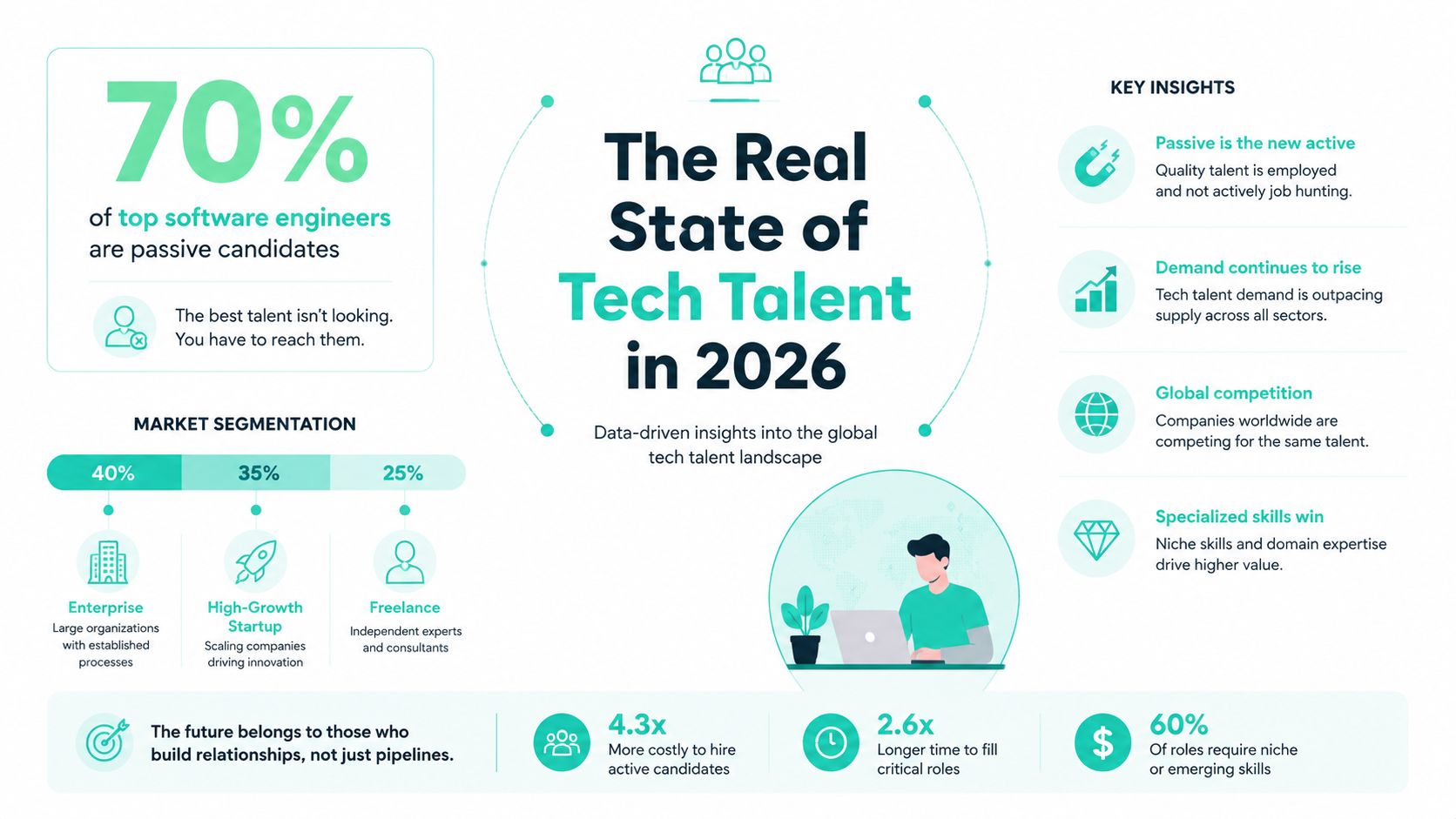
Technology employers receive 51% more applications per opening than other industries, averaging 110 applications per hire, yet only about 0.7% of candidates reach an offer and roughly 77% accept it according to this benchmark on hiring tech talent. That contrast changes the question. Learning how to attract top tech talent isn't mainly about generating more applications. It's about making the right candidate notice the role, trust the opportunity, and reach a confident decision before your process loses them.
The strongest hiring teams treat recruiting as a product experience. They define the customer, remove unnecessary steps, explain the value clearly, and measure where people abandon the journey. Generic perks might decorate a careers page, but role quality, speed, flexibility, credible growth, and respectful communication determine whether experienced engineers and product leaders engage.
The tech hiring market rewards precision, not broad messaging. In March 2023, McKinsey reported a 2.2% tech unemployment rate, below the 3.5% national average, while open tech positions increased by almost 77,000 month over month and nearly 316,000 unfilled tech jobs existed across the U.S. economy. Those figures help explain why qualified candidates often have alternatives, even when hiring conditions soften. The historical pattern is documented in McKinsey's analysis of digital talent.
Demand is uneven across specialties. Robert Half reported nearly 1.1 million technology and IT job postings in 2025, with AI, machine learning, and data science roles reaching 49,200 postings, up 163% from 2024 in its technology demand research. A 2026 market report citing Indeed Hiring Lab data found U.S. tech postings roughly 36% below the February 2020 baseline. Machine learning engineer openings were up 59% over that period, while general software engineering roles were down 49%. A generic “join our tech company” message cannot address both audiences.
Startups face an even tighter entry-level market. SignalFire reports that new grad and entry-level hiring at early-stage startups is down roughly 76% compared with 2019, and new graduates accounted for under 6% of startup hires in 2025, according to its State of Tech Talent Report. Experienced specialists therefore matter more, yet they need evidence before leaving a stable role for an unfamiliar company.
Use signal-rich outreach. Name the system, customer problem, ownership boundary, and decision authority. Explain what the candidate would improve, not only which frameworks appear in the stack. Passive candidates respond to a specific opportunity and a quick reply more readily than to a broad job-board campaign that creates administrative noise.
Remove friction before outreach begins. Candidates should understand the company, role, location expectations, compensation approach, interview structure, and likely impact without opening five tabs. Teams can apply these streamlined hiring process tips and review tech hiring trends to sharpen how they present specialist roles.
Practical rule: If a candidate has to infer the role's value, your competitors get to define it for you.
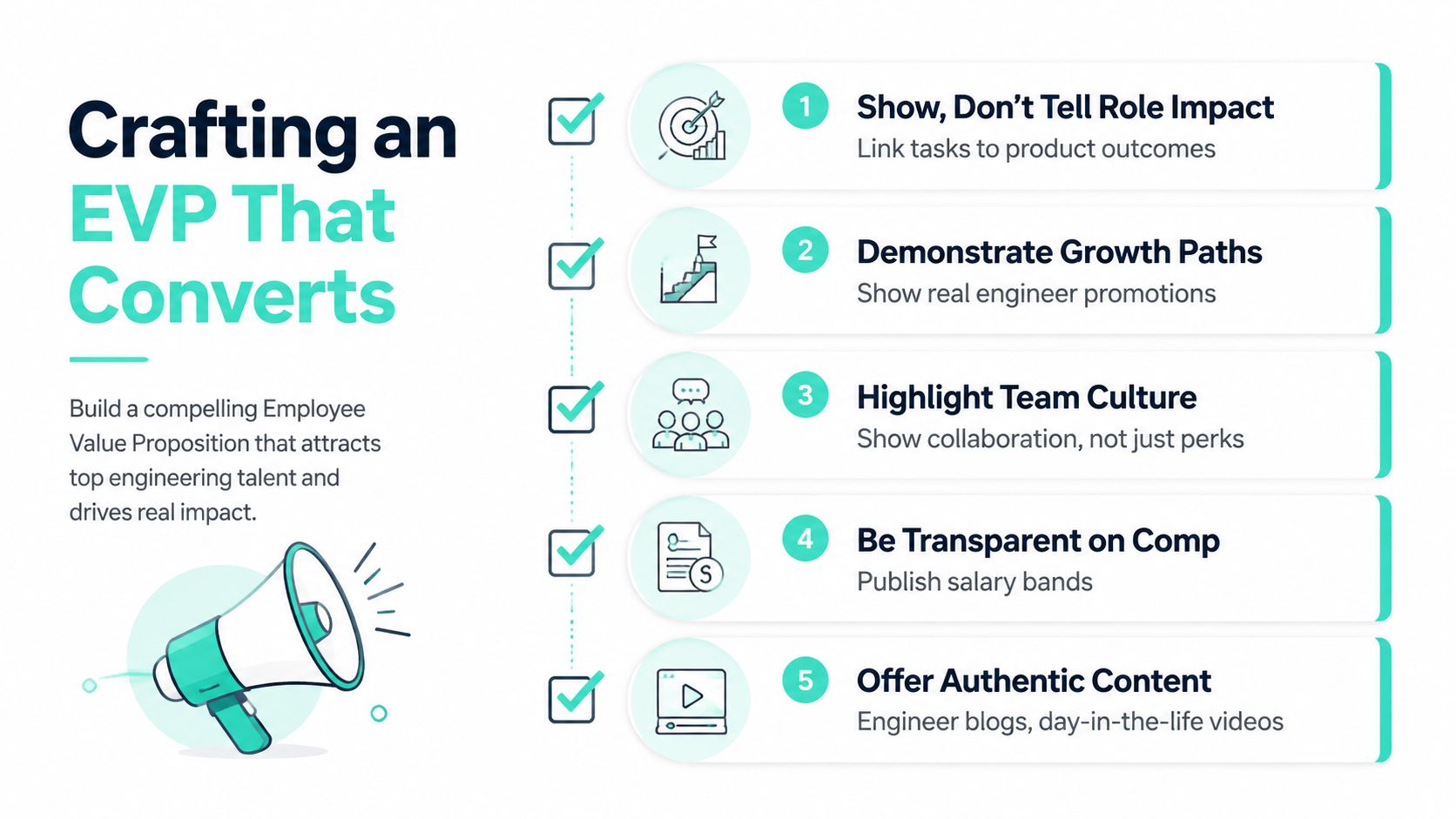
A credible employer value proposition answers a skeptical candidate's questions before the first call:
A mission statement rarely proves these points. A startup EVP should connect technical work to visible outcomes, define ownership boundaries, and describe growth in terms a senior candidate can verify. The goal is to reduce uncertainty, not add another list of perks.
Start with the job description. “Work on a fast-paced product with a great team” gives candidates little to assess. “Own the event-processing layer used by the payments team, define reliability targets with platform engineering, and shape the next migration plan with the CTO” gives them concrete scope, stakeholders, and decision context.
Use the same standard in outreach:
We're building an audit system for teams managing regulated workflows. You'd own the ingestion service, work directly with the product lead on prioritization, and help decide whether we extend the current architecture or replace it. The team can share the roadmap and current technical constraints on the first call.
The message does not claim the workplace is free of friction. It makes the work inspectable, which is more persuasive to passive candidates who are comparing your opportunity with a stable role.
Show proof where candidates research the company:
Use these employee value proposition examples for role-specific messaging to compare broad promises with evidence candidates can test.
Ask three employees to review the job page independently. Have each person identify what the role owns, what success looks like, and which growth opportunities are real. Differences in their answers expose ambiguity that candidates will encounter too.
State the difficult facts alongside the opportunity. Legacy systems, on-call work, uncertain priorities, or limited management support can all affect a candidate's decision. Experienced candidates do not require a perfect company. They require a company that understands its trade-offs.
Explain equity in plain English. Cover the grant type, vesting structure, refresh approach, and conditions that affect its value. Treat speculative upside as speculative, not guaranteed compensation. Clear information builds trust before the interview and removes a common source of funnel friction.
A startup sourcing flywheel begins with a narrow definition of fit. “Senior backend engineer” isn't enough. Specify the systems experience, operating environment, product stage, and constraints that matter. One company may need someone comfortable with distributed systems and ambiguous ownership. Another may need a product-minded engineer who can work closely with design and customers. The sourcing channel should follow that distinction.
Use several channels, but give each a job:
For founders tracking newly financed competitors or potential hiring markets, resources that let them browse new startup funding can inform both timing and positioning. Funding context doesn't replace candidate research, but it can reveal which companies are likely to compete for similar profiles.
Underdog.io is one option for a curated startup pipeline, combining reviewed candidates with a short application and employer-side matching for technology and product roles. The point isn't to replace referrals or outbound. It's to reduce the time spent searching broadly when the company needs a more relevant starting pool.
Passive candidates worry about confidentiality, wasted time, and awkward conversations with their current employer. Don't ask for a public profile, a long application, or a speculative call before explaining the role. Tell them what will happen after they respond, who will see their information, and when the company will reveal details.
A useful first-touch sequence looks like this:
A sourcing flywheel needs ownership. Each week, the hiring manager should review the target profile, recruiter activity, response quality, and candidate objections. Employees should receive a short referral brief with the mission, must-have capabilities, compensation approach, and the profile that doesn't fit.
Keep the assessment lightweight at the top of the funnel. A short technical conversation can establish relevance before a deeper exercise. For design, review a portfolio case tied to the company's product. For product, discuss a prioritization decision and ask how the candidate would gather evidence. The format should mirror the work rather than test endurance.
More detail on combining channels, referral loops, and structured outreach appears in this talent pipeline guide. The operating principle is simple: every candidate interaction should either increase trust or provide useful information. If it does neither, remove it.
A slow interview process creates uncertainty while candidates compare alternatives. Technical roles can sit about 10 days between interview and offer, and median hiring time reaches 48 days, according to the benchmark on hiring tech talent. Startups can preserve decision quality while removing avoidable waiting. Every delay should have a clear reason.
Set service-level agreements before opening the role:
| Interview Format | Signal Quality | Candidate Time | Drop-off Risk |
|---|---|---|---|
| Structured technical conversation | Good for fundamentals and communication | Low | Low |
| Pair programming | Strong for collaboration and working style | Moderate | Moderate |
| System design discussion | Strong for architecture and trade-offs | Moderate | Moderate |
| Practical take-home | Useful for role-specific depth | High | High |
| Panel loop | Broad signal when coordinated well | High | High |
Use the smallest combination that answers the hiring question. A take-home exercise should represent real work, have a clear time boundary, and produce useful feedback. If interviewers cannot explain how they will evaluate the submission, do not assign it.
Technical candidates still average 3.5 hours of interviews before receiving an offer, while time to first fill for technical roles has settled at about 10 weeks, according to Ashby's talent trends research. Coordination therefore becomes part of the candidate proposition. Book stages together where possible, avoid repeated introductions, and give each interviewer a distinct question. A short process with unclear ownership still feels disorganized.
Compensation benchmarking matters, yet candidates also need a complete view of the package. Explain base salary, bonus eligibility, equity type, vesting schedule, exercise conditions, refresh practices, benefits, and remote or hybrid expectations in one conversation. If the company cannot offer the highest salary, be precise about ownership, flexibility, learning, and the work's long-term value.
Remote flexibility can influence the decision. One large study reported that remote or hybrid acceptances averaged 25% lower pay than comparable in-office offers, while tech candidates often complete applications in about 14 minutes, according to candidate experience benchmark data. The practical implication is clarity. Explain how remote work operates, what flexibility includes, and what collaboration requires before the final stages. Candidates can then compare the offer on its full terms rather than guessing at hidden trade-offs.
Experienced candidates rarely need another employer to tell them that the company has a “fun culture.” They need evidence that the work will be worthwhile, the process will respect their time, and the role will make them more capable over time. This is why candidate experience and internal growth signals often outperform a longer perks list.
Application design is the first test. SHRM reports that 61% of candidates said it took 15 minutes or less to complete a job application, while 36% of U.S. candidates said they hadn't heard back from employers one to two months after applying, according to SHRM's candidate experience research. A short application followed by silence still feels broken. Set expectations, provide a contact, and close the loop.
Training is often treated as an internal retention program, but it also attracts candidates who are thinking beyond their next title. The Linux Foundation found that training current staff is 62% faster than hiring and onboarding new talent, and 91% of organizations offering training say it helps, according to its 2025 technology talent research.
Market that investment clearly. Explain how engineers learn the company's domain, whether people receive certification support, how technical talks work, and how AI-adjacent skills fit into the roadmap. A 2025 report found that 18% of HR professionals were increasingly likely to prioritize certifications and non-degree education for remote software engineering, data analytics, data science, and UX roles, tripling in two years. Candidates don't need a grand academy. They need proof that the company will help them stay relevant.
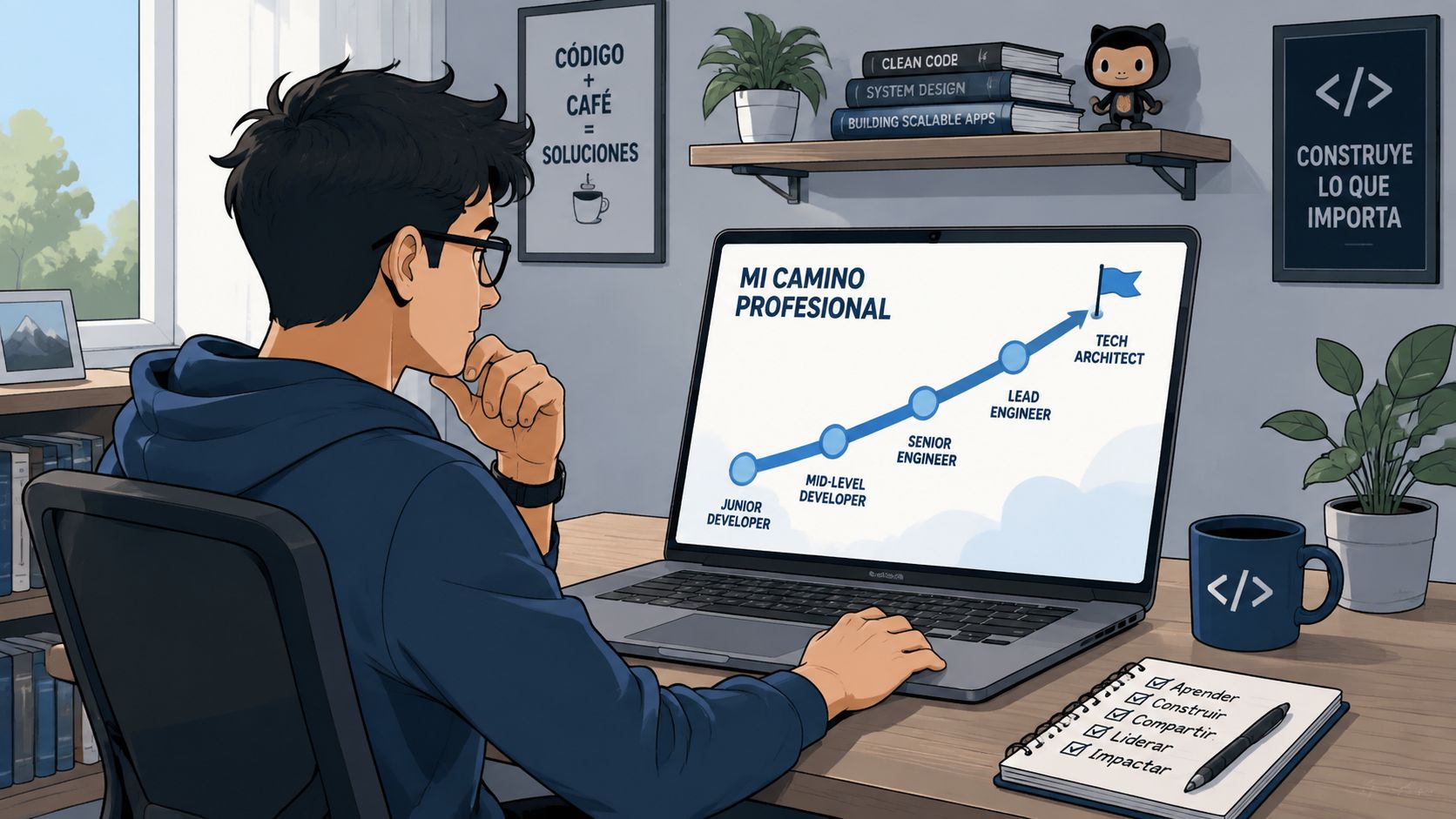
Create a one-page growth map for each role. It should show the scope expected at the next level, examples of decisions that demonstrate readiness, and the support available to reach it. Use real internal promotions, with permission, and explain where the path is uncertain. A credible path can be more persuasive than a vague promise of rapid advancement.
The strongest growth message is not “you can become a leader here.” It's “here is the next scope, here is how people earn it, and here is what we'll provide while you build toward it.”
Protect discretion throughout the process. Don't contact a current employer, publish identifying details without permission, or pressure candidates to disclose their search. Passive talent evaluates your behavior before it evaluates your product. Every unnecessary request lowers trust.
A recruiting dashboard should expose friction, not reward activity. Track time to first human contact, application-to-screen conversion, interview-to-offer latency, offer acceptance rate, source quality, and candidate drop-off by stage. Pair each metric with an owner and a review date.
Use SLAs as operating commitments:
At seed stage, prioritize speed, clarity, and direct founder involvement. As the company grows toward Series B, add source quality, interviewer calibration, and performance reviews of hiring channels. Run a monthly retrospective that ends with a process change, such as removing an interview, rewriting an unclear role brief, or assigning feedback ownership. A dashboard that never changes behavior is reporting, not recruiting strategy.
If your startup needs a more focused way to reach reviewed engineers, product managers, designers, and other tech candidates, explore Underdog.io. Its curated marketplace and short candidate application are designed to help hiring teams reduce sourcing friction and start relevant conversations sooner.