You've opened a dozen tabs, saved roles you can't remember, revised your resume until every bullet sounds interchangeable, and still don't know what to do first. That confusion is understandable. The modern search isn't a hunt for information. It's a funnel with weak signals, short screening windows, opaque application systems, and too many opportunities competing for your attention.
The strongest starting point is not “apply everywhere.” It's a focused system that turns your experience into a clear signal, routes that signal through trusted people and curated channels, and measures where candidates drop out. Networking deserves priority because 54% of U.S. workers said they were hired through a personal connection in 2025, while a separate report found that 71.3% of job seekers used referrals during their search, according to networking hiring data from Career Launch Kit.
This guide shows you how to start a job search without wasting the first month on low-signal activity. You'll build the foundation, prepare a profile that converts, source startup roles intelligently, run a trackable pipeline, handle interviews, evaluate offers, and execute a 90-day plan.
Treat your job search like a conversion funnel, not an information hunt. Your first week determines whether later effort produces interviews or disappears into generic applications, so begin with a written search brief before you contact anyone.
Write one page containing:
This brief prevents a common mistake: changing your target after every rejection. You can refine it, but you shouldn't reinvent it every time a recruiter sends an unrelated role.
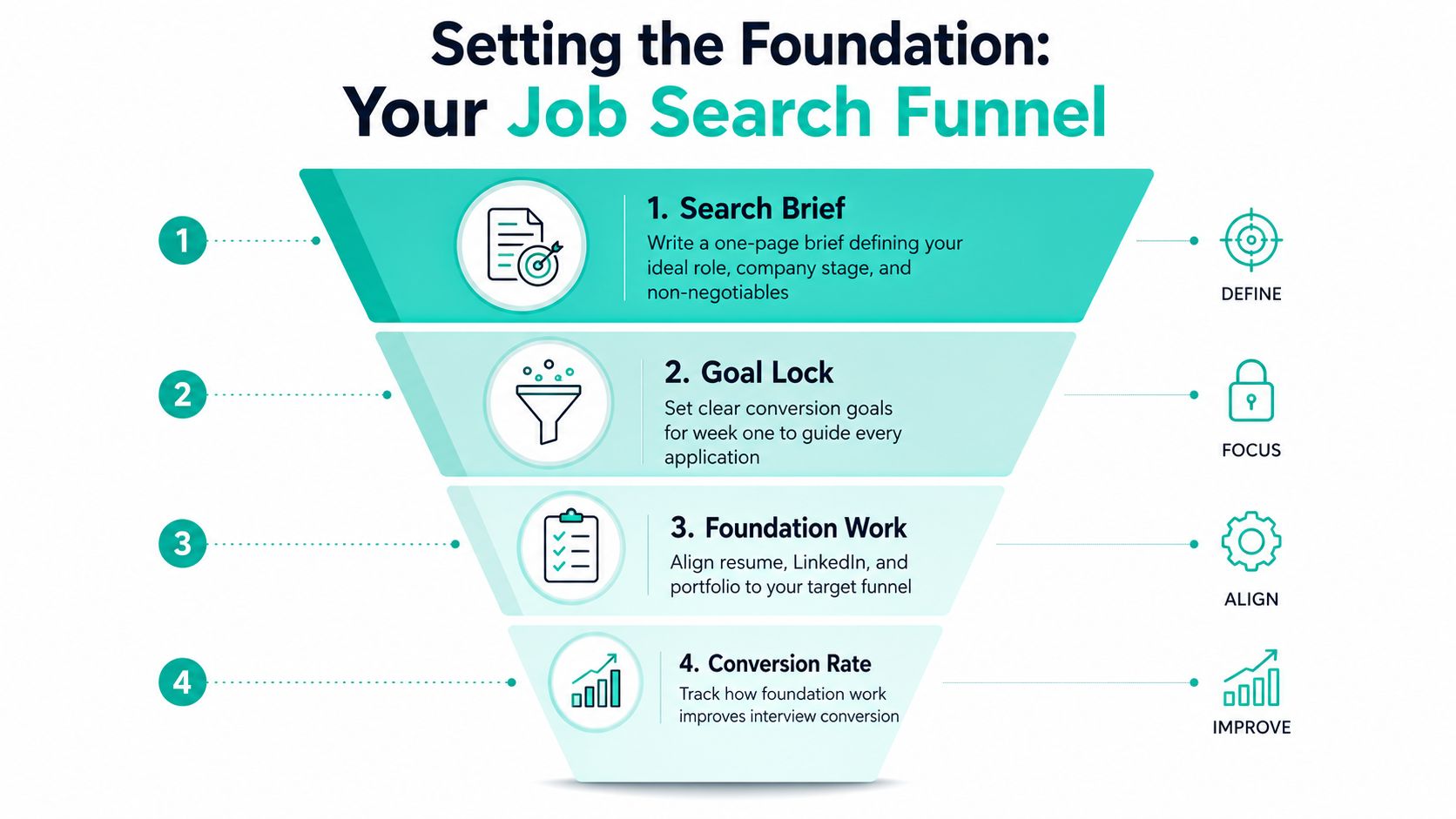
Set outcome goals and activity goals separately. If you assume a startup funnel converts 5% of targeted applications to offers, you'd need roughly 20 serious conversations to create one offer. That means sourcing far more introductions than applications, then protecting time for follow-up and interview preparation. Those figures are a planning assumption, not a market benchmark, so use your own results to replace them after the first review cycle.
Block your calendar for four recurring jobs:
Build a personal signal stack as well. Start with a list of 40 to 60 startups you'd consider, identify three to five investor portfolios worth mining, and choose two communities where you can observe how people discuss the work. Read the guidance in Underdog.io's startup job search guide before you begin outreach, especially if startup hiring is new to you.
Practical rule: No applications before the brief exists. A target list without a decision framework becomes scrolling with better branding.
Review the brief weekly. If you're getting conversations but no interviews, your profile or role fit may be weak. If you're getting interviews but no finals, your preparation or positioning needs work. A funnel tells you where to debug instead of encouraging you to send more applications blindly.
Your resume isn't a biography. It's a fast screening document that must make role fit obvious before the reader moves on. Recruiters spend an average of 7.4 seconds on an initial resume screen, up from about 6 seconds in 2012, and other survey data found that 60% of employers view a resume for 11 seconds or less, according to resume screening data from Novorésumé.
Lead every bullet with the business result, then explain the action that produced it. “Owned roadmap” says little. “Improved activation by redesigning onboarding and aligning product analytics with lifecycle messaging” gives the reader a reason to ask questions. Use real figures from your work when you have them. Don't manufacture precision to make a bullet look impressive.
For startup roles, keep the document compact:
Customization should be systematic, not an excuse to spend a week polishing one document. For each serious application:
A 2026 analysis of 30,688 resume-to-job comparisons found that the average resume matched only 48.3% of its target job, while 53.8% matched less than half of the listed requirements. Only 9.8% were strong matches at 80% or higher, according to Resumly's resume-job match analysis. Read the posting line by line. If your document doesn't show the required work, the problem isn't the applicant tracking system. The problem is weak evidence.
Your LinkedIn profile should function as a landing page. Write a headline that names the role you want, then structure the About section around the problem you solve, proof that you've solved it, and the kind of conversation you're open to. Eztrackr's LinkedIn About guide offers a useful structure for turning a general summary into a clearer professional pitch. Use Featured for your strongest work, not a pile of links.
Your portfolio needs the same discipline. Include one flagship case study, two supporting pieces, and a short walkthrough that lets a recruiter understand your thinking quickly. For an Underdog.io profile, treat the one-line pitch as your headline, the background summary as your About section, and role preferences as a specific shortlist of titles and company stages. “Open to anything” communicates nothing. For additional resume examples, review Underdog.io's tech resume guidance.
Channel mix matters more than raw effort. A candidate who spends every morning applying to public listings may be working hard while staying invisible to the people who decide whom to interview.
Referrals deserve the first block of your calendar. One widely cited dataset reports that referrals make up only 5% to 7% of applicants but account for 30% to 50% of hires, with referred candidates converting at roughly four times the rate of non-referral applicants, according to Career Launch Kit's networking statistics. A separate 2025 to 2026 dataset reports that referred candidates are 4 to 5 times more likely to be hired, while referrals can represent only 2% of applications and about 11% of hires, as summarized by Wave Connect's referral research. The exact ratios vary by dataset, but the direction is consistent: trusted introductions carry more signal than anonymous submissions.
| Channel | Signal Strength | Best Use |
|---|---|---|
| Referrals and warm introductions | High | Reach hiring managers through people who can explain your fit |
| Curated startup marketplaces | High for startup roles | Let a reviewed profile reach relevant early-stage companies |
| Direct founder outreach | Medium to high | Contact smaller teams when your experience solves a visible problem |
| Investor portfolio sites | Medium | Find early-stage roles and companies that may not appear on broad boards |
| Communities and private groups | Medium | Build credibility by sharing work before asking for opportunities |
| Company career pages | Medium | Apply when the role is a close match and the company is a priority |
| LinkedIn and Indeed boards | Low to medium | Use as a backup source for roles you can target carefully |
Curated channels change the math by reducing irrelevant volume. A platform such as Underdog.io uses one profile and a single application to connect startup-focused candidates with companies, with human review and direct interest from hiring teams rather than requiring candidates to repeat the same submission across every listing. Treat that as one route in your system, not a substitute for judgment.
Use a sourcing mix that keeps high-signal activity dominant:
That mix is an operating preference, not a universal benchmark. Adjust it based on your response data and field. A senior engineer with a strong alumni network may lean harder into referrals, while a career changer may spend more time creating visible work and building direct relationships.
Start with the list of 40 startups from your brief. For each company, identify employees in your function, alumni connections, investors, founders, and relevant community members. Don't ask strangers to “keep you in mind.” Send a short note tied to a specific product, role, or problem. Use Underdog.io's tech job board guide to broaden your channel map without letting job boards become the entire search.
A search without a tracker depends on memory, and memory fails as soon as several recruiters, referrals, and interview loops overlap. Build a simple spreadsheet or use a lightweight CRM. The tool matters less than recording the next action every time you touch an opportunity.
| Column | What to Track | Why It Matters |
|---|---|---|
| Company | Name, stage, industry, location | Keeps the target list focused |
| Role | Exact title and job URL | Prevents applying to the wrong version of a role |
| Source | Referral, community, board, recruiter, direct outreach | Shows which channels produce movement |
| Contact | Name, title, email, or profile | Makes follow-up personal and specific |
| Stage | Sourced, contacted, applied, screen, interview, final, closed | Gives you a current funnel view |
| Last action | What you sent or discussed | Stops repeated or contradictory messages |
| Next step | Follow-up, preparation, referral request, decision | Keeps every active thread moving |
| Date | When the next action is due | Turns intention into a calendar item |
Prioritize roles by signal strength. A referred role with a direct hiring-manager conversation should outrank a generic listing that barely matches your background. A targeted application can still be worthwhile, but only when the company, role, and evidence align.
Your application target should favor quality over volume. A 2026 survey found that job seekers applied to an average of 16.6 jobs in their last search and received 2.8 interview invitations. People using AI-customized resumes averaged 24.0 applications and 3.7 interview invitations, while those manually customizing resumes averaged 14.8 applications and 2.6 invitations, according to Novorésumé's 2026 resume report. The useful conclusion isn't to automate every document. It's to stop sending the same resume everywhere.
Cold referral ask:
Hi Maya, I'm exploring product roles focused on activation and onboarding. I saw that your team is hiring for a Growth PM and noticed the role emphasizes experimentation and lifecycle analytics, which matches my recent work at [company]. Would you be open to a brief call about the team and, if the fit seems relevant, advising me on whether a referral makes sense?
Warm intro note:
Hi Jordan, thanks for connecting us. Priya suggested I reach out because I'm exploring senior product roles in developer tools. I've led launches involving onboarding, usage analytics, and cross-functional adoption, and the work at [company] looks closely aligned. I'd appreciate a short conversation about the team and where the product needs the most leverage.
Apply first when the role is time-sensitive, then trigger two parallel touchpoints within 72 hours: one person who can refer you and one person close to the team or problem. Keep each message distinct. The referral request asks for judgment. The second message asks for context.
Review the tracker every Sunday for 30 minutes. Close dead roles, schedule overdue follow-ups, identify the strongest channel, and write one sentence about what changed. Lost threads are not bad luck. They're an operational failure you can prevent.
A startup interview loop tests more than competence. It tests whether you can understand an ambiguous problem, make tradeoffs, communicate under pressure, and work with people who may change the role around your strengths.
Consider a senior product manager interviewing at a 40-person Series B SaaS company. The loop includes a recruiter screen, hiring manager call, product work sample, founder conversation, and cross-functional panel. The candidate doesn't prepare one generic pitch. They prepare for the company's likely problems.
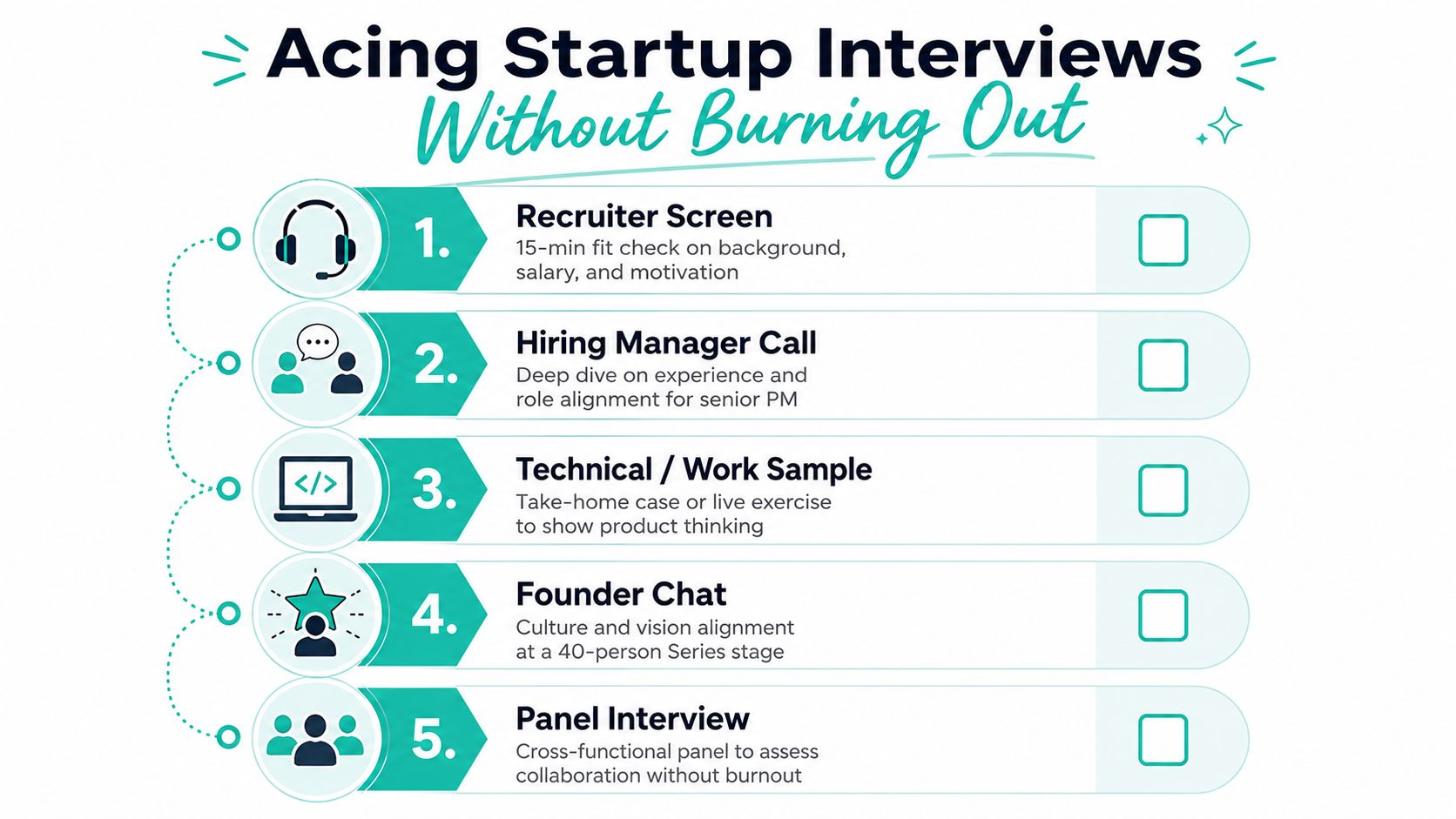
Before each conversation, the candidate completes four tasks:
The candidate drafts three questions that reveal operator thinking:
The founder conversation is also due diligence. Ask about runway, founder communication, decision-making, team turnover, and how leaders handle missed targets. You're not trying to sound suspicious. You're trying to understand the environment you're considering.
Don't schedule every conversation at the first available time. Group similar preparation where possible, leave recovery space after demanding exercises, and keep a running note after each interview. Record the questions you struggled with, the examples that landed, and the claims you need to verify.
After each round, send a short thank-you note that mentions one specific discussion point and confirms your interest. If the company goes quiet, send a concise check-in after 7 days. Ask whether the process is still active and whether the team needs anything else from you. If there's no reply after a further reasonable follow-up, close the loop politely and move on.
Interview standard: A stale process is information about the company's operating discipline, not a challenge to prove your worth indefinitely.
Interviewing can drain the rest of your life if you let every silence dictate your mood. Build routines that keep the search contained, and use actionable strategies to stop burnout when preparation starts damaging sleep, relationships, or current work.
An offer is not a salary number. At a startup, the package includes base compensation, equity, variable pay, scope, title, reporting structure, learning velocity, and the company's ability to execute.
Normalize each offer across a common framework before you react emotionally.
| Lever | What to Evaluate | Negotiation Leverage |
|---|---|---|
| Base compensation | Fixed pay, review timing, location adjustments | Strong when your experience matches a scarce need |
| Equity | Grant size, type, vesting, cliff, exercise terms, dilution | Strong when the company values your long-term contribution |
| Bonus or commission | Target, eligibility, payment conditions, historical attainability | Useful when base bands are fixed |
| Role scope | Ownership, decision rights, team size, product area | Often the highest-value lever for startup operators |
| Title and reporting | Level, manager, executive access, promotion path | Valuable when scope exceeds the initial title |
| Working terms | Remote expectations, travel, start date, severance terms | Practical leverage when the company needs speed |
For equity, ask what the grant represents, how vesting works, whether there's a cliff, what happens if you leave, and how future dilution may affect ownership. Don't treat an impressive share count as meaningful without understanding the total capitalization and the company's financing position. Test the offer under a flat or down-round scenario, not only the optimistic case.
When the offer arrives, say:
Thank you for the offer. I'm excited about the team and the scope, especially the opportunity to own [specific area]. I've reviewed the package and would like to discuss a few adjustments. Based on the responsibilities and the experience I'd bring, could we explore [specific base adjustment], [equity adjustment], or a clearer title and scope commitment? If we can align on those points, I'd be ready to move quickly.
Lead with enthusiasm for the work, then name the levers. Give the company choices instead of presenting a scattered list of personal needs. If base compensation is fixed, negotiate equity, a signing payment, an earlier review, title, reporting line, or written scope.
Don't invent competing offers. Don't tell personal hardship stories as your main argument. Don't make threats you won't carry out. You're showing the company how you'll handle difficult business conversations.
Before signing, ask yourself two questions:
If the answer to either question is no, keep investigating. A larger package can't repair a role you fundamentally don't want.
A 90-day plan gives the search a rhythm without pretending every hiring process moves on your schedule. Labor-market conditions support a slower, more selective approach. Indeed reported the U.S. Job Postings Index hovering just above pre-pandemic levels in August 2026, while hiring, quits, and layoffs remained subdued, according to Indeed Hiring Lab's 2026 labor-market update. Huntr's Q1 2026 dataset found the median time from search start to first offer rose to 108 days, up 30% from Q4 2025, before easing to 82 days in Q2 2026, according to the supplied labor-market analysis. Plan for iteration rather than assuming a quick linear process.
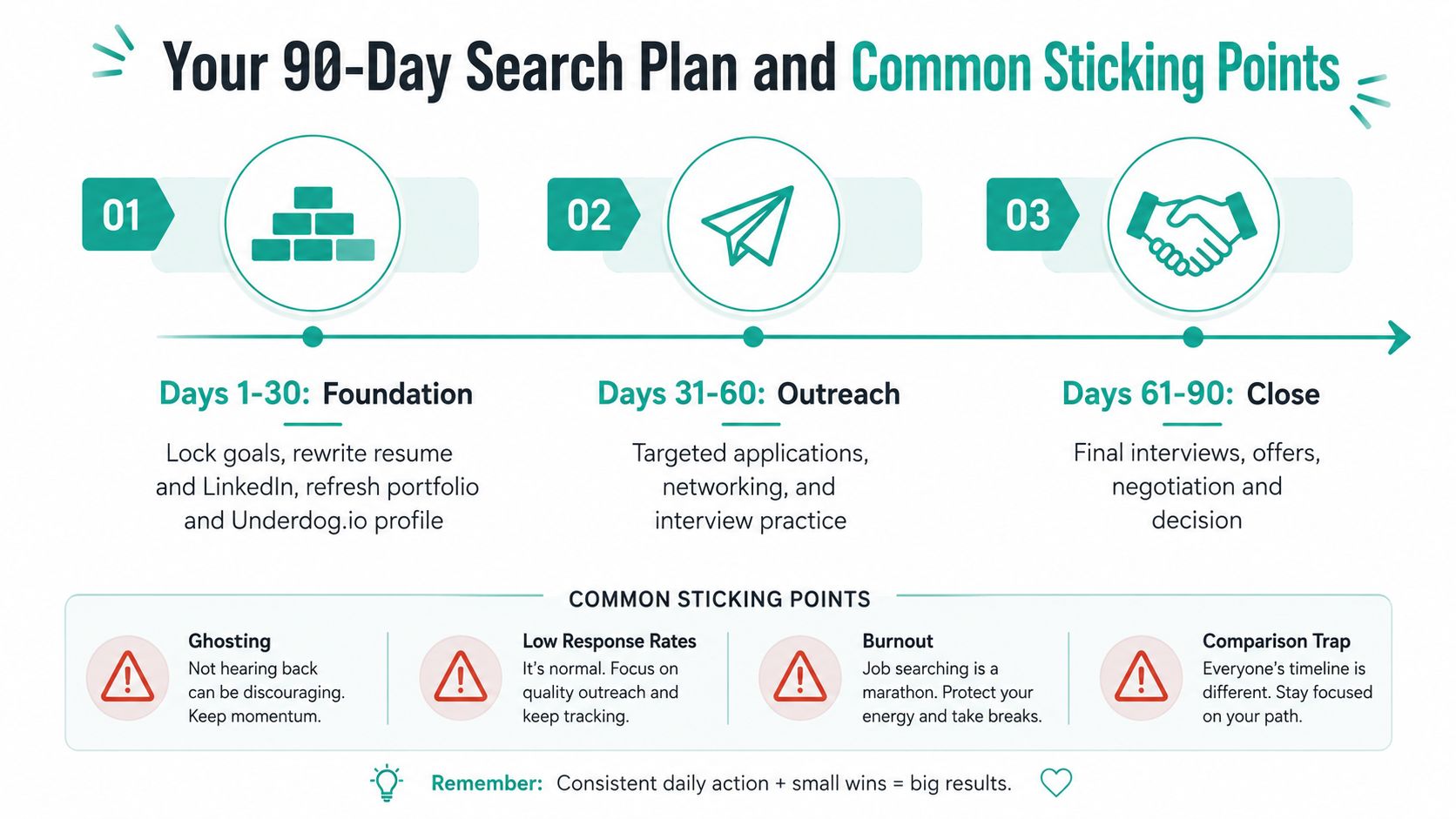
Write the search brief, lock your targets, rebuild the resume, rewrite LinkedIn, refresh the portfolio, and create the Underdog.io profile. Mine your alumni network, investor portfolios, and communities for the first company list. Your output is a finished profile stack and a ranked list of target companies, not another draft in a private folder.
Add 50 targeted companies, send 20 outreach messages per week, submit two to three curated-channel applications daily when the roles fit, and maintain the tracker. Start interview practice as soon as conversations begin. Your output is a clean pipeline with a next step attached to every active role.
Review interview feedback, improve your stories, prepare references, rehearse offer discussions, and compare role quality instead of chasing every process to the finish. Your output is stronger late-stage performance and a decision framework you can defend.
Four patterns commonly stall otherwise capable candidates:
When should I follow up? Follow up after the time the recruiter or hiring manager gave you. If they gave no timeline, send a concise check-in after a week and then close the thread respectfully if silence continues.
How long should I wait between interview loops? Ask the company about its expected timing, then protect enough preparation time to perform well. Speed matters, but rushing into every round exhausted weakens your position.
Should I tell my current employer? Keep the search confidential unless disclosure is necessary for a specific reference, scheduling issue, or internal process. You can explain your goals to trusted contacts without announcing the search broadly.
What if I have no referrals? Start with weak ties, alumni, former colleagues, community members, and people whose work you've studied. Lead with a specific question or relevant observation, then earn the referral through fit. A referral is a consequence of credibility, not a favor you demand.
Measure the search by funnel movement. If nobody responds, revise the target or message. If people respond but don't refer, improve the proof. If you reach interviews but stall, prepare more deliberately. If offers arrive but feel wrong, revisit the brief rather than blaming the market.
Underdog.io offers a curated route into startup hiring, letting candidates create one profile and reach vetted technology companies through a single application rather than repeating the same submission across broad boards. Visit Underdog.io, build the profile from your search brief, and use it alongside referrals, targeted outreach, and the tracking system above.