Software engineering salary in the US ranges from $85,000 for entry-level engineers to well over $280,000 base for staff-level engineers in top tech markets — and that's before equity and bonuses. The median total compensation hit $190,417 in 2026. Your actual offer depends on your experience level, location, specialization, and whether you're joining a startup or a big tech company. Understanding all three components of your compensation — base, bonus, and equity — and how to negotiate each one is what separates a good offer from a great one.
When you get an offer for a software engineering role, the number that jumps out is usually the base salary. But that’s just one piece of the puzzle. The most competitive offers, especially in tech, are a carefully constructed package of salary, bonuses, and equity that together create your total compensation.
A software engineering salary in the United States can be impressive, but your final offer will swing wildly depending on your experience, the company you join, and where you're located. Understanding how these packages are built is the first step to knowing your true worth and negotiating a better deal.
The software engineering salary in the United States varies dramatically based on experience, location, specialization, and company type. Here are the key numbers for 2026:
The median total compensation for software engineers in the US is $190,417. For entry-level engineers, national base salaries typically range from $85,000 to $115,000, reaching $110,000 to $145,000 in top markets like New York City and San Francisco. Mid-level engineers earn $115,000 to $150,000 nationally and $145,000 to $185,000 in major hubs. Senior engineers command $150,000 to $190,000 nationally, with $180,000 to $230,000+ in NYC and SF. Staff and Principal engineers typically earn $180,000 to $240,000 nationally, and $220,000 to $280,000+ in top markets.
However, base salary is only one component. Total compensation also includes performance bonuses (typically a target percentage of base salary) and equity — either RSUs at established companies or stock options at startups. Top engineers at leading firms like Meta and Airbnb are seeing total packages ranging from $273,000 to over $459,000 annually. Specializations in AI/ML engineering (average $170,750, up 4.1% year-over-year) and DevOps/Cloud engineering (average $145,750) command some of the highest premiums in the market.
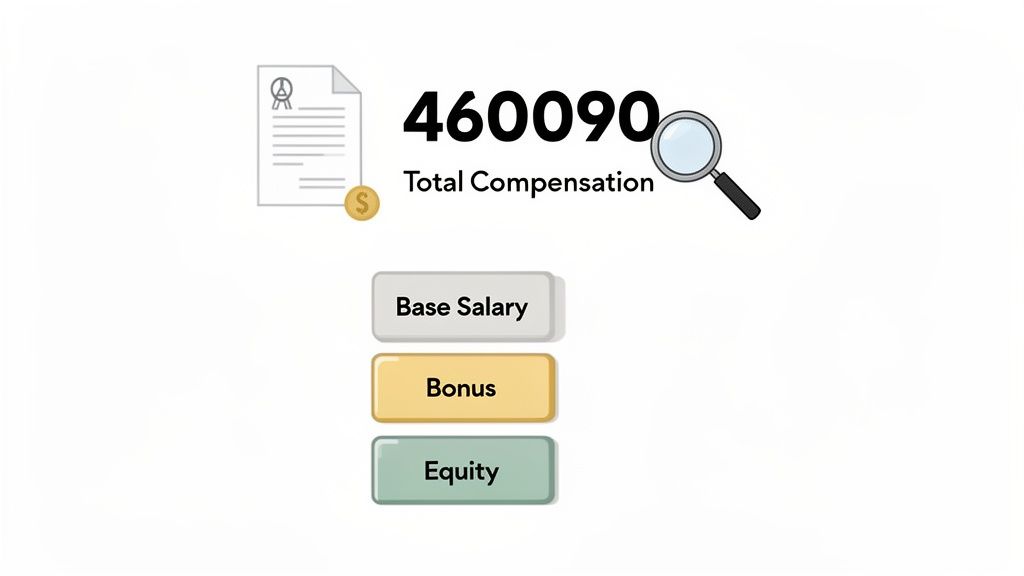
Think of your total compensation offer as a three-legged stool: a steady base, a performance-based reward, and a long-term investment in the company's success. Each part plays a totally different role in your financial picture, and you need to understand all three to accurately evaluate what's on the table.
Let's unpack the core components you'll find in almost every offer letter from a tech company.
Your offer will almost always detail three main financial components. Figuring out how they interact is the key to seeing the real value of an offer.
To give you a clearer picture, here's a quick summary of what makes up a modern software engineer's pay package.
Software Engineer Salary Components at a Glance (2026 Averages)
These components—base, bonus, and equity—combine to form your total compensation (TC), which is the number that really shows your earning potential. For instance, a candidate might get an offer with a $150,000 base salary, a 15% target bonus, and a $100,000 equity grant that vests over four years.
Actionable Insight: Always calculate the total annual value. An offer of $150,000 base, a 15% target bonus ($22,500), and $100,000 in equity vesting over four years ($25,000/year) gives you an on-paper TC of $197,500 for the first year. Use this number to compare against other offers.
Recent data shows just how high these packages can climb. As of 2026, the median total compensation for software engineers in the United States hit an impressive $190,417. This figure is heavily influenced by the fierce demand in tech hubs like San Francisco and New York.
Top engineers at leading firms like Meta and Airbnb are seeing total packages ranging from $273,000 to over $459,000 annually. For more background on how pay is shifting across the industry, check out our 2025 tech salary guide.
When a job offer lands in your inbox, it's easy to fixate on one number: the base salary. But focusing only on that figure is like judging a house by its front door—you’re missing the foundation, the layout, and the land it’s built on. To get the full picture, you have to look at total compensation, or TC. It’s the complete package that combines your steady paycheck, performance-based cash, and a real stake in the company’s future.
Think of your compensation as a financial portfolio. Each component plays a different role, and understanding how they work together is the only way to know if an offer is just paying your bills or actually building wealth.
Your base salary is the bedrock of your personal finances. It’s the guaranteed, predictable amount that hits your bank account with every paycheck, rain or shine. This is the number you’ll use for your monthly budget, mortgage applications, and all your day-to-day expenses. It’s stable, reliable, and the anchor for your entire compensation package.
While it's the most straightforward part of your pay, its growth is usually limited. A standard annual raise might be 3-5%, but your base isn't going to double overnight. That’s where the other pieces of the puzzle come in.
If base salary is the foundation, an annual bonus is the high-end kitchen remodel you get after a great year. It’s a variable cash payment tied to performance, giving your standard earnings a serious boost.
Bonuses aren’t just random payouts; they’re usually tied to specific goals and can be structured in a few different ways:
A common setup is a target percentage of your base salary. For instance, a 15% target bonus on a $160,000 base salary means you’re aiming for an extra $24,000. But remember, it’s a target, not a promise. You could earn more if you and the company have a phenomenal year, or less if targets aren't met.
Actionable Insight: When negotiating, ask the recruiter about the company's bonus payout history. "What has the typical bonus payout percentage been for this team over the last two years?" This tells you if the "target" is realistic or purely aspirational.
Equity is the land your financial house is built on. It might not seem like much at first glance, but it holds the most potential for long-term growth. For many software engineers, it’s the primary vehicle for building serious wealth in the tech world. It represents a slice of ownership in the company, directly tying your financial success to the company's growth.
But not all equity is the same. The two most common types you’ll see are Restricted Stock Units (RSUs) and stock options, and they work very differently.
RSUs are grants of company shares that are given to you over a set period. You don’t buy them; you earn them simply by staying with the company. A typical offer might include $200,000 in RSUs that vest (become yours) over four years. In that scenario, you’d receive $50,000 worth of stock each year.
Stock options are different. They give you the right to buy a set number of company shares at a fixed price, known as the strike price. This is the go-to form of equity for early-stage and high-growth startups.
For example, you might be granted 10,000 options with a strike price of $2. If the startup takes off and its shares are eventually valued at $20 each, you can exercise your option to buy them for $2 and pocket the $18 per-share gain. But if the company stalls and its share value never climbs above your strike price, your options are essentially worthless. This high-risk, high-reward dynamic is the name of the game in the startup world. Learning how to evaluate these offers is a skill in itself, which is why we put together a complete guide on how to negotiate stock options.
Two of the biggest factors that will shape your software engineering salary are your experience level and where you choose to work. It’s pretty intuitive, right? As you climb the career ladder from writing your first lines of code to architecting major systems, your pay should grow with your impact. But just as important is your physical or virtual location—a salary in San Francisco is a totally different beast than one in a lower-cost city.
Getting a handle on how these two elements play off each other is key. This isn't just about knowing what you're worth today; it's about making smart, strategic moves that will build a well-compensated career for the long haul.
Your job title is more than just a line on your resume. It’s shorthand for your level of autonomy, the scope of your impact, and, of course, your earning potential. As you gain experience, you'll find your role shifts from pure execution to technical strategy and mentorship.
Here’s what that progression generally looks like:
While base salary is your foundation, other components like bonuses and equity start to make up a much bigger piece of the pie as you become more senior.
As you can see, total compensation becomes a much more complex and rewarding picture as you advance in your career.
Your job title tells one half of the salary story; your location tells the other. For years, tech hubs like New York City and San Francisco have paid a premium to attract top talent, but those high salaries come with an equally high cost of living. It's a trade-off every engineer in a major hub has to weigh.
The boom in remote work has thrown another variable into the mix. Companies are all over the map when it comes to remote pay. Some have adopted a location-based approach, adjusting your salary based on local market rates. Others have gone with a single national rate, meaning you earn the same whether you’re in a bustling city or a quiet suburb.
To put some real numbers on this, let's compare what you might expect to see for base salaries across different experience levels, looking at the US national average versus what you might find in top-tier markets like NYC and SF.
Note: These are typical base salary ranges and can vary significantly based on the company, specific skills, and total compensation structure.
The difference is clear. While a national average for an entry-level engineer might hover around $89,752, that figure gets a serious boost in high-cost-of-living areas. For senior roles at top tech companies, total comp can easily climb past $400,000.
Of course, a bigger number on an offer letter doesn't always mean more money in your pocket. A $175,000 salary in San Francisco might feel a lot smaller after taxes and rent than a $140,000 salary in a city with a much lower cost of living. This is especially true when you're just starting out.
For a closer look at what to expect at the beginning of your journey, check out our guide on junior software engineer salaries. Ultimately, your decision on where to work comes down to a personal calculation, balancing pure earning potential with career opportunities and the lifestyle you want to lead.
While being a great generalist software engineer will always keep you employable, developing deep expertise in a high-demand specialty is your most direct route to the top of the pay scale. Think of it like medicine: a general practitioner is vital to the healthcare system, but a neurosurgeon commands a premium for their specific, hard-won skills. The same logic applies in tech.
Going from a generalist to a specialist is the difference between being a valuable part of the team and becoming an indispensable one. Certain skills don't just add to a product; they define its future or open up entirely new lines of business. Naturally, companies are eager to pay top dollar for that kind of impact.
So, what makes companies willing to write much bigger checks for these roles? It all boils down to direct, measurable business impact. A generalist might build and maintain core features—absolutely crucial work. But a specialist is often brought in to solve a company's most expensive problems or to unlock its most profitable opportunities.
Practical Example: An e-commerce company hires a Senior Machine Learning Engineer to revamp its product recommendation algorithm. The new system increases the average order value by 12%, adding millions in new revenue. That engineer’s high salary is easily justified by the direct ROI they generated.
If you're looking to invest in skills that will really move the needle on your earning potential, the data points to a few clear winners. As companies continue to pour money into their digital infrastructure and intelligent products, the demand for engineers with these specific skills is skyrocketing.
This trend is showing up directly in compensation. Specialized software engineering roles are commanding premium salaries in 2026, with AI engineers leading the pack at a mid-range of $170,750—up 4.1% year-over-year—fueled by a surge in corporate AI investments. DevOps engineers follow closely at $145,750 with 2.3% growth, prized for their ability to merge coding, cloud, and infrastructure skills, which is essential to the fast-scaling startups Underdog.io serves. You can explore the 2026 tech salary trends outlook to see how these roles are evolving.
Focusing on these areas can make you a highly sought-after candidate. The right specialization doesn't just give you a pay bump; it makes you a strategic hire—someone who companies will compete for. By aligning your skills with the market's biggest needs, you position yourself not just for a higher salary, but for a far more impactful career.
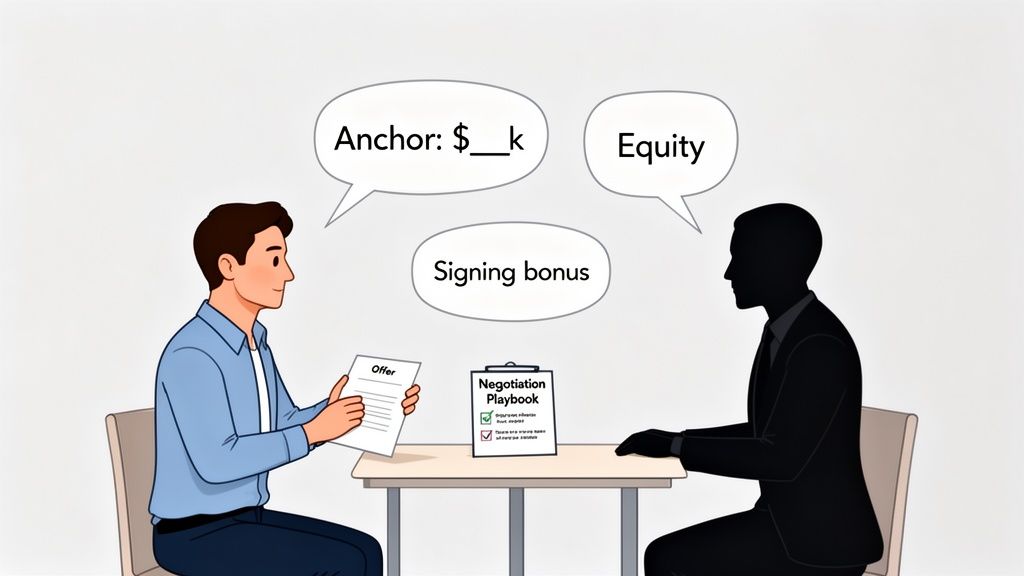
Getting a job offer feels like the finish line, but it’s really just the starting gate for the most important conversation you'll have. Companies fully expect you to negotiate—it’s a standard, baked-in part of the hiring dance.
This is your single best chance to boost your lifetime earnings, so you need to walk in with a strategy.
Forget the old idea that negotiation has to be a fight. The best negotiations are collaborative. You’re not demanding more; you’re advocating for your market value. With the right prep, you can turn a good offer into a great one.
The bedrock of any strong negotiation is data. Showing up to a salary discussion without knowing your market rate is like trying to drive across the country without a map. You’ll get lost, fast. You need to benchmark what a competitive software engineering salary looks like for your specific skillset, experience level, and location.
Use resources like Levels.fyi and other company-specific data to get reliable salary bands. Your research should be tailored to match your profile:
With this data, you can define your target compensation range. This isn't just one number. It’s a spectrum that includes your ideal outcome, an acceptable middle ground, and your non-negotiable walk-away number.
One of the trickiest moments in any interview process is when a recruiter asks, "So, what are your salary expectations?" If you name a number too early, you risk anchoring yourself too low before you even know what they’re willing to offer.
Your goal is to politely defer this conversation until they’ve made the first move.
If they ask, you can gently redirect the conversation back to them.
Example Script: "I'm really focused on finding the right role, and I'm confident we can agree on a fair number if we both feel it's a great fit. For now, could you tell me more about the approved salary range for this position?"
This response keeps things collaborative and puts the ball in their court to provide the first number, which becomes your negotiation anchor. If they really press you for a number, give a broad, well-researched range based on your market data. Just be sure to add that your final expectation depends on the full scope of the role and the total compensation package.
Once you have an offer in hand, it's time to build your counter. A powerful counteroffer is never just a bigger number pulled from thin air. It’s a well-reasoned argument that directly connects your request to the value you’re going to bring to their team.
Your counter should stand on three pillars:
A rookie mistake is getting tunnel vision on the base salary. Total compensation has multiple levers, and you can—and should—negotiate all of them. If a company says they can’t budge on base, that’s your cue to look elsewhere.
By negotiating the entire package, you create a win-win. You get closer to your target number, and the company finds a creative way to land a top candidate while staying within its budget.
When you're trying to make sense of your compensation, you quickly move past the big, flashy salary numbers and into the nitty-gritty details. Here are the questions we hear most often from engineers who are trying to make smarter career and financial decisions.
For most engineers who meet expectations, a standard annual raise lands in the 3-5% range. Think of it as more of a cost-of-living adjustment than a real pay bump. If you want to see a meaningful jump in your salary, you have two clear paths: get a promotion or change jobs.
A promotion can boost your base salary by 10-20% and often comes with a bigger bonus target and new equity. But switching companies is typically the fastest way to get to the top of the market, often netting you a 20% or greater increase if you play your cards right during negotiations.
Actionable Insight: Don't wait for your annual review to see if you're underpaid. Every 18-24 months, browse job listings and even take an interview or two. This gives you real-time data on your market value and leverage for a raise or a new role.
Trying to put a dollar value on an equity offer from an early-stage startup is more art than science. With no public share price and little revenue, you’re really betting on the future. The trick is to stop thinking about its current value (which is basically zero) and focus on the percentage of the company you're actually being offered.
Make sure you get answers to these questions:
With this information, you can start to calculate the "paper value" of your grant and understand what your stake could be worth if things go well. An offer of 0.1% at a $10 million company is a world away from 0.01% at a $50 million company.
There's a definite pay difference between a tech giant and a Series B startup, but it all comes down to the trade-offs you're willing to make. Big public companies like Google or Microsoft will almost always offer a higher base salary and more liquid equity through RSUs.
A Series B startup usually can't compete on that high base salary. Instead, they’ll offer a much larger equity grant in the form of stock options. It's riskier, sure, but the upside is exponentially higher. It's not unusual to see a startup offer with a 15-25% lower base salary but an equity package that could potentially be worth several times what a big tech company would offer.
The average base salary for a software engineer in the United States ranges from approximately $85,000 for entry-level roles to $240,000 or more for staff and principal engineers at top companies. The median total compensation — which includes base salary, bonuses, and equity — hit $190,417 in 2026. Salaries in major tech hubs like San Francisco and New York City are typically 25 to 35 percent higher than the national average. Engineers at leading public tech companies with strong equity packages frequently see total compensation well above $300,000 annually.
Big tech companies like Google, Meta, and Microsoft almost always offer higher base salaries and more predictable liquid equity through RSUs. A senior engineer at a FAANG-tier company might earn a base salary of $200,000 or more, with RSUs adding significant additional value. A Series B startup at the same seniority level will typically offer a lower base — often 15 to 25 percent below big tech — but compensates with a significantly larger equity grant in the form of stock options. If the startup succeeds and exits, that equity can far exceed what a large-company RSU package would have delivered. The trade-off is risk and liquidity: startup equity is speculative and takes years to realize, while RSUs from a public company convert to cash predictably.
Total compensation, commonly abbreviated as TC, is the complete financial value of a software engineer's offer — not just the base salary. It typically consists of three components: base salary (the guaranteed, fixed amount paid in every paycheck), bonuses (variable cash payments tied to individual or company performance, usually expressed as a target percentage of base), and equity (either RSUs at public companies or stock options at startups, representing an ownership stake in the company). For example, an offer with a $150,000 base salary, a 15 percent target bonus ($22,500), and $100,000 in equity vesting over four years ($25,000 per year) carries a first-year total compensation of $197,500. Always calculate TC rather than comparing base salaries alone when evaluating competing offers.
Salaries scale significantly with experience. Entry-level engineers with zero to two years of experience earn a national average base of $85,000 to $115,000, rising to $110,000 to $145,000 in top markets. Mid-level engineers with two to five years earn $115,000 to $150,000 nationally and $145,000 to $185,000 in NYC and SF. Senior engineers with five or more years earn $150,000 to $190,000 nationally and $180,000 to $230,000 or more in major hubs. Staff and Principal engineers with eight or more years of experience earn $180,000 to $240,000 nationally, with top-market packages frequently exceeding $280,000 in base salary alone. Equity and bonus components scale with seniority as well, making the gap in total compensation between junior and senior levels even wider than base salary figures suggest.
AI and Machine Learning engineering leads all specializations in 2026, with a mid-range salary of approximately $170,750 — up 4.1 percent year-over-year — driven by surging corporate investment in AI infrastructure and intelligent product development. DevOps and Cloud engineering follows closely at approximately $145,750 with 2.3 percent annual growth, reflecting the critical importance of infrastructure scalability at fast-growing companies. Cybersecurity engineering is also commanding a premium as data protection and compliance become non-negotiable priorities. Specializations in high-performance systems programming (Go, Rust), backend architecture for high-traffic applications, and distributed systems consistently command premiums above generalist roles at equivalent experience levels.
Effective salary negotiation starts with thorough market research — use platforms like Levels.fyi to benchmark total compensation for your specific role, experience level, location, and company stage before any salary conversation. When a recruiter asks for your expectations, politely defer by asking for the approved salary range first, which becomes your negotiating anchor. Once you have an offer, build your counter on three pillars: market data showing the competitive range for your profile, specific skills or past achievements that justify your ask, and concrete examples of value you will deliver based on challenges discussed in interviews. If base salary is genuinely fixed, negotiate the signing bonus, equity grant size and vesting schedule, and bonus target percentage — companies frequently have more flexibility on these components than on base.
Standard annual raises for engineers who meet performance expectations run between 3 and 5 percent — effectively keeping pace with inflation rather than meaningfully growing real income. A promotion typically adds 10 to 20 percent to base salary alongside a larger bonus target and new equity. Changing companies is historically the fastest and most significant lever for salary growth, frequently delivering 20 percent or greater increases when negotiated well. The most effective strategy for staying competitive is to check your market value every 18 to 24 months — browsing listings, taking occasional interviews, and tracking total compensation data — so you always know your worth and have real leverage when negotiating, whether internally or externally.
RSUs (Restricted Stock Units) are grants of actual company shares that vest over time — typically four years — without requiring any purchase. They always have value as long as the company's stock price is positive, making them the lower-risk, more predictable equity type. RSUs are standard at large public tech companies. Stock options give you the right to buy company shares at a fixed strike price set at the time of your grant. If the company's value grows significantly above that price, your options can be worth far more than an equivalent RSU grant — but if the company stalls or fails, options may expire worthless. Stock options are the standard equity vehicle at early-stage and growth-stage startups. The core trade-off is that RSUs offer more certainty and liquidity, while stock options offer potentially higher upside paired with higher risk.
Location remains one of the most significant variables in software engineering compensation, even in the era of widespread remote work. Base salaries in San Francisco and New York City run 25 to 35 percent higher than national averages for equivalent roles, reflecting both the higher cost of living and the concentration of well-funded companies competing aggressively for talent. For remote roles, companies take three different approaches: paying based on the employee's local market (location-adjusted pay), paying a single national rate regardless of where the employee lives, or anchoring all remote salaries to the company's headquarters pay band. Understanding which model a company uses is an important due diligence question when evaluating remote offers, particularly if you are in or plan to move to a lower-cost market.
Evaluating startup equity requires shifting focus from the raw number of options granted to the ownership percentage your grant represents and the company's current and potential valuation. Ask for the total number of fully diluted shares outstanding so you can calculate your ownership percentage (your options divided by total shares). Ask for the company's most recent 409A valuation or last funding round valuation to estimate the current paper value of your grant. Understand the vesting schedule — the standard is four years with a one-year cliff — and ask about the post-termination exercise window (how long you have to buy your vested options after leaving). A grant of 10,000 options sounds very different when you know whether it represents 0.1 percent or 0.001 percent of the company, and whether the company's trajectory makes the current valuation a floor or a ceiling.
Ready to see what top startups are willing to pay for your skills? Underdog.io flips the script on job searching. With one application, you get access to hundreds of vetted startups in NYC, SF, and remote-first roles, so companies apply to you. Find your next opportunity on Underdog.io.