You know the pattern. You find a Node.js role that looks close enough, tweak your resume, answer the same screening questions, and send the application into a system that gives you nothing back. No rejection worth learning from. No conversation with an engineering lead. Just silence.
That silence makes people misdiagnose the problem. They assume their skills are weak, their background is off, or the market has moved on. In most cases, that isn't the true issue. The issue is distribution. Strong engineers get buried on generic boards because those systems reward keyword overlap, not judgment, timing, or startup fit.
That mismatch is especially painful in jobs node js searches because the skill itself is still highly relevant. Node.js held the #1 spot in global developer usage for web frameworks in 2025, commanded over 40% usage, powered more than 6.3 million websites, and reached over 375 million monthly downloads by May 2025 according to Node.js ecosystem statistics compiled by Electro IQ. If you're good at building backend APIs, internal services, queues, event-driven systems, or full-stack JavaScript products, you're not carrying a dated skill. You're carrying one that startups still use to ship fast.
The problem is that broad job advice rarely helps with startup hiring. Early-stage companies don't hire the same way larger companies do. They care more about range, shipping ability, and whether you can make sensible trade-offs with limited context. They also often recruit through tighter networks and curated channels, not just public listings. If you're still relying on volume alone, it's worth studying alternative routes like job search sites built for software engineers, because the search strategy matters almost as much as the resume.
A lot of Node.js developers are trying to solve the wrong problem. They spend time polishing bullets, adding one more library to a side project, or applying to more roles, when the bottleneck is often signal. On a crowded board, your profile gets flattened into title matching and keyword counts. A startup founder hiring their second backend engineer usually wants something much narrower than "Node.js developer."
They want someone who can own a service, think clearly about failure modes, and join a small team without needing a long runway. That's different from being "qualified" in the broad sense.
There's no shortage of proof that the ecosystem remains important. Node.js is still one of the default choices for teams that want JavaScript across the stack, fast iteration, and a mature package ecosystem. That matters in startups because hiring one engineer who can reason across backend, tooling, and product constraints is often more useful than hiring a narrow specialist too early.
Practical rule: If your search feels broken, don't assume your Node.js skill set is the problem. Assume your go-to-market as a candidate is weak.
A lot of candidates underestimate how attractive startup-ready backend skills are when they're shown properly. Node.js isn't just about writing Express routes. It's often tied to internal APIs, event processing, real-time product behavior, integrations, and operational work that directly affects customer experience.
The black hole usually comes from three things:
The fix isn't applying to fewer jobs blindly. It's applying with a more precise story and targeting the part of the market where that story makes sense.
"Node.js developer" sounds like one job. In startup hiring, it's usually at least three different jobs wearing similar labels. If you don't know which one you're targeting, your resume, portfolio, and interview prep will feel scattered.
A simple way to think about it is a restaurant. One person runs the kitchen. Another handles what customers see. Another keeps the whole operation working behind the scenes. Node.js shows up in all three.
This is the kitchen. Backend engineers handle the service logic that keeps the product running. They build APIs, authentication flows, data models, queues, background jobs, and integrations with outside systems.
At an early-stage startup, this person often owns ugly but important work. Billing webhooks. Retry logic. Rate limiting. Search indexing. File processing. The best backend candidates don't just know frameworks. They know where systems break.
This is the front-of-house person who also jumps into the kitchen when needed. Full-stack engineers use Node.js on the backend but are also expected to connect it cleanly to the frontend. That usually means React in practice, though what matters more is whether you can move from an API contract to a usable product feature without creating friction between layers.
If you came into engineering through product work, startup teams often value this profile because it reduces handoffs. If you're unsure which academic route better maps to this kind of work, this breakdown of compare computer science and software engineering is a useful framing tool. It helps explain why some roles reward systems thinking while others reward implementation breadth.
This is facilities and operations. Platform engineers may still use Node.js, but their focus is less on user-facing features and more on internal tooling, deployment workflows, developer experience, build systems, and reliability. In smaller startups, this role may not exist by title yet. The work still exists.
Node.js experience with scripts, CLIs, queue workers, and infrastructure glue can become a differentiator. If you've ever improved local development, standardized service templates, or automated painful manual tasks, you're closer to platform work than you may think.
| Role Type | Primary Focus | Key Skills | Best Fit For |
|---|---|---|---|
| Backend Engineer | APIs, services, business logic, integrations | Node.js, databases, auth, queues, testing, cloud basics | Engineers who enjoy systems, data flow, and reliability |
| Full-Stack Engineer | End-to-end product delivery across backend and frontend | Node.js, API design, frontend framework work, state management, UX awareness | Engineers who like shipping user-facing features quickly |
| Platform Engineer | Tooling, deployment, internal systems, developer workflows | Node.js scripting, CI/CD, containers, observability, infrastructure thinking | Engineers who like leverage, automation, and operational quality |
Good startup candidates don't force themselves into all three categories. They pick one primary identity and show enough overlap to be useful on a small team.
A job post may say "Node.js engineer," but the actual ask is often hidden in the responsibilities:
Once you know which role you're targeting, your application gets simpler. You stop trying to look universally qualified and start looking specifically useful.
Startup hiring managers usually don't ask, "Do you know Node?" They ask a more practical version of it. Can you help us ship and keep the backend stable while the product changes fast?
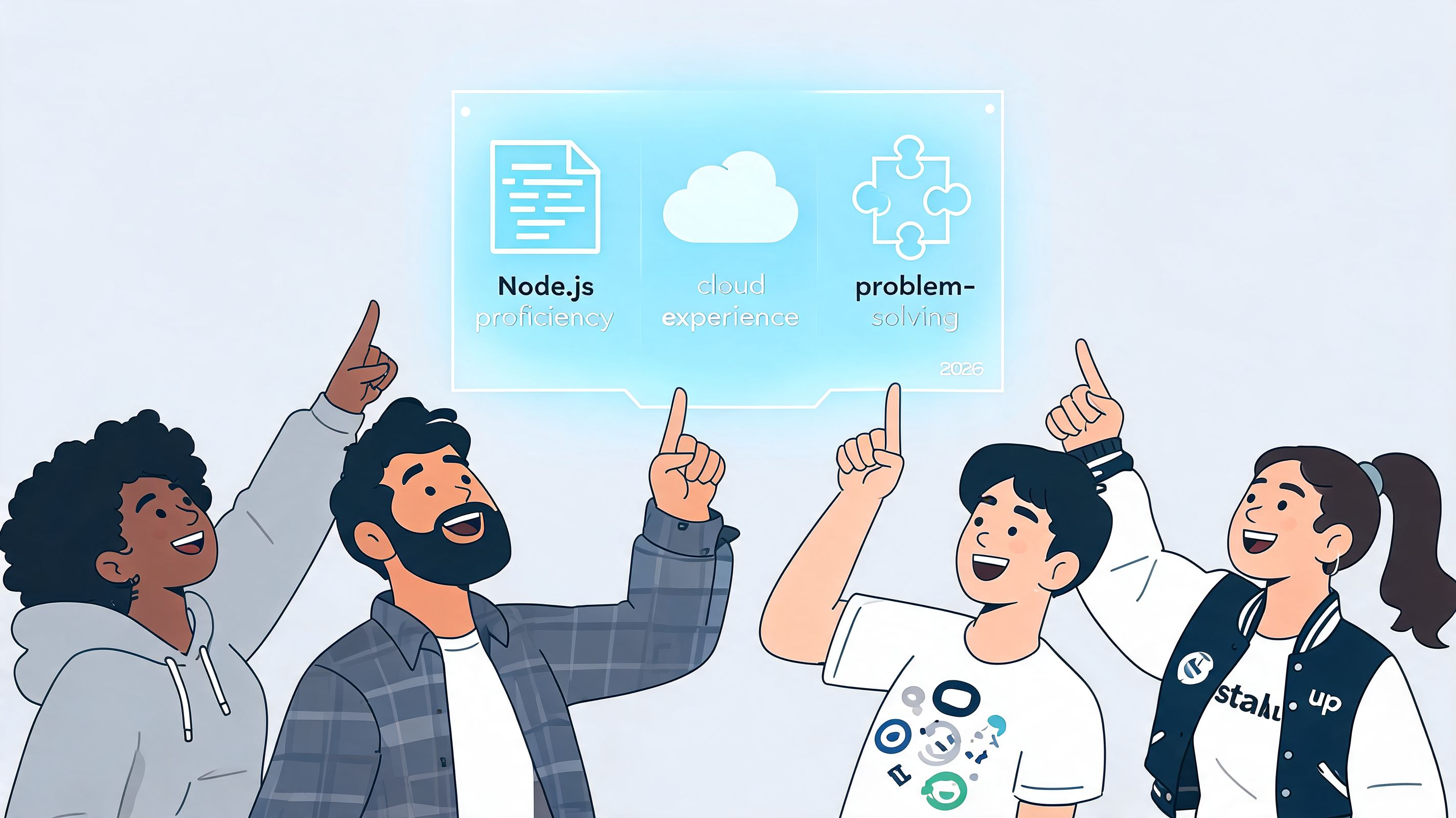
That changes what counts as a valuable skill. The market signal around top roles is pretty clear. In the US, many Node.js roles ask for 3+ years of hands-on experience, with emphasis on microservices and high-traffic backend APIs, because startups need systems that can handle growth without collapsing under traffic spikes or operational complexity, as reflected in remote Node.js role requirements collected by Turing.
The strongest startup candidates tie technical skills to business needs. That's what interviewers remember.
You don't need every trendy framework. You need a stack that makes a hiring manager think, "This person can contribute in week one."
A practical baseline often looks like this:
| Skill area | What hiring teams want to see |
|---|---|
| Core Node.js | Solid async patterns, error handling, streams, process behavior, testing |
| API design | REST or GraphQL, auth, pagination, validation, versioning |
| Data layer | SQL or NoSQL, schema choices, indexing awareness, migration discipline |
| Deployment | Containers, CI/CD familiarity, environment management, cloud debugging |
| Team code quality | TypeScript, linting, test coverage, readable service boundaries |
Candidates often waste time collecting tools instead of building depth in a small set of startup-relevant skills.
What works:
What doesn't:
If you can't explain why a startup would choose your architecture under time pressure, you don't fully own the skill yet.
If you're trying to level up for jobs node js roles at startups, focus in this order:
Early-stage startups don't expect perfection. They do expect evidence that you can make progress with imperfect information and leave the codebase better than you found it.

Most Node.js portfolios fail for one reason. They prove you can follow instructions, not that you can solve startup problems.
A hiring manager doesn't need another to-do app. They need evidence that you can design something under constraints, make trade-offs, and explain them clearly. The good news is that you don't need a huge project. You need a believable one.
A strong portfolio usually looks less like a class assignment and more like a small internal product.
Project one: a real-time analytics dashboard
This is useful because it shows performance thinking, state updates, and event-driven behavior. It also maps to a real startup use case. Node.js's event-driven, non-blocking I/O model can cut latency by 30 to 40% compared to traditional stacks in cited benchmarks, and showing that idea in a real-time dashboard is a strong signal for teams building fintech or other data-heavy products, as discussed in Indeed's Node.js technical lead job landscape.
What to include:
Project two: a commerce-style API
Not because ecommerce is magical. Because it gives you a realistic domain with auth, inventory rules, carts, order states, and webhooks. That's enough complexity to show architecture without becoming impossible to finish.
Project three: a background processing service
A small file-processing or notification pipeline shows the kind of backend ownership startups value. You can demonstrate async work, retries, status tracking, and separation between request flow and worker flow.
The README is where a mid-level project starts to look senior. Most candidates treat it like setup notes. Strong candidates use it to explain decisions.
A useful README should answer:
If you want ideas for making those repos more credible, this guide on how to make your GitHub more impressive to employers is worth reviewing before you start polishing screenshots.
"A decent project shows code. A strong project shows judgment."
They usually scan for these things before they read much code:
When you present a project, don't say, "I built this to learn Node.js." Say something closer to this:
I built a small event-driven dashboard for a subscription product. I chose Node.js because I wanted a simple way to handle concurrent updates and push real-time state to the client. I kept the storage layer simple, documented where backpressure would become an issue, and added tests around message ingestion because duplicate events were the most likely failure mode.
That tells a startup team how you think. It sounds like someone who has worked on real systems, even if the project is self-directed.
Startup interviews are usually less polished than big-company loops, but they aren't easier. They compress a lot of judgment into a small number of conversations. One weak signal can matter because teams are small and every hire changes the engineering culture.
The candidates who do well don't just know Node.js concepts. They make the interviewer's job easy by communicating clearly and showing how they reason under constraints.
This round isn't fluff. It's where many strong engineers fail by sounding too generic.
You need a crisp answer to three questions:
If you're targeting early-stage startups, talk about ownership, speed, and product proximity. Don't say you "love fast-paced environments" because everyone says that. Say you prefer teams where backend decisions visibly affect customer experience and where engineers own problems beyond ticket boundaries.
If the role is remote, prep for a different kind of evaluation too. A lot of companies are trying to figure out whether you can communicate asynchronously, stay organized, and work without constant prompts. This guide on how to land a remote role is useful because it surfaces the non-obvious questions remote employers often ask.
For Node.js roles, this round often checks whether you understand behavior, not just syntax. Expect questions around:
A weak answer sounds like memorized definitions. A better answer ties the concept to implementation. For example, don't just define the event loop. Explain how poor async handling can block useful work, create hidden latency, or produce brittle retry behavior in API handlers.
Treat the take-home like a miniature production repo. Most candidates still treat it like a coding exercise. That's a mistake.
What evaluators usually care about:
| Area | What they want |
|---|---|
| Code clarity | Names, structure, and flow make sense without narration |
| Trade-off awareness | You explain what you simplified and why |
| Testing | Core logic is protected, not just happy path demos |
| Developer experience | Setup is easy, scripts work, docs exist |
| Product judgment | You didn't overbuild or ignore obvious edge cases |
A good take-home submission includes a short design note. Keep it plain. Mention assumptions, what you skipped, and what you'd improve with more time.
Hiring signal: If the assignment says "build an API," they're also testing whether you know what not to build.
Early-stage startup system design is usually less about giant distributed systems and more about practical service design. You might get prompts like:
Use a clear framework:
The strongest answers sound collaborative. You aren't presenting a perfect blueprint. You're showing how you'd think with the team in the room.
Here you evaluate them too. Ask questions that reveal engineering maturity:
If the answers are vague, chaotic, or detached from product reality, pay attention. Interviews aren't only about getting an offer. They're about avoiding the wrong one.
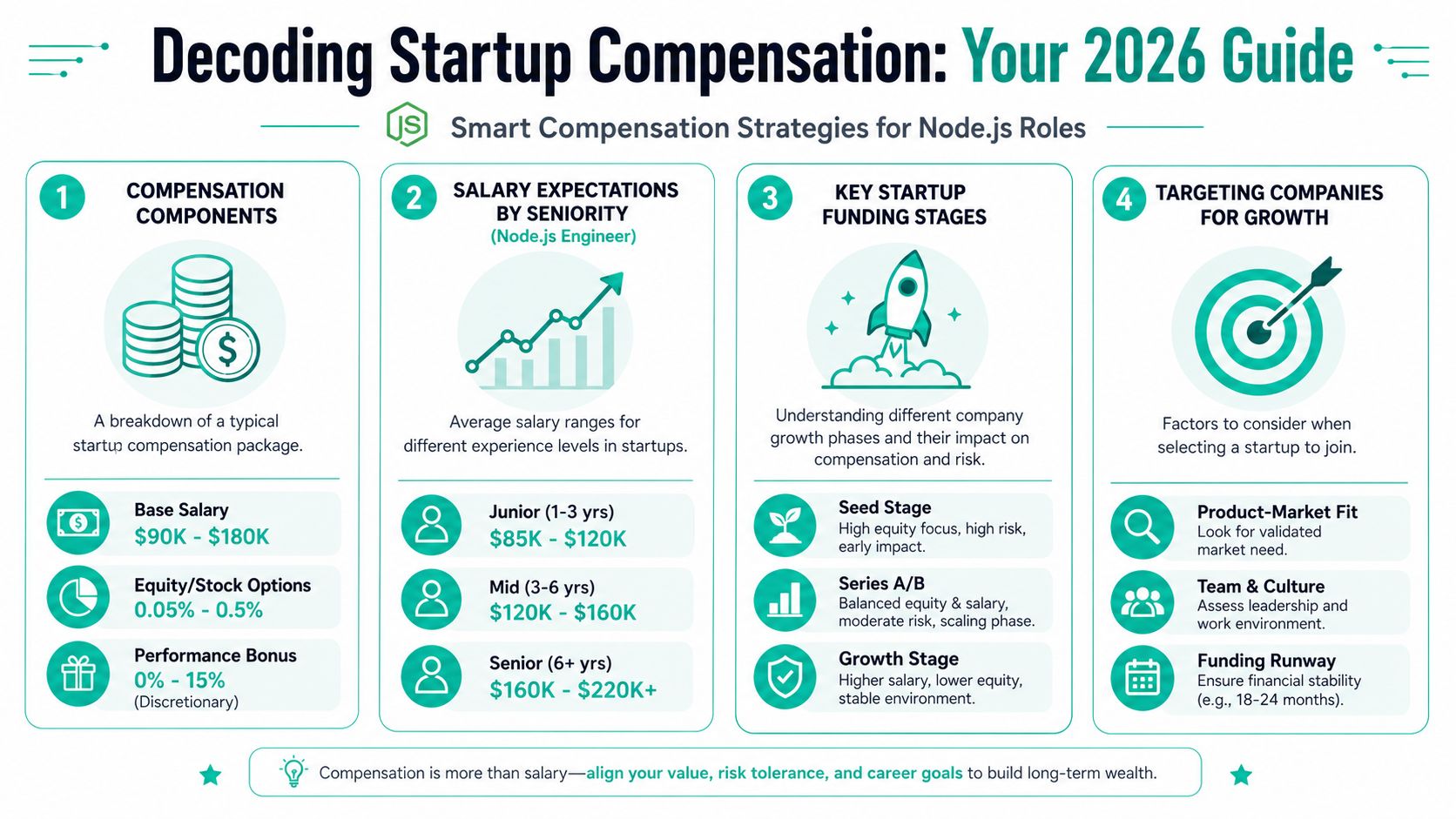
A pre-Series B offer can look strong on paper and still be the wrong move. I see candidates fixate on base salary, then realize too late that the company has nine months of runway, vague product direction, and no real plan for the role. At an early-stage startup, compensation is tied to risk. Salary, equity, benefits, and team quality need to be evaluated together.
Node.js still commands strong pay in the broader market. In the UK, IT Jobs Watch's Node.js salary and demand data shows a median annual salary of £75,000 and a 90th percentile of £115,000. That does not map cleanly to US startup packages, but it does reinforce a useful point. Backend Node.js skill is valuable, so if a startup is paying below market, there should be a clear trade-off in return, such as stronger equity, unusual scope, or a team worth betting on.
The key question is simple. What are you being paid to risk, and is that risk priced fairly?
For pre-Series B companies, ask direct questions early:
Those answers tell you more than a polished pitch deck will.
Equity deserves the same level of scrutiny as salary. Ask for the number of shares, not just the percentage. Ask about the latest valuation, the vesting schedule, the exercise window, and whether there has been meaningful dilution across recent rounds. If you want a baseline for comparing packages, review these startup compensation benchmarks before you negotiate. The goal is not to copy someone else's script. The goal is to understand whether the package matches the stage and the risk.
Benefits matter more at startups than candidates sometimes expect. A slightly higher salary can disappear quickly if the health plan is weak, parental leave is poor, or the company has no real support for remote equipment and travel. These HR insights on employee benefits are a useful reference when you compare the full package.
Remote roles need extra filtering. Some early-stage teams run remote work with clear documentation, fast decisions, and thoughtful onboarding. Others use remote hiring to paper over disorganization. If nobody can explain communication norms, on-call expectations, or how product decisions get made, assume daily work will be harder than the interview suggests.
Targeting matters here. Generic job boards bury this context, which is why startup candidates end up in long interview loops for companies they should have screened out in the first call. Build a short list by stage, product quality, and role shape. A Seed startup may need a Node.js engineer who can ship APIs on Monday and debug billing issues on Friday. A Series A or B startup may need someone to stabilize backend systems, clean up operational debt, and help define engineering process.
A good target list is small and specific:
That discipline saves time and produces better offers.
You spend an hour tailoring a resume, send it into a generic job board, and get silence. Repeat that ten times and the problem is no longer effort. It is distribution.
Early-stage startups rarely hire the same way larger companies do. A Seed or Series A team may have one engineering manager, a founder screening resumes at night, and no recruiter triaging hundreds of applicants. That creates a real opening for candidates who apply with context instead of volume. It also explains why generic boards feel like a black hole, especially for Node.js roles that can range from API work to infrastructure, integrations, and customer-facing debugging.
The goal is to get reviewed by the right team, not to maximize application count.
I advise candidates to treat the application like a technical pitch. Show the team how you think. If the company handles payments, mention billing systems, idempotency, or webhook retries you have worked on. If it sells to developers, point to API design, SDK support, or reliability work. That level of specificity tells a startup you can contribute before they even schedule the first call.
A weak application says, "I am a Node.js developer with three years of experience." A strong one says, "I built and operated Express and PostgreSQL services that processed high-volume background jobs, reduced p95 latency, and supported production incidents." Startup hiring teams notice the difference fast.
If you are trying to avoid another month of generic job boards, Underdog.io is one example of a startup-focused channel that can put a single profile in front of vetted companies without the usual mass-application churn.