You're three tabs deep into LinkedIn at 11:47 p.m., telling yourself you're only browsing. A former colleague has sent a Slack DM about a startup hiring someone with your background, your current role feels increasingly disconnected from where you want to go, and suddenly you're comparing job descriptions instead of sleeping. Then the confusion starts: salary ranges don't line up, equity language is vague, applications disappear into silence, and every recruiter seems to describe the NYC market differently.
The useful question isn't which job board has the most listings. It's how a New York startup sources, evaluates, and closes candidates, and how you can position yourself inside that process. This guide gives you the market context, compensation benchmarks, sourcing tactics, interview mechanics, and negotiation checks you can use this week. If you're also managing the practical realities of renting while self-employed or between roles, RentReboot's self employed renter guide NYC is a useful companion resource.
You're not a beginner, and you don't need another generic application checklist. You need to stop mass-applying and start reverse-engineering the funnel.
The passive candidate usually makes the decision in a small, almost forgettable moment. A former teammate sends a message saying, “You'd be good for this,” or you see a founder post about a product problem that looks far more interesting than your current roadmap. Sometimes it's less dramatic. You realize your title has changed, your responsibilities haven't, and your next promotion would put you further from the work you want to do.
That realization creates a messy search. You open LinkedIn, Wellfound, Built In NYC, and company career pages. You save roles in fintech, AI, enterprise software, and consumer products without deciding which environment suits you. One listing offers a wide salary range, another says “competitive,” and a third mentions equity without explaining whether it means options, restricted stock, or a number that only sounds impressive in a pitch deck.
Ghosting makes the process worse. A strong application can vanish because the recruiter changed priorities, the hiring manager paused the requisition, or the company received a warm referral before reviewing its inbound queue. Treating every silent application as a verdict on your ability is a fast way to lose perspective.
New York City's tech sector reached 203,819 jobs in 2024, compared with 161,447 in 2019, an increase of 42,372 jobs. Tech employment grew 64% in five years and represented 41% of the city's net job growth since 2019, according to Tech:NYC's reports. The same source says the sector added an average of 8,000 jobs per year across the five boroughs between 2014 and 2024.
That doesn't mean every startup is hiring, or that every role is equally accessible. It means the city has a deep labor market, a broad employer base, and enough hiring activity for a targeted search to work. Your job is to identify where your skills meet a real hiring problem.
Recruiter's rule: Don't ask, “How do I apply to more jobs?” Ask, “Which hiring manager has a problem I can credibly solve?”
Start by defining your target in practical terms. Choose the functions you can perform immediately, the company stage where you're comfortable, the technical or product problems you want to own, and the compensation structure you can accept. A senior backend engineer who wants platform ownership should search differently from a product manager who wants customer discovery at a seed company.
The rest of the process becomes clearer once you stop treating NYC startup jobs as one market. Stage changes the interview pace, role changes the evidence required, and the company's funding position changes how much risk sits inside the offer. Your search should reflect those differences from the first message.
New York's technology market has reached a scale that supports several startup ecosystems at once. The city has fintech companies selling into financial institutions, AI companies recruiting specialized technical talent, enterprise software firms using Manhattan proximity to reach buyers, and consumer businesses drawing from a large product and design community. That diversity matters because a slowdown in one pocket doesn't automatically shut down the entire market.
The employment base was already substantial before the latest expansion. A Center for an Urban Future analysis summarized by Tech:NYC counted 193,929 tech jobs by December 2021, after the sector added 114,000 jobs since 2010, a 142% increase from 80,020 jobs in 2010. The analysis also estimated 25,451 tech-enabled startups in New York City. That combination of employment scale and startup density gives candidates more routes into the ecosystem than a single cluster of venture-backed companies.
Late-stage companies often hire through planned headcount cycles. They may have dedicated recruiters, formal interview rubrics, specialized teams, and multiple approvals before an offer reaches you. Seed through Series B startups usually hire in sharper bursts. A new customer, funding event, product deadline, or executive hire can create an urgent role, then the same company can pause unrelated requisitions.
Function matters just as much. AI and machine learning roles remain scarce, while senior engineering positions require candidates who can make sound decisions without a large support structure. Product managers need to show judgment under incomplete information, not just polished product vocabulary. Forward-deployed engineers, data specialists, and designers become especially valuable when the company needs people who can work directly with customers and turn messy feedback into shipped work.
CompTIA projects 11,317 additional tech jobs in New York City in 2026, as reported in its State of the Tech Workforce 2026 findings. That's a projection, not a guarantee for any individual candidate. It supports a practical conclusion: specialized skills and senior ownership are more defensible positioning than a broad claim that you're “open to anything.”
| Startup Stage | Top Hiring Functions | Headcount Trajectory |
|---|---|---|
| Seed | Founding engineering, product, early sales, operations | Small teams add selectively around urgent product and customer needs |
| Series A | Engineering, product, design, initial go-to-market | Hiring expands around repeatable product delivery and early revenue |
| Series B | Backend, AI and ML, product, sales, customer success | Teams add functional depth and build management structure |
| Late stage | Platform engineering, data, security, enterprise sales, operations | Hiring follows planned budgets, specialized orgs, and market expansion |
Funded startups with a clear product milestone, active customer demand, or scarce technical requirement are the strongest targets. Companies that post repeatedly without explaining ownership, reporting lines, or the hiring reason deserve more scrutiny. A job description that stays live for months may reflect a difficult search, a flexible talent pipeline, or a requisition that isn't urgent.
The data shows a large market, not universal momentum. Calibrate your expectations by looking for evidence of active hiring: recent funding, named team growth, a responsive recruiter, clear interview scheduling, and a manager who can explain what the first months will involve.
Compensation conversations in New York startups go wrong when candidates compare unlike offers. A seed-stage option grant isn't equivalent to late-stage equity, and a large target bonus isn't the same as guaranteed cash. You need to separate base salary, variable compensation, equity type, vesting terms, and liquidity before deciding whether an offer is attractive.
New York's pay-transparency law requires employers with four or more employees to include a good-faith salary range in ads for jobs that can be performed, at least partly, in NYC. The law took effect on November 1, 2022, and also applies to promotions and transfers, as explained in this NYC startup software-engineer salary guide. Use the posted range as an opening signal, not as proof that the company will make an offer at the top.
A 2026 benchmark places median total compensation at $120K to $150K at seed and $185K to $225K at Series C+. It also reports that Series B startups pay about 12% more than seed-stage companies, according to the NYC startup salary benchmark report. The stage premium reflects more structured compensation, greater ability to pay cash, and higher expectations for candidates who can operate independently.
The table below uses the most concrete published engineering bands available. For product, design, and data roles, companies often set ranges around seniority, domain expertise, and hiring urgency rather than publishing a consistent stage-by-stage grid. Ask for the range and leveling framework instead of treating an unverified estimate as market fact.
| Role / Level | Seed (Base / Equity) | Series A (Base / Equity) | Series B (Base / Equity) | Late Stage (Base / Equity) |
|---|---|---|---|---|
| Software engineer, mid-level | Cash is usually constrained, equity is a larger part of the risk-adjusted package | $130,000 to $155,000, plus startup equity | $145,000 to $170,000, plus startup equity | Structured cash and equity, with terms varying by company |
| Software engineer, senior | Lower cash may be offset by a larger option grant, but liquidity is uncertain | $150,000 to $180,000, plus startup equity | $165,000 to $195,000, plus startup equity | Often closer to public-company compensation structure |
| Product manager | Negotiate ownership, scope, and cash separately from options | Request level, bonus, and grant terms in writing | Cash generally becomes more competitive as product teams mature | More formal bonus and equity programs are common |
| Designer | Early-stage value depends heavily on product ownership and portfolio evidence | Clarify whether you own product direction or execution | Ask how design is staffed and measured | Structured levels may make comparisons easier |
| Data scientist or ML engineer | Equity can carry substantial risk, especially where valuation is hard to assess | Specialized expertise can strengthen the cash negotiation | Scarcity can support stronger base positioning | Equity may be more standardized, but still review liquidity |
The engineering figures in the table come from a 2026 NYC startup salary guide. Independent data also shows wide dispersion. Wellfound reports an average expected New York startup salary of about $138,667, with a range from $75,000 to $225,000, while its software-engineer data reports an average of about $139,000, ranging from $80,000 to $236,000. Review the New York startup compensation data on Wellfound as directional evidence, not a promise for your level.
For another market reference, one live job board currently surfaces 500 tech startup jobs in New York, with listed pay ranging from roughly $30 to $40 per hour at the low end to $150,000 to $200,000 annually at the high end. The Indeed NYC tech startup listings demonstrate dispersion more than they establish a benchmark.
At seed and early stages, equity commonly comes as stock options. Ask for the number of shares, total fully diluted shares, strike price, vesting schedule, cliff, exercise window, and the most recent valuation context. A percentage without the denominator is not enough information.
Late-stage equity may look more like restricted stock or a structured option package, but it can still be illiquid. Ask whether there is a secondary market, tender program, or expected liquidity path. Don't let a recruiter convert uncertain paper value into guaranteed compensation.
The cleanest comparison uses scenarios. Calculate what your cash compensation looks like if the equity produces no liquidity, then compare it with a plausible upside case based on the company's current valuation context. A Series B product manager might land around $180K to $225K all-in only if the specific base, bonus, and equity terms support that result. An early-stage staff engineer can appear to clear $300K or more on paper when equity is valued optimistically, yet realize far less. Those are negotiation examples, not guaranteed outcomes.
For a deeper role-specific reference, compare your offer against this New York software-engineer salary analysis, then return to the offer letter and examine what is guaranteed.
The hiring funnel is less mysterious than candidates assume. Startups pull from four main pools: inbound applications, outbound sourcing, referrals, and curated marketplaces or communities. Your objective is to enter through the strongest available route and make each handoff easy for the next decision-maker.
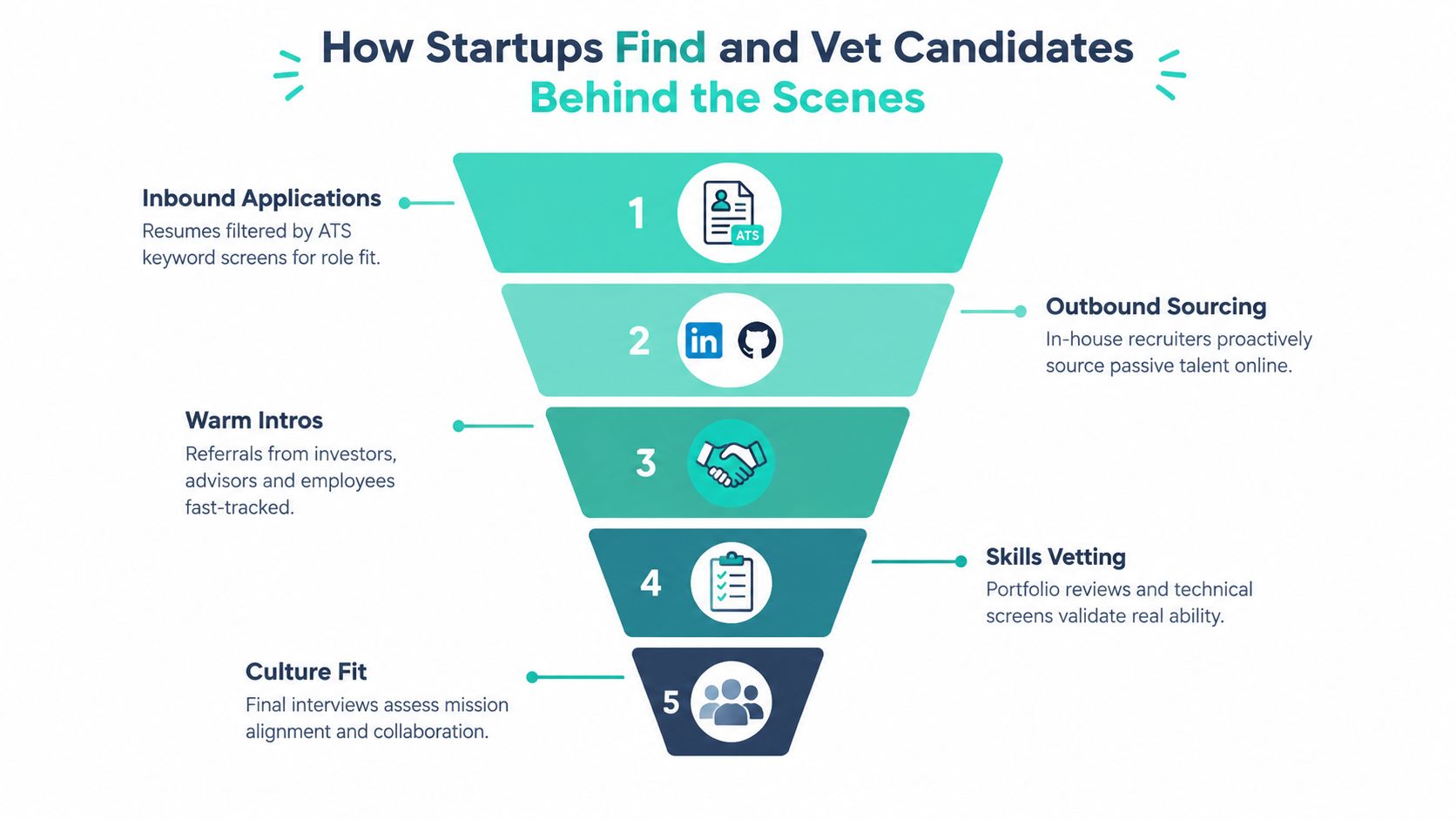
Inbound applications are usually filtered first by an ATS and then by a recruiter or hiring manager. Keyword alignment matters, but a resume that only repeats the job description won't survive human review. Put the relevant stack, product domain, level, and measurable outcomes near the top.
Outbound sourcing is more deliberate. An in-house recruiter searches LinkedIn, GitHub, conference speakers, open-source work, and referrals from current employees. Your profile needs to make the intended role obvious. A recruiter shouldn't have to infer whether you're a platform engineer, product-minded backend engineer, or people manager.
Warm introductions move faster because someone has already supplied a credibility signal. Investors, advisors, employees, and former colleagues can all shorten the path to a hiring manager. Don't ask a contact to “put in a good word” without giving them a concise role target and two or three relevant accomplishments.
Curated platforms such as Underdog.io, A.Team, and Pallet can also provide a more focused route than broad job boards. Candidates who use these channels still need a clear profile, current work samples, and a sharp explanation of the problems they want to solve. For a company-side view of the same mechanics, review recruitment for startups.
A common sequence includes a recruiter call, a take-home or paired coding exercise, a hiring-manager interview, a founder conversation, and reference checks. Early-stage processes often run in roughly 2 to 5 weeks, while Series B and later companies can take 4 to 8 weeks. These timelines are practical ranges, not guarantees, and internal urgency can compress or extend them.
Candidates get cut for predictable reasons:
Your preparation should match the gate. Use a concise impact resume for ATS review, a focused work sample for skills evaluation, and three stories that demonstrate judgment, execution, and collaboration. If your current materials were designed for office-based roles but you're targeting distributed teams too, this remote job resume help can help you pressure-test how clearly your experience reads.
Job discovery works better as a layered system than as an endless scroll. Each layer answers a different question: where are roles appearing, who owns the hiring decision, which companies are visible in the community, and who can create a warm introduction?
Start with curated and local sources. Review Underdog.io, Pallet, A.Team, NYC Tech, and Hacker News' “Who's Hiring” monthly thread on a fixed schedule. Filter for role fit, stage, location expectations, and evidence that the company is actively moving candidates. Don't save every interesting listing. Save the ones where your background solves a stated need.
Then build a target list of companies rather than a list of job titles. A company with no perfect opening may still be worth contacting if it has recently launched a relevant product, raised capital, or hired a leader in your function. Founders respond better to a specific observation than to a generic note asking whether they're hiring.
New York's event ecosystem gives candidates access to context that job descriptions leave out. Look at NY Tech Week, Technical.ly, First Round Capital's Founder Summit, ProductTank NYC, and borough-specific meetups in Flatiron, DUMBO, and SoHo. You don't need to attend everything. Choose events where the people building or buying your target product are likely to appear.
A useful outreach note has three parts:
For example, a backend engineer might write that they've worked on event-driven systems for financial workflows and noticed the company is expanding its enterprise offering. A product manager could connect a prior onboarding problem to the company's current activation challenge. The point is to demonstrate useful pattern recognition before asking for access.
| Channel | Avg Response Rate | Time per Week | Best For |
|---|---|---|---|
| Curated marketplaces | Varies by profile fit and company demand | Focused review rather than broad browsing | Passive candidates who want relevant introductions |
| LinkedIn outreach | Varies by specificity, relationship, and timing | A short block for research and personalized notes | Reaching founders, recruiters, and hiring managers |
| Community events | Depends on attendance and follow-up | Event time plus follow-up | Building context and warm relationships |
| Alumni and former colleagues | Usually strongest when the connection is direct | Targeted conversations | Referrals and honest company context |
| Investor and advisor networks | Depends on portfolio relevance | Research plus specific asks | Access to funded startups with urgent needs |
Use the NYC tech startup jobs discovery guide to expand your platform list, but don't confuse a longer list with a better process.
Create a spreadsheet or Notion board with these fields:
Review it weekly. If you're sending many notes and receiving no replies, fix your targeting or message. If people respond but interviews stall, inspect your stories and work samples. If you reach offers but reject them, improve your compensation and risk analysis earlier in the process.
Startup hiring managers rarely hire the person with the most impressive brand name by default. They hire the person who can explain a relevant problem, show strong judgment, and make the team more confident about execution. A polished pedigree can open a conversation, but a clear narrative usually determines whether that conversation continues.
Research the company from several angles. Check recent funding announcements on Crunchbase, product reviews on G2, team moves on LinkedIn, and the founder's writing on Substack or Twitter. You're looking for strategic priorities: enterprise expansion, pricing changes, platform reliability, onboarding friction, sales efficiency, or a shift toward AI-enabled workflows.
Prepare one story about shipped impact. Explain the problem, the constraints, the decision you made, the work you personally owned, and the outcome. Prepare a second about ambiguity, where the requirements were incomplete or competing stakeholders wanted different solutions. Prepare a third about influence, especially a situation where you changed a decision without direct authority.
These stories should work in behavioral and technical conversations. An engineer can discuss a system redesign through the lens of reliability, cost, and team adoption. A product manager can explain prioritization through customer evidence, commercial constraints, and delivery tradeoffs. A designer can show how research changed the product direction rather than only presenting polished screens.
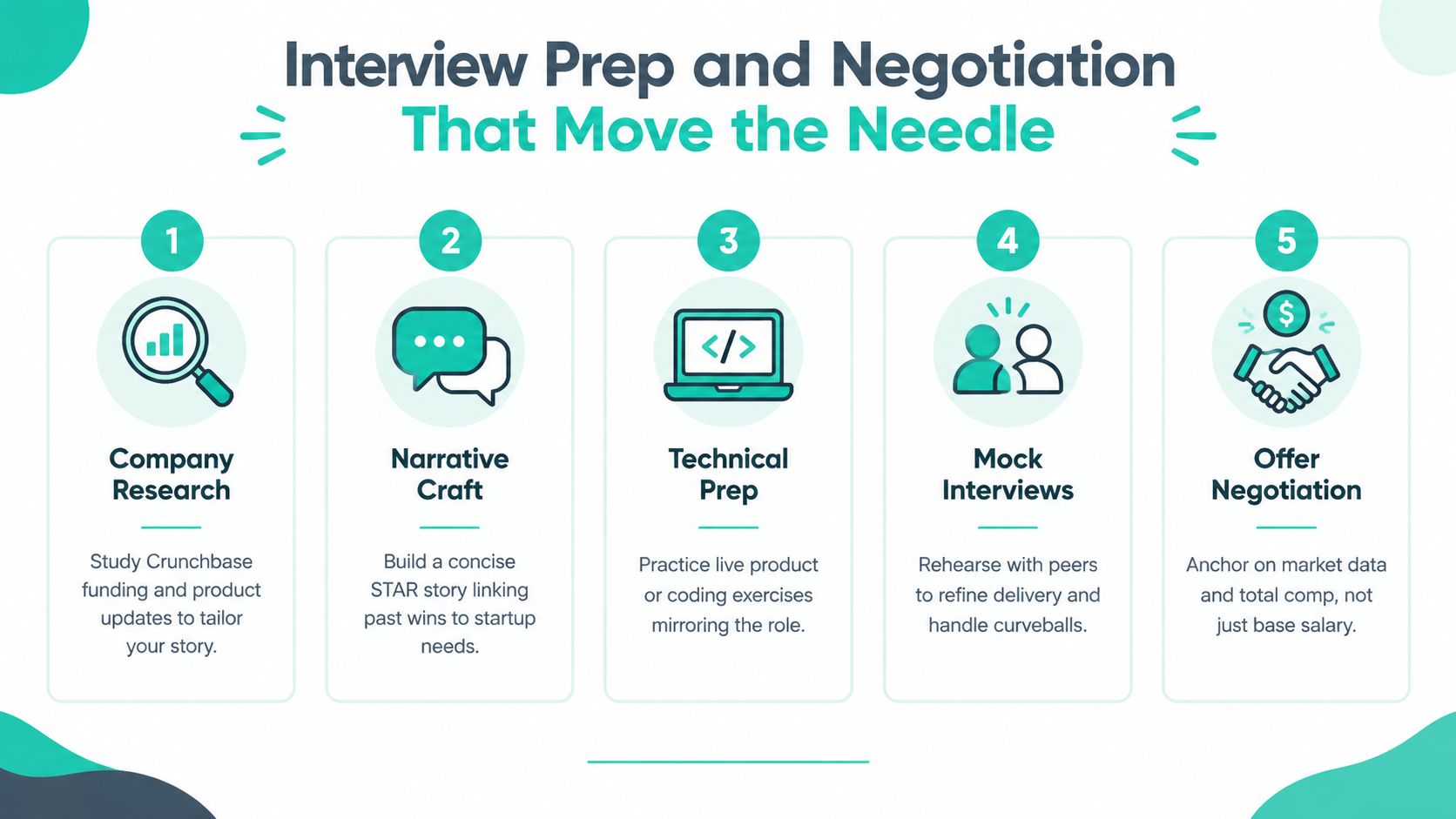
Start with the written range and your target level, then compare the full package. Ask whether equity comes as options, RSUs, or another instrument. Request the grant size, vesting schedule, cliff, strike price where relevant, exercise window, refresh policy, and liquidity information. A candidate who negotiates only base salary can miss the biggest risk in the offer.
Visa sponsorship also belongs in the early conversation. Some NYC startups can sponsor H-1B visas, while others can't or won't. Don't wait until the final stage to discover that the role can't support your work authorization needs. Ask the recruiter directly and get the answer in writing when the process advances.
For early-stage equity, use scenario-based valuation rather than promised percentages. Compare the offer at zero liquidity, moderate liquidity, and a strong outcome. Then ask what assumptions make each scenario possible. This approach keeps the conversation grounded in terms you can evaluate instead of a percentage detached from dilution, preferences, and exit timing.
Forty-eight hours before accepting, confirm:
Send a concise follow-up email after the verbal offer. If the company won't document material terms, treat that as information about how the company handles commitments.
A startup search becomes exhausting when every day feels like an emergency. You don't need to apply constantly. You need a repeatable presence that keeps your work, interests, and availability visible to the right people without turning your network into a list of leads.
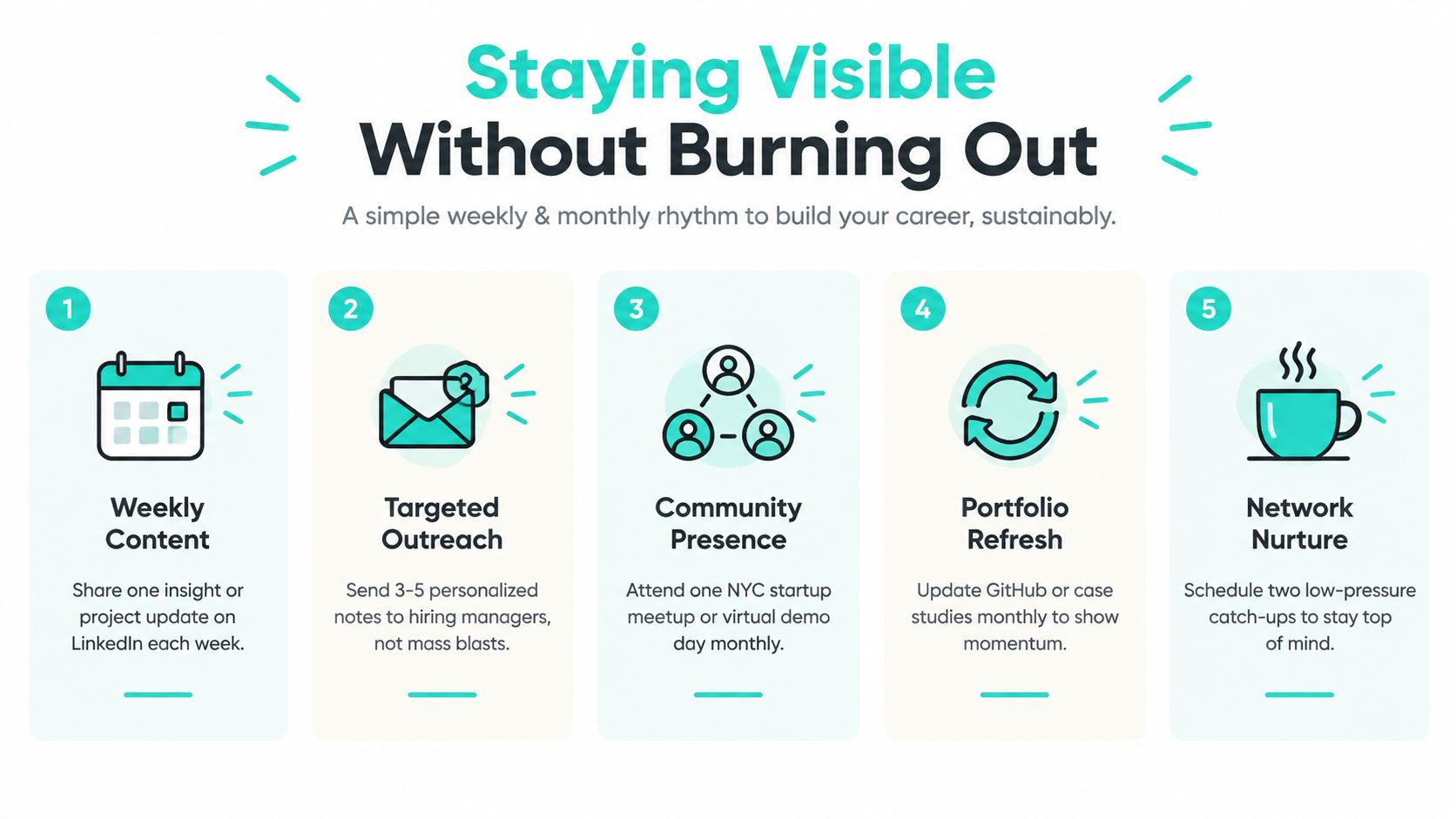
Monday: Spend thirty minutes scanning curated feeds, company career pages, and portfolio communities such as A.Team, NYC-on-Plug, and relevant startup marketplaces. Save only roles that match your level and target problem.
Midweek: Set aside an engagement block. Comment on a founder's product post when you have a useful perspective, share a relevant article with your own analysis, or attend a virtual office hour. Avoid empty visibility. A thoughtful response is more memorable than repeated “interested” comments.
Friday: Contact two existing relationships. Ask how a project is going, share a relevant candidate or article, or suggest a short catch-up. Don't turn every message into a job request. People are more willing to help when the relationship isn't activated only during a search.
Keep the system in a spreadsheet or Notion board. Record the contact, the last interaction, the next action, and whether a conversation is active. This prevents duplicate pings and stops you from forgetting a promising connection.
At the end of each month, update your resume link, GitHub projects, portfolio case studies, and LinkedIn headline. Prune stale threads that no longer have a clear next step. Reassess whether your attention is going toward the right part of the ecosystem, such as AI infrastructure, fintech platforms, enterprise SaaS, product-led consumer startups, or operations-heavy companies.
Consistency beats intensity. A sustainable search gives you enough time to do strong work in your current role, prepare properly for interviews, and maintain relationships that can produce opportunities later.
Underdog.io offers a curated hiring marketplace where one candidate profile can be considered by vetted startups and high-growth technology companies, rather than requiring you to send separate cold applications everywhere. If you're targeting New York tech startup jobs and want a more focused discovery channel, submit your profile through Underdog.io and use the resulting conversations to test your role, stage, and compensation criteria.