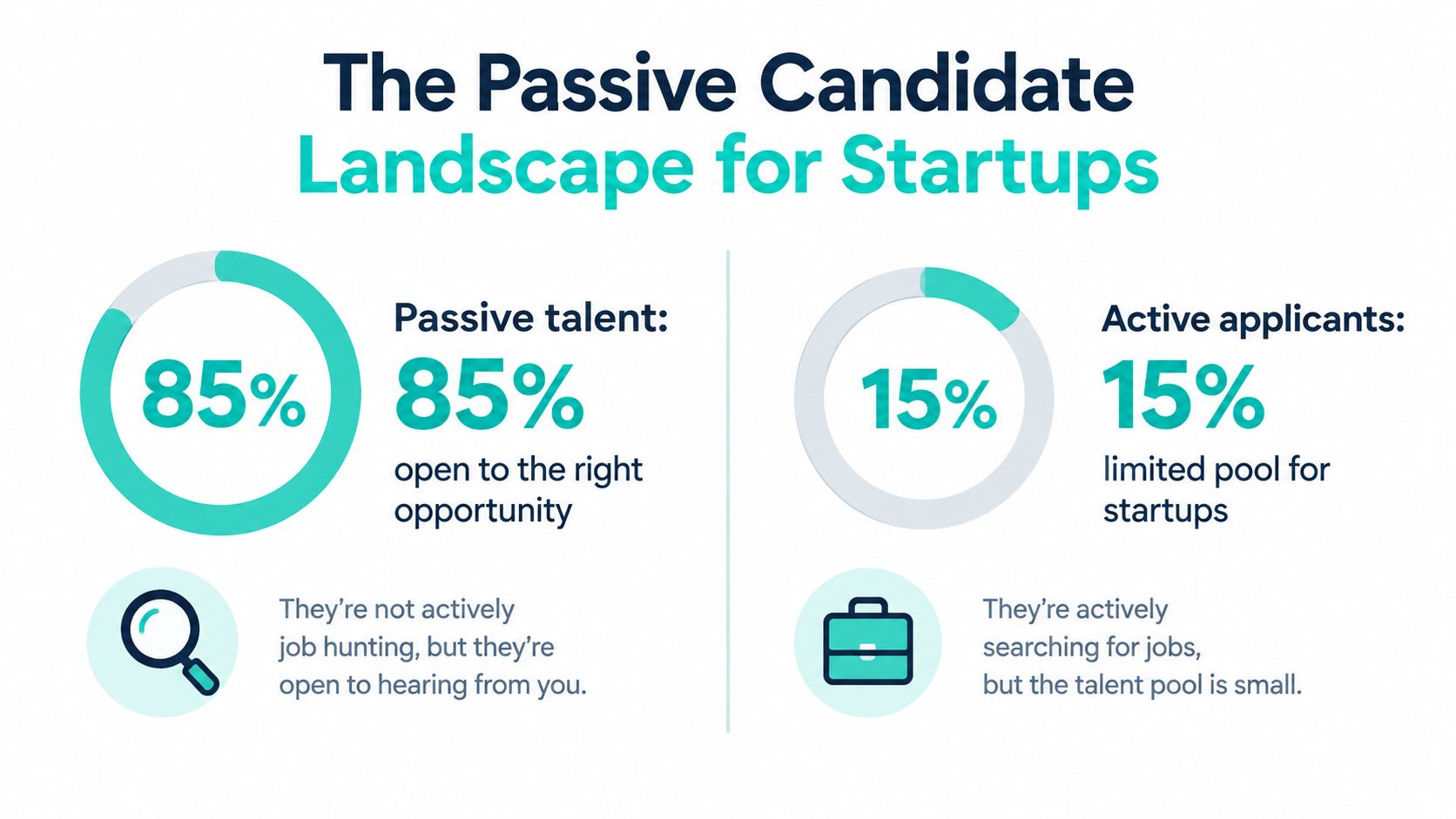
Roughly 85% of the professional workforce is reachable through passive recruiting, while only 25% is actively looking, making proactive sourcing essential for startups. The opportunity is too large to ignore, but careless outreach can damage trust faster than it creates conversations.
That tension defines passive candidate recruiting in 2026. Startups need access to people who already have jobs, yet those professionals may not want colleagues, managers, or employers to know they're exploring alternatives. The answer isn't sending more messages. It's building a sourcing system that combines precise targeting, useful context, transparent expectations, and genuine confidentiality.
Startup hiring often starts with a job post and waits for applications. That works for people already searching, but it leaves out employed professionals who are not browsing job boards and might consider the right opportunity. For early-stage companies, that gap matters because a strong candidate may never encounter a startup's posting, even when the role offers greater ownership or more meaningful work.
LinkedIn's Global Talent Trends research surveyed 18,000 fully employed professionals across 26 countries. Approximately 75% considered themselves passive candidates. Among them, 15% were already networking or initiating conversations, while 45% were open to considering a new opportunity if approached by a recruiter (LinkedIn's global breakdown of active and passive candidates). The findings show why startups need a sourcing approach that reaches people before they decide to apply.
Only 15% were described as “super-passive,” meaning they were satisfied in their current roles and unwilling to discuss another opportunity. The share of professionals who were active job seekers or approachable passive candidates ranged from 78% to 90% across countries, and approachable passive candidates outnumbered active candidates in every market.
Large employers can offset weak sourcing with brand recognition, established compensation structures, and high application volume. Startups usually have less room for error. Their hiring teams must explain the work, the risks, the manager, and the level of ownership clearly enough to earn a private conversation.
That makes passive candidate recruiting an operating capability, not a last-minute response to an open requisition. Teams need to identify promising people before urgency takes over, learn what could make a move worthwhile, and protect the candidate's privacy throughout the process. Cold outreach that ignores confidentiality can create reputational damage before a relationship begins. Repeated, irrelevant messages also contribute to fatigue, so precision and trust matter more than sending at scale.
The practice has a long history. LinkedIn's 2013 Global Recruiting Trends survey, covering more than 3,300 talent-acquisition leaders in 19 countries, found that 61% focused on passive talent either very much or to some extent. The survey also found that 57% maintained lists of previously interesting candidates, 33% maintained active dialogue with them, and 22% kept leads who had not applied (LinkedIn's historical recruiting trends discussion).
Practical rule: If your hiring process starts only when a role opens, you are already late for scarce talent.
A passive candidate is someone who is not actively searching but may consider a role that fits their circumstances. Passive does not mean uninterested. It means the candidate needs a credible reason to spend time evaluating a change, along with confidence that their interest will remain confidential. See this guide to what a passive candidate means in recruitment for a plain-language explanation.
Sourcing infrastructure should support that standard. Teams evaluating tools for applicant records, talent pools, and workflow automation can consult this recruitment software buying guide for agencies when deciding how much process they need before outreach expands.
The best passive sourcing rarely starts with a broad search for job titles. It starts with a sharply defined hiring need. Before looking for names, write down the problem this person must solve, the evidence that would demonstrate capability, and the constraints that could make the role unattractive.
For a startup hiring a senior engineer, “strong backend developer” is too vague. A better profile might describe someone who has owned a service migration, made architecture decisions under delivery pressure, and can operate with limited product support. This level of specificity helps recruiters search for evidence rather than keywords.
Employee referrals are powerful because they transfer context and credibility. A current employee can explain the manager, technical trade-offs, working conditions, startup risk, and actual level of autonomy in a way a generic recruiter message can't.
One Jobvite benchmark reports that referred candidates are hired at approximately 30%, compared with 7% for candidates from other sources, a roughly 4.3-fold conversion difference (Jobvite referral benchmark and program guidance). That isn't a universal forecast. Role scarcity, employer reputation, compensation, and referral design all affect conversion. It does show why referrals deserve an operating process rather than an occasional announcement.
Give employees a short role brief containing:
SHRM reports that approximately 71% of companies had referral programs, while 75% of those companies said they weren't meeting their referral-program goals (SHRM's guidance on improving employee referral programs). The lesson is simple. A referral program needs clear priorities, easy submission, feedback, and visible follow-through.
Professional platforms provide useful signals, but recruiters should use them to prioritize respectful conversations, not to create a surveillance system. LinkedIn reports that people who follow a company's career page are 27% more likely to respond, people sharing a former employer with the recruiter are 21% more likely, and members who follow the recruiter are 81% more likely to respond to InMail (LinkedIn's modern recruiter guidance).
Use those signals to improve relevance:
A structured profile can help hiring teams distinguish demonstrated capability from assumptions. This resource on candidate profiling for hiring teams is useful for creating a consistent evaluation approach without reducing people to keyword matches.
The goal isn't to build the largest list. It's to build a defensible list of people you can contact with a specific, honest explanation of why the conversation may be worth their time.
A passive candidate's first concern is often privacy, not benefits. They want to know why you contacted them and who might learn that they are considering a move. Your opening message must answer both questions without pressuring them to disclose interest.
Start with the evidence behind the outreach. Mention a relevant project, product decision, technical contribution, market insight, or leadership responsibility that is publicly visible. Keep the praise measured. People recognize when a recruiter has copied a profile summary into a generic template.
Describe the role as a problem to solve, rather than a stack of job-title language. “We need a senior engineer” gives little to evaluate. “The team is rebuilding a workflow that depends on manual operational support, and this person would own the architecture and hiring plan” gives the candidate a clearer basis for deciding whether to talk.
Personalized outreach performs better when it reduces uncertainty. Industry guidance places generic outreach at roughly 5% to 12% response, compared with approximately 15% to 35% for personalized outreach (industry guidance on passive-candidate sourcing). Treat these figures as directional benchmarks, not promises.
A concise first message should answer four questions:
State material constraints early. A candidate who discovers a location mismatch after investing time will not feel respected. The same applies to reporting lines, interview expectations, and whether the company can support the person's preferred working arrangement. Clear information also lets employed candidates assess the opportunity privately, before a conversation creates unwanted exposure.
Tell the candidate that their interest will not be shared with their employer. Do not request a work email, contact them through a public company channel, or mention their possible interest to people who do not need to know. Offer a private reply path and make declining easy.
A message can say:
Confidentiality first: This is a private introduction. You do not need to share your interest publicly, and I will not follow up if you prefer not to hear more.
That promise only works when the team follows it. Confidentiality is an operating behavior, not a sentence in a template. Limit access to candidate notes, document consent, and avoid retaining sensitive details that are unnecessary for the hiring decision. Candidates considering a move may also find this guide on confidential job searches useful when deciding how much information to disclose.
Send one thoughtful message, then use a restrained follow-up that adds new information. Repeating the same pitch under another subject line creates pressure rather than trust. For email mechanics, proven cold email tactics can provide useful ideas, but technique should never override discretion.
Volume outreach creates visible activity. A recruiter sends hundreds of messages, watches replies arrive, and reports a larger top-of-funnel count. The cost appears later: weak fit, lower trust, and hiring managers spending time sorting conversations that should never have started.
A precision funnel makes a different trade-off. It begins with fewer, better-matched contacts and gives each person enough context to judge the opportunity. The response benchmarks discussed earlier reinforce that relevance matters, but the gain comes from reducing wasted conversations and protecting candidate trust (the sourcing benchmark guidance).
| Generic volume outreach | Precision sourcing |
|---|---|
| Searches broad titles | Searches for evidence of relevant work |
| Uses one message for many people | Connects the message to a specific achievement |
| Hides constraints until later | States location, scope, and compensation structure early |
| Optimizes total replies | Optimizes qualified conversations and hires |
| Treats silence as a reason to repeat | Treats silence as a signal to stop or reconsider |
Take a startup hiring a senior product engineer for a distributed team. Start with a narrow list of people who have shipped the relevant type of product, worked at a similar stage, or solved the technical problem the role owns. Remove candidates whose location, working preferences, or likely scope clearly conflict with the position.
Send a short first message that names the specific evidence behind the contact. Explain the product problem, the manager, and the working arrangement without forcing a call. Ask whether the candidate is open to a private exchange.
If there is no reply, send one follow-up that adds useful information, such as the decision-making scope, the expected technical challenge, or a clearer description of the team. Stop after that. A second message should help the candidate evaluate the role, not repeat the subject line with stronger pressure.
Use readiness to choose the next step:
The meaningful unit of progress is a qualified conversation that preserves trust. A smaller pipeline can produce better hiring decisions when each person knows why they were contacted and what happens next.
Re-engagement needs its own cohort. If a suitable nonresponder receives another message later, include new information, such as clarified scope or a changed working arrangement. A recycled pitch signals that the sender is tracking activity rather than listening.
Reply rate is a useful diagnostic, but it isn't a hiring metric by itself. A campaign can generate enthusiastic responses from people who lack the required experience, can't work in the role's location, or leave during the process because expectations were unclear.
Track the funnel from first contact through durable employment. Recruiting guidance recommends separating reply rate, assessment-completion rate, score-qualified rate, and 12-month retention by source (candidate sourcing outreach metrics). Each measure answers a different question:
Your ATS or recruiting system should preserve the origin of each candidate, the reason for outreach, the message version, response type, stage movement, and final outcome. Keep employee referrals, direct searches, professional communities, previous applicants, and curated marketplaces separate. Combining them hides which relationships create value.
A simple review can reveal important patterns. If a channel produces many replies but few qualified conversations, the search criteria or message may be too broad. If candidates qualify but don't complete the assessment, the process may be demanding, unclear, or poorly timed. If hires leave quickly, investigate role expectations, manager fit, compensation alignment, and the promises made during outreach.
A startup should also log candidate experience signals. Did the person receive a clear answer after declining? Was confidentiality maintained? Did the recruiter honor a request not to be contacted again? These aren't soft extras. They determine whether employees and professional communities will recommend or avoid the company.
Use weekly operating reviews for active searches and a longer-term retention review for completed hires. Don't reward recruiters solely for contacts or replies. Reward accurate targeting, qualified progression, clean handoffs, and respectful closure.
A quality-of-hire framework can help teams connect recruiting activity to business outcomes. This guide to quality-of-hire metrics provides a useful reference for separating activity measures from evidence that the hiring decision worked.
Technology should support memory, not replace judgment. Automation can prevent duplicate outreach and preserve follow-up timing, but a human should decide whether contacting someone is appropriate and whether the message reflects the actual role.
The most damaging mistake is treating passive candidates as an audience that needs to be overcome. They're professionals making a risk calculation. Leaving a current job can affect reputation, income, relationships, immigration status, career momentum, and personal stability. A recruiter who ignores those stakes turns curiosity into distrust.
Cold outreach fatigue is now a serious constraint. Recent reporting citing 2025 outreach data says passive-candidate response rates fell from 38% in 2022 to 12% in 2025, while positive-interest responses reached only 4.2% (reporting on the decline of cold outreach). Those figures don't prove that every message is ineffective, but they do challenge the assumption that more automation and higher volume will solve a weak signal problem.
A passive candidate may be open to a relevant role without wanting a job search. Someone who doesn't answer may be busy, cautious, unconvinced, or uninterested. You can't distinguish those possibilities by sending the same follow-up repeatedly.
Use the response to choose the next action:
Don't infer private events from public activity. A promotion, new profile headline, conference appearance, or change in posting behavior isn't permission to contact someone repeatedly. Treat public information as context for relevance, not evidence of dissatisfaction.
AI tools can identify passive candidates and personalize engagement using candidate-provided preference data, according to Deloitte's discussion of AI in talent acquisition. That capability creates a critical question: did the candidate knowingly provide those preferences for recruiting use?
A system that stores inferred preferences, personal circumstances, or suspected job-search intent can expose people to unnecessary risk. Limit data collection to what the hiring decision needs, control who can view it, and document how the information was obtained.

Founders sometimes oversell mission, equity, speed, or culture because they fear the candidate will reject the company. That creates a worse outcome when the person discovers the role's ambiguity, runway concerns, workload, or decision-making limits during interviews.
State the attractive parts and the hard parts. Explain who owns decisions, what the team has already built, what remains uncertain, how the manager operates, and which trade-offs come with joining. Candidates who are still interested after hearing the constraints are more likely to enter the process with realistic expectations.
A trust-based passive recruiting program doesn't eliminate rejection. It makes rejection informative and protects the company's reputation when the answer is no. Less outreach, better targeting, and genuine control for the candidate can produce a stronger pipeline than aggressive sourcing ever will.
Underdog.io offers a curated hiring marketplace where employed tech professionals can explore startup opportunities through anonymous profiles and selective introductions, helping protect confidentiality during passive candidate recruiting. If you're a startup founder or candidate looking for a more controlled path into high-growth tech hiring, visit Underdog.io.