Read Time: 8 min read
Recruiting for a startup isn't just another task on the list—it's a high-stakes hunt for the very people who will build your company's future. This process goes way beyond slapping a job post on a board. It's about building a magnetic employer brand, strategically sourcing talent that isn't even looking, and crafting a candidate experience that makes people want to join your mission.
The right hires are your ultimate competitive advantage, making this a core business function from day one.
You can pretty much toss those corporate hiring manuals in the bin. The rigid, slow-moving strategies that work for established companies often crash and burn in the fast-paced, scrappy world of a startup. You’re not just filling a seat; you’re looking for a co-builder, someone who will wear multiple hats and actually thrive in ambiguity. That reality demands a totally different approach.
The market today isn’t making it any easier. Startups are facing a serious talent crunch, especially for seasoned tech professionals. The data is telling: new grad hiring has plummeted to under 6% of total startup hires, a steep drop of over 30% from pre-pandemic levels. With a staggering 74% of employers struggling to find skilled talent, winging it is no longer an option. A well-defined playbook is essential for survival, let alone growth.
Let's be real: the best talent has options. Lots of them. Your hiring process is often their first real glimpse into your company’s culture and how you get things done. A modern playbook puts the candidate experience front and center, recognizing that every single interaction is a chance to sell your vision.
Think of this guide as your blueprint for building a winning team. We'll walk through the essentials of effective recruitment for startups, covering the pillars you need to get right:
At its core, startup recruiting is storytelling. You're not just offering a job; you're inviting someone to join a mission. Your ability to convey that mission with passion and authenticity is what will set you apart from the competition.
As you scale, your hiring methods need to evolve from one-off, ad-hoc searches into a structured, repeatable engine. This playbook provides the framework to do just that. It's always a good idea to see how other companies are tackling this; learning how we hire people with a different approach can spark some great ideas.
This guide will give you the practical, actionable steps to turn hiring into a sustainable competitive advantage.
Before you write a single line of a job description, stop. Most startups jump straight to posting a role, but this reactive approach is a recipe for vague requirements and, eventually, costly mis-hires. The best recruitment for startups always starts with a simple but powerful internal document: the role scorecard.
Think of it less as a checklist and more as a blueprint for success. This exercise forces you and your founding team to get crystal clear on what this person will actually achieve, not just the skills they happen to possess. It’s about translating high-level business goals into a tangible mission for your next hire, making sure every new team member directly moves the needle.
Every single role at an early-stage company has to solve a critical business problem. Full stop. Kick things off by defining the role's core mission in one clear, outcome-focused sentence that ties directly to a company objective.
Actionable Example:
See the difference? That simple shift changes the entire hiring conversation. You're no longer looking for someone who can write blog posts; you’re hunting for an individual who can architect and execute a strategy that drives measurable growth. It forces you to think about impact first, which is the most important filter you have.
With a clear mission in hand, you can start outlining the competencies needed to pull it off. The key here is ruthless prioritization. Overloading a role with a dozen "must-have" skills shrinks your talent pool to nearly zero and makes it impossible to find the right person.
A practical way to do this is to create two distinct columns:
A classic startup pitfall is mixing up nice-to-haves with must-haves, which creates a "unicorn" profile that doesn't actually exist. Be realistic. Hire for the skills that will solve your most immediate problems, and trust that great people can learn the rest.
This discipline is what stops you from passing on a fantastic candidate who has 80% of what you need just because they’re missing a peripheral skill.
The final piece of your role scorecard is a set of clear, measurable goals for the new hire’s first 90 days. This isn't just for onboarding; it sets expectations from the very first interview and gives you a concrete framework for their initial performance reviews.
These goals need to be specific and tie directly back to the role's mission.
Example 90-Day Goals for a Product Manager
By building this scorecard, you get complete stakeholder alignment before the search even begins. It becomes your single source of truth for writing the job description, crafting interview questions, and, ultimately, evaluating candidates. This proactive step is the foundation of any successful and efficient hiring process.
Let’s be honest: the best hires for your startup probably aren’t scrolling through job boards. They're too busy crushing it in their current roles. These are the people you want, but winning them over is a completely different ballgame than just posting a job and hoping for the best. This is where surgical, proactive recruiting comes into play.
Successfully sourcing and engaging these "passive" candidates gives you a massive competitive advantage. It’s a skill that goes way beyond mindless LinkedIn scrolling and requires a much more strategic, human-centered game plan. Get it right, and you'll build a pipeline of incredible talent that your competitors can't even get on the phone.
This is especially critical right now. With 19% of adults in the US starting or running new businesses, the fight for top-tier talent is brutal. The hard truth is that many startups don’t make it, and poor hiring is a key reason for 23% of those failures. Mastering passive candidate outreach is a direct investment in your company's survival. If you want a clearer picture of the landscape, you can explore more entrepreneurship statistics.
To find great people, you have to show up where they are—both online and off. This means becoming a real participant in niche communities, not just a recruiter spamming inboxes. It's about building credibility before you ever make an ask.
Think about your ideal hire for a second. Where do they go to learn, share ideas, and geek out about their craft?
This isn't a quick-win strategy. You're playing the long game here, building a reputation as a thoughtful leader in your space. When you do finally reach out, it feels less like a cold email and more like the start of a real conversation.
Choosing the right sourcing channel is key to finding the right people without wasting time and money. Some channels are great for casting a wide net, while others are better for targeted, surgical strikes. Here’s a quick breakdown to help you decide where to focus your energy.
Ultimately, a multi-channel approach is usually best. Don't put all your eggs in one basket. Experiment, see what yields the best results for your specific roles, and double down on what works.
That first message is your one shot to grab a passive candidate's attention. A generic, copy-pasted template is a one-way ticket to their trash folder. Personalization is non-negotiable. Your message has to scream, "I've done my homework, and I respect your time."
Don't lead with a job title and a list of responsibilities. Top performers are driven by solving hard problems and making an impact, not just punching a clock.
The most effective outreach is short, deeply personal, and framed around the candidate's actual work and the unique challenges your startup is trying to solve. You’re not filling a role; you're inviting them to build something meaningful with you.
Let’s make this real. Imagine you’re trying to hire a senior backend engineer who recently gave a talk at a conference.
Bad Outreach Example:
"Hi Alex, I saw you're a Senior Backend Engineer and we're hiring for a similar role at our startup. We're growing fast and I think you'd be a great fit. Let me know if you're open to chatting."
This is lazy. It’s all about what you need and shows zero genuine interest.
Good Outreach Example:
"Hi Alex, I was seriously impressed by your talk on distributed systems at PyCon last month—your approach to managing data consistency was brilliant. At [Your Startup], we're tackling a similar scaling challenge as we build out our real-time analytics engine. I think your expertise could have a massive impact here. Would you be open to a brief, no-pressure chat about the problems we're trying to solve?"
See the difference? The second message works because it’s specific, shows you actually paid attention, and connects their expertise directly to a compelling challenge. It respects their accomplishments and frames the opportunity around impact. This is how you cut through the noise and start a conversation worth having.
In a competitive market, a slow or disorganized interview process is a silent killer. Top candidates simply won't wait around. If you want to win the best talent, your startup needs a hiring loop that’s fast, decisive, and leaves every single person impressed—even those you turn down.
This isn't just about vetting candidates; it’s one of your best chances to sell them on your vision and culture. Your interview process is a direct reflection of your company. A thoughtful, efficient process signals that you value people's time. A chaotic one suggests internal dysfunction. Every interaction, from the first email to the final call, has to be intentional.
This simple flow shows how finding, engaging, and hiring talent comes together.
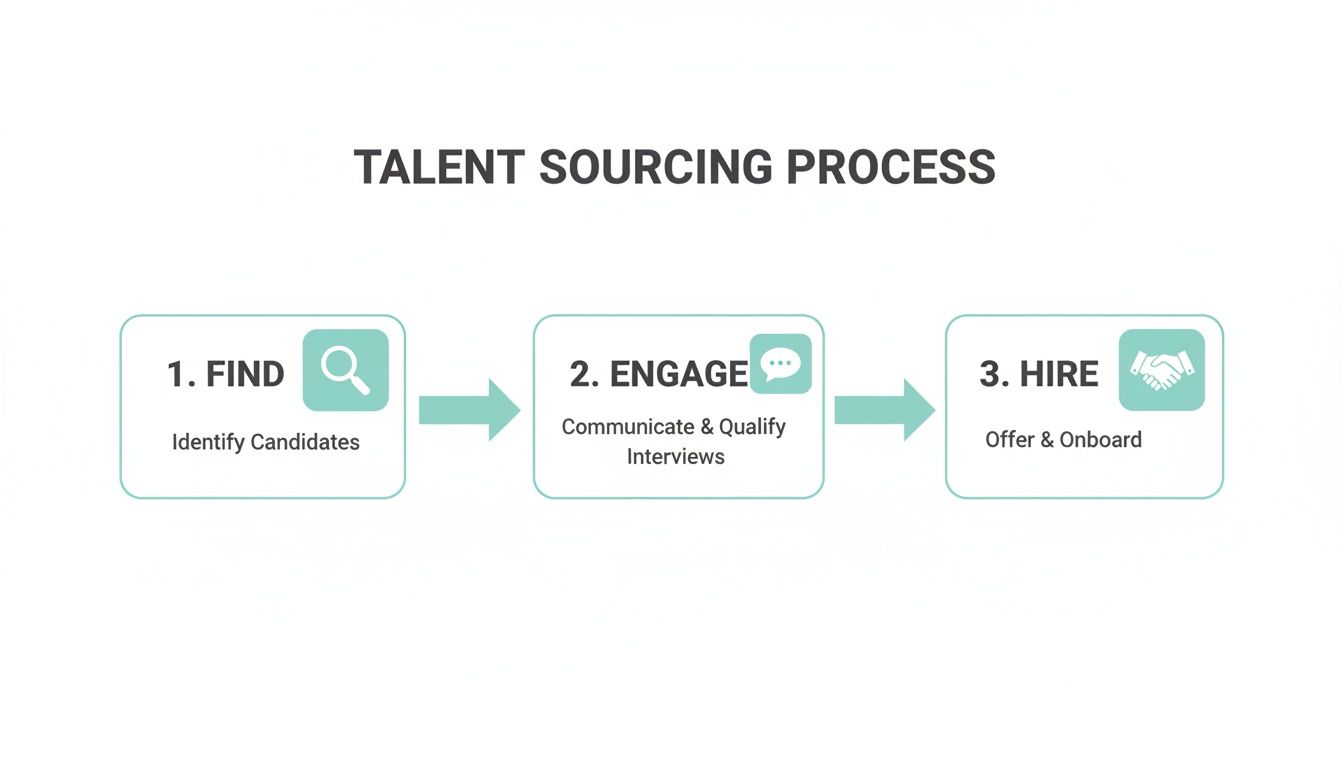
The key takeaway? Each stage requires a different gear. Finding talent is strategic, engagement is all about personalization, and hiring is won with a compelling process.
Bias is the enemy of good hiring. The absolute best way to combat it is by building a structured interview process where every candidate for a given role goes through the same stages and gets evaluated against the same criteria. Consistency ensures you’re making decisions based on skill and potential, not just gut feelings.
A typical startup interview loop might look something like this:
The goal isn’t to find people who are just like you. It's to find people who share your core values but bring different perspectives and experiences. A standardized process helps you focus on what truly matters for the role.
Standardizing also means creating a bank of core questions for each stage. This ensures you gather comparable data on every candidate, making your final decision more objective. For more on this, our article on hiring manager interview training can help you get your team ready.
Take-home assignments can be a powerful tool for recruitment for startups, but they're also easy to mess up. A poorly designed task disrespects a candidate’s time and will cause your best prospects to drop out. The key is to make it realistic, time-bound, and directly relevant to the work they’ll actually be doing.
A good take-home assignment should:
Actionable Example: Instead of asking a Product Manager to design a brand new product from scratch (which is too abstract and time-consuming), ask them to write a one-page brief for a new feature on your existing product. This shows you how they think about your users, prioritize, and communicate ideas in a realistic context.
Finally, remember the candidate experience extends beyond the interviews. It’s in your communication speed, the clarity of your feedback, and how you treat people every step of the way.
Actionable Tip: Set a service-level agreement (SLA) for your team to respond to every candidate within 24 business hours. Use a shared email inbox or a simple applicant tracking system (ATS) to ensure no one falls through the cracks. This simple discipline makes a huge impression.
The shift toward flexible work has also become a massive factor. Remote work is a huge draw, especially for high-growth firms. By 2025, 82% of leaders plan to incorporate some form of remote work, which has been linked to 25% lower turnover. The trend is powerful: remote job postings attract 2.5 times more applicants, and 83% of recruiters say it improves the quality of their talent pool.
Even if you don’t hire someone, a positive experience can turn them into an advocate for your brand. They might refer a friend or reapply for a different role down the line. Treat every candidate like a future customer or partner—because they just might be.
You’ve navigated the sourcing maze and run a sharp interview process. Now comes the moment of truth: the offer.
In the startup world, a compelling offer is about much more than just a salary figure. It’s the final, crucial step where you sell the entire opportunity—the mission, the growth, the ownership—and turn a top candidate into your next team member.
Getting this stage right requires a blend of art and science. It means understanding market data, explaining equity in a way that actually gets people excited, and handling the offer call with confidence and empathy. This is your chance to reinforce why your startup is the best possible next step for their career.
For many candidates, especially those coming from larger companies, startup compensation can feel like a foreign language. Your job is to be a clear, confident translator. The total package typically has two main components: base salary and equity.
Don't just give them a number of shares. Explain what percentage of the company those shares represent and paint a picture of what that could be worth at different, realistic exit scenarios. Frame it as, "You will own X% of the company you are helping to build."
This shift from abstract numbers to tangible ownership is what makes the startup proposition so powerful.
Never, ever send an offer over email. Seriously. The offer call is a critical, high-touch moment that allows you to convey excitement, answer questions in real-time, and read the candidate's reaction. It’s a conversation, not a transaction.
Start the call by expressing your genuine enthusiasm. Reiterate the specific reasons why the team was so impressed and connect their skills directly to the mission-critical problems they will be solving.
Before you even mention numbers, remind them of the bigger picture. Talk about the company vision and the massive impact they will have. This reframes the entire discussion around the opportunity, not just the compensation.
If you’ve targeted a top-tier candidate, you should expect them to have competing offers. Don't panic—this is a good sign you’ve identified high-quality talent. How you manage this situation can make or break your ability to close them.
When a candidate brings up a competing offer, approach it with curiosity, not defensiveness.
Closing isn't about pressure; it's about partnership. By handling this final stage with transparency, strategy, and genuine excitement, you confirm that your startup is the right place for them to build their future.
Your first few hires feel monumental, and they are. But to really grow, you have to move beyond just filling the immediate open role. Sustainable growth is all about shifting from reactive hiring to proactive talent acquisition.
Building a scalable talent engine means creating systems that keep a steady stream of great people flowing your way, even when you aren't actively hiring. This is the strategic move that separates startups that scale smoothly from those that are always scrambling.
At the heart of this engine is a proactive talent pipeline. Instead of starting from scratch every single time a new req opens, you should always be nurturing relationships with high-potential people. This completely changes the game, turning recruitment for startups from a frantic search into a strategic conversation with folks you already know and respect.
Proactive pipelining is simple: you identify and engage future stars long before a role ever exists. When you meet an impressive designer at a local meetup or get an intro to a sharp engineer, the conversation shouldn’t just die because you don't have a spot for them today.
Instead, add them to a simple talent relationship management (TRM) system. Honestly, a well-organized spreadsheet is perfectly fine to start.
Then, just keep in touch periodically. Share a big company milestone. Send over an interesting article that’s relevant to their work. This kind of low-touch, high-value engagement keeps your startup top-of-mind. You can find more practical advice on how to build a talent pipeline that actually delivers when you need it.
Building a talent pipeline is like planting a tree. The best time to start was a year ago. The second-best time is today. It's a long-term investment in your company's future that pays massive dividends when you need to scale quickly.
Your employer brand isn't some glossy marketing campaign; it’s simply the story people tell about what it’s like to work at your company. For an early-stage startup, this brand is built on authenticity, not a huge budget.
Get your team to share their experiences. What excites them about the problems you’re solving? What have they learned? Those are the stories that matter.
Leverage these authentic stories everywhere you can:
This consistent, genuine storytelling attracts candidates who are truly aligned with your mission and culture. It turns your team into magnets for like-minded talent, creating a self-sustaining recruitment engine that will power your growth for years to come.
When you're in the trenches building a startup, hiring can feel like a whole separate, daunting challenge. We get a lot of questions from founders and early-stage leaders about how to navigate it all. Here are some of the most common ones, along with some straight-up advice.
Let's be real: you probably can't win a bidding war with Google. The good news is, you don't have to. Trying to match a FAANG salary is a losing game, so your job is to change the playing field entirely.
Focus on what big tech can't offer. Lead with a significant equity stake and be crystal clear about the potential upside. Show them the math. Beyond that, highlight the sheer impact they can have. In a huge corporation, their work might be a drop in the ocean; with you, they could be the person who builds a core feature that defines the entire product.
You're selling a different kind of opportunity. Frame it around things like:
Hands down, the single biggest mistake is a slow, messy interview process. The best candidates, especially in tech, are juggling multiple offers. If your hiring loop drags on for weeks, it screams inefficiency and shows a lack of respect for their time.
Startups have to be fast to win.
Your interview process is a direct reflection of your company's culture and operational cadence. A fast, decisive process signals a high-functioning team, while a slow one suggests chaos. Don't lose your ideal candidate because of internal delays.
Get your house in order before you even post the job. Map out every stage, know who is interviewing, and schedule interviews back-to-back—ideally all within a week. Get back to candidates quickly with honest feedback, and be ready to pull the trigger on an offer.
It’s absolutely critical, but don't mistake "branding" for expensive marketing campaigns or fancy swag. For a brand-new startup, your employer brand is just authentic storytelling. It’s the sum of every interaction someone has with your company.
Start with the networks of your founders and first few employees. Talk about your mission and the problems you're obsessed with on platforms where the people you want to hire already hang out—think niche tech blogs, specific subreddits, or social media.
Your career page shouldn't be a boring list of openings; it needs to tell a story. Every email you send, every interview you conduct, and every follow-up note shapes your reputation. A great candidate experience can turn people into advocates for your company, even the ones you don't hire.
The most common mistake is a lack of process. Relying on ad-hoc interviews, unclear role definitions, and making hiring decisions based on gut feeling alone leads to inconsistent results, bias, and poor-quality hires. Successful recruitment for startups requires structure, even if it's lightweight, to evaluate candidates fairly and efficiently.
Startups must leverage their unique advantages: meaningful impact, ownership, learning opportunities, and culture. A compelling equity package can offset a lower base salary. Focus on building a strong employer brand by showcasing your mission and team authentically. Utilize cost-effective channels like employee referrals and curated hiring platforms that target candidates specifically interested in the startup environment.
An effective process is streamlined but structured. Key stages include: 1) Planning: Clearly define the role's impact, not just duties. 2) Sourcing: Use targeted channels (referrals, curated platforms, niche communities). 3) Screening: Use a consistent scorecard for resume review and initial calls. 4) Interviewing: Conduct structured interviews focused on skills and values. 5) Decision & Offer: Collaborate with the team using data, then make a compelling offer quickly.
Shared values are crucial for a small team, but "culture fit" can dangerously lead to hiring people who are simply similar to you. Reframe it as "values alignment" and "skills add." Assess it by asking behavioral questions about how candidates have operated in past environments and by involving diverse team members in the process to get multiple perspectives.
A curated platform, like Underdog.io, focuses on quality over quantity. Instead of posting a job and sifting through hundreds of unvetted applications, these platforms pre-screen both companies and candidates. They facilitate introductions based on mutual fit, connecting startups with talent that is already qualified and interested in startup roles, which dramatically increases hiring efficiency.
Extremely important. A negative experience can damage your early-stage employer brand and deter other talented people from applying. A great candidate experience—marked by clear communication, respectful timelines, and constructive feedback—signals that you value people and run a professional operation, making candidates more likely to accept your offer.
Move beyond vanity metrics like "number of applicants." Focus on meaningful metrics that indicate quality and efficiency: Source of Hire (which channels bring your best people?), Time to Fill, Offer Acceptance Rate, and most importantly, Quality of Hire (measured by new hire performance and retention at 6-12 months).
Ready to stop scrambling and start building a pipeline of top-tier talent? Underdog.io connects you with a curated pool of vetted, high-intent candidates who are actively looking for their next role at a startup just like yours. Find your next great hire.