A passive candidate is an employed professional who isn't actively applying for jobs but is open to the right opportunity, and LinkedIn-based reporting estimates that passive talent represents about 70% of the global workforce. In other words, most of the people you'd want to hire aren't waiting on a job board for your vacancy.
You've probably felt the problem directly. Your startup needs a senior engineer who can own a difficult system, make sound decisions, and work comfortably with a small team. You post the role, share it across your network, and wait. The strongest person you can think of isn't applying anywhere. They're busy shipping products at another company, and your job description may never cross their screen.
That's the recruiting situation passive hiring addresses. Instead of treating candidates as people who must first raise their hands, you identify capable professionals, understand what could motivate a move, and open a respectful conversation. The process takes more judgment than sorting applications, but it gives startups access to the part of the talent market that inbound recruiting misses.
This guide explains what is a passive candidate in recruitment, how passive and active candidates differ, which signals indicate openness, and how personalized outreach turns quiet interest into a real conversation. It also covers follow-ups, response-rate benchmarks, process speed, and the role curated marketplaces can play when a startup needs quality without adding noise.
A founder I worked with once needed a staff-level backend engineer for a small product team. The company had a compelling technical problem, a thoughtful founder, and enough runway to hire carefully. The job post attracted applicants, but none had the combination of distributed-systems experience, product judgment, and comfort with ambiguity the team needed.
The likely match was already employed and doing well. He wasn't scrolling through job boards or asking recruiters for introductions. He became a realistic prospect only after someone connected his recent work to the company's technical challenge and explained the opportunity without pressuring him to leave his current role.
That distinction matters. Passive doesn't mean uninterested. It means the candidate isn't conducting an active search. They may be satisfied, cautious, curious, or open to a better fit. Your outreach has to create enough relevance for them to consider a conversation they hadn't planned to have.
LinkedIn-based industry reporting describes three-quarters of fully employed workers worldwide as passive candidates. The same 2025 LinkedIn talent-strategy summary says 15% are already networking and 45% are open to being approached by a recruiter. Those figures explain why a startup can receive weak results from job advertising while a focused recruiter builds a strong pipeline through direct introductions and referrals. (LinkedIn's global breakdown of active and passive candidates)
The historical shift happened as professional and social networks matured during the 2010s. Recruiters gained practical ways to find people based on experience, projects, communities, and recommendations rather than waiting for applications. For specialized technology roles, that changed sourcing from vacancy promotion into relationship-building.
Practical rule: If your ideal hire is already employed, posting alone is a visibility tactic, not a complete recruiting strategy.
The same principle applies beyond conventional startup structures. Teams exploring decentralized HR employment can also benefit from explaining their operating model clearly before contacting professionals who may be unfamiliar with distributed work. The more unusual the employment model, the more context your first message needs to provide.
By the end of this guide, you'll have a practical way to define passive talent, prioritize prospects, write a credible first message, follow up without becoming intrusive, and decide when a curated hiring channel makes sense.
Start with the plain definition. A passive candidate is someone who is currently employed, isn't actively looking for a job, and may consider a new role if an opportunity fits their goals. They haven't necessarily signaled that they want to leave. They haven't entered a formal search.
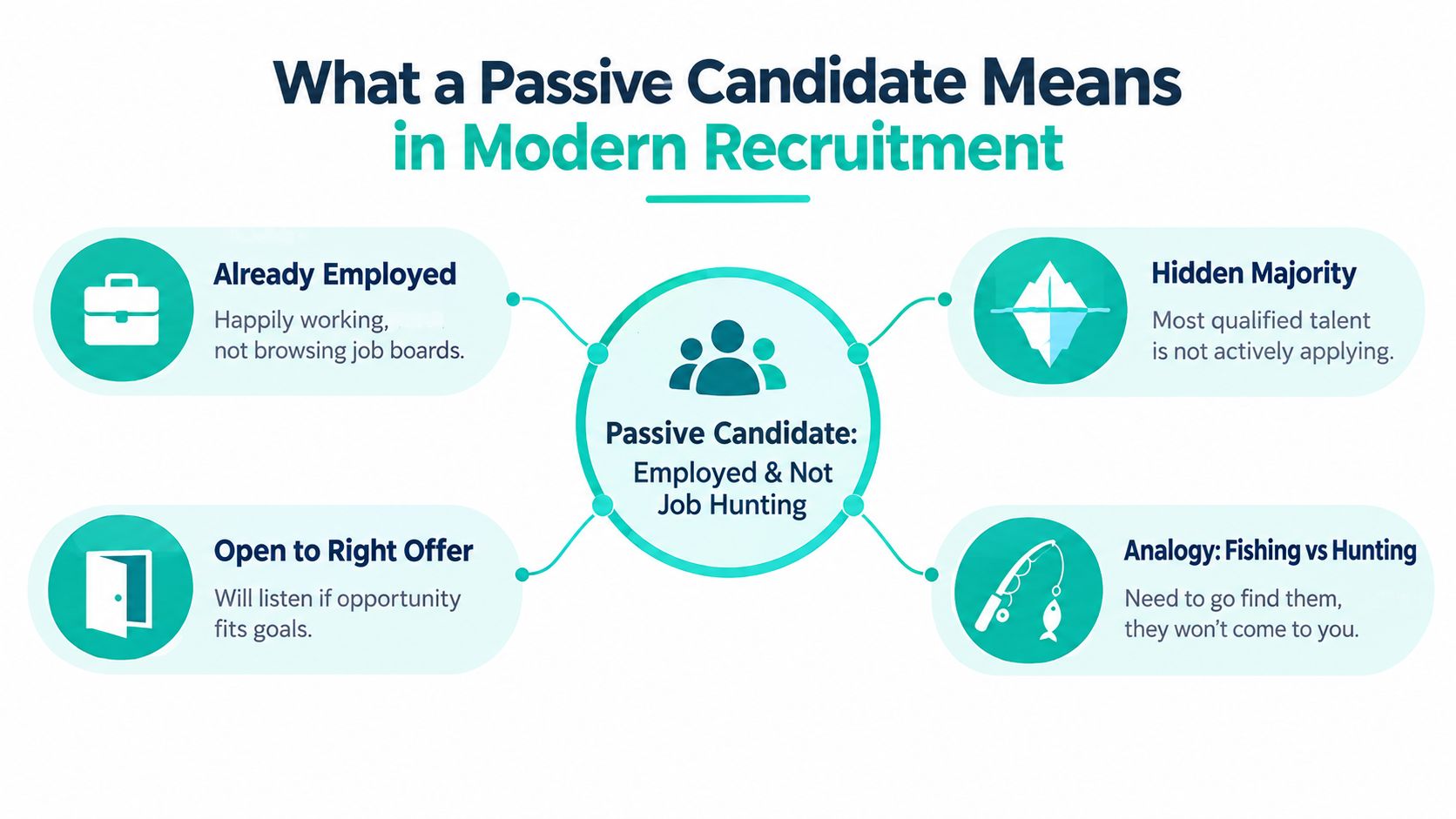
A useful analogy is the difference between fishing in a stocked pond and hunting across an empty field. Active candidates are already near the hiring process. They search for openings, submit applications, and make their availability visible. Passive candidates are in the larger professional pond, but they won't swim toward your careers page because you posted a role.
Recruiters often make two mistakes. They treat passive candidates as completely unavailable, or they assume anyone with a polished profile is ready to interview. Neither is accurate.
A passive professional might reply because the role offers technical ownership, a more flexible working arrangement, stronger mentorship, or a mission that fits their interests. Another person with a similar background might ignore the same message because the timing is wrong. Your task isn't to declare that someone is looking. It's to assess whether a relevant, low-pressure conversation is worth offering.
The sourcing motion is therefore outbound rather than inbound. You locate people through professional networks, open-source communities, referrals, portfolios, and industry conversations. Then you present enough specific information for them to decide whether they want to learn more.
LinkedIn-based estimates put passive talent at about 70% of the global workforce. A separate 2024 Employ study reported that 52% of U.S. workers consider themselves passive candidates, and 54% of those workers would consider a new role if contacted by a recruiter. (Candidately's passive-candidate definition and sourcing context)
The exact share varies by definition and market, but the strategic conclusion is stable. The available talent pool is much larger than the group submitting applications today.
That's why employer branding matters. A candidate who isn't searching may still inspect your company website, product, leadership team, engineering content, and public reputation after receiving your message. Your outreach starts the conversation, but your public proof helps the candidate decide whether the conversation deserves time.
A startup may receive dozens of applications for a backend role while the engineer with the strongest fit is still shipping code at another company. The two candidate groups can overlap, but they enter the hiring process with different levels of intent. An active candidate has already begun a job search. A passive candidate first decides whether your opportunity deserves attention.
| Dimension | Passive Candidate | Active Candidate |
|---|---|---|
| Current status | Usually employed and not actively applying | Searching actively, applying, or visibly available |
| Initial motivation | May listen if the role fits personal and professional goals | Wants to evaluate available opportunities |
| Primary sourcing route | Recruiter outreach, referrals, networks, communities, and direct research | Job boards, careers pages, applications, and recruiter responses |
| Message expectation | Relevant, personalized, discreet, and low friction | Clear role information and an efficient application path |
| Candidate availability | Often requires coordination around a current job | Usually more prepared to discuss an immediate search |
| Funnel dynamic | Relationship-led and slower to develop | More transactional at the beginning |
| Hiring economics | Industry reporting describes passive hiring as twice as expensive as active hiring (Passive job seeker statistics and recruiting benchmarks) | Generally less expensive to engage through inbound channels |
| Dropout behavior | Reported as 17% less likely to drop out of the funnel than active candidates (Passive job seeker statistics and recruiting benchmarks) | More likely to compare multiple active applications |
| Time to close | About 4.5 months from first contact to hire in one industry benchmark | Typically follows the candidate's active search timeline |
These figures are industry benchmarks, not guarantees for every company or role. Treat them as planning signals. Passive hiring can require more patience and coordination, yet it gives startups access to the broader talent pool, including the roughly 70% of workers often described as passive. A curated, human-led process helps turn that reach into relevant conversations rather than a list of cold names.
Active recruiting works well when a role has broad appeal, the skills are available, and the company needs candidates who can move quickly through a standard process. A job board can create useful volume for those searches.
Passive sourcing fits roles that depend on scarce experience, a specific technical track record, or a close match with a particular team. It adds a deliberate outbound layer for people who are unlikely to apply without a clear reason. The message must explain the problem, the team, and why the opportunity could fit their goals.
Passive recruiting is less like taking orders and more like starting a thoughtful sales conversation. The candidate needs to understand why the opportunity belongs in their world.
The success measures change too. Applications and completed screens can indicate early progress with active candidates. For passive candidates, positive response is often the first meaningful signal. Follow-up quality matters after that: a respectful second message can keep a promising conversation open, while repeated generic nudges can end it.
Startups rarely need a generic version of a role. They need a person who can solve a specific problem while operating without the support structure of a large company. A software engineer may need to design systems, explain trade-offs to customers, mentor peers, and make progress with incomplete information. The candidate who can do all of that may not be applying anywhere.
That's why startup hiring benefits from curated, quality-first sourcing. A focused list of relevant people is more useful than a large pile of resumes when the role depends on judgment, adaptability, and technical depth.

Passive professionals can evaluate your opportunity from a position of relative stability. They don't need to accept the first available role, so they can ask harder questions about architecture, leadership, product direction, ownership, and how the team makes decisions.
That selectivity can help a startup. A candidate who joins because the problem interests them may be more aligned with the work than someone who applied broadly and is primarily optimizing for any change. It doesn't guarantee retention or performance, but it creates a stronger basis for a mutual decision.
For founders, the practical question is simple:
Startups also need to recognize the candidate's risk. An employed professional may want discretion, particularly if they're exploring options without notifying their current employer. Anonymous profiles and selective introductions can make early exploration more comfortable than a public application.
For a broader look at how startup teams can structure recruiting around scarce skills and limited hiring capacity, see this guide to recruitment for startups. The central lesson is that startup hiring needs more than exposure. It needs judgment about fit, timing, and the candidate experience.
A senior engineer may appear fully settled, yet still be open to the right problem. Their profile alone cannot confirm job-search intent. Treat identification like assembling a case from several clues: look for signals of professional activity and possible openness, then test interest through respectful outreach.
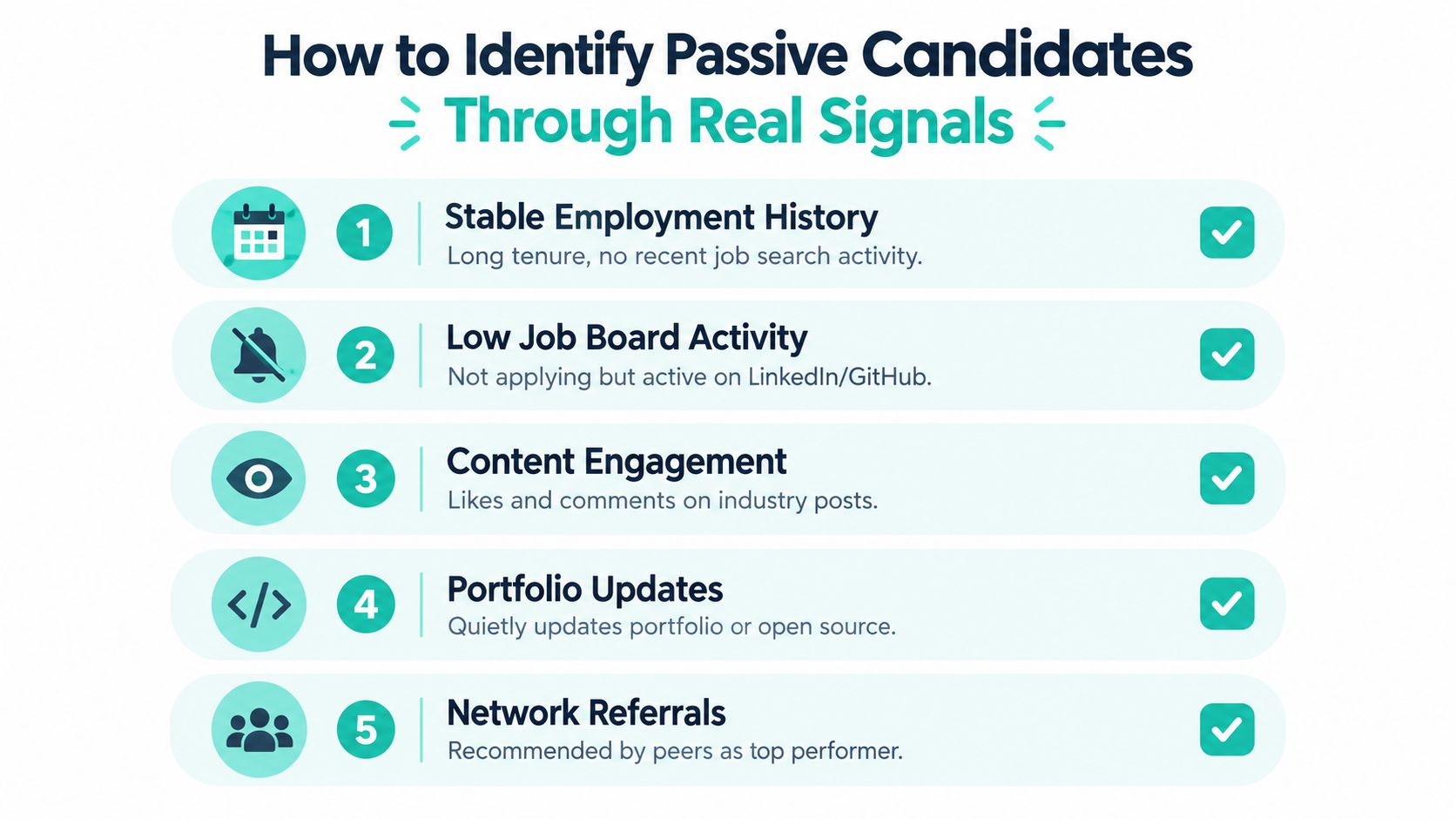
Several signals together create a stronger reason to reach out. A senior engineer might hold a stable role, contribute to a relevant open-source project, discuss technology your startup uses, and come recommended by a former colleague. That combination supports a specific message, not an assumption of interest.
Begin with the role, then build the prospect list. Define the systems, responsibilities, collaboration style, and ownership level the hire requires. Search for evidence across professional profiles, public work, referrals, and relevant communities.
GitHub activity can show how an engineer approaches code and collaboration, but every contribution needs context. A repository update may come from a personal project, a team responsibility, or a one-time experiment. This guide to what hiring managers look for on GitHub offers a practical way to assess those signals without treating activity as a complete profile.
Referrals deserve deliberate attention. They carry context and trust, making a warm introduction more informative than a cold name from a search result. Ask the referrer what the candidate does well, what kind of work motivates them, and whether a discreet conversation would be appropriate.
Record four points for each prospect: why their work fits, what might motivate them, who can introduce them, and what information remains uncertain. This simple note keeps outreach human and helps a startup focus on the broad passive talent pool rather than waiting for applications.
Passive outreach succeeds when the candidate can answer three questions quickly: Why me, why this role, and why now? A message that only says “we have an exciting opportunity” forces the recipient to do all the work, so many won't bother.
Segment prospects by role, seniority, technical background, and likely motivators. A platform engineer who has written about reliability may care about infrastructure ownership. A product manager who has worked through a difficult launch may care about decision authority and customer proximity. Your message should connect the person's visible work to a specific problem your team needs solved.
Industry guidance places generic mass-outreach conversion at 4% to 6%, personalized digital outreach at 10% to 14%, and relationship-based referrals at 22% to 28%. Positive response benchmarks similarly range from 8% to 15% for non-personalized campaigns and 20% to 35% for highly personalized outreach. (Passive-candidate conversion and response benchmarks)
A useful first message includes:
The first touch should feel human. Keep the detail useful, but don't turn it into a full job description.
Many recruiters stop after the first message and label silence as rejection. Recent reporting cited a 2026 dataset in which 60.8% of candidate responses came from follow-ups rather than the first message, suggesting that timing and persistence deserve their own measurement. (SignalHire's 2026 passive-candidate report)
A follow-up should add context rather than repeat the same request. You might share a relevant product update, clarify the role's scope, answer a likely question, or acknowledge that the person may not be looking. Stop when the candidate says no, asks not to be contacted, or remains unresponsive after a respectful sequence.
Follow-up principle: Persistence keeps the door open. Pressure closes it.
Passive candidates are easier to lose once they become curious. Recent recruiting guidance says top talent may be available for about 10 days, while cited time-to-fill benchmarks range from 42 to 63.5 days. Candidates increasingly expect salary ranges upfront and mobile-friendly, fast applications. (Passive-candidate recruiting guidance for startup founders)
That doesn't mean rushing every decision. It means removing avoidable delay. Send the role details promptly, explain the interview stages, identify decision-makers, and make scheduling easy. If you use automation, learn the core components of outreach automation, but keep human review over targeting, personalization, and follow-up timing.
Benchmark the chain from outreach to positive response to active pipeline entry. Generic outreach is often reported below 15% response, a threshold associated with weak targeting, generic messaging, single-channel contact, or some combination of these problems. (Passive-candidate conversion and communication guidance)
For a deeper sourcing workflow, see this guide to passive candidate sourcing. Measure response before hires. A low response rate tells you the message or audience needs work long before a final-stage hiring report does.
Passive hiring works best when the candidate doesn't have to expose themselves to every employer just to discover one relevant opportunity. A curated marketplace can reverse the usual process: the professional creates a selective profile, and qualified companies reach out with roles that match their background.
That model reduces several points of friction. Human reviewers can assess experience beyond keywords, companies can receive context before contacting someone, and candidates can explore discreetly while remaining employed. The result isn't a replacement for referrals, direct sourcing, or a strong careers page. It's another route for connecting specialized talent with teams that have already passed a quality filter.
Underdog.io operates in this category for startup and high-growth technology hiring across New York City, San Francisco, and remote roles in the United States. Candidates submit a single 60-second application, create an anonymous profile, and can receive selective introductions from vetted companies. The marketplace focuses on early-stage to Series B startups and uses human-powered matching rather than relying only on keyword similarity.
Define the role around outcomes and essential skills. Identify likely passive prospects through networks, public work, and referrals. Prepare a short message that explains the personal relevance, the business problem, and the reason to talk now. Then track positive responses, follow-ups, conversations, and pipeline entry separately.
If your team needs broader technical recruiting support, keep a specialized staffing resource such as nexusITgroup.com in your wider hiring toolkit. The right channel depends on the role, the urgency, the required experience, and how much discretion candidates need.
Start with one difficult vacancy. Build a small, researched prospect list, ask trusted contacts for introductions, send personalized messages, and review the response pattern before expanding the campaign. That's how passive recruiting becomes a repeatable operating habit rather than a last-minute rescue tactic.
Underdog.io gives employed technology professionals a discreet way to create a single profile and hear from vetted startups with relevant opportunities, while helping hiring teams reach curated passive talent. Visit Underdog.io to explore the marketplace for your next startup hire or your next carefully chosen move.