Cracking the product manager interview isn't about memorizing answers. It’s a marathon, not a sprint. The best candidates build a solid foundation over 8 to 10 weeks, methodically mastering everything from behavioral storytelling to deconstructing complex product design questions. This is about building the muscle memory for how top PMs think.
Welcome to your playbook for landing a product manager role. The hiring landscape, especially in the startup world, is constantly shifting. Forget generic advice; we're diving deep into the specific frameworks, question types, and narrative techniques that hiring managers at top tech companies are actually looking for.
This guide will show you how to do more than just answer questions. You'll learn to dissect product design prompts, nail behavioral interviews with proven storytelling methods, and demonstrate the kind of data-driven thinking that gets you noticed.
To give you a bird's-eye view of the journey ahead, we’ve broken down the preparation process into a structured, week-by-week timeline. This isn't about cramming; it's about layering skills so you're ready for anything.
This timeline provides the structure, but the real magic happens in the day-to-day execution. Each phase builds on the last, ensuring you walk into your interviews with genuine confidence.
Think of the PM interview process as a series of conversations designed to see how you think. It's not a single, high-stakes exam. Hiring managers want to see a consistent, structured thought process across different interview formats. While knowing things like Agile Development Best Practices is a good start, it’s only a small piece of the puzzle.
Success is about showing them how you think like a product manager on the job.
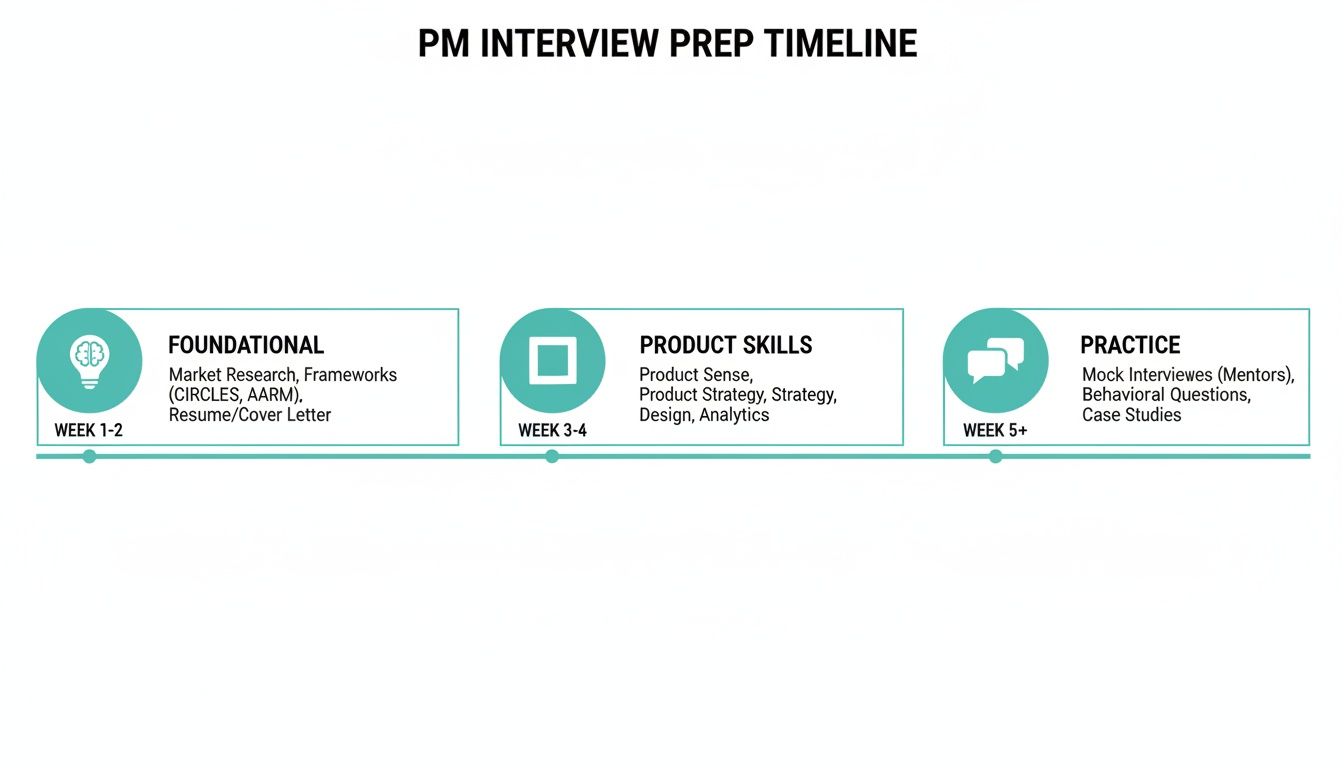
As you can see, this is a strategic buildup. For a closer look at what the role itself entails day-to-day, check out our guide to the product manager career path.
The best candidates don’t just answer questions; they lead the interviewer through a logical, user-centric thought process. Your goal is to showcase how you would perform on the job, not just how well you prepared for the interview.
Let’s get started. Think of this as your personal coaching plan, complete with real examples and inside tips to help you land a PM role you’ll love.
Before you even think about diving into complex frameworks for product design or estimation, your interview prep needs to start with a rock-solid foundation. This first phase is all about nailing your personal narrative and mastering the behavioral interview—often the first real hurdle you'll face.
Your goal here isn't just to list your skills; it's to build a library of compelling stories that prove them. Hiring managers are looking for concrete evidence of your leadership, collaboration, and problem-solving chops through real-world examples. This is where you show you can actually handle the heat.
First things first, you need to mine your career for impactful experiences. Don't just focus on the big wins. The most memorable stories often come from challenging situations that forced you to grow.
To get the ball rolling, ask yourself a few tough questions:
Try to brainstorm at least ten distinct scenarios. The key is to find moments that highlight core product management skills. You want a versatile collection of stories you can pull from and adapt to almost any behavioral question they throw at you.
Once you've got your list of scenarios, you need to structure them so they land with maximum impact. The STAR method (Situation, Task, Action, Result) is the gold standard for a reason—it forces you to be clear, concise, and focused on outcomes. It stops you from just describing what you did and pushes you to explain the why and the so what.
Here’s how to break it down:
The 'Result' is where most candidates completely drop the ball. Vague statements like 'it improved the user experience' mean nothing. You have to attach a number to every outcome—revenue, engagement, retention, cost savings, you name it.
The work you're doing here has an immediate payoff: your resume. Think of your resume as your first story, and it needs to be just as impactful as the ones you tell in person. Stop listing job duties and start showcasing quantified wins.
Instead of writing this: "Responsible for the mobile app roadmap."
Reframe it with impact, like this: "Owned the mobile app roadmap, launching three major features that drove a 15% increase in daily active users and a 10% lift in session duration."
This simple shift ensures your resume gets past the initial screen and arms you with powerful talking points for every stage of the interview. For a deeper dive, our product manager resume template and guide has more actionable tips to make your accomplishments impossible to ignore.
This is where the interview really kicks into high gear. Behavioral questions look at your past, but product design and strategy questions are all about your future potential. They’re designed to see how you think on your feet, how you handle ambiguity, and whether you have that elusive product sense—an almost intuitive feel for what makes a great product.
The stakes here are getting higher. PM interviews in 2025 are stretching to 3-5 rigorous rounds. We're seeing 72% of high-growth startups in SF and NYC use product sense questions early to filter out 80% of candidates before they even reach the full loop. It's a tough market, with only a 16% year-over-year growth in junior PM roles despite a 42% overall market boom. You can dig into the full research on these PM interview trends to get the complete picture.
Ultimately, these questions aren't about finding one "right" answer. The interviewer wants to see your thought process unfold in real-time. They're watching to see if you can be structured, creative, and relentlessly user-focused, all while under pressure.
Product design and strategy questions usually come in a few predictable flavors. Learning to spot the pattern is the first step toward giving a solid, structured answer. You'll likely run into one of these:
No matter the flavor, the goal is the same: show them you have a structured, user-centric way of solving problems.
When you get hit with a big, open-ended design question, the absolute worst thing you can do is ramble. A framework gives you the guardrails to keep your answer logical and easy for the interviewer to follow. For this, the CIRCLES method is a fantastic tool.
It breaks the problem down into a clear, step-by-step process:
Using a framework like CIRCLES isn't about sounding like a robot. It’s about showing the interviewer you have a reliable, repeatable process for tackling unstructured problems—which is the core of a product manager's job.
Practical Example: Let’s imagine you were asked to "Improve a coffee shop's mobile ordering app." Using CIRCLES, you'd start by clarifying the goal (is it to increase order frequency or raise the average order value?). From there, you'd identify different user types—like the "Daily Commuter" who needs speed vs. the "Weekend Lounger" who wants to browse—and think through their unique needs. This structure forces you to cover your bases before you ever jump to a solution, and that's exactly what hiring managers want to see.
Right, you've nailed your storytelling and can whiteboard a product design with the best of them. Now it's time to shift gears into the analytical and technical rounds. This is where you prove you've got the quantitative chops and technical literacy to be a credible partner to your data and engineering teams.
Don't sweat it if you don't have a computer science degree. These interviews aren't about writing code. They're about thinking logically, communicating clearly, and showing you can hold your own when the conversation gets technical.
Interviewers want to see how you tackle ambiguity head-on. Can you take a big, fuzzy problem and break it down into something structured and solvable? This is your moment to prove you're more than just an "ideas person"—you're someone who gets the real-world constraints of building things.
You've probably heard the classic brain teasers: "How many scooters are in San Francisco?" or "What's the market size for dog walkers in New York City?"
Let’s be clear: the interviewer doesn't actually care about the number. They want to see how you get to a number. It's a test of your ability to make logical assumptions, structure a problem, and talk through your reasoning out loud.
Here’s a practical way to approach these questions without freezing up:
The final answer is the least important part of an estimation question. The real evaluation is on your journey from a completely unknown question to a reasonable, defensible estimate. Your structured thinking is what's on display.
The technical round is usually what causes the most anxiety, especially for PMs coming from non-engineering backgrounds. Take a deep breath. You are not expected to write production-ready code or architect a system from the ground up.
This interview is all about your technical fluency. Can you hang in a conversation with engineers? Do you understand enough to have a productive discussion about trade-offs? That's what they're looking for.
Focus your prep on these key areas:
The absolute best way to shine here is by talking about trade-offs.
Practical Example: If asked how you'd build a new feature, you might say, "Well, we could hack something together quickly to get it to market, but it probably wouldn't scale well if usage spikes. The alternative is to invest more engineering time upfront to build a more robust architecture, but that would delay our launch. My first move would be to chat with the engineering lead to understand the level of effort for both paths before we commit."
That single response shows you respect their expertise, think about consequences, and operate like a true partner to the engineering team. And that’s exactly what they want in a PM.
You’ve built your story library and dissected product frameworks. Now for the most critical part: turning theory into practice. Mock interviews are where you pressure-test everything, refine your delivery, and build the muscle memory to perform when it actually counts.
Simulating the real interview is everything. It’s one thing to have the perfect answer in your head, but it’s a whole different ballgame to articulate it clearly and concisely under pressure. The goal is to get so comfortable with the format that all your mental energy goes into solving the problem, not fighting your nerves.
Your mock interview is only as good as your partner. You absolutely need someone who can give you honest, constructive feedback. I always recommend seeking out peers who are also in the interview trenches, as they’ll be up-to-date on the latest question trends and frameworks.
Here’s where to look:
Try to do mocks with at least five different people. This exposes you to a variety of interviewing styles and feedback, preventing you from over-indexing on one person’s opinion.
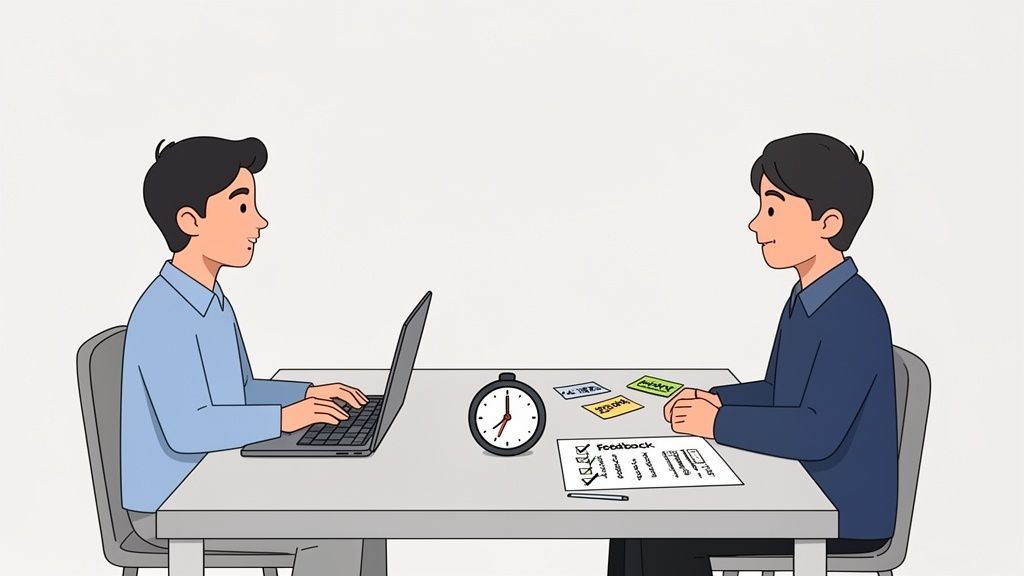
To really squeeze the value out of each session, you need some structure. Don't just jump in and ask random questions. A well-organized mock should feel like a dress rehearsal, covering timing, feedback, and different question types.
A productive session should run for about an hour, split evenly:
After each mock, set aside at least 10-15 minutes for feedback. The person who played the interviewer needs to share specific observations on what went well and what could be stronger. This feedback loop is where the real learning happens.
Don’t just ask, "How did I do?" Get specific. Ask targeted questions like: "Was my framework clear?" "Did I do a good job of stating my assumptions upfront?" "Where did my energy or clarity dip?"
This focused approach helps you pinpoint your weaknesses. It's not just about what you say, but how you say it. Pay close attention to your pacing, your tone, and how you carry yourself. You can get more pointers on projecting confidence by reviewing tips on mastering your body language during an interview.
As you practice, make a conscious effort to weave data into every response. Modern PM interviews are heavily skewed toward data-driven thinking. In fact, data-driven answers dominate 2025 PM interviews. We're seeing that candidates who mention specific metrics in 80% of their responses advance 35% further in the process.
Ignoring analytics is a major red flag that dooms 40% of otherwise strong performers. And in a market where mid-size firms have boomed by 243%, this fluency with numbers is completely non-negotiable. You can discover more insights on these PM hiring trends.
Instead of saying "the feature improved engagement," say "the feature drove a 12% lift in daily active users and increased session duration by 45 seconds." That kind of specificity makes your impact tangible and shows that you measure what matters—a core competency for any product manager.
As you get into the final stretch of your interview prep, a few nagging, practical questions always seem to pop up. Think of this as the ultimate FAQ—a final checklist to tackle the common worries and what-ifs that nearly every PM candidate faces.
Getting these details ironed out can give you that last jolt of confidence you need before walking into your first real interview. We're skipping the high-level theory here and getting straight to the point.
For most people, a structured plan over 8 to 10 weeks is the sweet spot. This timeline gives you enough breathing room to seriously cover all the key interview types—behavioral, design, estimation, technical—without completely burning out. A steady 1 to 2 hours per day is way more effective than marathon cram sessions on the weekends.
Think of it in two phases. The first half is all about building your foundation. This is when you're crafting your go-to stories with the STAR method and getting comfortable with core frameworks like CIRCLES until they feel like second nature.
The second half should be almost entirely dedicated to mock interviews. This is where the real learning happens. You’re building the muscle memory to apply all that knowledge under pressure. If you're on a tighter schedule, triage ruthlessly. Focus on the highest-impact areas first: nailing your core behavioral stories and mastering one versatile product design framework.
It’s funny, but the most common and damaging mistakes are almost always the same ones. If you can sidestep these three major pitfalls, you’ll immediately stand out from a huge chunk of the applicants.
The interview is a performance, and your thought process is the main event. Interviewers want to see how you break down complex problems in a logical, user-focused way. Proving you have a reliable method is more important than finding a single "correct" answer.
While the core PM skills are universal, startup interviews definitely have a different flavor. They put a much heavier emphasis on scrappiness, speed, and a "0 to 1" mindset. Your prep needs to mirror that.
You'll want to lean into stories that highlight your ability to execute under pressure. Talk about the times you had to make a big call with incomplete data or when you wore three different hats just to get a product out the door. Be ready for questions about launching an MVP on a shoestring budget or how you'd validate a new product idea when you don't have a massive user base to survey.
It's also absolutely critical that you do your homework on the startup itself. Go way beyond their homepage and really dig in:
Showing that you’re genuinely passionate about their mission and already thinking deeply about their specific challenges is how you win them over. Startups want to hire owners, not just employees.
This question isn't just a warm-up; it's your professional elevator pitch and the first real chance you get to steer the conversation. A weak, rambling answer can put you on the back foot before the interview even gets going. The key is to frame your response as a tight, compelling 90-second story.
Practice this until it flows naturally, not like you're reading a script. It's your opportunity to make a killer first impression and frame the rest of the interview around your biggest strengths. For a look at what comes after the initial rounds, checking out common remote tech second interview questions can give you a heads-up on how to prepare for those deeper conversations.
Ready to put all this product manager interview preparation to the test? Stop shouting into the void of online applications and let the best opportunities find you. At Underdog.io, we connect top product talent with innovative startups and tech companies. Sign up in 60 seconds and let curated companies apply to you. Find your next PM role on Underdog.io.
A comprehensive product manager interview typically covers five key areas: product sense and design (e.g., "design a feature for X"), behavioral and situational questions (e.g., "tell me about a conflict with an engineer"), execution and strategy (e.g., "how would you launch this product?"), analytical and estimation questions (e.g., "estimate the market size for Y"), and technical understanding relevant to the company's domain.
Preparation should focus on mastering a structured framework. A common and effective one is the CIRCLES method (Comprehend, Identify, Report, Cut, List, Evaluate, Sum up) or a simple 4-step approach: 1) Ask clarifying questions, 2) Define the user and core problem, 3) Propose solutions and discuss trade-offs, 4) Define success metrics and a rollout plan. Practice this aloud with popular products.
Use the STAR method (Situation, Task, Action, Result) to structure concise, compelling stories. For any behavioral question, prepare 5-7 core stories from your past that demonstrate key PM competencies: leadership, conflict resolution, data-driven decision-making, and influence without authority. Focus on your specific actions and the measurable impact of your work.
It is critically important and often what separates good candidates from great ones. Go beyond using the product; analyze the company's business model, recent news or launches, competitive landscape, and target customers. Formulate insightful questions that show you've thought deeply about their strategic challenges and opportunities.
These questions test your ability to plan and prioritize. You might be asked how to improve a key metric, build a roadmap, or decide between two features. Emphasize how you would align with business goals, use data to prioritize, sequence work for quick learning, and communicate plans to stakeholders. Discuss trade-offs openly.
While you typically won't be asked to code, you will be assessed on your technical understanding, especially at tech-centric companies. Expect questions about system design basics (e.g., "how would you architect a URL shortener?"), the company's tech stack, and how you work with engineering teams. Understanding APIs, databases, and architectural trade-offs at a high level is essential.
Common pitfalls include: diving into solutions without asking enough clarifying questions, being too vague in behavioral answers (not using STAR), lacking a structured approach to product design questions, not having thoughtful questions for the interviewers, and failing to demonstrate a balance of business, user, and technical thinking.