A seed-stage engineer stares at the same bug queue for the third sprint in a row. A founder looks at the payroll sheet and wonders how to keep that engineer engaged without adding another expensive line item. That tension is exactly where professional development opportunities matter, because they connect a person's next career step with a company's next stage of growth. For teams comparing hiring and growth paths, Underdog.io's guide on why skills are in, degrees are out is a useful reminder that capability and momentum often matter more than credentials alone.
Think of development opportunities as a career navigation map. A map does more than show roads, it helps you avoid dead ends, choose the fastest route, and know when to reroute because the terrain changed. In a startup, that matters because roles shift quickly, product priorities move, and people often need to grow before a formal title change appears.
Harvard Division of Continuing Education defines professional development as gaining new skills after entering the workforce through classes, workshops, conferences, and certificates. That definition is useful because it keeps the category broad enough to fit both an engineer taking a technical course and a founder learning how to lead a growing team. It also shows that development isn't one event, it's a sequence of choices that build on each other over time.
A practical way to think about it is this. Formal learning gives you new knowledge, applied learning lets you use it on the job, and internal movement lets you turn that growth into a larger role. If a startup only funds one of those layers, people often learn in theory but never fully convert that learning into better output.
The business case is plain. LinkedIn's Workplace Learning Report says companies with training programs can see 218% higher income per employee, 17% higher productivity, and 21% higher profitability, while 94% of employees say they'd stay longer at a company that invests in their learning and development, according to the same report. Those numbers make development look less like a perk and more like an operational advantage.
The labor market points in the same direction. The U.S. Bureau of Labor Statistics projects 11% growth from 2024 to 2034 for training and development specialists, with about 43,900 openings per year on average and a median annual wage of $65,850 in May 2024 for the role BLS occupational outlook data. That tells you organizations are paying for expertise because the work matters.
Practical rule: if an opportunity doesn't help someone do better work, move faster, or earn a larger scope, it probably isn't the right investment for a lean team.

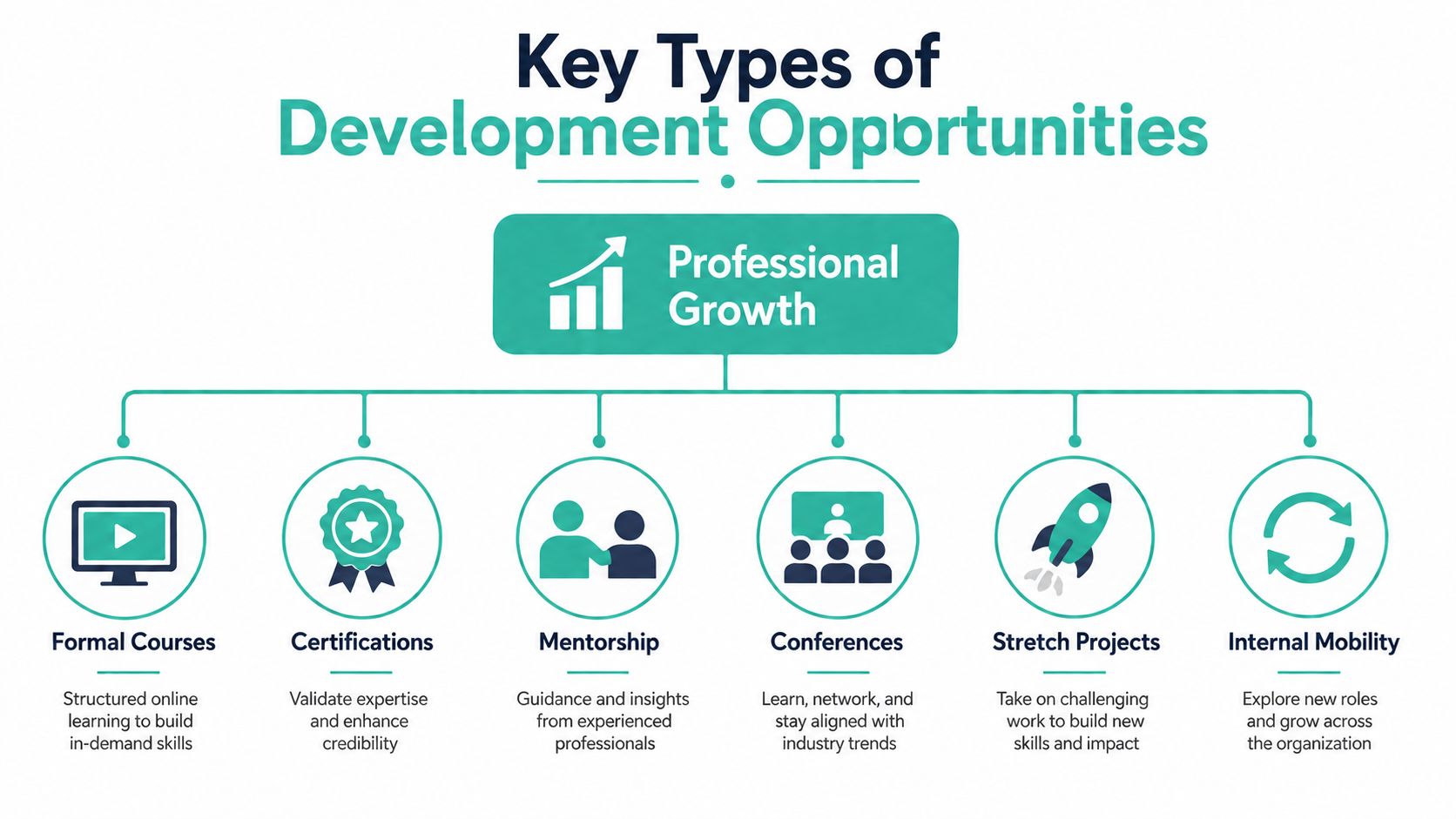
The best development plans usually mix formats instead of betting on one. A founder who sends someone to a course without any follow-through often gets shallow learning. A manager who only assigns stretch work can create confusion if the person lacks the baseline skill to do it well.
Formal courses work well when someone needs a clean introduction to a new subject, especially in tech where the learning curve can be steep. They're a good fit for topics like data tooling, cloud platforms, or management fundamentals, because structured instruction reduces guesswork. For startup budgets, a team can often start with a focused online class instead of a broad training library.
Certifications make sense when the role requires proof of competency or when a skill needs clear external validation. They're more expensive than casual learning, but they can be worth it for specialized functions where credibility matters. For a small startup, a certification often works best when tied to an immediate business need, not as a general nice-to-have.
Mentorship is one of the lowest-cost formats because it uses time and experience instead of a large vendor fee. A peer mentor, a senior engineer in another team, or a founder who meets monthly with a manager can provide a lot of value without much budget. The tradeoff is consistency, because a weak mentoring relationship can become random advice instead of structured growth.
Conferences help people absorb fresh ideas, compare notes with peers, and spot market shifts. They're useful when the goal is networking or trend awareness, not just task training. If travel is too expensive, virtual attendance or a smaller local event can still create value.
Stretch projects are often the highest ROI option for startups because they combine learning with real work. A designer leading a small product experiment or an engineer owning an internal automation task learns faster when the output matters to the company. The risk is overload, so the project has to be bounded.
Internal mobility is the cleanest way to keep institutional knowledge inside the company. Moving someone across functions or into a broader role can deepen loyalty and reduce hiring pressure. It works best when leaders make the path visible instead of waiting for people to guess what's possible.
In the tech industry, formal courses are better for entirely new skills, online courses are stronger for tool-specific refinement, and at-work learning is essential because technology changes so quickly that you can't hire for every emerging need. Ironhack's professional development guidance frames the value clearly through faster transfer into production work Ironhack's tech learning framework. That's why a developer learning a new framework may need both a course and a live project before the skill sticks.
Professional development programs also come in different lengths. FACTS Education Services notes they can range from a single-day workshop to a multi-week coaching cycle, customized to goals such as leadership growth, AI integration, or technical refinement FACTS coaching overview. For a startup, that range matters because a short workshop can solve a narrow problem quickly, while a coaching cycle can support bigger behavior change.
If you're evaluating communication-heavy roles, Talent Pronto's interview guide on communication skills is a helpful lens for spotting which abilities are worth strengthening before promotion conversations start.
A lot of people know they want to grow, but they don't know where to start. The answer is usually not “more learning.” It's “the right learning, at the right time, in the right format.” That means treating development like a decision process, not an impulse.
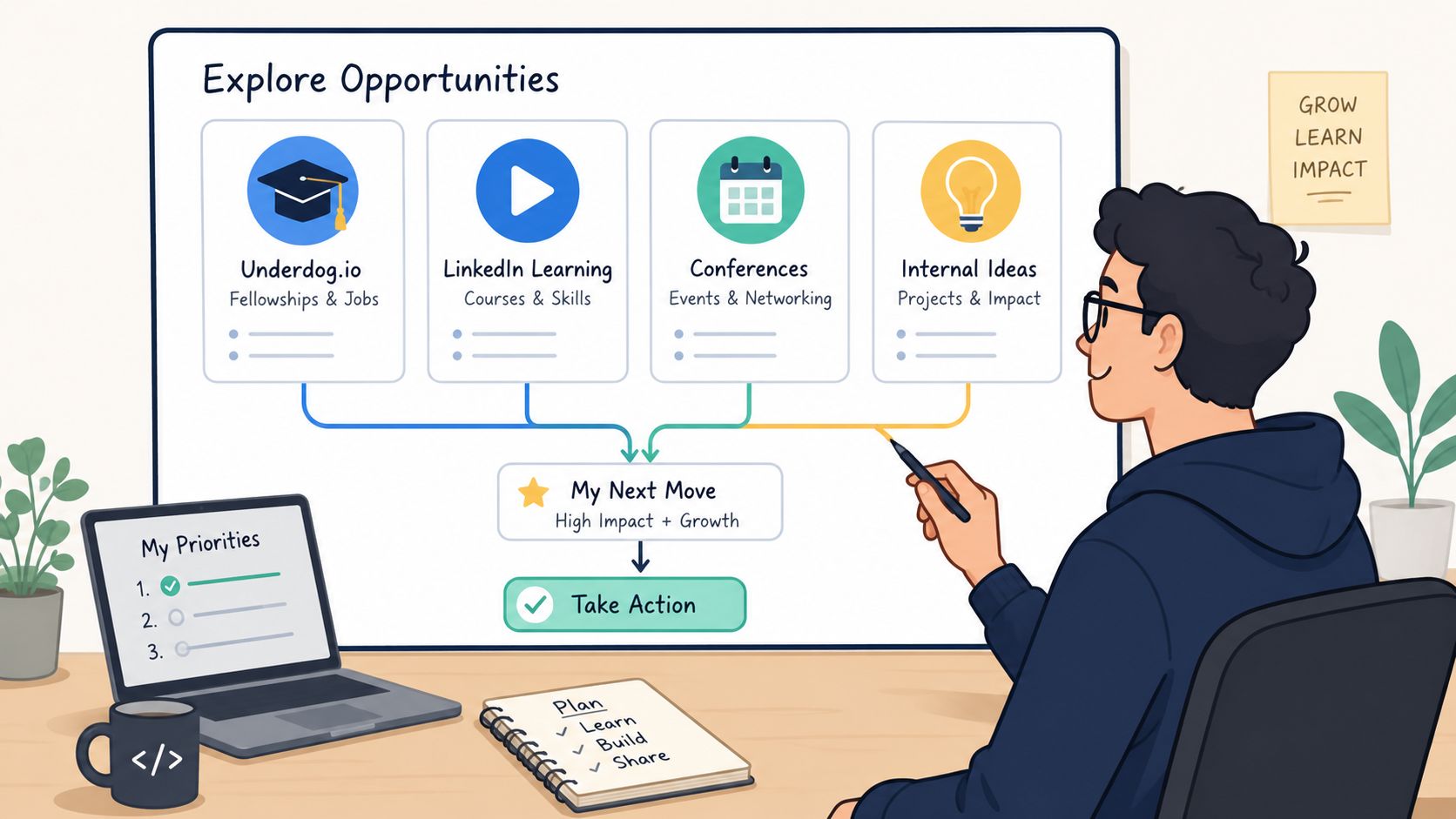
A skill gap is usually the easiest place to begin. If an engineer wants to move into platform work, the question isn't “what course looks interesting?” It's “what tasks keep blocking me from doing platform work now?” That's where tools and assessments help, especially if you want a structured way to evaluate skill gap analysis tools before choosing a learning path.
From there, look inside the company first. ERGs, internal job postings, shadowing, and stretch assignments often reveal opportunities that don't require a large budget. External sources matter too, but startup teams usually get faster payback when they start with work that's already relevant to current product or revenue goals.
Time is the hidden filter. Employees often need leadership support to count development hours as work time, which is why learning has to live inside the workday instead of sitting on top of it Educause on low-cost professional development.
A lean way to rank options is to score each opportunity from 1 to 3 on four questions.
Add the scores, then rank the top two or three options. A conference might score high on network value but lower on time and cost. A mentoring circle might score lower on formal structure but higher on affordability and immediate relevance. That's enough information to make a smart call without overengineering the process.
If a new manager needs confidence, a short coaching cycle may beat a broad leadership course. If a backend engineer needs a new tool, an online module plus a small production task may beat a long certificate program. If a founder wants to improve team quality, internal mentorship and clearer mobility paths may beat another outside hire.
The point is not to collect opportunities. It's to choose the few that will change behavior fast enough to matter.
Lean startups do not need lavish training budgets to create strong development cultures. They need clear competency gaps, realistic timelines, and enough structure that learning turns into better work. A small company can usually beat a larger one on speed here because the feedback loops are shorter.
Paycor's framework is a good model for this because it recommends defining job-relevant competency gaps, then pairing them with outcomes, resources, milestones, and timelines Paycor on professional development areas. That structure keeps the plan concrete. Instead of saying “improve leadership,” you might say “run weekly 1:1s, give feedback on sprint handoffs, and lead one cross-functional project by the end of the quarter.”
A budget-friendly plan usually mixes three layers. First, use online modules for tool-specific skills. Second, add on-the-job practice so the skill gets used right away. Third, create peer accountability through a manager, mentor, or team lead. That mix is often cheaper than buying a broad external program and more effective than leaving people to learn alone.
A startup can often build a strong program with a few low-cost moves:
One practical template is to use a short learning sprint tied to a real company objective. If a startup is trying to improve onboarding, one person can study the workflow, another can rewrite the checklist, and a manager can review the result. That's development and operational improvement in the same motion.
For teams thinking about how growth programs fit the wider employer brand, Underdog.io's employee value proposition examples can help frame the message without drifting into expensive perks that don't scale.
A development program without measurement usually turns into a feel-good expense. Leaders may like it, employees may enjoy it, but nobody can tell whether it changed the business. The fix is to track a small set of signals before and after the work begins.
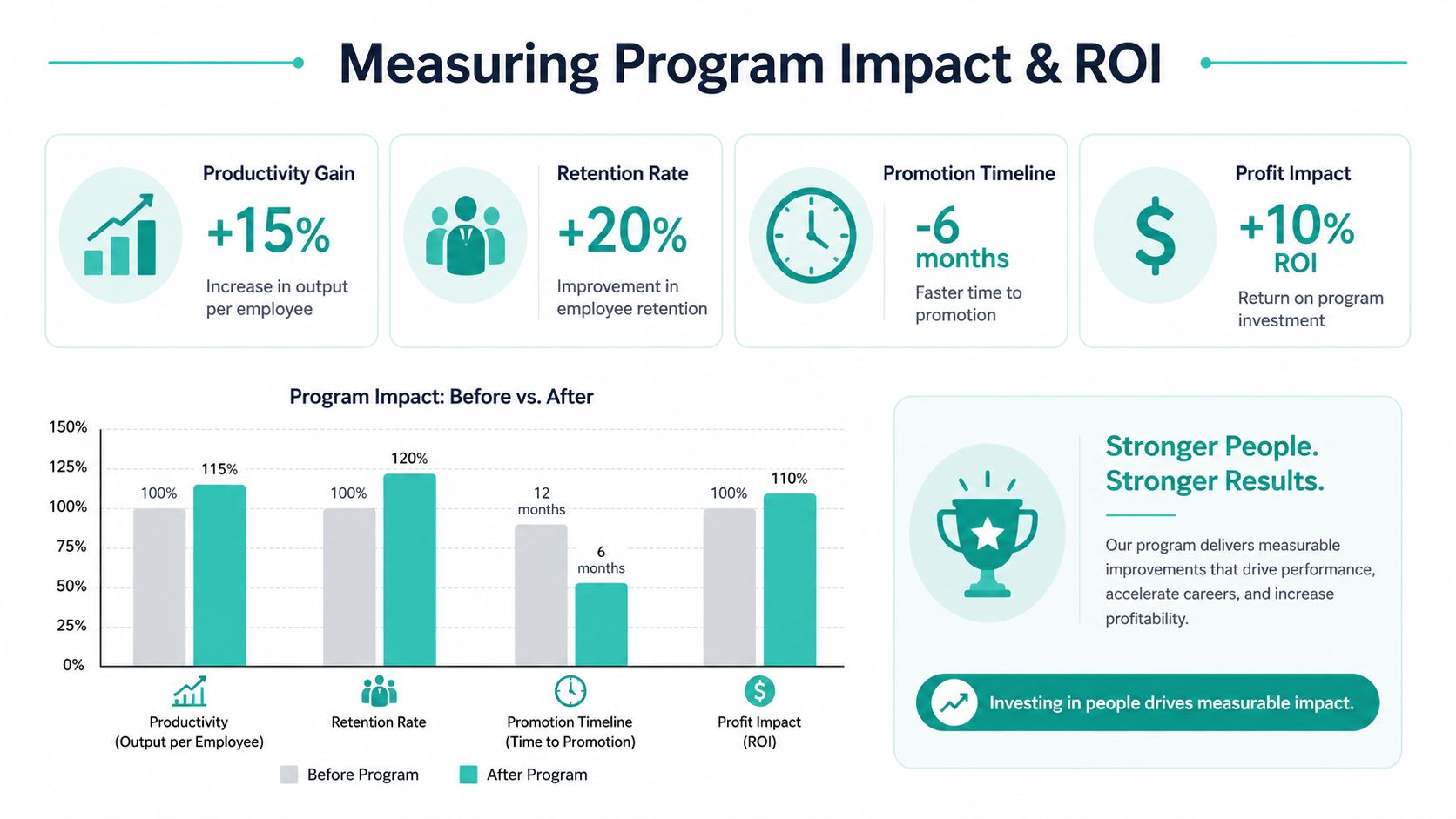
Start with a baseline. What does the person or team do now, and what should be different after the program? A developer's baseline might be bug turnaround, code review quality, or confidence with a new stack. A manager's baseline might be team clarity, handoff quality, or retention risk.
Then add a simple before-and-after check. A short assessment, a manager review, and a self-evaluation can reveal whether the learning stuck. If the program is team-based, the same logic applies at the group level. You want evidence that people are applying the skill, not just attending the session.
LinkedIn's Workplace Learning Report gives the strongest business case for this approach. It says organizations with thorough training programs can see 218% higher income per employee, while companies providing needed training are 17% more productive and 21% more profitable overall, and 94% of employees say they would stay longer when a company invests in their learning LinkedIn Workplace Learning Report. Those figures are not a promise for every startup, but they do show why ROI deserves real tracking.
The right metrics depend on the goal.
One useful mistake to avoid is measuring only completion. A person can finish a course and still not use the skill. That's why post-training observation matters. If the learning is worth funding, it should show up in work behavior.
Good measurement asks one question first, did the person do the job better after the opportunity, and can the team prove it with work evidence?
For hiring leaders who already use operational scorecards, Underdog.io's quality-of-hire metrics guide fits naturally alongside development tracking because both are about proving people decisions with evidence.
A good template saves time and makes the decision easier to repeat. It also prevents development planning from becoming a custom project every time a manager wants to support someone's growth. Below is a simple set of structures you can adapt for a startup team or your own career plan.
| Template | Use Case | Format | Link |
|---|---|---|---|
| Competency Gap Worksheet | Identify the skill gap tied to a role change or performance issue | One-page checklist with current skill, target skill, evidence, next step | Use this structure |
| Six-Week Mentorship Outline | Create a short, focused mentoring cycle for a new manager or IC | Weekly topics, one action item, one reflection prompt | Adapt this outline |
| Mini Budget Planner | Compare low-cost training options before approving spend | Simple table with cost, time, expected output, and owner | Copy the planner |
Start with five fields. Current skill, target skill, evidence of the gap, one learning action, and one on-the-job practice task. That's enough to keep the plan focused. If the person cannot connect the learning to a real work example, the skill gap probably needs sharper definition.
Week one can cover role goals. Week two can cover a recent challenge. Week three can focus on decision-making. Week four can review a live project. Week five can address feedback. Week six can capture next steps and whether the mentee is ready for a broader assignment.
List the option, direct cost, time cost, and expected business effect. Then choose the option with the best fit, not the flashiest label. For most early-stage teams, the cheapest option is not always the best, but the best option is usually the one that converts into better work fastest.
The strongest professional development opportunities are the ones tied to actual skill gaps, a realistic budget, and a visible business outcome. That's why startups should prefer targeted learning over generic programs and why tech professionals should choose opportunities that move them toward a real next role. When development is planned well, it supports retention, speed, and confidence at the same time.
A simple next-step checklist works well: run a skill gap review, pick one low-cost pilot, assign a manager or mentor, and set a basic measurement plan before the work starts. If you do that, development stops being an extra expense and starts acting like part of the operating system.
If you're building a startup team or looking for your next move in tech, Underdog.io connects candidates and startups in a way that keeps the focus on fit, growth, and opportunity. It's a practical place to explore roles and hiring paths that line up with the kind of professional development covered here.