The usual advice about programmer vs software engineer is too neat: programmers write code, engineers design systems, so choose the engineer title if you want to advance. That framing mistakes a job label for a job description. It can steer you toward a prestigious title with narrow responsibilities, or away from a programmer role that offers meaningful technical ownership.
A better approach is to ask what you'll be trusted to decide, what you'll be accountable for after release, and what evidence you can show. At a startup, those answers matter more than the wording on your offer letter.
A programmer is usually judged on implementing a defined task correctly, while a software engineer is judged on the whole system, from requirements and architecture through operation and maintenance. The practical difference is scope and ownership, not coding ability.
Programmer vs software engineer at a glance
| Criterion | Programmer | Software Engineer |
|---|---|---|
| Primary unit of work | A defined task, module or feature | A complete system across its lifecycle |
| Core question | How do I implement this correctly? | What should we build, and will it keep working? |
| Design authority | Implements a design someone else specified | Proposes and defends architecture and trade-offs |
| Operational ownership | Fixes bugs in assigned code | Owns reliability, deployment and monitoring |
| Typical startup profile | Execution-focused, clear tickets | Owns a product area end to end |
| Typical title signal | Programmer, or developer on a narrow scope | Software engineer, often full-stack or platform |
The distinction grew out of the software crisis of the 1960s. At NATO's Software Engineering Conference in Garmisch, Germany, held October 7–11, 1968, organizers deliberately used the term software engineering to argue for theoretical foundations and disciplined practices comparable to established engineering fields; a follow-up conference took place in Rome in 1969, according to this history of software engineering's emergence.
The problem wasn't just getting people to write better functions. Teams needed ways to address late, over-budget, unreliable software that was difficult to maintain or failed to meet user requirements. That history explains why engineering still implies responsibility beyond implementation.
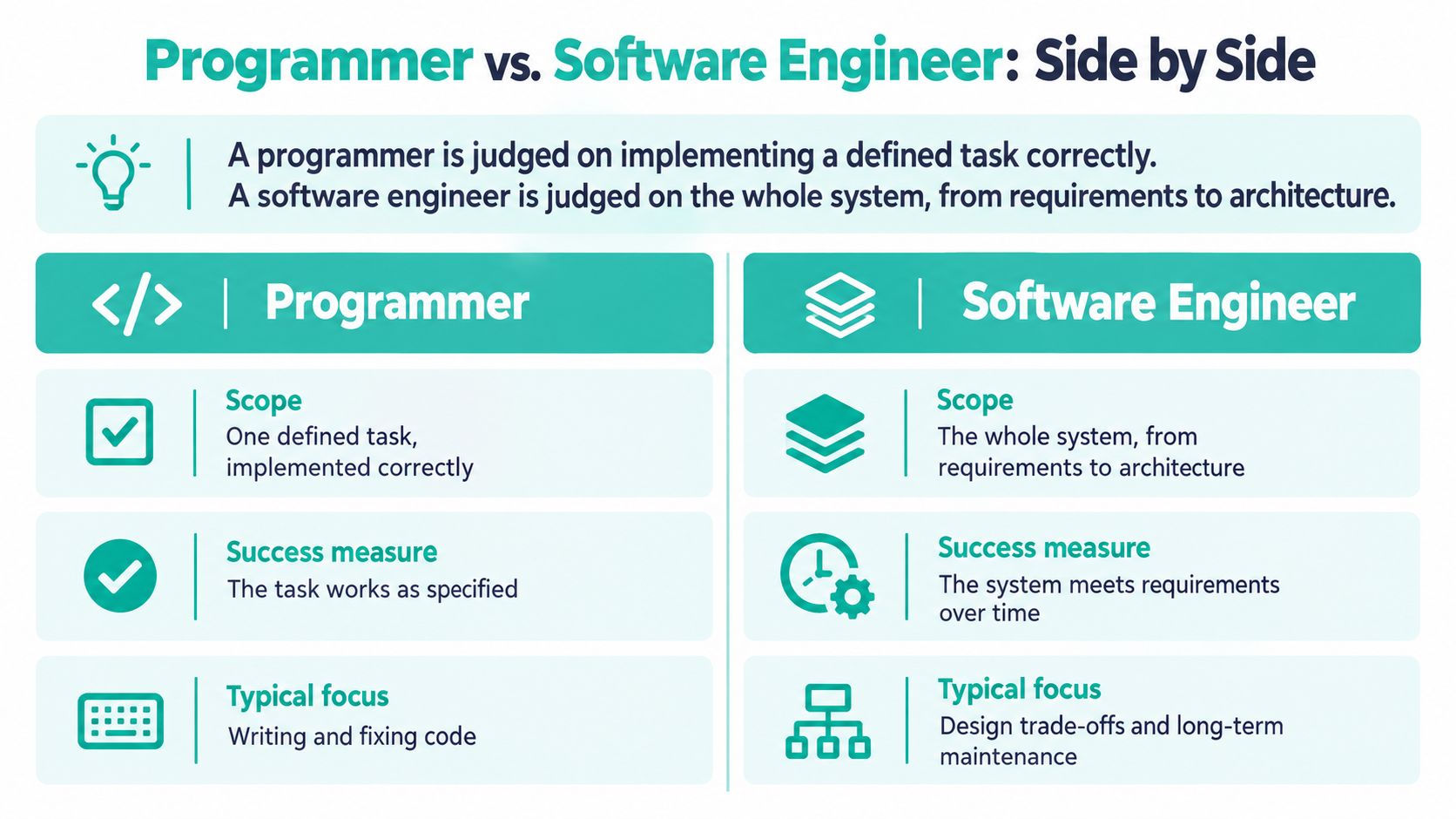
Neither column describes an exclusive set of abilities. An excellent programmer can understand architecture well, and an engineer still needs to write dependable code. The difference is which decisions the employer expects that person to own.
Use a broader guide to tech job titles to interpret unfamiliar labels, but don't treat any title as proof of seniority or responsibility. A role can combine duties from both columns.
Test any posting with this question: does the role end at the code, or at the running system?
Start with the actual work rather than an abstract distinction between thinkers and doers. Both roles involve thinking, implementation, review, and maintenance. What changes is how far the person's responsibility extends.
The O*NET programmer task descriptions include writing, analyzing, reviewing, and rewriting programs; repairing existing programs; adapting software to new requirements or hardware; and maintaining software for activities such as inventory tracking, data storage, and equipment control.
A programmer's week might therefore include:
The O*NET software developer profile describes broader duties: analyzing user needs, applying computer-science, engineering, and mathematical principles, updating software, preparing specifications and performance requirements, coordinating database development, and designing or directing testing and validation.

Consider a hypothetical seed-stage application adding password resets. The product requirement sounds straightforward: a user requests an email, follows a reset link, and chooses a new password.
With a settled specification, a programmer can build the request endpoint, implement token validation, connect the email template, and test valid and invalid requests. They can also identify ambiguities and flag them for the person responsible for the design. That's substantive work, not mechanical translation.
The engineer responsible for the feature must settle the unanswered questions. How should token expiry work? What prevents repeated requests from overwhelming the email provider? Which events should be logged without exposing credentials or reset tokens?
Release planning creates another set of decisions. Someone must determine how to deploy the change safely, detect failed delivery, and roll back without leaving users stranded. In this example, that engineer also gets paged when reset emails stop arriving.
The same person could perform all these tasks. The useful distinction is between contributing to the feature and being accountable for its behavior after customers depend on it.
Touching a deployment isn't the same as owning its outcome. Ask who must notice the failure, make the decision, and coordinate the repair.
For your current role, ask: which of these tasks do I own, and which do I only touch?
Think of the skill expectations as overlapping layers rather than separate professions. The implementation layer remains necessary even when someone takes on broader engineering responsibilities. Architecture doesn't compensate for code that mishandles inputs or cannot be tested.
The systematic lifecycle view of software engineering supports assessing both coding execution and judgment across requirements, design, testing, operation, and maintenance.
For an implementation-focused role, demonstrate language fluency in your working stack, algorithmic reasoning, effective debugging, and the ability to read unfamiliar code. Show that you can test your changes and submit a clean diff another person can review.
A practical example is fixing an API pagination defect. A strong submission identifies the boundary condition, adds a failing regression test, corrects the behavior, and explains any compatibility implications. Rewriting the entire module without justification isn't stronger evidence.
The broader layer concerns decisions whose effects extend beyond the immediate change:
For a hypothetical billing webhook, parsing the payload is only the implementation starting point. The engineering question is what happens when the provider delivers the same event again, events arrive unexpectedly, or processing fails after part of the operation completes.
A credible design explains how duplicate events are recognized, how processing state is recorded, and how support staff can investigate a disputed result. Strong programmers may already demonstrate much of this layer, regardless of their title.
For a self-audit, list three recent tasks and mark which layer each required. Then identify a decision you could explain with evidence rather than hindsight.
In the 2025 Stack Overflow Developer Survey's work findings, 64% of developers didn't view AI as a threat to their jobs, down from 68% the previous year, and the survey distinguished multiple developer-role categories.
My interpretation is that code generation makes verification and design judgment more important, not implementation expertise irrelevant. Ask whether AI removes routine work from your day or shifts your effort toward reviewing generated code, testing edge cases, and owning production behavior. Mark which current tasks AI already handles, and which decisions you still need to defend.
Lines of code, commit frequency, sprint velocity, and task duration are convenient measurements. They're weak standalone measures of contribution because they don't establish whether the software is correct, understandable, or safe to change.
Research summarized by the IEEE Computer Society on software quality measurement identifies reliability, maintainability, testability, complexity, comprehensibility, and defect rate as recurring quality dimensions. It also reports that process measures, including deterministic testing, thorough code review, consistent practices, and effective planning, can predict post-release defects better than code-only metrics.
Performance metrics by title
| Metric | Programmer benchmark | Software engineer benchmark |
|---|---|---|
| Escaped defects | Defects found after release in assigned code | Defects found after release across the owned system |
| Test coverage | Coverage matched to the risk of their own code | Test strategy across services and integrations |
| Recovery time | Time to fix assigned defects | Mean time to restore service after an incident |
| Change-failure rate | Not a primary measure | Share of deployments that need a fix or rollback |
| Review latency | Time to get their code reviewed | Time to review designs and others' code |
| Future change cost | Not a primary measure | Estimated effort for the next feature in the same area |
| Lines of code or commit count | Weak proxy, don't use alone | Weak proxy, don't use alone |
For assigned implementation work, examine whether tasks meet acceptance criteria, whether defects escape release, and how effectively the person investigates failures. Check algorithmic or API performance against the actual requirement, not an unrelated benchmark.
For system owners, add deployment failures, restoration time, availability, dependency-risk reduction, and the effort required for subsequent changes. Review latency matters too, but distinguish waiting for someone else's approval from delaying reviews that other people need.
“Not a primary measure” doesn't mean “irrelevant.” A programmer benefits from understanding deployment failures, and an engineer still needs effective tests around individual changes. The table identifies emphasis, not permission to ignore quality.
Avoid turning these measures into individual quotas. Codebase maturity, testing automation, and team collaboration affect defect outcomes, so compare the surrounding conditions before attributing results to personal effort.
Consider a hypothetical comparison in which engineers each merge twelve pull requests. One adds a retry policy and load test that prevent recurring incidents; the other closes tickets quickly but triggers two rollbacks. The equal pull-request count conceals the difference in outcomes.
The lesson isn't to replace commit counts with an incident leaderboard. Investigate whether each person made sound decisions with the information and authority available.
For hiring, combine a coding exercise, a design discussion, and a production-style failure scenario. Score correctness, complexity, testability, failure recovery, communication, and maintainability consistently. That lets a candidate demonstrate both execution and judgment without relying on their previous title.
The title on an offer tells you little about its pay or career path. Compare the actual scope, location, company stage, and compensation terms. A programmer role can include broad technical authority, while a software engineer role can be limited to implementing assigned work.
A reliable occupation-level salary comparison needs figures for the same reporting period and geography. The available source here does not establish comparable median pay for both occupations, so assigning amounts would create false precision. The BLS employment projections analysis can inform a discussion of software-development demand, but its category should not be treated as an exact match for every employer's software engineer title. Demand projections also cannot predict an individual candidate's prospects or the quality of a particular opening.
An implementation-focused programmer can build a career through deeper expertise in areas such as performance, security, or data tooling. For example, a programmer who improves a compiler or hardens a production service may take on technically demanding work without moving into management.
Broader engineering paths often add ownership across systems or teams. When assessing senior, staff, or principal roles, ask what decisions the person makes and what technical work they own. A staff role might involve setting an architecture used by several teams; a management role instead centers on hiring, feedback, and delivery. Specialization and management are different directions, not automatic rungs on one ladder.
Use a software engineer salary comparison as a reference point, then assess the specific offer. Cash-heavy and equity-heavy packages carry different risks, and a promised future promotion should not be required to make the current terms acceptable.
The trade-off is practical: a broad-scope programmer role may offer more authority but unclear leveling, while a narrowly scoped engineer role may have a more defined pay band and promotion path. Compare the duties and terms in writing before treating either title as a salary signal.
Treat a startup job listing as a proposal about work, not a reliable occupational classification. The BLS description of computer programmers centers on translating designs into instructions computers can follow, but employers can assign broader duties under that label.
For reading purposes, treat programmer as a possible signal of implementation-heavy work or an internal pay-band convention. Treat software engineer as a possible signal of full-stack or product-area responsibility. Neither interpretation is strong enough to justify applying or rejecting a role without examining its duties.
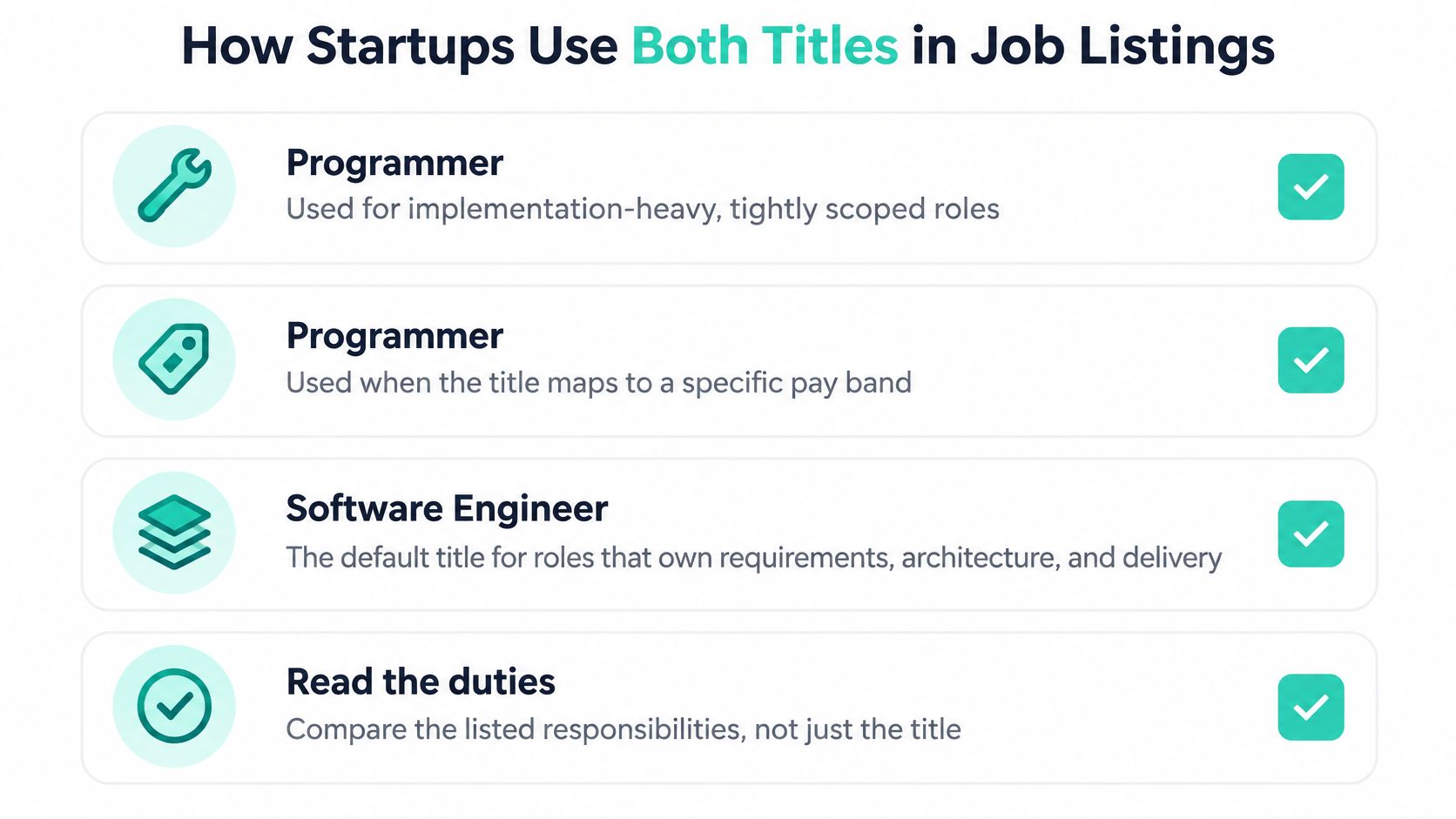
Look for verbs and named responsibilities, then ask what they mean in that team.
“Own” can mean technical authority, or it can mean being blamed when something breaks. Ask who approves designs and who can change priorities. A guide to startup engineering team structure can help you frame questions about reporting lines and responsibilities.
Consider a hypothetical Software Engineer posting at a four-person startup. It asks the hire to join the pager rotation and define the data model. Those duties suggest an end-to-end role, but the candidate should still ask what support and escalation coverage exist.
Contrast that with a hypothetical Programmer posting at a sixty-person company that emphasizes Jira tickets and code review. It looks execution-focused, but the candidate should ask whether they can propose designs or assume ownership of a subsystem.
The team sizes don't determine the answer. The advertised work and the hiring manager's explanation do.
For employers, filtering applicants by previous title can exclude people who have already done the relevant work. State the scope in the opening paragraph, name the decisions the hire will own, and describe what the first ninety days include. Specific expectations help candidates assess fit before either side invests in interviews.
| Situation | Better-fit title | Evidence to show |
|---|---|---|
| You want deep focus on one language or product domain | Programmer | Shipped features with tests and clean, reviewable changes |
| You want to own a product area from spec to on-call | Software engineer | A design document you wrote and an incident you helped resolve |
| You're moving from a programmer title to a broader startup role | Software engineer | Scope examples with a metric you influenced |
| The listing says software engineer but describes only tickets | Check the description before applying | Ask who designs and who is on call |
| Your past titles are inconsistent across employers | Describe the work, not the label | Scope, decisions made, and ownership held |
Choose using the scope you want, the pace at which you want to learn, and the evidence you can show. Broader responsibility can create useful learning opportunities, but unsupported ownership isn't a development plan. Ask who will review your decisions and help when you reach an unfamiliar problem.
Over the next quarter, assemble a shipped feature with tests, a design document or postmortem you led, and a metric you influenced. Describe your contribution precisely, including constraints and decisions you didn't control. If you lack an artifact, seek an opportunity to produce one rather than stretching your title.
When a listing's label and description disagree, apply if the responsibilities match your goals and experience. On the first call, ask: Who is on call? Who writes the technical design? Those answers make the expected boundary much clearer.
Keep official titles accurate in your employment history. Use your headline and accomplishment bullets to explain the scope behind them.
Your next action is to rewrite your resume headline around work you really held. "Backend developer owning billing integrations and production support" tells a hiring manager more than an inflated label. Choose wording you can substantiate, then make the supporting accomplishments easy to find.
Underdog.io is a curated, candidate-focused hiring marketplace connecting tech professionals with startups and high-growth tech companies through a single short application. Visit to explore opportunities beyond title matching, and use ownership, design authority, and on-call expectations to decide which conversations fit your next move.