You publish a role, share it across job boards, and wake up to an inbox full of resumes. The hiring team spends days sorting profiles that look promising on paper, while the experienced engineer or product leader you need never applies. In another search, the opposite happens: the job remains open, outreach is inconsistent, and every interview gets scheduled through a chain of messages.
The core recruiting software problem for startups is this. An applicant tracking system can organize people who enter your funnel, but it can't automatically solve a weak funnel. The right choice depends on whether your bottleneck is application volume, passive candidate sourcing, evaluation, or hiring speed.
| Recruiting need | Software category | Best fit | Main trade-off |
|---|---|---|---|
| Organize inbound applicants | Applicant tracking system | Teams receiving steady applications | Strong process control, limited proactive sourcing |
| Build passive pipelines | Sourcing and recruiting CRM | Technical or hard-to-fill roles | Requires thoughtful outreach and follow-up |
| Evaluate candidate capability | Assessment and interview platform | Teams needing consistent screening | Adds structure, but can create candidate friction |
| Access vetted talent | Curated marketplace | Startups seeking high-signal passive candidates | Smaller, more selective pool than open job boards |
A founder hiring the first engineers often reaches the same uncomfortable fork. One week brings hundreds of applications for a generalist role, but few have the required experience. The next week brings almost no relevant applicants for a specialized position. In both cases, the team may blame the ATS, even though the underlying problem is candidate generation and qualification.
The distinction matters because an ATS is primarily an intake and workflow system. It stores applications, moves candidates between stages, supports interview coordination, and gives the hiring team a shared record. Those functions are valuable, especially once several people are reviewing candidates. They prevent resumes from disappearing in email threads and make ownership visible.
But an organized backlog is still a backlog. If the right people aren't applying, a cleaner pipeline doesn't create them.
Early-stage hiring creates two competing pressures. Inbound applications can overwhelm a founder who has limited time for screening, while outbound sourcing demands research, personalization, follow-up, and judgment. Traditional job boards address visibility, but they often increase volume without guaranteeing relevance. Sourcing platforms address discovery, but they still leave the startup responsible for deciding whom to contact and how to earn a response.
That's why recruiting software for startups should be evaluated by the job it performs, not by the number of features on its product page. A basic ATS may be enough for recurring inbound roles. A sourcing CRM becomes more useful when the company needs to build relationships with people who aren't actively job hunting. An assessment tool helps when the hiring team needs a repeatable way to test skills without relying on unstructured interviews.
Slow processes create a separate failure point. SHRM's 2024 Talent Acquisition Benchmarks, summarized in a startup hiring report, put average time-to-fill for professional roles at 44 days for small businesses (startup hiring report). A startup can lose candidates during that period because interview scheduling, feedback, or approvals move too slowly.
Practical rule: Buy software for the stage where candidates are being lost, not the stage that looks most visible in your dashboard.
The strongest stack may therefore combine an ATS with outbound sourcing or a curated talent channel. The point isn't to purchase everything. It's to identify whether your team needs better organization, more candidate generation, stronger evaluation, or a faster handoff between those activities.
Recruiting technology becomes easier to compare when each category has a defined responsibility. Start with the hiring problem, then choose the system that handles it.
An Applicant Tracking System manages the operational backbone. It captures applications, records candidate stages, assigns interview tasks, supports communication, and preserves hiring history. For a small company, that shared workflow can replace scattered spreadsheets and private inboxes. The category has become a core layer of recruiting software for smaller employers. A 2026 industry report valued the global ATS market at $17.22 billion in 2025 and projected it to reach $34.83 billion by 2034, implying an 8.20% CAGR (Bullhorn's ATS usage report).
A sourcing or recruiting CRM performs a different job. It helps a team discover prospects, save profiles, segment talent pools, personalize outreach, and maintain relationships before someone applies. Tools such as Gem, Ashby, and LinkedIn Recruiter fit this category in different ways. They're useful when the hiring team must create a pipeline rather than wait for one.
Assessment and interview platforms sit further down the funnel. They can support structured scorecards, technical exercises, recorded responses, or interview scheduling. Their value depends on role design. A coding assessment may help evaluate an engineer, while a work sample may offer better signal for a product or design position. The wrong assessment can make the process feel impersonal and discourage strong candidates.
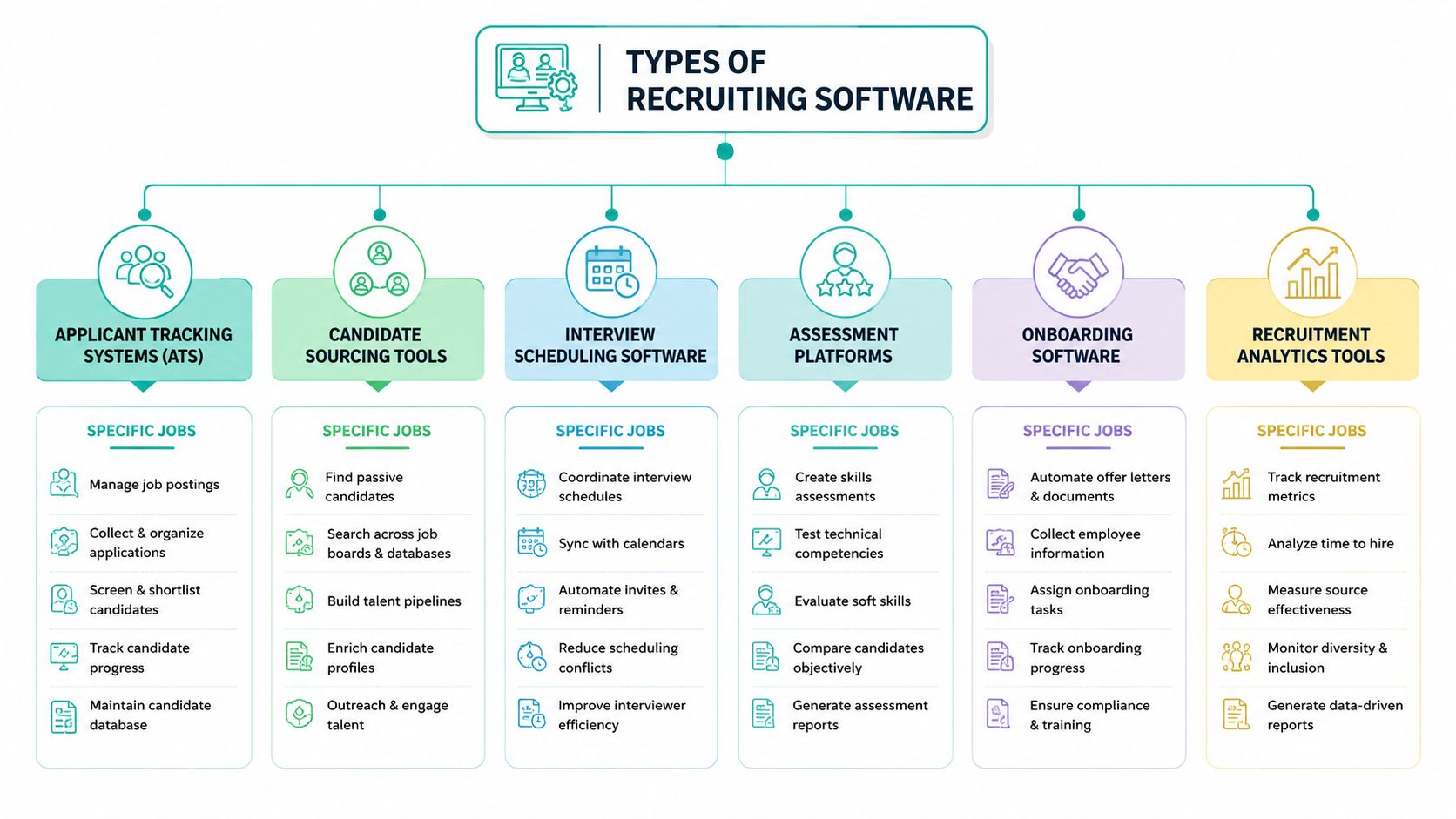
An ATS is strongest when applications already exist. A sourcing CRM is strongest when the team must find and nurture people who aren't applying. An assessment platform is strongest when interviews alone don't provide enough evidence.
Curated marketplaces occupy a separate position. They don't just distribute a job posting or store an applicant record. They filter and match candidates before the employer invests time in outreach. The model described in this guide to candidate sourcing tools for startups illustrates why that distinction matters for lean teams.
Founders who want to evaluate adjacent job-search and application automation tools can also review AIApply as a separate resource. It's most relevant when the question concerns candidate-side application support, not when the startup needs a complete employer workflow.
A sourcing platform earns its place in a startup's stack by improving pipeline behavior. Track whether qualified candidates reply, whether replies become genuine interest, and whether the team can manage follow-up without losing context. A polished search interface matters less if the workflow produces weak conversations or leaves promising candidates unattended.
Ashby analyzed roughly half a million sourcing sequences from January 2022 through January 2024. Its dataset reported an average campaign reply rate of 19.6%, with technical roles at 19.4% and business roles at 18.7%. It also recorded a 37.7% average interest rate across sourcing campaigns. Reply and interest measure different stages, so hiring teams should not treat them as interchangeable (Ashby's candidate sourcing benchmarks).
| Channel or role | Reply rate | Interest rate |
|---|---|---|
| Ashby sourcing campaigns overall | 19.6% | 37.7% |
| Technical roles | 19.4% | Not reported |
| Business roles | 18.7% | Not reported |
| Recruiter-written email | 6.31% | Not reported |
| Automated recruiting email | 4.96% | Not reported |
| LinkedIn messages | 17.08% | Not reported |
Independent 2026 outreach benchmarks covering more than 4,000,000 messages provide the channel comparison. Recruiter-written emails averaged 6.31% replies, automated recruiting emails averaged 4.96%, and LinkedIn messages averaged 17.08% (HeroHunt's recruiting outreach benchmarks). The results support a multi-channel workflow rather than dependence on automated email alone. LinkedIn messages produced roughly three times the reply rate of automated email in that comparison.
Reply rate alone does not measure hiring quality. A poorly targeted campaign can attract responses from people who lack the required experience, while a narrower search may produce fewer replies and stronger interviews. Interest rate also needs context. It reflects candidate-reported curiosity, not accepted offers or completed hires.
Review campaign metrics alongside the quality of the conversations:
Outreach software should support recruiter judgment. Automation works well for reminders, routing, and consistent follow-up. Role positioning, candidate selection, and meaningful replies still require human ownership. Generic messages sent at scale can weaken trust, particularly with senior candidates who already receive frequent recruiting outreach.
Traditional recruiting stacks depend on candidates finding a public application route. The company posts a role, the ATS collects resumes, and the hiring team works through the resulting pool. That process can support broad reach and documented hiring, but it also creates a familiar startup problem: a high volume of applications can arrive while experienced passive candidates remain invisible.
Curated marketplaces change the bottleneck. Instead of waiting for qualified people to apply, they select candidates before an introduction. In the Underdog.io model, candidates submit one anonymous profile in about 60 seconds, stay anonymous until mutual interest, and typically receive 1 to 3 personalized introductions per month. Underdog.io also describes about 85% of candidates as passive and says only about 5% of applicants are accepted, indicating a selective process rather than open job-board distribution.
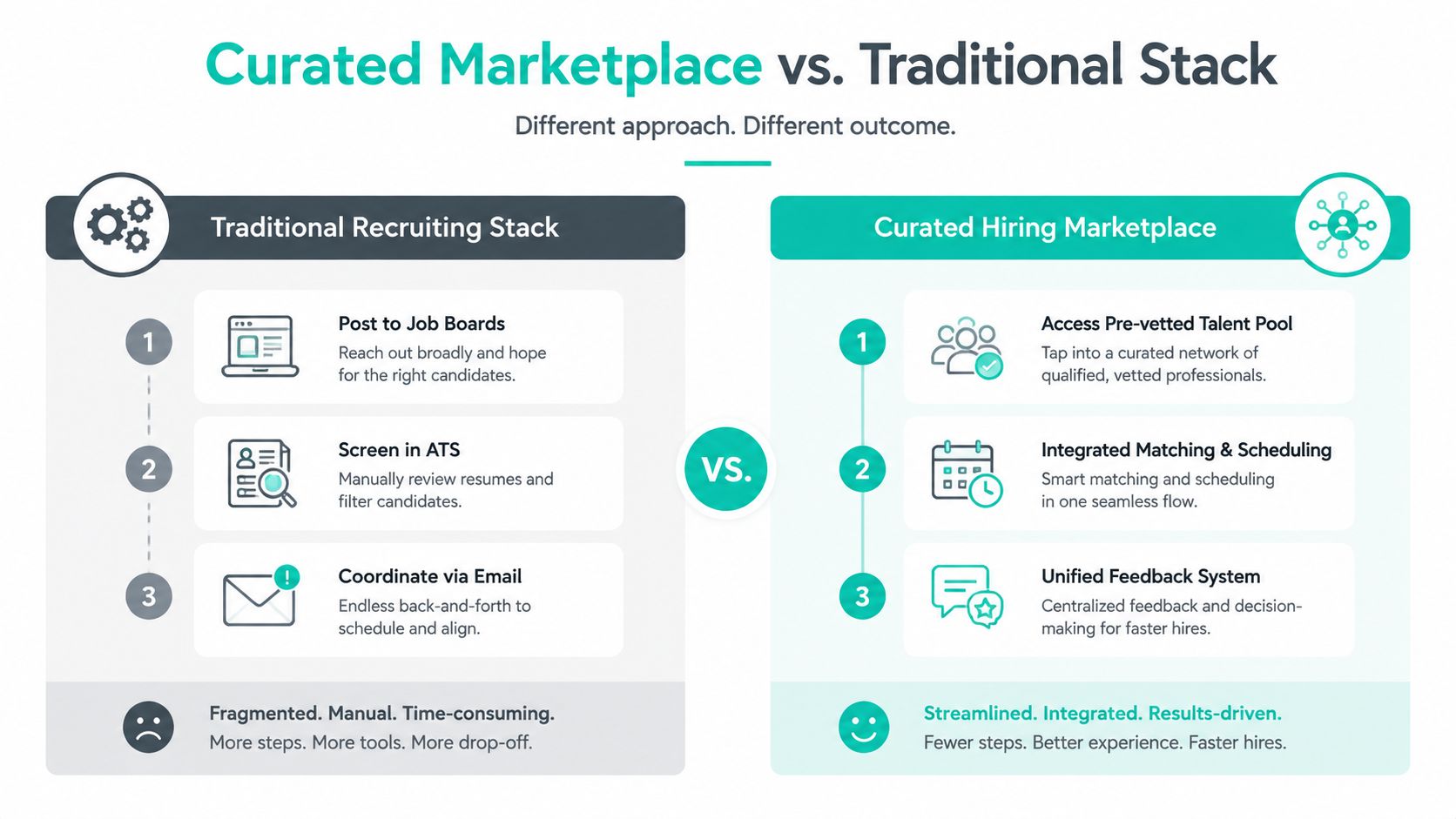
An open application flow maximizes access. Any interested candidate can apply, and the employer gets a broad pool to search. The trade-off is screening time, uneven applicant quality, and the possibility that a strong candidate is buried among weaker submissions.
A curated marketplace applies selection before introduction. A smaller pool can reduce noise, while anonymity gives employed candidates a discreet way to consider a new role. That matters for startup positions where qualified technical and product candidates already have jobs and may ignore a generic posting.
The right choice depends on the hiring problem. Open applications fit teams that need broad reach, a documented process, or roles with many active candidates. Curated matching fits teams that need passive talent but lack the time to identify, qualify, and contact those candidates directly. Teams comparing distribution options should also distinguish a marketplace from job board software. A job board publishes an opportunity for candidates to find, while a curated marketplace focuses attention on selected matches before they apply.
Anonymity may affect participation, but the result depends on how the product applies it. Ashby's candidate experience survey data reports an average response rate of roughly 17.8% overall, 17.7% when anonymity is allowed, 20.6% when anonymity isn't allowed, and 15.3% when anonymity is enforced (Ashby's candidate experience survey data).
Anonymity also does not guarantee fairer hiring. An IZA and LISER paper on anonymous resumes found that participating firms became less likely to interview and hire minority candidates after receiving anonymous resumes. The paper reported an average interview rate of about 10.5% in the control group and 11.3% in the treatment group (IZA and LISER paper on anonymous resumes). Founders should evaluate the full matching, screening, and interview process rather than assume that hiding identity improves outcomes by itself.
Software only improves hiring when the team agrees on how work moves through it. A startup can own an ATS, a sourcing tool, and an interview platform and still operate through spreadsheets if nobody defines the handoffs.
Write the workflow in plain language before configuring products:
This exercise exposes unnecessary steps. If a candidate's information is copied from a sourcing CRM into an ATS and then into a scheduling tool by hand, look for an integration or simplify the stack.
The ATS should usually hold the official candidate record, while the sourcing CRM manages prospect discovery and outreach. Connect calendars and communication tools where appropriate, then decide which system owns stage changes, notes, and rejection reasons. Your HRIS or people-operations system should receive the final hiring data without forcing the recruiting team to re-enter it.
Data hygiene matters more than elaborate configuration. Standardize job titles, candidate stages, source labels, and disposition reasons. Remove duplicate profiles before campaigns begin. Give every hiring manager a short operating guide that explains where to leave feedback and when to update a stage.
Implementation test: If a candidate can move from first contact to scheduled interview without someone copying the same information twice, the stack is probably serving the process.
Track time-to-first-slate, response quality, interview conversion, and candidate drop-off. A 2026 startup hiring guide describes traditional startup hiring as 30 to 45 days from requisition to offer acceptance, while its cited AI-driven workflows describe 15 to 20 days by automating sourcing, resume screening, and scheduling (startup hiring speed guide). Treat those figures as directional benchmarks, not promises. Your workflow, role complexity, and decision discipline will determine the result.
For a deeper operating model, use this guide on building a recruiting system that scales with talent engineering.
Startup recruiting budgets fail when founders compare subscription prices without counting internal labor. A tool can look inexpensive while requiring hours of configuration, training, data cleanup, and manual outreach. The cheapest license isn't always the lowest-cost process.
ATS pricing commonly follows seats, employee count, active roles, or recruiting modules. That structure is predictable for a team with stable hiring activity, but costs can rise as more hiring managers need access. Sourcing products often use subscriptions or credits tied to searches, contact discovery, or outreach volume. Those models make sense for active pipeline building, but unused credits and poorly targeted campaigns can waste budget.
Curated marketplaces may use flat fees or success-based pricing, shifting more financial risk toward the provider or toward completed hiring outcomes. The right comparison is not “software versus marketplace.” It's fixed platform cost plus internal effort versus variable access cost plus reduced sourcing workload.
A founder hiring occasionally for broad roles may need a simple ATS and manual referrals. A startup recruiting several engineers at once may justify a CRM, sourcing capacity, and structured interview tools. A company with one urgent, specialized search may prefer a selective marketplace or recruiting support instead of building a permanent stack.
Ask vendors:
Founders comparing recruiting costs with broader operating subscriptions can also view subscription costs from Yubook. Keep that exercise separate from hiring ROI, but use the same discipline: identify recurring commitments, variable usage, and the cost of switching later.
The right recruiting software follows the bottleneck, not the startup label. A team with strong inbound interest needs application control and coordination. A founder seeking a senior infrastructure engineer needs candidate discovery before an ATS can help. Start with the hiring problem, then add only the capacity required to address it.
A small team receiving relevant applications should begin with a basic ATS. Prioritize an easy application flow, clear stages, interview scheduling, scorecards, search, and reliable reporting. These features prevent candidates from being lost and reduce coordination work.
Hold off on advanced sourcing tools until the team has evidence that application volume, rather than candidate discovery, is slowing hiring. Paying for unused outreach capacity adds cost without fixing the immediate constraint.
A startup filling several technical or business roles at once needs more than intake. Add a sourcing CRM or outbound platform when founders or recruiters repeatedly build talent lists, run campaigns, and maintain relationships with people who are not ready to move immediately.
Review channel performance before choosing a tool. Earlier benchmark data showed meaningful differences between sourcing sequences, automated recruiting email, and LinkedIn outreach. Those figures come from different datasets and methods, so they are directional rather than a universal forecast. Use them to ask whether a vendor reports results by channel, supports personalization, and helps the team manage follow-up beyond email automation.
A startup pursuing experienced engineers, product leaders, or designers in competitive markets may gain more from a curated marketplace than from another job-posting tool. The marketplace can surface candidates before they apply and reduce the screening workload, addressing the hidden bottleneck that standard ATS features do not solve. The trade-off is that the team still needs a credible role, fast follow-up, and a clear explanation of the product and working environment.
Run a practical trial with one real role. Define the quality bar before launch, measure the time to the first credible slate, and review candidate relevance manually. Confirm that the provider can connect with the existing ATS, export records, and support a clear feedback loop. Negotiate around the hiring pattern the company has, not a projected scale that may never arrive.
Decision rule: Choose the smallest stack that solves the current bottleneck, then add capacity only when evidence identifies the next constraint.
A mature startup may eventually use three layers: an ATS for process control, sourcing software for proactive pipeline creation, and a curated marketplace for scarce passive talent. An early team may need one layer and disciplined human judgment. The purchase should follow the role, stage, and workload rather than a feature checklist.
Underdog.io connects startups with a curated pool of tech candidates through selective matching, anonymous profiles, and personalized introductions. This helps founders reach qualified people before they apply. Visit Underdog.io to define a role, review matched candidates, and build a more focused hiring pipeline.