Recruitment agency costs usually land between 15% and 30% of a candidate's first-year salary. For a senior tech hire on a $100,000 salary, that often means an agency fee of roughly $18,000 to $25,000.
That's the number many founders first react to, usually after they've already agreed to a search and the invoice hits. The core problem isn't just the fee. It's that budgeting often focuses solely on the visible line item, overlooking the full acquisition cost around it: internal interview time, delays in shipping, recruiter management overhead, and the downside if the hire doesn't last.
For startups, this matters fast. One agency-assisted tech hire can feel manageable. A cluster of hires across engineering, product, and go-to-market can turn into a meaningful budget line, especially when the company is still protecting runway. That's why the smartest hiring leaders don't ask only, “What does the agency charge?” They ask, “What are we buying, what risk are we taking on, and what hiring model fits our stage?”
A common startup scenario looks like this: a founder signs off on a search because the role feels urgent, then gets surprised when the final bill reflects not just the hire, but the pricing structure they didn't fully unpack.
Most agencies work under two core models. Contingency search means you pay only if the agency places a candidate. Retained search means part of the fee is paid upfront, often regardless of outcome. According to Alcor's overview of IT recruitment agency fee structures, recruitment agencies generally operate under these two primary payment structures, and retained searches often require 30% to 40% of the total fee upfront.
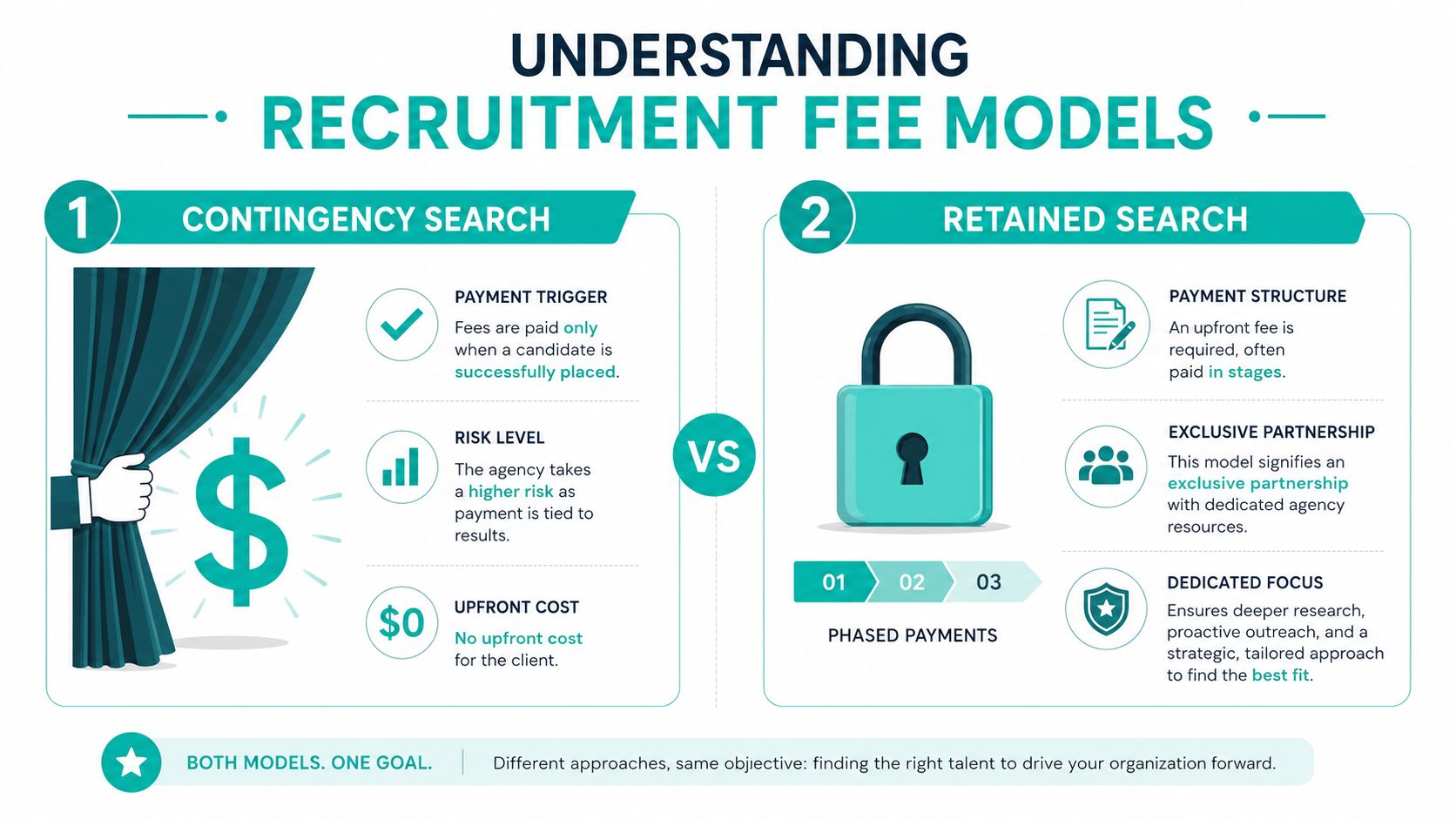
This is the most familiar model for venture-backed startups hiring mid-level and senior individual contributors.
You don't pay to start. You pay if the candidate signs and joins. On the surface, that feels low risk. Cash stays in the business until there's a result.
The trade-off is incentive design. Because the agency only gets paid when a placement closes, many firms run multiple searches at once and prioritize speed. That can work well when the role is standard, the market is active, and you need fast candidate flow. It works less well when the role needs careful calibration around startup experience, technical depth, and team fit.
Practical rule: If an agency is working contingency, treat response time and candidate quality as your leading indicators. If they're sending volume without calibration, the model is working for them, not for you.
Retained search is different. You're not buying a stream of resumes. You're paying for dedicated search capacity, research, and a more exclusive engagement.
This model is common for executive hires, confidential searches, and roles where the candidate pool is narrow. It usually comes with more structure, more market mapping, and more direct involvement from senior recruiters. It also shifts risk back to the employer because some money is due before the role is filled.
That doesn't automatically make retained search bad. It makes it expensive to use casually.
| Model | Typical Fee Structure | When It's Paid | Best For |
|---|---|---|---|
| Contingency | Percentage of first-year salary, paid on successful hire | After placement | Mid-level hiring, urgent searches, companies that want no upfront cost |
| Retained | Portion paid upfront, with remaining fee paid in stages | At kickoff and later milestones | Executive hiring, confidential roles, highly specialized searches |
A founder reviewing proposals should read the contract with one question in mind: who carries the risk if the search drags, misses, or produces weak fit?
That's where a lot of hiring teams get tripped up. They compare percentages and ignore the operating model underneath. If you want a good primer on how specialist firms position themselves in tech, this breakdown of tech recruitment agency options is a useful companion read.
You're not just paying for a resume. You're paying for access, speed, specialization, and in some cases, scarcity.
In the United States, LinkedIn's analysis of recruitment firm fees notes that recruitment agency fees consistently average between 15% and 25% of a new hire's first-year salary, with specialized or executive roles often reaching 30% to 35%. That spread exists for a reason.
An agency can usually fill a generalist individual contributor role faster than a VP search. Senior roles have fewer viable candidates, more stakeholders, and a higher bar for judgment. Each of those increases search effort.
That's why a fee that looks aggressive for a standard role can still be normal for leadership hiring. The invoice is reflecting search difficulty, not just candidate compensation.
A recruiter who hires broadly across functions is different from one who knows exactly how to source startup staff engineers, machine learning talent, or senior product leaders who've worked through scale transitions.
That expertise can be real value. But companies should verify it. Ask what kinds of roles the firm fills repeatedly, what candidate market they know, and whether they're bringing proprietary access or just re-running LinkedIn and job board workflows your team could run itself.
Some roles are hard because the job is unclear. Others are hard because the talent market is tight.
When demand spikes for technical talent, agencies know clients have fewer options and longer vacancies hurt more. That often pushes fees upward, especially when the company wants speed and won't invest internal capacity to build pipeline patiently.
A high fee isn't proof of quality. It's often proof that the agency believes the role is difficult, urgent, or both.
A boutique specialist, a general contingency shop, and an executive search firm won't price the same way because they aren't selling the same thing.
Use this lens when reviewing quotes:
If an agency can't explain why it deserves the higher end of the fee range, treat that as a buying signal in reverse.
Hiring departments understand fee percentages in theory. What they miss is how quickly those percentages turn into real budget pressure once you map them across an actual hiring plan.
Staffing Partner's breakdown of recruiter costs reports that tech companies in the USA spend an average of $14,000 to $25,000 per IT specialist hire when using recruitment agencies, and that figure includes not only the placement fee but also auxiliary costs.

The basic formula is simple:
Here's a practical example for a startup hiring a senior software engineer at $160,000.
That's before you account for team time spent on intake, interview loops, debriefs, and offer coordination.
One role rarely breaks a budget. Several do.
If your company plans to hire multiple technical employees in a year, agency costs scale linearly because the model charges per placement. The spend doesn't flatten as you hire more. It compounds with each accepted offer.
A simple forecast sheet should include:
Don't approve agency use role by role in isolation. Approve it against the full hiring plan, because that's where the economics become obvious.
Founders often ask, “Can we afford this hire?” The better question is, “Can we afford this channel for this class of hire?”
That's where planning discipline matters. This guide to recruitment planning for startups is useful if you're building hiring plans before headcount requests turn into rushed searches. For a more tactical look at reducing spend without weakening hiring quality, these insights for affordable tech startup hiring are also worth reviewing.
If you run this math early, you'll spot where agency use makes sense and where it's the default because the team didn't build another option.
The visible fee is only the first layer of recruitment agency costs. The larger financial question is whether that spend creates a stronger hire, a faster hire, or a lower-risk hire.
That distinction matters because a cheaper search can still be the expensive outcome.
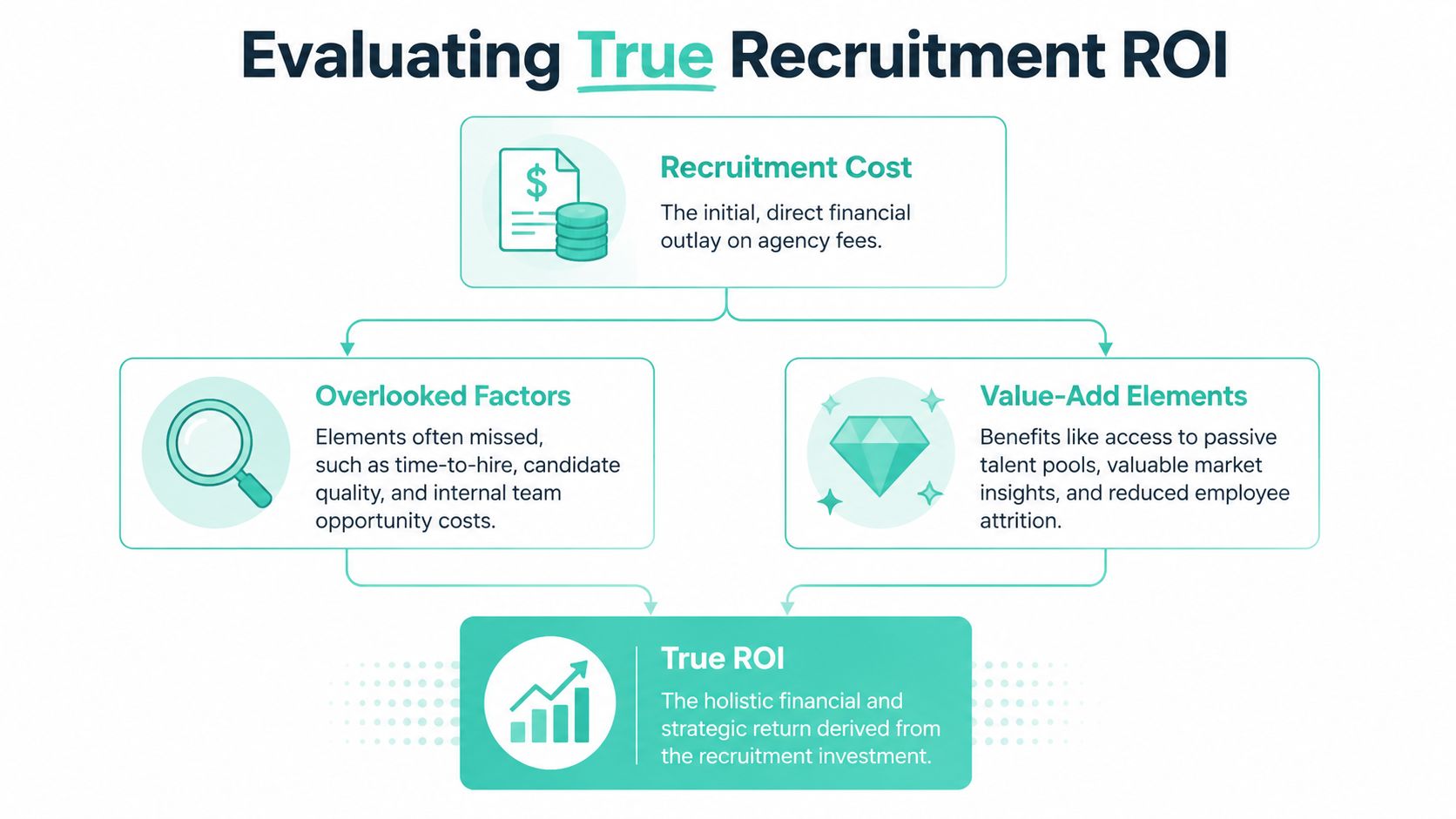
When leaders compare hiring channels only on fee percentage, they miss what happens around the search.
A slow process leaves important work uncovered. A poor shortlist burns manager hours. A weak match creates reset costs for the whole team. Those costs don't usually appear on the agency agreement, but the company still pays them.
That's why ROI has to include more than “Did we fill the role?”
Wide and Wise's analysis of agency costs and benefits states that a bad hire averages 30% of annual salary in turnover costs, and agency pricing models rarely account for placement guarantees or performance-based refunds in their base quotes.
For startup teams, that number hits harder than it does in larger companies. A mis-hire in a six-person engineering team isn't a localized issue. It slows product delivery, changes who mentors whom, and forces the company to reopen the search while carrying the cost of the first mistake.
Strong hiring economics come from reducing failure risk, not just negotiating a lower fee.
An agency can justify its cost if it materially improves one of three things:
| Value driver | What it means in practice | Why it matters |
|---|---|---|
| Speed | Qualified candidates arrive quickly and the role closes without drift | Critical roles stop blocking product or revenue work |
| Access | The recruiter reaches candidates your team wouldn't have reached alone | Especially useful for passive or highly selective talent |
| Judgment | Candidate evaluation improves, not just candidate volume | Better fit lowers the odds of an expensive reset |
If the agency isn't improving at least one of those areas, it's probably just an outsourced sourcing layer.
Before you engage any firm, ask questions that reveal whether they improve outcomes or just add activity.
A practical benchmark is this: if the agency creates more interviews but not more conviction, it's not creating ROI.
If your company is still figuring out when an external recruiter helps versus when it creates noise, this perspective on recruiters for startups is a useful way to think about the trade-offs.
Startups don't have to choose between “build a full talent team” and “pay an agency fee every time.” There are now better-fit options for companies that need quality, speed, and more transparent economics.
The most useful comparison isn't agency versus cheap. It's agency versus aligned.
Execue's breakdown of agency operating costs and hiring economics notes that in-house recruiting costs average $80K to $120K annually per recruiter and can deliver a lower cost per hire of $4,000 to $15,000 when scaled.
That's the key phrase. When scaled.
If you're hiring consistently, an internal recruiter can outperform agencies on both cost and learning curve. They understand your company, tighten the process over time, and build institutional knowledge that compounds. But if you're making only occasional hires, a full-time recruiter can be underutilized.
A curated hiring marketplace sits between job boards and traditional agencies.
Instead of paying for broad outbound search or managing a flood of unqualified applicants, companies get access to a narrower pool of pre-vetted candidates. The better versions of this model focus on fit, transparency, and success-based economics. That changes the operating dynamic in a few important ways:
This is especially useful for high-growth startups hiring technical talent, where speed matters but random volume creates more drag than value.
There are still cases where a classic firm is the right call.
A confidential executive search, a narrowly specialized leadership hire, or a role where your company has no market credibility may justify a retained or specialist search partner. The mistake is treating that as the default for every software engineer, product manager, or designer opening.
A smart hiring system uses the expensive channel selectively and builds repeatable channels for everything else.
Hiring channel decisions also connect to worker classification and contract design. If you're evaluating whether a role should be full-time employment or independent contractor work, this guide on understanding employment and contractor contracts is helpful before you choose the sourcing path.
The broader point is simple. Don't ask which option is cheapest in the abstract. Ask which one gives your company the best mix of signal, speed, flexibility, and repeatability for the roles you hire most often.
The right answer depends on stage, urgency, and hiring volume.
If you're making a rare leadership hire and the search is sensitive, paying more for dedicated search attention can make sense. If you're building a recurring engine for software engineers, product talent, or startup operators, the smarter move is usually to avoid a model where costs rise every time someone signs.
A simple decision filter works well:
Recruitment agency costs aren't just a procurement issue. They're a capital allocation decision. The money goes toward acquiring an asset your company depends on: people who can ship, lead, and stay.
Leaders who hire well don't just minimize the invoice. They choose a hiring model that fits the business they're building.
If you're hiring startup talent and want a model built around curated candidate quality and success-based pricing, Underdog.io is worth a look. It gives high-growth tech companies a more transparent way to meet vetted talent without defaulting to the traditional agency playbook.