The national median robotics engineer salary is $122,930 per year, or $59.10 per hour, in the latest O*NET wage data for SOC 17-2199.08. Actual offers vary widely by experience, city, technical scope, employer, and the value of bonuses, equity, and benefits.
That median is useful, but it isn't a promise. A controls engineer maintaining factory automation, a perception engineer building an autonomous vehicle stack, and a robotics software engineer deploying ROS 2 systems may all carry the same title while receiving very different offers. The question isn't “What do robotics engineers earn?” It's which work you own, how difficult it is to hire for, and how the employer pays for that value.
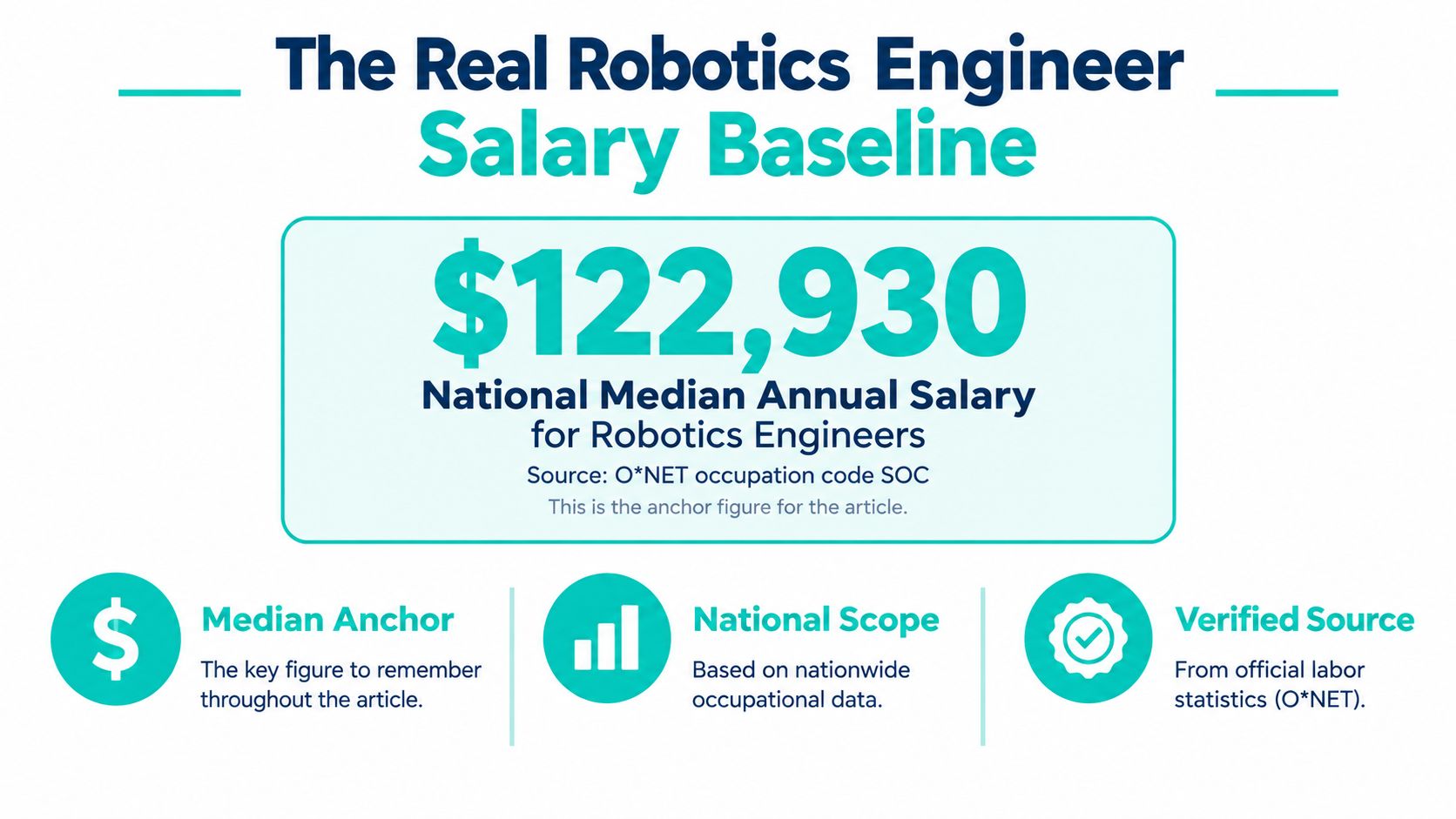
Federal wage data classifies robotics engineers under SOC 17-2199.08, rather than giving the occupation a separate broad category in the Bureau of Labor Statistics system. The latest O*NET wage distribution for Robotics Engineers reports national median annual pay of $122,930, equal to $59.10 per hour.
Treat that figure as a market reference, not an expected offer. The same distribution places the lowest-paid 10% at $66,810 or less annually and the highest-paid 10% at $189,950 or more. Hourly pay reaches $32.12 or less at the 10th percentile and $91.32 or more at the 90th percentile. That $123,140 spread shows why one “average robotics engineer salary” can conceal meaningful differences in responsibility, scarcity, and employer type.
This distribution is a national occupational benchmark. It does not guarantee an offer for robotics software, controls, perception, hardware, or autonomous-systems work. Seniority, specialization, geography, and employer type can move compensation substantially within that range.
Classification also hides the work behind the title. A production controls engineer, an autonomy engineer, and a robotics software engineer may all appear in related categories while owning very different risks and outcomes. Scarce production skills, such as reliable deployment, hardware integration, safety validation, and failure diagnosis, can command more than degree prestige alone.
A startup in a major technology market may offer less cash but include equity, a signing payment, broader ownership, or faster access to staff-level responsibility. A larger company may provide stronger benefits, more predictable bonuses, and clearer compensation rules. Compare the full package, including equity terms, bonus conditions, vesting, and the scope of decisions you will own.
Practical rule: Use $122,930 as a U.S. reference point, then price the actual responsibilities and total compensation before judging an offer.
A role near the median can be a strong career move if it gives you production ownership, safety responsibility, and direct customer deployment. A higher-paying position can be weaker if the work is narrow, heavily supervised, or disconnected from system performance. For context on how robotics pay compares to top engineer salaries across tech, compare adjacent engineering markets, then return to the specific robotics scope before deciding.
Experience matters because robotics systems punish shallow ownership. Junior engineers often implement defined components under supervision. More experienced engineers choose architectures, resolve failures that cross hardware and software boundaries, validate safety and reliability, and take responsibility for production deployment.
One Salary.com robotics engineer benchmark estimates annual pay at $81,477 for engineers with less than one year of experience, $98,866 at one to two years, $132,561 at two to four years, $148,283 at five to eight years, and $168,312 beyond eight years.
| Experience level | Estimated annual pay |
|---|---|
| Less than one year | $81,477 |
| One to two years | $98,866 |
| Two to four years | $132,561 |
| Five to eight years | $148,283 |
| More than eight years | $168,312 |
The sharp change at two to four years reflects a shift in ownership, not a magic anniversary. Engineers at this stage may be trusted to take a subsystem from design through integration, troubleshoot failures on real hardware, and make trade-offs that affect delivery schedules and product reliability.
Years alone won't justify a senior offer. Hiring managers want evidence that you can operate a robot in a constrained environment where sensors fail, latency matters, hardware changes, and safety requirements limit convenient solutions.
Strong evidence includes:
A candidate with fewer years but clear production ownership can outperform a candidate with a longer academic résumé and limited deployment experience. Treat the figures as market indicators, since salary sources use different samples and job definitions. A startup can also make a credible offer through transparent equity, technical autonomy, and a defined path from subsystem ownership to staff-level scope.
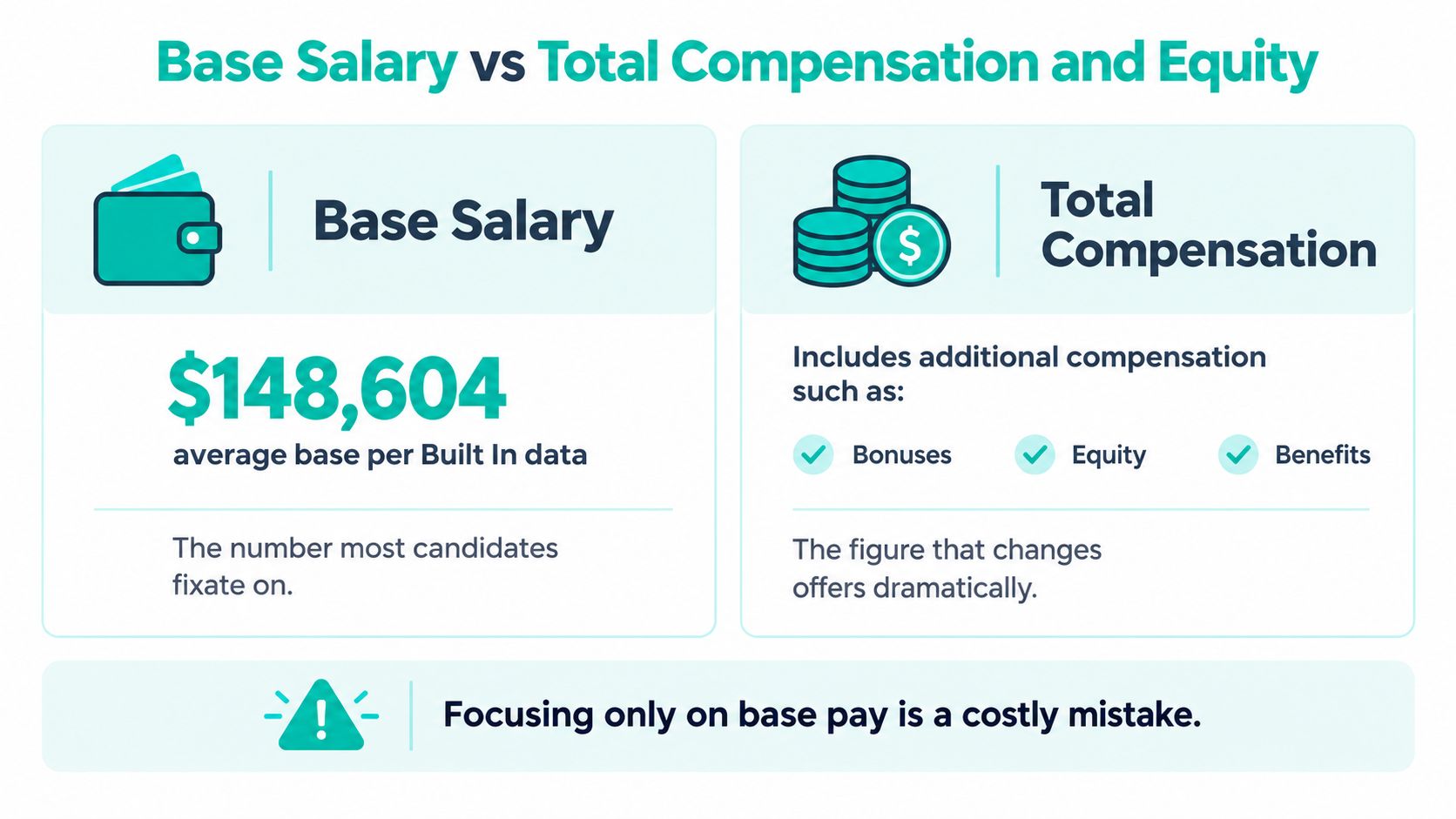
Base salary is the simplest figure to compare, but it does not describe the full offer. Built In's U.S. robotics engineer compensation data reports an average base salary of $148,604, average additional cash compensation of $34,890, and average total compensation of $183,494. Additional cash represents about 23.5% of base salary, so a base-only comparison can understate expected annual pay.
Built In also reports that robotics engineers with seven or more years of experience average $172,000 in salary. Use that figure as a reference, not a promise. Confirm whether the bonus is guaranteed, targeted, discretionary, or tied to company performance outside your control.
Build the offer around what you can count on:
A target bonus is not equivalent to base pay. Ask what triggers payment, whether the company has paid it historically, and whether the employer can change the target. Recruiters should not present a target as guaranteed compensation.
Equity requires a separate risk assessment. Record the value supplied by the company, then test how realistic that value is and whether a liquidity event is plausible. Private-company valuation is not spendable cash, and unvested stock is not salary. The startup equity compensation guide provides useful background, while the negotiation checklist below covers the vesting questions to ask.
For startup roles, compare guaranteed cash with risk-adjusted equity upside, ownership scope, and the work's value to your next career move. A lower base can make sense when the equity terms are clear and the role gives you meaningful responsibility. Opaque bonus rules and vague equity language should reduce the offer's value immediately. Get the compensation terms in writing before treating any upside as part of your pay.
A robotics engineer title can hide a wide pay gap. The same label may cover robotics software, autonomy, controls, perception, hardware integration, or research. Each path demands different skills, carries different operational risk, and belongs in a different compensation band.
A robotics engineer salary classification guide explains that the U.S. Bureau of Labor Statistics has no standalone robotics-engineer occupation code. Comparable work often falls under “Engineers, All Other,” SOC 17-2199, a broad category with a 2025 median of $122,930. The guide also reports published averages for the literal title ranging from approximately $106,000 on ZipRecruiter to $128,000 on Indeed.
Those figures can all be accurate because they may cover different populations, titles, samples, and occupational scopes. Classification is not a technical footnote. It can conceal the difference between a specialized autonomy position and a general engineering benchmark, leading candidates to price the wrong job.
Start by documenting the role's actual operating conditions:
Use the answers to match the position against salary data with the same scope. A field-deployment engineer who owns uptime should not be benchmarked against a research role that ends at a prototype. Production ownership, customer exposure, and failure accountability often justify a higher band than title or degree prestige alone.
Hiring teams need the same discipline. If you need to compare AI solutions for recruiters, use that comparison as a process aid, but keep human judgment in role calibration. Software cannot fix a job description that combines research, controls, embedded software, and field deployment under one vague label.
The practical rule is direct: compare responsibilities, seniority, industry, location, and compensation components together. Candidates who benchmark the work instead of the title avoid underpricing production experience and accepting a polished title with narrow ownership.
A degree shows technical study. It does not show that you can keep a robot running when conditions change, customers are waiting, and a software update changes physical behavior.
Employers pay more for production readiness because deployment exposes the skills that prototypes conceal. European manufacturing research found significant or very significant shortages in mechanical and industrial engineering at 63% of companies, and in electrical engineering at 54%. It also reported that 60.6% emphasized robotics operations, including programming, integration, maintenance, troubleshooting, and collaborative-robot management, according to the CECIMO skills-gap research.

U.S. sector reporting described strong demand in 2025, with especially acute shortages in ROS 2 development, computer vision with physical-AI and edge-deployment experience, systems integration, and safety and compliance. Those capabilities connect engineering work to reliable operation outside the lab. A clever demonstration has limited commercial value if the system cannot run consistently in production.
A research position can offer prestige and difficult technical problems. A production role carries consequences that reach customers, revenue, and safety. Engineers who bring up hardware, resolve integration failures, improve uptime, and handle field incidents often create more immediate business value than engineers whose algorithms never reach deployment.
The pay premium usually follows four forms of ownership:
Use those outcomes in salary discussions. Lead with systems deployed, failures resolved, and constraints handled. Degree prestige matters less when another candidate can prove they have protected production continuity.
Startups can offer less cash than major technology companies while giving engineers broader ownership and faster exposure to scarce production work. Accept that trade only after checking the equity terms, decision rights, and expected scope. A peer advisory group for engineering leaders) can provide a useful outside view when a startup title may represent genuine authority or just a long list of responsibilities.
Negotiate the job you will perform, not the title printed at the top of the offer. A robotics employer should be able to explain why your compensation fits the technical scope, the deployment burden, and the ownership expected from you.
Use these questions before signing:
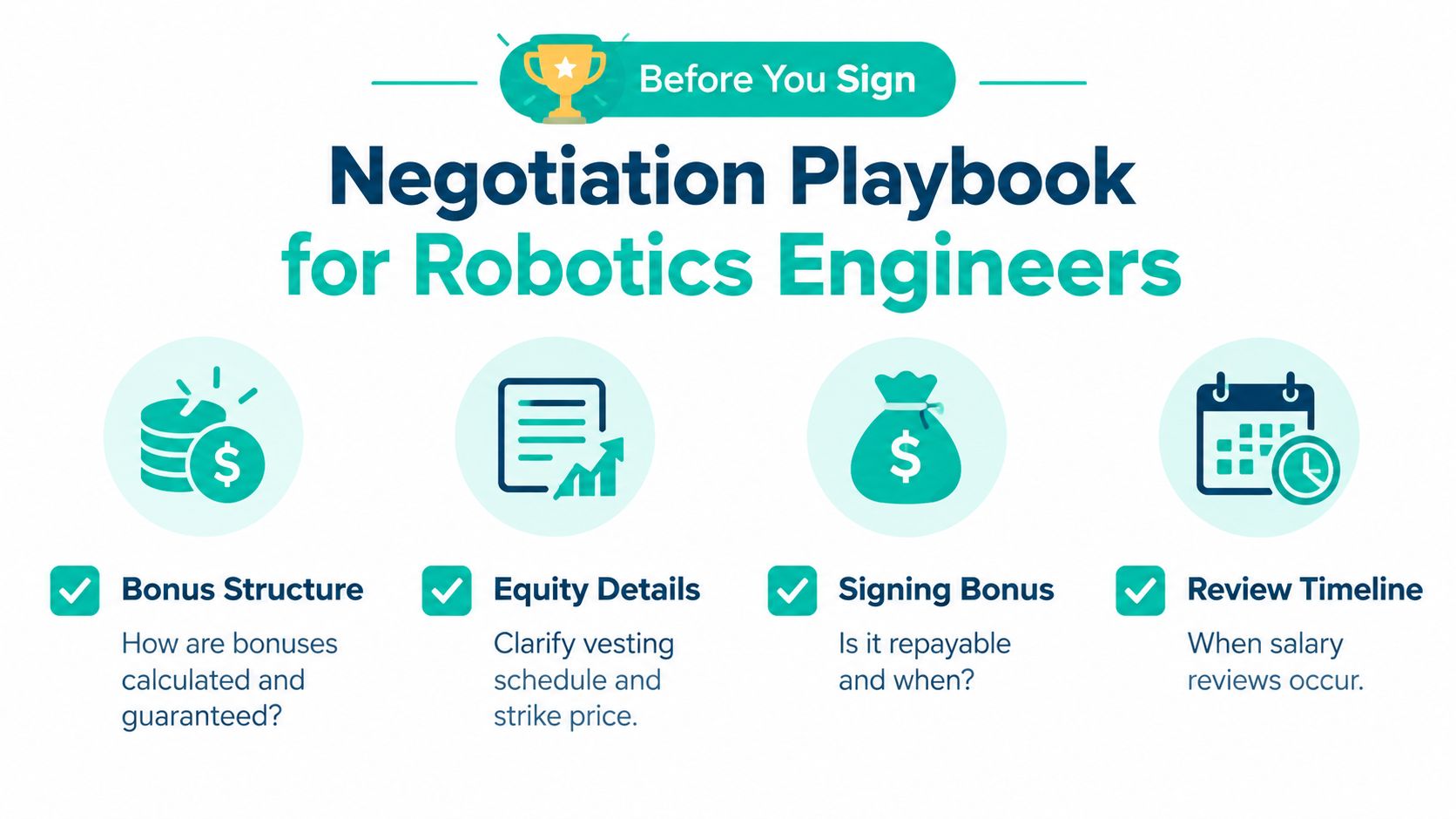
Bring a concise ownership record to the conversation. State the robot or subsystem, your responsibilities, the constraints, and the operational result. ROS 2 deployment, real-time control, reliable perception, hardware bring-up, safety systems, and measurable uptime are more persuasive than a list of libraries.
Ask the hiring manager to define the role's first major deliverable. If the answer is “support the team” or “help wherever needed,” ask who owns architecture, integration, and field failures. Broad work can be valuable, but undefined accountability often means you absorb risk without receiving authority or compensation.
Use the classification problem intelligently. You don't need to argue over which online salary average is correct. Ask the employer which comparison group they used, whether the role is software, controls, perception, hardware, autonomy, or research, and how the band changes with the expected level of ownership.
Negotiation standard: If the company wants senior-level deployment responsibility, the package should reflect senior-level scope, regardless of whether the title says engineer, robotics engineer, or systems engineer.
Walk away, or reopen the conversation, when the company won't explain equity terms, treats a target bonus as guaranteed cash, or expects production responsibility without decision authority. A strong base salary doesn't repair a package that hides its risk. Ask for the offer in writing, calculate guaranteed and conditional value separately, and negotiate the elements the company can change.
Startup compensation should be judged as a package of salary, equity, ownership scope, and career trajectory. A smaller company may expect one engineer to connect perception, controls, hardware, deployment, and customer feedback. That breadth can build scarce production experience quickly, but unclear priorities can turn it into unpaid risk.
Test the opportunity with direct questions. Who shipped the current robot? Which customer or production milestone comes next? What decisions will this role own? How does the company explain the equity grant? What support exists when deployment fails outside the lab?
Scope matters more than title. An engineer who owns integration, customer delivery, or field reliability may create more value, and command stronger compensation, than a candidate with a more prestigious degree but narrower production experience. Assess whether the package reflects that responsibility, then negotiate the elements the company controls.
A curated marketplace can reduce search noise. Underdog.io connects candidates with vetted startups and high-growth technology companies through a single application and confidential profiles that remain anonymous until interest is mutual. Its robotics engineer opportunities suit candidates seeking startup exposure without announcing a job search to their current employer.
The strongest offer is not always the highest base salary. Choose the package that prices risk fairly, builds scarce experience, and assigns credible value to equity rather than wishful upside.
Underdog.io connects robotics and software candidates with startup opportunities where salary, equity, and ownership scope can be discussed together. Compare your current package with matched early-stage roles by submitting your profile through Underdog.io.