When you see headlines about senior software developer salaries, it's easy to get fixated on the massive paychecks from tech giants. But before we get into the high-flying numbers, let's ground ourselves in reality and establish a solid, data-backed baseline for what a senior developer can expect to earn across the United States.
This national baseline is your starting point. Think of it as the financial foundation you build on as we layer in factors like your city, the type of company you work for, and your specific skills—all of which can send your income climbing.
In the United States, a senior software developer’s salary usually starts with a base component of around $123,541 per year as of 2026. This number is just the beginning, though. Total compensation often includes hefty bonuses and equity, pushing the overall package much, much higher.
The base salary is the clearest part of your pay, but it rarely tells the full story. To really get a handle on the senior developer salary landscape, you have to look at the entire range of potential earnings.
As of 2026, the average base salary for a senior software developer in the U.S. is $123,541. This figure sits right in the middle, with the 10th percentile earning around $90,000 and the top 90th percentile hitting $163,000 annually.
But base pay is just one piece of the puzzle. Once you factor in bonuses, profit sharing, and commissions, the picture changes dramatically.
This table breaks down what a typical compensation package might look like for a senior software developer in the U.S.
As you can see, add-ons like bonuses averaging between $2,000 to $21,000 and profit sharing from $1,000 to $21,000 can significantly boost your earnings. In some roles, commissions can add up to another $43,000, pushing the total pay range for many senior developers well into the $91,000–$172,000 bracket. You can dig into more detailed salary data and see how these numbers shift over on PayScale.
This wide range brings up a key point: the title "senior" is incredibly broad. An engineer with six years of experience and another with fifteen might both be called "senior," but they'll likely sit at opposite ends of this pay scale.
The term 'senior developer' covers a wide spectrum of experience and impact. Your actual earnings depend heavily on whether you are at the beginning of your senior-level journey or are a seasoned expert leading complex projects.
Treat the national average as a starting point in a much bigger conversation about your value. The most rewarding opportunities often show up when you look past the base salary and dig into the complete compensation package. As you move up in your career, getting a firm grip on these other components is absolutely essential.
For a deeper dive into how tech pay has been shifting, check out our 2025 tech salary guide. Understanding that context is key to knowing where the market is headed and how you can position yourself for the best possible offers in the years to come.
That six-figure base salary might feel like you've hit the jackpot, but in the world of senior software development, it’s often just the starting line. If you really want to grasp your earning potential, you have to look past the base number and get a handle on your Total Compensation (TC). It's a critical shift in perspective, because extras like bonuses and equity can completely change the financial picture.
Focusing only on base pay is like judging a car by its paint job—you're ignoring what’s under the hood. A slightly lower base salary at a high-growth startup could make you far wealthier than a higher base at a stable corporation, all thanks to the power of bonuses and equity.
So, what exactly is total compensation? It’s the full financial package of a job offer, and it generally stands on three pillars: the predictable base salary, variable cash bonuses, and long-term wealth builders like equity.
This chart breaks down how these pieces come together for a typical senior developer.
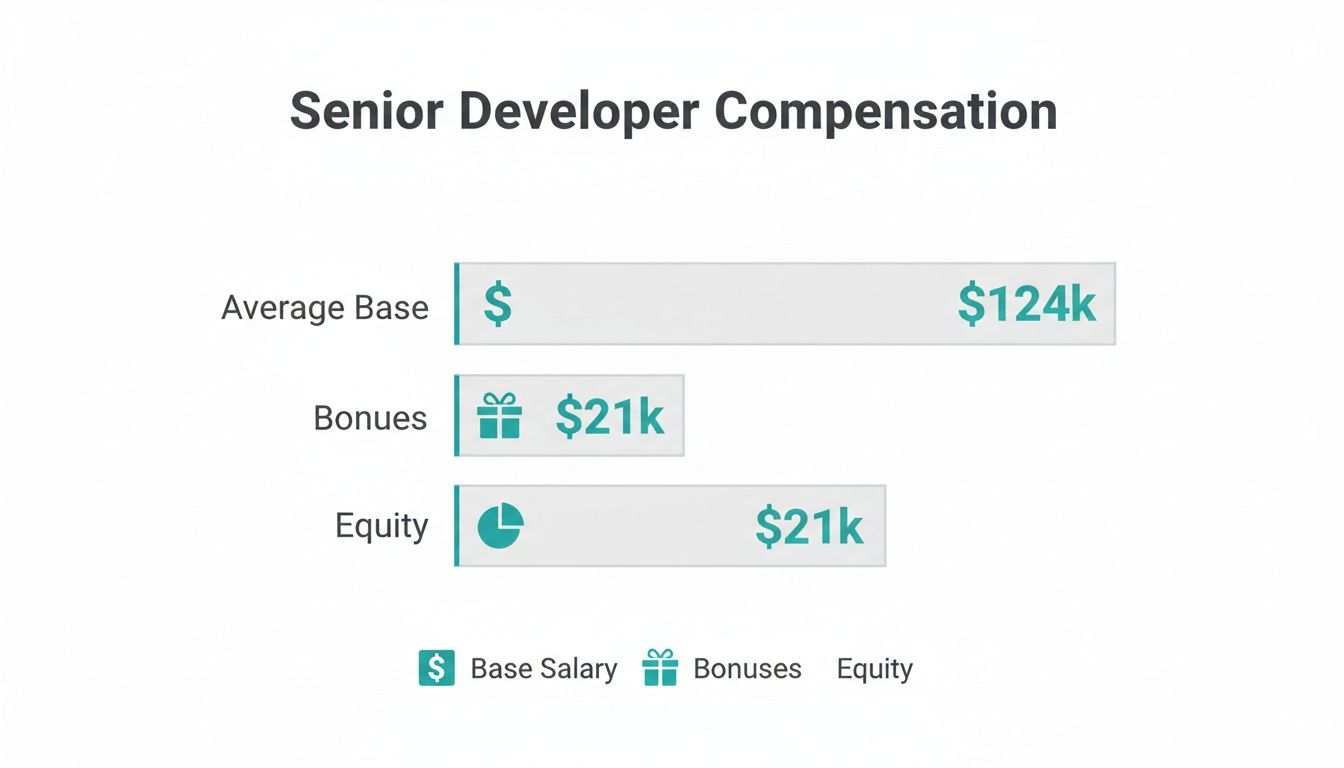
As you can see, bonuses and equity can stack nearly 35% on top of the average base salary. That's what turns a solid income into a serious financial package, and it's why you can't afford to ignore the full picture when you're weighing offers.
Let’s make this real with a practical example. Imagine you have two competing offers on the table. Company A is a big, established corporation offering a $170,000 base with a 10% annual bonus. Company B is a promising startup offering a $150,000 base and a 5% bonus, but they’re also throwing in equity worth $100,000 over four years.
At first glance, Company A looks like the winner with more cash upfront. But let's run the numbers and see how the total compensation stacks up.
Company A (Corporate):
Company B (Startup):
In year one, the corporate job still seems to have a slight edge. But the true potential of the startup offer lies in the equity. If Company B’s valuation doubles, that annual equity grant is suddenly worth $50,000, catapulting your TC far past what the corporate job can offer. This is exactly how many senior developers build significant wealth over their careers.
This difference gets even starker at top-tier tech companies. Senior software developers at the big names pull in an average total compensation of $212,000, with the top 1% climbing as high as $349,000. That massive earning potential is fueled by huge stock grants and performance bonuses, especially in tech hubs like Sunnyvale, CA—the kind of dynamic, high-growth environment where Underdog.io connects talent with game-changing companies.
Ultimately, understanding the full scope of your compensation is non-negotiable. For a wider view of how pay is structured across the industry, check out our guide on how much money software engineers make across different roles.

The title "senior software developer" casts a wide net. It can describe someone who just hit their five-year anniversary or a 20-year veteran who architects entire platforms. Naturally, not all senior roles are compensated equally. Your specific years of experience and your technical toolkit are the two biggest factors that will drive your earning potential.
Think of your career like a ladder. The title might not change for a few rungs, but your compensation should climb steadily with every year of proven impact. A newly-promoted senior is valuable, sure, but a seasoned expert who has navigated multiple complex product launches is playing in a different league entirely.
The salary gap between an engineer with six years of experience and one with sixteen can be massive. As you become more tenured, your role shifts from just executing tasks to defining strategy, mentoring teams, and solving problems that have a much bigger ripple effect across the business. That increased responsibility is—and should be—directly reflected in your paycheck.
The data shows a clear, rewarding climb. An analysis from Coursera reveals that a senior developer with 7-9 years of experience earns around $127,000. That number jumps to $141,000 for those with 10-14 years under their belt. For veteran engineers with over 15 years of experience, the average climbs again to $156,000—a 23% increase from the lower end of the senior spectrum.
This isn't just about "putting in the time." Your value grows as you build a track record of tackling harder problems, leading bigger projects, and making decisions that directly contribute to the company's bottom line.
A senior title gets you in the door, but a portfolio of complex, successfully delivered projects gets you the top-tier salary. Companies pay a premium for engineers who can de-risk major initiatives and guide teams to a successful launch.
Your compensation journey doesn't hit a ceiling at the senior level. The experience ladder keeps going, leading to even more specialized and high-impact roles:
Each of these steps represents a significant leap in both responsibility and, you guessed it, pay.
Beyond the years you've been in the game, the specific technologies you've mastered are a huge lever for your salary. The market simply pays more for skills that are both in high demand and short supply. If you're a mid-level engineer thinking about your next move, strategically choosing what to learn next might be the single best investment you can make in your career.
Specialized backend languages, for instance, often command higher salaries than more common frontend frameworks. According to Motion Recruitment's 2026 salary guide, the differences are pretty stark. Senior backend developers are now averaging $158,000, which reflects a 6.85% year-over-year increase.
To give you a clearer picture, here’s a look at how average salaries for senior developers can vary based on their technical focus.
This table breaks down the average low and high-end salary ranges you can expect for different technical specializations, based on current market data.
Developers specializing in languages like Golang, for example, can see offers approaching $200,000 because of intense demand for their skills in building cloud infrastructure and high-performance systems. On the other hand, while frontend development is still incredibly valuable, the larger talent pool tends to keep the upper end of the salary range a bit more moderate.
The takeaway here is simple: follow the demand. By focusing your learning on high-growth, high-value tech stacks, you put yourself in the driver's seat to command a premium salary when you step into your next senior role.
Let's be blunt: where you park your laptop has a massive impact on your paycheck. A senior software developer salary in San Francisco is a completely different beast than one in Austin, and the boom in remote work has added a whole new layer to the compensation game.
Figuring out these geographic nuances is absolutely key to maximizing your earnings.
It’s no secret that major tech hubs pay the highest salaries. Cities like San Francisco and New York have long been magnets for top talent, and companies there pay a serious premium to attract and keep the best engineers. This isn't just a few extra bucks; it can be a life-changing amount of money.
Living in a high-cost-of-living (HCOL) area almost always translates directly to a higher salary. Companies in these cities have no choice but to bake the steep housing, tax, and living expenses right into their compensation models.
As a result, a senior engineer in the Bay Area might easily earn 20-30% more than a peer with the exact same skills in a smaller city.
While the national average senior salary sits around $123,000, the data from top tech hubs tells a much different story:
Of course, a higher salary in these cities is directly offset by a significantly higher cost of living. A $180,000 salary in San Francisco might feel surprisingly similar to $120,000 in a city with lower expenses. The real trick is to weigh the bigger paycheck against your lifestyle costs to see what your actual disposable income will be.
While a high salary in an expensive city looks great on paper, your real financial gain comes from the difference between your earnings and your expenses. It's the savings and investment potential, not just the gross income, that builds long-term wealth.
The explosion of remote work has thrown a fascinating wrench into traditional salary structures. Companies are no longer stuck with the talent pool in their immediate zip code, and engineers have more freedom than ever to choose where they live.
This has forced companies to answer a critical question: Do we pay for the person or the place?
Three primary compensation models have emerged for remote employees:
Given the unstoppable trend of remote work, exploring available remote jobs can dramatically reshape your salary expectations and career path. Finding out which compensation model a company uses is a critical piece of information you need to gather during the interview process.
If you have the flexibility to move, you can strategically position yourself to get the best possible blend of salary and quality of life. The choice between a higher salary in an expensive city or a slightly lower one in a place you love is deeply personal, but it's a choice more senior developers have today than ever before.

Knowing your market rate is half the battle. The other half is actually getting paid that rate. The good news is that successful salary negotiation isn't about some high-stakes confrontation. It's a strategic conversation where you’re prepared to articulate your value.
Forget the generic advice. This is a playbook built from years of experience on both sides of the hiring table. Let's walk through how to confidently advocate for yourself and secure the compensation you've earned.
This is the classic first hurdle. When a recruiter asks, “So, what are your salary expectations?” your answer can set the ceiling for the entire negotiation. Naming a single number is a rookie mistake that can easily leave thousands on the table.
Your primary goal here is to delay giving a number for as long as you can. In any negotiation, the first person to put a figure out there tends to lose a bit of leverage. The better move is to flip the question back to them.
Here’s a script you can make your own:
"That's a great question. Right now, my main focus is on finding the best fit for my next role. If we both agree this is a great match, I’m confident we can land on a compensation package that’s both fair and competitive. To help me understand, could you share the approved salary band for this position?"
This script is effective because it shows you're collaborative, reinforces that you're genuinely interested in the role itself, and puts the ball in their court to provide a range first. If they insist on getting a number from you, anchor your response in the market research you did earlier, always speaking in terms of total compensation.
So you’ve got an offer in hand—congratulations. But don't pop the champagne just yet. Now the real work begins. You should almost never accept the first offer outright.
Most companies fully expect you to negotiate, and their initial number usually has some buffer built in. In fact, one study found that 84% of employers expect candidates to negotiate their salary. A strong counteroffer is built on your market value and the specific impact you'll have on the company. It's not just about asking for more money; it's about justifying why you're worth it.
When you build your counter, follow this simple framework:
Here’s what that might look like in an email:
For a deeper dive into crafting the perfect response, check out our complete guide on how to counter a job offer for more scripts and pro tips.
Nothing gives you more leverage in a negotiation than having another offer in your back pocket. A competing offer is the market's stamp of approval on your value, making it much harder for a company to lowball you.
When you bring it up, the key is to be professional, not confrontational. Never frame it as an ultimatum. Instead, present it as a tough decision you need their help with.
You could say something like this: "I have to be transparent—I've received another offer that's very compelling at a total compensation of $195,000. However, I’m genuinely more excited about the work we'd be doing here. Is there any flexibility on your end to help bridge that gap?" This approach shows them they're your top choice but also gives them a concrete number to work with.
Once you’ve got a handle on total compensation and feel ready to negotiate, the last piece of the puzzle is finding those high-caliber roles that will actually meet your financial goals. But navigating the crowded job market can be a slog, filled with endless listings and very little transparency. For senior talent, a curated approach isn't just nice to have—it's a game-changer.
Firing off applications on traditional job boards often feels like shouting into the void. You can spend hours tweaking your resume and writing cover letters, only to get lost in a sea of hundreds of other applicants. A curated hiring marketplace like Underdog.io completely flips that dynamic on its head.
Instead of you chasing companies, the right companies start competing for you. After filling out a single, streamlined application—which takes about 60 seconds—your profile gets in front of hundreds of vetted, high-growth startups and tech firms. This isn't a numbers game; it's a quality game.
The platform is built to connect experienced developers with innovative companies in hubs like New York City, San Francisco, and a growing number of remote-first organizations. Every single company is screened for its funding status, team quality, and growth potential, so you know you're only seeing genuine, compelling opportunities.
The most efficient job search isn't about applying to more roles—it's about applying to the right ones. Curated platforms give you direct access to hiring managers at companies that are actively seeking and willing to pay for top-tier senior talent.
This focused approach saves you countless hours. More importantly, it directs your energy toward conversations that are far more likely to land you a competitive senior software developer salary. It's all about working smarter, not harder, to find a role that truly values your expertise.
One of the biggest frustrations for any job seeker is the lack of clarity around pay. Platforms like Underdog.io tackle this head-on by making sure companies are upfront about salary ranges and equity. You get the data you need right from the start.
This transparency immediately empowers you and gives you leverage. When top companies are the ones reaching out to you, it validates your market value and puts you in a powerful negotiating position before you even have the first conversation. A strong online presence is also crucial for senior software developers, and optimizing your LinkedIn profile, including a professional photo, can significantly impact how recruiters and hiring managers perceive you. Consider leveraging modern tools like advanced AI headshots for LinkedIn to stand out.
By connecting directly with decision-makers at fast-growing companies, you get a straight shot at the lucrative opportunities we've talked about in this guide. It’s the most direct path to finding a role where your skills aren’t just recognized, but handsomely rewarded.
Compensation is more than just a single number on an offer letter. To really understand your earning potential, you have to get into the weeds. Here are some of the most common questions we see from senior developers, with straight-shooting answers to help you navigate your next career move.
The size and stage of a company have a huge effect on how they structure your pay. Early-stage startups just can't throw cash around like Big Tech, so they lean heavily on equity to attract talent.
Looking at an equity offer from a private company can feel like trying to value something imaginary. But it really comes down to a simple formula: (Number of Options) x (Current Price - Strike Price). The trick is getting the numbers to plug into that formula.
You need to ask some direct questions. First, ask for the company's current 409A valuation, which sets the "fair market value" (FMV) per share. This is your "Current Price." Next, get your strike price in writing—that’s the price you’ll pay for each share. The difference between the two is your paper gain. Finally, ask for the total number of outstanding shares so you can figure out what percentage of the company you actually own.
An offer of 10,000 options sounds fantastic, but it's meaningless without context. Owning 0.1% of a $10 million company is a world away from owning 0.001% of a $1 billion company.
Once you hit the senior level, your salary growth starts to look different. The automatic, year-over-year bumps you saw as a junior or mid-level developer tend to flatten out.
From here on out, significant pay increases are tied to your impact. This could mean moving into a management track, specializing in a niche that's in high demand, or demonstrating clear leadership that drives major business outcomes. For example, a senior manager in the UK might only see a 0.3% base salary bump annually, but shifting to an AI-focused role could net a premium of 3% or more. Your career path becomes less of a ladder and more of a strategic map you draw yourself.
The national average base salary for a senior software developer in the United States is approximately $123,541 as of 2026. That figure sits in the middle of a wide range — the 10th percentile earns around $90,000, while the 90th percentile reaches $163,000. When you layer in additional compensation components like annual bonuses (averaging $11,500), profit sharing (averaging $11,000), and commissions that can reach $43,000 in certain roles, total compensation for many senior developers lands somewhere in the $146,000 to $172,000+ range. The headline base number is a useful starting point, but total compensation is the figure that actually determines how well a role pays.
Experience level, technical specialization, company stage, and location are the four biggest drivers of senior developer compensation. Within experience, there's a meaningful gap across the senior tier — developers with seven to nine years of experience average around $127,000, those with ten to fourteen years average $141,000, and engineers with fifteen or more years average approximately $156,000. Technical specialization also plays a significant role: Golang specialists, for example, command average salaries between $150,000 and $196,000, while frontend-focused engineers tend to see a range of $122,000 to $161,000. Company funding stage and location layer additional variability on top of those baselines.
Location can shift a senior developer's salary by 20 to 30 percent compared to the national average. In San Francisco, base salaries for senior developers frequently start around $160,000 and can exceed $200,000 when total compensation is included. New York and Seattle are similarly competitive, with senior roles typically ranging from $145,000 to $190,000. Outside major tech hubs, salaries generally align closer to the national average of $123,000. For remote roles, compensation structure varies considerably by employer — some companies offer location-agnostic pay (the same salary regardless of where you live), while others use tiered location bands that adjust pay based on your city's cost of living, and others simply peg compensation to your local market rate.
Total compensation is the full financial value of a job offer, combining base salary, annual bonuses, profit sharing, and equity. For senior developers, focusing only on base salary often means undervaluing — or overlooking — the components that can most dramatically increase earning potential over time. A startup offering a $150,000 base with $100,000 in equity vesting over four years can significantly outpace a corporate role offering a $170,000 base with a 10% cash bonus, especially if the company grows and the equity appreciates. At the highest levels of the market, senior engineers at top-tier tech companies average total compensation of $212,000, with the top one percent reaching $349,000 — numbers that are largely driven by equity grants, not base salary alone.
Company stage shapes both the level of base salary and the structure of equity compensation. At early-stage startups (pre-seed to Series A), base salaries for senior developers tend to run lower — around $94,500 — but equity grants are typically more generous, representing a higher percentage of the company and carrying more upside if the company grows. At growth-stage companies (Series B and C), base salaries become more competitive, averaging around $111,600, while equity packages remain meaningful but represent smaller ownership stakes. Late-stage and public companies (Series D and beyond) generally offer the highest base salaries — often above $124,000 — with equity shifting from high-risk stock options to more predictable restricted stock units (RSUs). The right stage depends on your financial priorities and your appetite for risk.
Equity in a startup context typically takes the form of stock options — the right to purchase shares at a fixed price called the strike price, which is set at the time your grant is issued. The potential value of an equity offer is calculated by multiplying the number of options by the difference between the current fair market value per share and your strike price. To evaluate any offer meaningfully, you need to ask for the company's 409A valuation (which sets the fair market value), your specific strike price, the total number of fully diluted shares outstanding (so you can calculate your ownership percentage), and the vesting schedule. Raw option counts without this context are not useful — 10,000 options in a company worth $10 million is a fundamentally different proposition than the same grant in a company worth $1 billion.
The most common vesting schedule across the industry is four years with a one-year cliff. This means no equity is earned during the first twelve months, but on the one-year anniversary, 25 percent of the total grant vests immediately. After that, the remaining 75 percent vests in equal monthly installments over the following three years until the grant is fully earned at the four-year mark. Some companies offer accelerated vesting provisions — for example, if the company is acquired before the four-year period ends — which can be an important term to negotiate or clarify before accepting an offer. Understanding the vesting schedule is essential for accurately comparing the long-term value of any startup offer against alternatives.
Effective salary negotiation for senior developers starts with market research — knowing your range for the specific role, location, and company stage before any conversation begins. When a recruiter asks for your salary expectations early in the process, the most advantageous move is to delay giving a number and ask the company to share the approved salary band first, which preserves your negotiating leverage. Once you have an offer, it is almost always worth making a counteroffer — most employers build a buffer into their initial number and expect negotiation. A strong counter connects your specific experience and past impact directly to the challenges the company has described, then anchors to a number slightly above your target to leave room to meet in the middle. Having a competing offer is the single most effective leverage tool, and it can be raised professionally by framing it as a difficult decision you need the company's help with, rather than as an ultimatum.
Significant salary growth past the senior level is less automatic and more tied to the type of impact you demonstrate. Engineers who move onto a staff engineer track — solving cross-functional technical challenges across multiple teams — and principal engineer roles — setting organizational technical strategy — see meaningful compensation jumps that reflect the broader scope of their influence. For those who transition into engineering management, compensation increases are driven by the size and performance of the team they lead. In both tracks, the largest pay gains tend to come from strategic moves to new companies rather than annual raises at the same employer. Specializing in high-demand domains like AI and machine learning, cloud infrastructure, or security can also accelerate compensation growth at the senior level beyond what general experience accumulation alone would produce.
In terms of base salary, big tech companies and late-stage public companies tend to pay the highest guaranteed compensation. However, total compensation at early and growth-stage startups can rival or exceed big tech packages when equity outcomes are factored in, particularly if a developer joins before a major funding round or liquidity event. The tradeoff is risk: startup equity only realizes value if the company reaches an acquisition or IPO, while RSUs from a public company are liquid and predictable. Developers who prioritize immediate, stable earning power typically fare better at large companies; those willing to accept some base salary discount in exchange for significant ownership upside and faster career growth often find startups the more financially rewarding path over a five to ten year horizon.
Ready to find a role that truly matches your worth? On Underdog.io, a single 60-second application gets your profile in front of hundreds of vetted startups and tech companies looking for top senior talent. Let top companies in NYC, SF, and remote-first environments compete for you. Sign up today at Underdog.io.