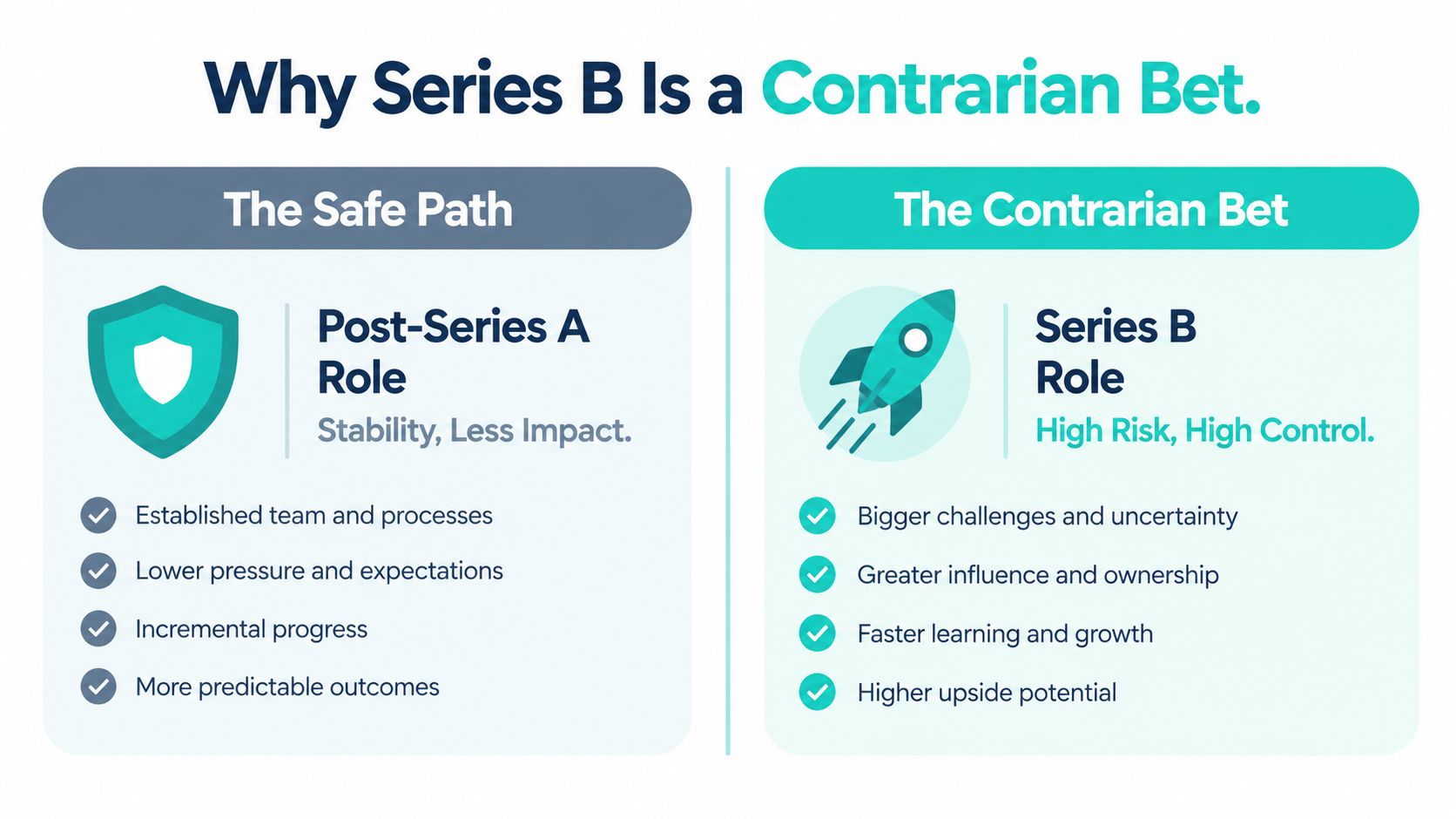
The popular advice is simple: a Series B startup is safer than an early-stage company because it has raised more money. That advice is incomplete. Series B startup jobs are risk-adjusted bets, not discounted versions of big-tech employment. The company has shipped, found some commercial traction, and earned another institutional round, but it still has to prove that its sales, product, and operating model can scale.
That tension creates the opportunity. You can get meaningful ownership, direct access to executives, and responsibility that would take years to earn at a large corporation. You can also join a company whose next funding milestone depends on aggressive revenue targets, disciplined hiring, and a runway that disappears faster than the press release suggests.
The right approach isn't to ask whether a company is “funded.” Ask whether the funding supports a durable operating plan. The checklist below covers sourcing channels, runway analysis, equity dilution, compensation, and stage-aware interview preparation so you can evaluate the job, not just the brand.
Series B companies can be the best hiring market in technology and one of the most fragile. That contradiction is the point. The company has enough traction to hire specialists, but not enough operating history to make the role predictable. A strong product, respected investors, or a recent funding announcement does not remove execution risk.
The career upside is clear. You can own a meaningful problem, work near founders and executives, and help build a function before its processes harden. The downside is equally direct: your team may be hired against a plan that depends on aggressive growth, successful market expansion, or another financing event. If those assumptions fail, headcount and scope can change quickly. Stripe's overview of startup stages describes this phase as the move from validating product-market fit to scaling a commercially viable business.
Venture-backed companies have historically produced substantially higher employment growth than comparable non-venture-backed firms. One long-term estimate places venture-backed employment growth at approximately 475% over 10 years, though outcomes vary widely by company and sector. The cited venture-capital employment estimate helps explain why growth-stage companies can create roles across engineering, product, sales, customer support, finance, and operations.
Evaluate the job as a risk-adjusted investment. Ask how many months of runway remain, what hiring depends on, whether the next round is required for the plan, and how future dilution could affect your equity. A higher title or larger option grant cannot compensate for a company that must hit an unrealistic target to stay funded.
My rule for candidates: Treat the round announcement as an invitation to investigate, not as proof that the job is safe.
Choose the bet that matches your priorities. A mature employer fits candidates who value predictable progression and lower company risk. Series B fits candidates who want ownership, executive access, and influence over a developing function. Verify runway, hiring assumptions, equity terms, and success measures before accepting.
Series B is the second major institutional venture-capital round after Series A, usually marking a shift from proving demand to repeating a workable business model. The company should be converting early traction into operating systems, clearer ownership, and more predictable execution. For a neutral explanation of startup stages, see Stripe's explanation of startup financing.
The funding typically supports new markets, expanded operations, sales and marketing, improved unit economics, and faster product delivery. Your experience changes with that growth. The company may still feel founder-led, yet engineering, product, sales, customer success, finance, and operations should have clearer responsibilities.
Series A teams are proving the playbook. Series B teams are repeating it under heavier demands. Series C teams are usually scaling a model with stronger commercial and organizational validation. In practice, Series B employers want people who can build systems while priorities, processes, and team boundaries are still changing.
A company can announce a Series B and still operate with weak planning or excessive founder dependence. Inspect the operating evidence before treating the round as a positive signal:
The hiring brief often reveals the actual stage. A company may need its first senior sales leader, a formal product-management function, or infrastructure that can support rising customer demand. That differs from joining a business where every department, manager, and process already exists.
Choose the role that matches the operating problem you know how to solve. A candidate who has built a team may fit a first-function leadership hire. Someone who has scaled systems may be better suited to infrastructure, operations, or revenue processes. The title matters less than whether the company has a problem your experience can address.
| Dimension | Series A | Series B | Series C |
|---|---|---|---|
| Primary challenge | Prove the commercial playbook | Repeat and scale the playbook | Expand a more established model |
| Typical hiring need | Foundational builders | Functional owners and scale operators | Specialists, managers, and organizational leaders |
| Candidate experience | High ambiguity | Ambiguity with emerging structure | More process and narrower ownership |
| Main diligence question | Is there real product-market fit? | Can this company scale efficiently? | Can growth continue at larger organizational complexity? |
A recent Carta-based report cited in this Series B startup funding overview placed the median U.S. Series B round at $29.4 million in the third quarter of 2025, with a median pre-money valuation of $118.9 million. That figure does not establish job security. Examine burn, planned headcount, hiring priorities, and the assumptions behind the next financing before you accept the offer.
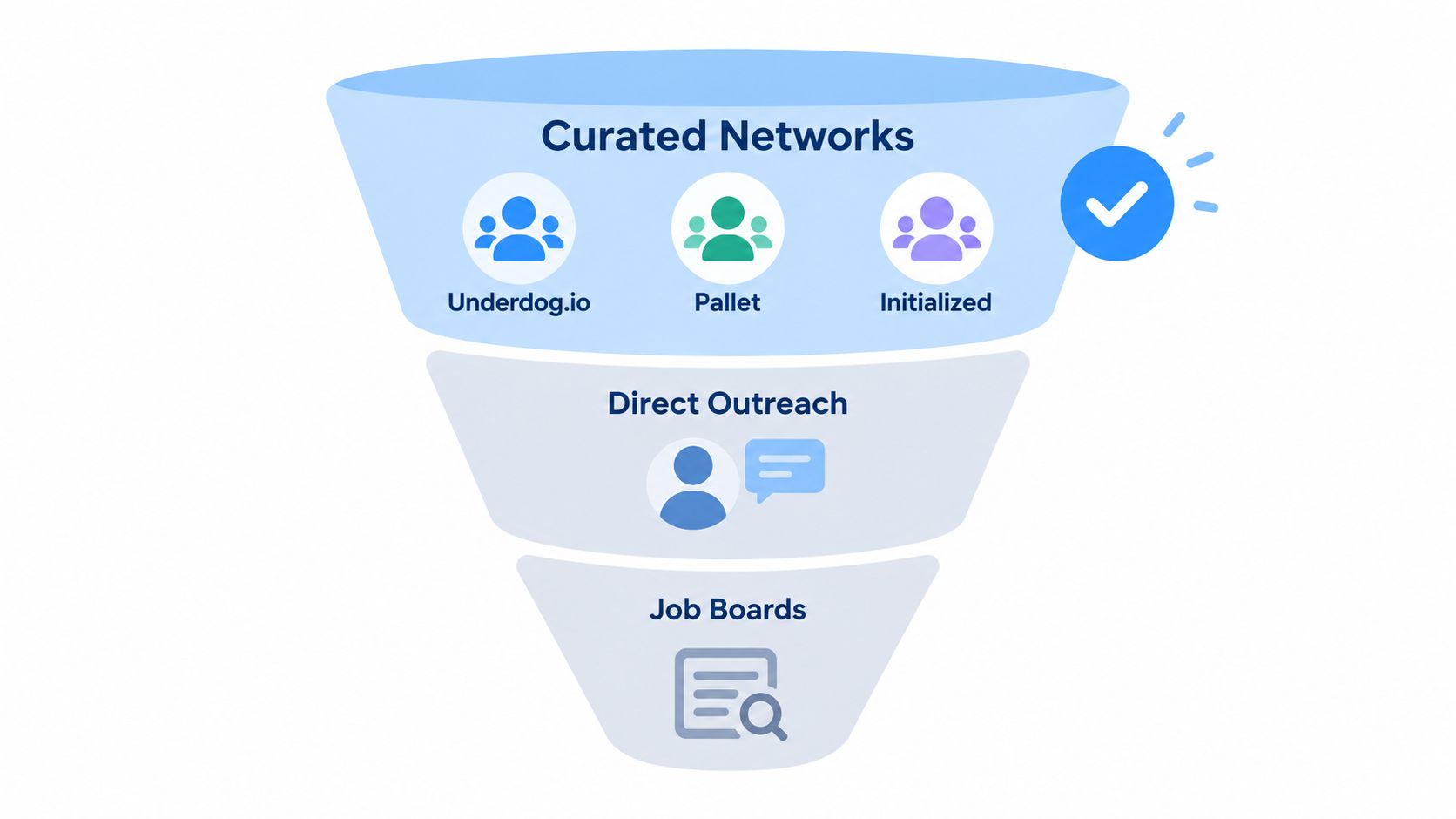
Broad job boards create activity, not necessarily access. For Series B startup jobs, your highest-probability path is a sourcing stack that puts you in front of people who understand startup hiring and can match your background to a specific operating need.
Start with curated marketplaces built around startup talent, including Pallet, Initialized's talent network, and comparable vetted communities. Use Wellfound for targeted discovery, then use LinkedIn Recruiter InMail selectively. Curated channels generally provide more context about stage and fit. LinkedIn offers reach, but it becomes a volume game quickly, especially when your profile doesn't make your target role obvious.
Underdog.io is one option in that stack. It uses a single candidate profile to connect job seekers with vetted startups and high-growth technology companies, including roles across engineering, product, data, design, and related functions. You can also review how startups recruit candidates before deciding how much of your search should rely on direct applications versus introductions.
Your profile should answer three questions immediately: what role you want, what scale you've handled, and what evidence proves it.
For commercial hiring, a specialized resource such as Best place to hire SDRs can also help you understand how companies evaluate sales talent and role scope. The same principle applies to technical candidates: make the match specific instead of presenting yourself as available for anything.
A useful cold message is short and company-specific:
“I saw your recent round and the launch of [product or feature]. I've worked on [relevant problem], where I owned [specific responsibility] and delivered [your verified result]. I'm exploring Series B roles where I can help with [their visible challenge]. Is that part of your current hiring plan?”
Don't praise the company. Reference a public signal, connect it to one relevant piece of your experience, and ask a focused question. That gives the recruiter or hiring manager a reason to reply.
A funding announcement tells you how much capital entered the company. It doesn't tell you how much remains, how quickly the company spends it, or whether the hiring plan assumes a growth rate the business hasn't achieved.
Start with public evidence. Read the financing announcement, inspect the company's current employee footprint on LinkedIn, review recent leadership changes, and compare product launches with competitor momentum. Crunchbase can help establish financing history, but you should treat every public database as a starting point rather than a complete financial record.
Ask for cash remaining, monthly net burn, planned hires, and the expected runway after those hires. The simple calculation is:
Runway in months = cash available ÷ monthly net burn
Gross burn describes total monthly spending. Net burn subtracts revenue from that spending. Net burn is more useful for a candidate because it reflects how much cash the business consumes.
A company can raise a large round and still have a weak position if it carries expensive infrastructure, an oversized sales organization, or concentrated customer revenue. The company should be able to explain how the hiring plan fits the burn model and what operational milestone the next financing depends on.
The candidate-facing framework in this guide to evaluating a Series B startup is especially relevant because funding can create opportunity and risk at the same time. At least 127,000 workers at U.S.-based technology companies were laid off in 2025, while Handshake job postings declined 15% year over year and applications per job increased 30%, according to the cited data. Those figures don't predict your target company's outcome, but they make diligence more important.
Ask whether the company expects to refresh its employee option pool, how many hires the current plan supports, and when the latest 409A valuation was set. The 409A helps establish the strike price for new options, but it doesn't tell you what your equity will ultimately be worth.
Look for founder turnover, flat or unclear revenue growth, a down-round history, and a cap table dominated by a small number of investors or customers. None of these signals automatically disqualifies a company. Together, they can indicate that the role carries more financing risk than the recruiter is acknowledging.
| Signal | Healthy range | Red flag |
|---|---|---|
| Runway | Clearly explained after planned hiring | Leaders won't provide an approximate view |
| Burn | Tied to a specific operating plan | Hiring is disconnected from milestones |
| Revenue quality | Repeatable demand and clear customer profile | Growth depends on a few uncertain accounts |
| Leadership | Stable ownership of the function | Repeated executive departures |
| Equity pool | Headcount plan and refresh approach are documented | Grant size is discussed without dilution context |
Use a focused pre-application review. Read employee feedback on Glassdoor, inspect the latest product releases, search for executive departures, and check whether competitors are gaining momentum. If you're building a broader target list, top job searching companies in 2026 can provide another source of market context, but your decision should rest on company-specific evidence.
Series B interviews should test whether you can create order without waiting for a perfect playbook. A polished resume gets you into the process. Ownership, judgment, and execution under ambiguity determine whether you get the offer.
The process should be stage-gated. A strong employer defines a scorecard with measurable outcomes for the first 6 to 12 months, sources for comparable scale, uses a structured screen and work sample, calibrates the panel, and completes references before the offer. The technical hiring guidance in this time-to-hire benchmark places engineering searches at roughly 35 to 55 days overall and recommends keeping an individual-contributor process within approximately 4 to 8 weeks.
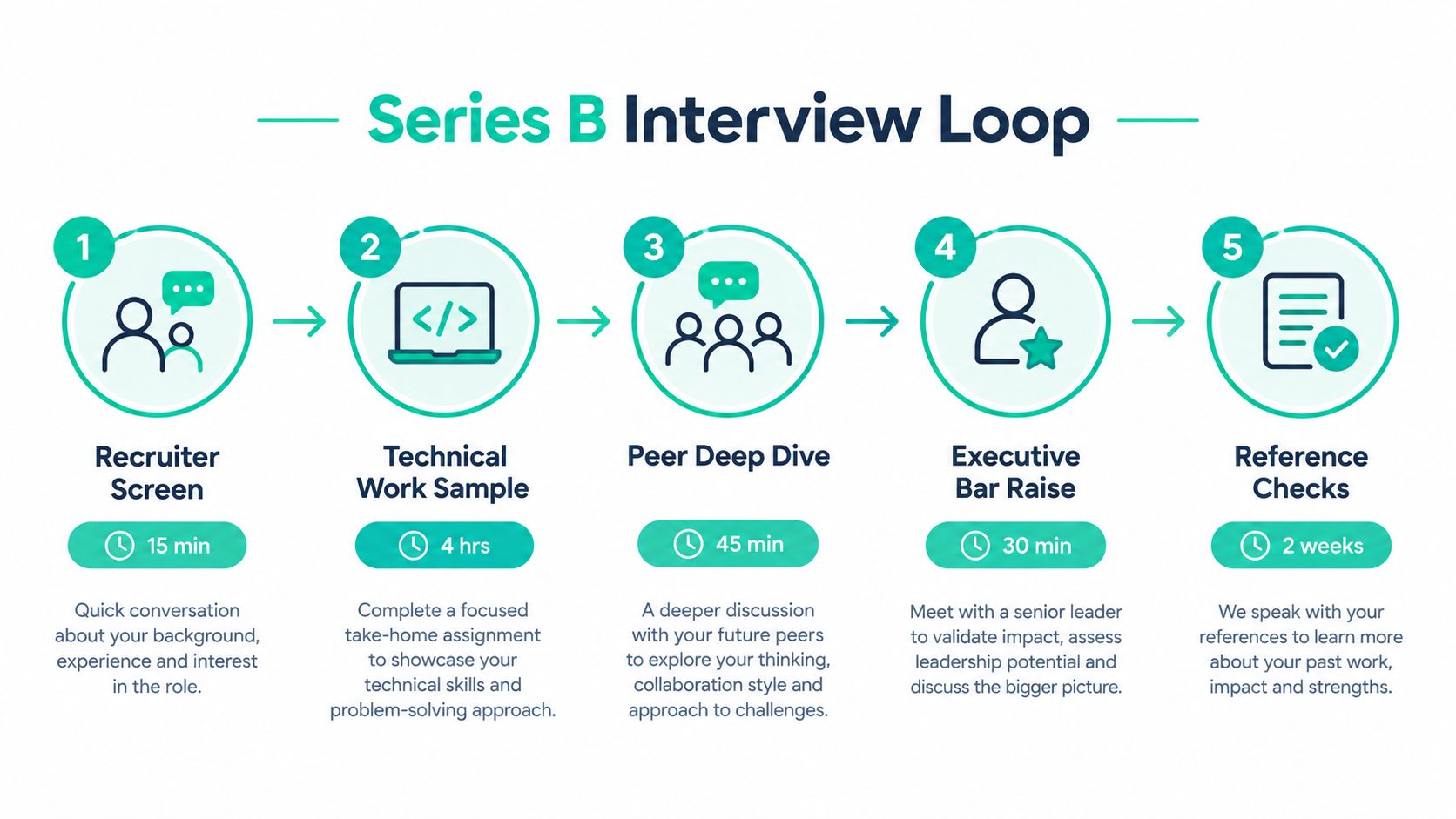
The recruiter screen tests motivation, scope, compensation alignment, and communication. Have a concise explanation for why this stage fits your next move, and ask what business problem the hire will solve.
The hiring-manager conversation tests ownership. Bring examples where you made a decision with incomplete information, changed direction after customer or production evidence, and delivered across functions without waiting for formal authority.
For a technical work sample, explain tradeoffs rather than presenting an idealized answer. In a 60-minute system-design discussion, spend the opening clarifying requirements, identify the failure modes, describe a workable architecture, and reserve time for scale, observability, and operational ownership. PM candidates should treat a product-sense prompt similarly: define the user, identify the highest-cost problem, state the decision criteria, and explain how they would validate the choice.
The peer or executive round tests whether your working style fits the company's operating reality. Don't perform “culture fit.” Ask how disagreements are resolved, who owns final decisions, and what happens when a launch misses its target.
References deserve proactive preparation. Ask former managers whether they'd recommend you for this specific scope, brief them on the role, and tell them which ownership and collaboration examples matter. One reported benchmark found that 58% of startups had experienced a bad VP-level hire, while only 34% had checked references beforehand, which is a strong argument for taking references seriously at senior levels.
A founder should be involved in a pivotal hire. A founder shouldn't have unlimited veto power over every interview decision.
Don't negotiate from the headline grant. Negotiate from the complete offer and the job's expected scope. A Series B package commonly combines base salary with stock options, while signing bonuses are less typical and equity may remain illiquid until an acquisition, IPO, or another liquidity event. This Series B salary negotiation guide explains the core questions around option count, fully diluted ownership, strike price, latest 409A valuation, post-termination exercise window, and expected liquidity path.
Read the offer line by line. Separate base salary, bonus eligibility, signing payment, benefits, refresh policy, and equity grant type. For options, confirm whether they're ISOs or NSOs, the number of shares, the fully diluted percentage, the strike price, vesting, cliff, exercise window, and what happens if the company is acquired.
A common option structure includes a 12-month cliff followed by monthly vesting over the remaining 36 months, but the offer letter controls. Ask for the actual documents rather than relying on a verbal description.
Build a spreadsheet with your grant, current fully diluted shares, strike price, vesting schedule, and possible dilution from future rounds. Model at least three outcomes: no liquidity event, a modest acquisition, and a strong IPO. Don't assign an exit value unless the company provides a defensible basis for it.
| Scenario | Pre-tax value | Assumed dilution | Notes |
|---|---|---|---|
| No liquidity event | No realized value | Future dilution may still occur | Options can remain illiquid or expire after departure |
| Acquisition | Depends on sale price and preferences | Ownership may decline before the sale | Confirm liquidation preferences and payout order |
| IPO | Depends on public valuation and lockups | Later rounds may reduce ownership | Confirm exercise cost, tax treatment, and sale restrictions |
A smaller grant can be rational if the company has stronger operating evidence, a clearer liquidity path, and a role with meaningful scope. It can also be underpayment disguised as maturity. Never compare percentages without comparing the fully diluted share count, strike price, preferences, and expected dilution.
For negotiation language, anchor to the scope: “This role owns the initial platform reliability program and the hiring plan for the function. Based on that responsibility, I'd like to discuss a higher level or an equity adjustment.” If the company can't move on base, ask about a larger grant, an early refresh review, a sign-on payment, or a written level review tied to specific outcomes. Candidates who want more phrasing options can review these expert counter offer templates, then adapt the language to their actual position.
You can also use this guide to negotiating startup equity to prepare questions before the final call. Confirm every agreed change in writing before signing. Verbal promises about title, refreshers, promotion timing, or future equity aren't part of your compensation until the company documents them.
A good search is a controlled experiment. Track the companies, messages, replies, interview outcomes, and diligence findings instead of applying randomly and judging the market by how discouraged you feel.
Inventory your strongest skills and identify the operating problems you solve. Build a target list of 15 to 25 Series B companies, then rewrite your resume, LinkedIn headline, and curated-marketplace profile around the three problems each company is publicly trying to solve.
Your profile should make your desired role obvious. Your resume should show ownership at comparable scale. Your target list should include a reason for every company, not just a recognizable name.
Deploy the sourcing stack:
Don't optimize for application count. Optimize for useful conversations with companies whose needs match your evidence.
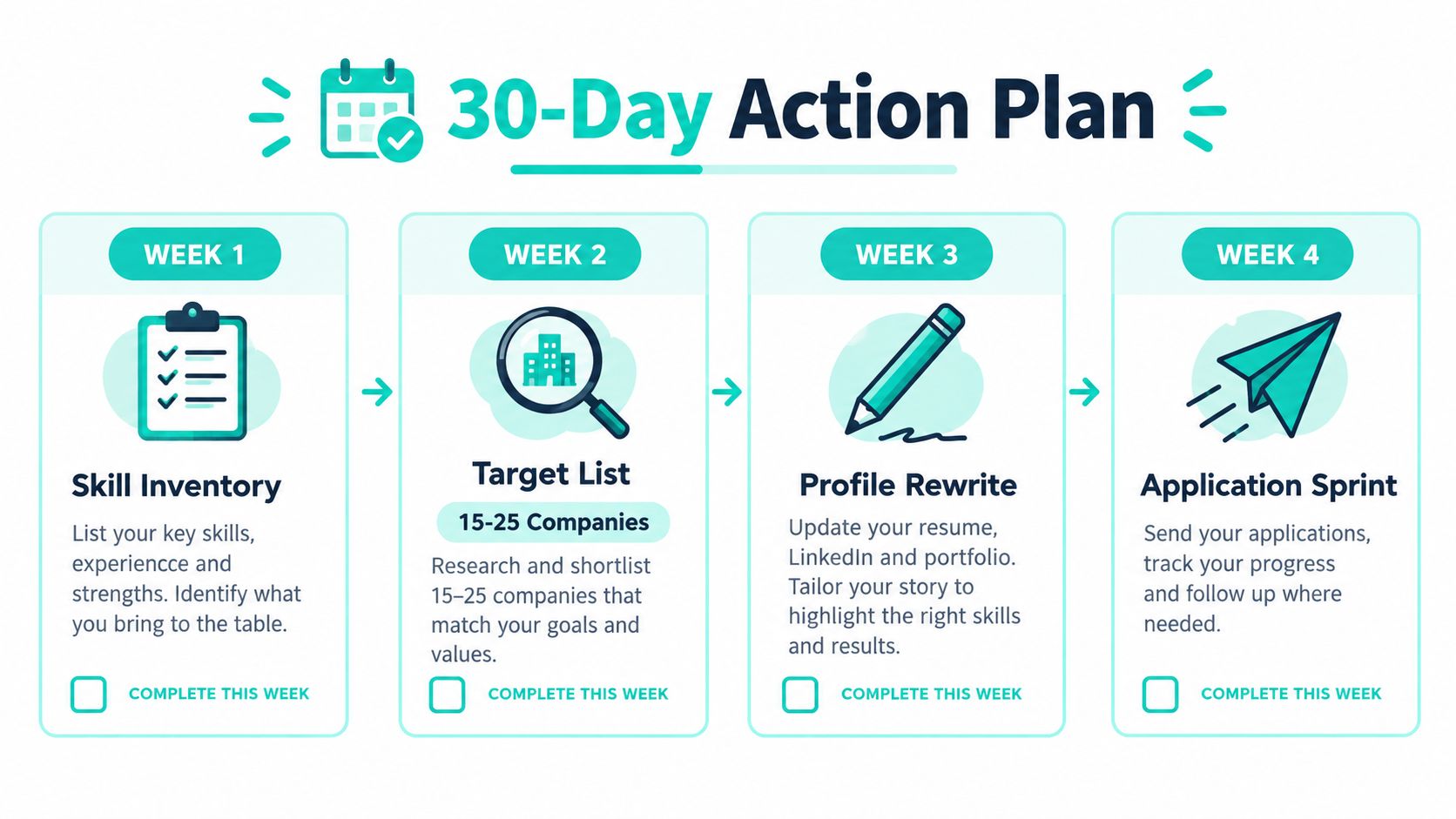
Run diligence on every company that replies. Calculate runway from cash and net burn, inspect the hiring plan, ask how the option pool supports planned headcount, and model dilution-adjusted equity. Reject any role that fails your 18-month survival test unless you have a deliberate reason to accept the financing risk. The broader planning guidance recommends building an 18 to 24-month headcount plan and targeting 24 months of runway at the expected post-raise burn rate, with a 15% to 20% execution buffer. The cited startup equity planning framework provides the underlying reference points.
Prepare against the scorecard, not against generic interview questions. Rehearse ownership examples, complete the work sample with explicit tradeoffs, and prepare questions for each interviewer. After the final round, send a written thank-you that references the role's actual scorecard domains.
Before accepting, ask the hiring manager:
Ask the recruiter:
Ask the CEO:
A Series B job should give you enough information to make a conscious bet. If the company won't answer basic questions about scope, runway, or equity, the lack of transparency is itself a decision signal.
Underdog.io offers a curated marketplace where candidates create one profile and can be introduced to vetted startups and high-growth technology companies, including Series B opportunities. Visit Underdog.io to put your profile in front of relevant hiring teams while you apply the runway, equity, and scope tests that separate a strong startup bet from a fragile one.