You've got the offer. The recruiter is excited, the salary looks respectable, and the equity line says something like “50,000 options.” Then you ask what percentage that represents and the conversation suddenly gets vague. That's where many candidates either accept too quickly or spend all their effort fighting over a tiny percentage increase without checking whether the grant can ever become real money.
The right way to negotiate startup equity is to treat it as a package. You're evaluating ownership, dilution, share type, exercise cost, vesting, acceleration, taxes, and liquidity together. The percentage matters, but it's only the headline. The terms underneath determine whether you can keep, exercise, and benefit from the equity you've earned.
A senior engineer once pushed hard to move an offer from 0.10% to 0.15%. She considered the negotiation a success until she reviewed the complete option agreement. The grant came with a 90-day post-termination exercise window, single-trigger acceleration that applied only after two years, and no clear refresher policy. She had won the visible argument and lost sight of the package.
That's the core mistake. Candidates treat equity as a single percentage instead of a set of interlocking terms. A larger grant can be less valuable if you can't afford to exercise it, lose unvested shares in an acquisition, or forfeit vested options shortly after leaving.
Use four questions to evaluate every offer:
The first question covers ownership percentage, fully diluted shares, future financing, employee-pool expansion, and refresh grants. The second covers options versus other equity, exercise price, current fair market value, and whether early exercise is available. The third covers the vesting schedule, cliff, and single-trigger or double-trigger protection. The fourth covers the post-termination exercise window, tender offers, and other opportunities to sell.
Practical rule: Negotiate the terms that control whether the grant survives, not just the number printed beside “equity.”
Cash compensation still matters. Independent guidance recommends securing enough base salary to cover your living expenses before using equity as the upside lever, while vesting, stock type, signing bonus, and benefits can all form part of the negotiation package. CNBC's startup equity negotiation guidance supports that package-first approach.
The percentage is usually the loudest number in the offer call. It's rarely the only number worth negotiating, and it's often not the term that gives you the strongest protection.
A raw share count tells you almost nothing. Fully diluted ownership means your grant is measured against the company's fully diluted capital, which can include founder stock, the employee option pool, preferred shares, granted and unvested options, unissued pool shares, and convertible instruments such as notes with a discount or valuation cap. The percentage is calculated by dividing your shares by that fully diluted total, not by the smaller number a company may casually call “shares outstanding.”
Consider two offers that both say 0.50%. A grant in a company with 10 million shares represents a different number of options than 0.50% in a company with 25 million shares. If the second company is also preparing a 20% option-pool expansion, the candidate's effective ownership can be lower after the pool is created, even though the offer letter still displays the same headline percentage.
Refresh grants and promotions create another wrinkle. Your share count doesn't automatically increase when the company issues new shares to investors or reserves more shares for employees. Your percentage can shrink while your number of options stays unchanged.
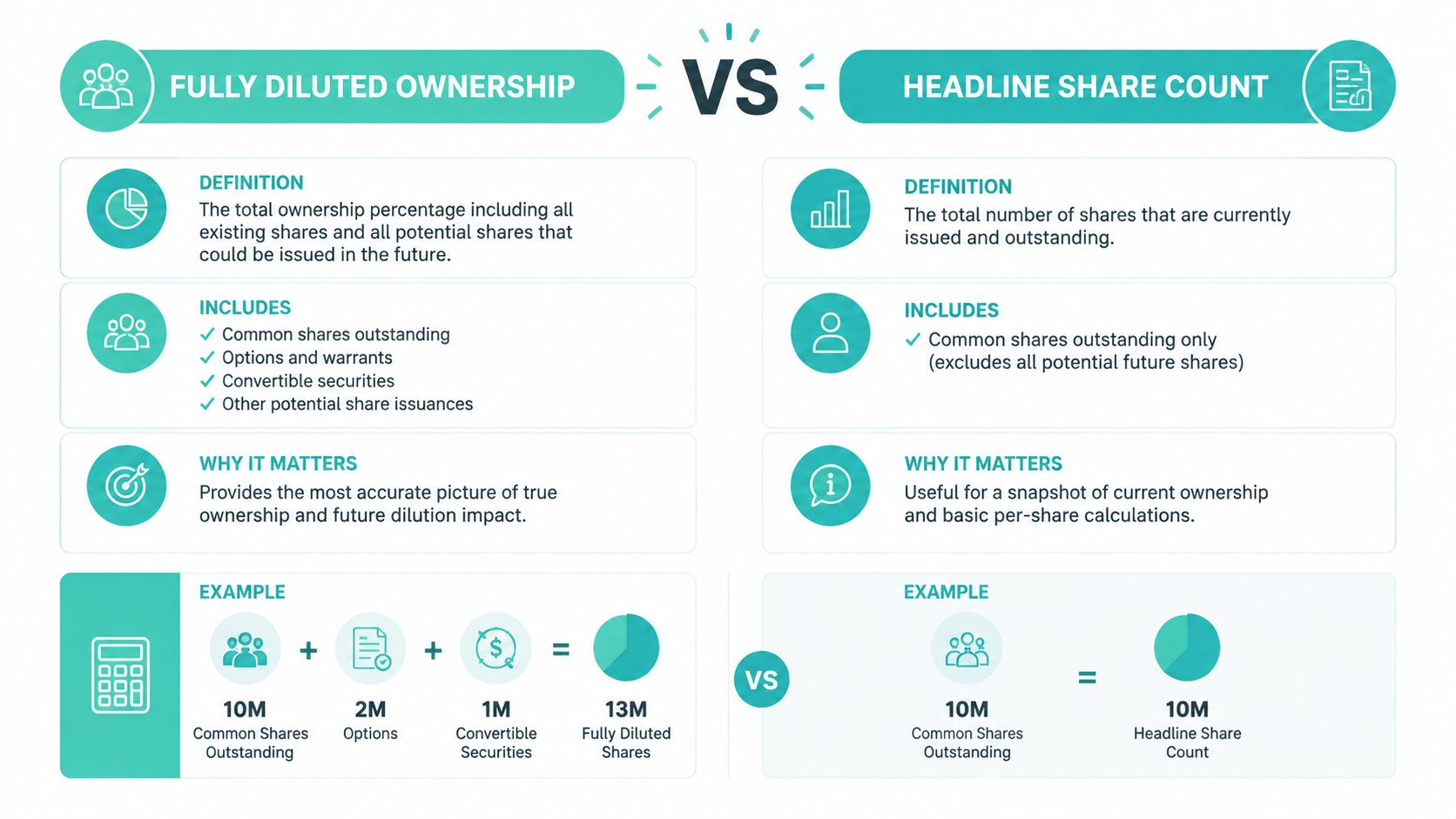
Request these figures before you counter:
A useful starting calculation is:
Option grant ÷ fully diluted shares = ownership percentage
For more detailed scenario planning, use an equity dilution calculator to model funding rounds, pool changes, and refresh grants. Don't treat its output as a promise. Treat it as a way to identify which assumptions you need the company to confirm.
Watch for phrases such as “pre-money basis” and “fully diluted inclusive of pool.” They can change the denominator underneath an otherwise attractive percentage. Ask the recruiter to put the calculation in writing, including whether the number reflects the current capitalization table or a post-financing structure.
The right counter depends on stage, role, hiring order, dilution, and influence. A senior engineer joining as an early employee has a different negotiation position from employee number 150, even if both roles carry the same title.
Historical benchmarks show how sharply grants can change by hiring order. SaaStr's analysis of 50,000 startups reports a median grant of 1.50% for hire number one and 0.85% for hire number two, with much smaller ownership ranges for later hires. SaaStr's startup equity analysis also sits alongside Equitybee data showing median new-hire grant value rising from about $18,000 in 2019 to about $57,000 in 2022, then remaining near $60,000 in 2024 and 2025. Equitybee's stage benchmarks put seed and Series A grants around $20,000, compared with about $62,000 at Series D and later.
Those figures are grant-value benchmarks, not automatic ownership targets. Carta's compensation data also found that average equity grants fell 26% from November 2022 to May 2023, while salaries held steady. That shift makes current fully diluted context more important than an old compensation anecdote.
For a senior software engineer at a Series A company, a counter in the 0.10% to 0.40% range can be reasonable depending on scope, hiring order, and company traction. Engineering managers and senior product managers often have stronger scope-based arguments for a range closer to 0.15% to 0.50%, particularly when they're expected to build teams, define strategy, or own a major product area.
The following table is a negotiation framework, not a universal entitlement:
| Stage | Senior Engineer | Engineering Manager | Senior PM |
|---|---|---|---|
| Seed | 0.50% to 2.00% | 0.50% to 2.00% | 0.25% to 1.00% |
| Series A | 0.10% to 0.40% | 0.15% to 0.50% | 0.15% to 0.50% |
| Series B | 0.10% to 0.30% | 0.10% to 0.35% | 0.10% to 0.30% |
| Series C | 0.05% to 0.20% | 0.10% to 0.25% | 0.05% to 0.20% |
The early-hire range of 0.5% to 2% for key employees and the higher ranges sometimes shown for senior engineers among the first 10 employees come from early-stage benchmark guidance, where role and proximity to the founding team materially affect negotiating position. Early-employee equity benchmarks are useful for context, but don't apply them mechanically to a later-stage hire.
Ask the recruiter for the current fully diluted cap table and the post-money pool size before naming your counter percentage. You'll sound informed because you're negotiating ownership, not a decorative share count. For broader role and stage comparisons, review startup compensation benchmarks.
Treat the offer as one compensation bucket, then decide how much should arrive as reliable cash and how much should remain a high-risk upside bet. Base salary protects your life if the company fails. Equity offers upside if the company grows. A signing bonus often gives the startup a practical way to close a gap without permanently changing salary bands.
Take a Series A product manager offer with a $170,000 base salary, a $15,000 signing bonus, and 0.15% equity at a $15 million post-money valuation. The equity's simple headline value is $22,500, calculated as 0.15% of $15 million, but that isn't its expected cash value. It ignores dilution, preferences, exercise cost, taxes, timing, and the possibility that the company returns nothing.
Because the brief provides no verified exit valuations for this scenario, don't manufacture downside, base, or bull outcomes. Instead, build the table with your own selected assumptions and label them clearly as assumptions.
| Scenario | Base Salary | Signing Bonus | Equity Grant | Downside NPV | Base NPV | Bull NPV |
|---|---|---|---|---|---|---|
| Original offer | $170,000 | $15,000 | 0.15% | Your downside assumption | Your base assumption | Your bull assumption |
| Trade salary for equity | $160,000 | $15,000 | 0.20% | Recalculate | Recalculate | Recalculate |
| Ask for cash instead | $170,000 | $25,000 | 0.15% | Recalculate | Recalculate | Recalculate |
Use this formula:
Equity value = ownership percentage × exit equity value − exercise cost − taxes
Then apply a probability and timing discount if you're calculating net present value. The point isn't false precision. The point is to see whether giving up $10,000 of salary for 0.05% more equity improves your actual risk-adjusted position, or makes the offer harder to live on.
Cash-heavy trades protect you in failure. Equity-heavy trades maximize upside. The signing bonus is often the easiest lever for a startup to pull.
If the company says salary is fixed, ask for the bonus. If the grant is fixed, ask for the exercise window, acceleration, or an earlier review tied to a refresh grant. Don't trade cash for equity until you can afford the cash reduction without relying on a future exit.
The best negotiation happens after the company has decided it wants you and before you accept. Don't negotiate during the technical loop. You don't yet have enough bargaining power, and you're distracting from the decision the company is making about your fit.
Prepare a one-page target sheet. Include the salary band the recruiter shared, recent compensation data from sources such as Pave or Levels.fyi, the company's latest 409A fair market value, the preferred share price if the company shares it, and your target package. Separate facts from assumptions so you don't present an estimated exit value as if it were guaranteed.
When the recruiter says, “We'd like to make you an offer,” don't immediately counter. Say:
“Thank you, I'm excited about the opportunity. Can you walk me through each component of the package?”
Take notes. Confirm base, bonus, equity type, number of shares, percentage basis, vesting, exercise price, benefits, and the timing of the formal board approval.
If the grant is described as fixed, pivot instead of arguing:
“I understand the grant band is standardized. Could we look at the other terms, such as the post-termination exercise window, acceleration, early exercise, or a signing bonus?”
For a top-up or refresher:
“If the initial grant can't move, would you consider a written refresh review after my first performance cycle, with the timing and criteria documented?”
For a salary trade:
“If base salary has limited flexibility, I'd be open to discussing additional equity. If the equity band is fixed, I'd prefer to explore a signing bonus.”
For runway and fundraising:
“Could the founder walk me through current runway, the company's financing plans, and what milestones need to be reached before the next round?”
The recruiter may not control the cap table, acceleration language, or funding strategy. Ask them to involve the hiring manager when the request concerns role scope, replacement difficulty, or founder-level risk. Keep the tone positive, specific, and easy to approve.
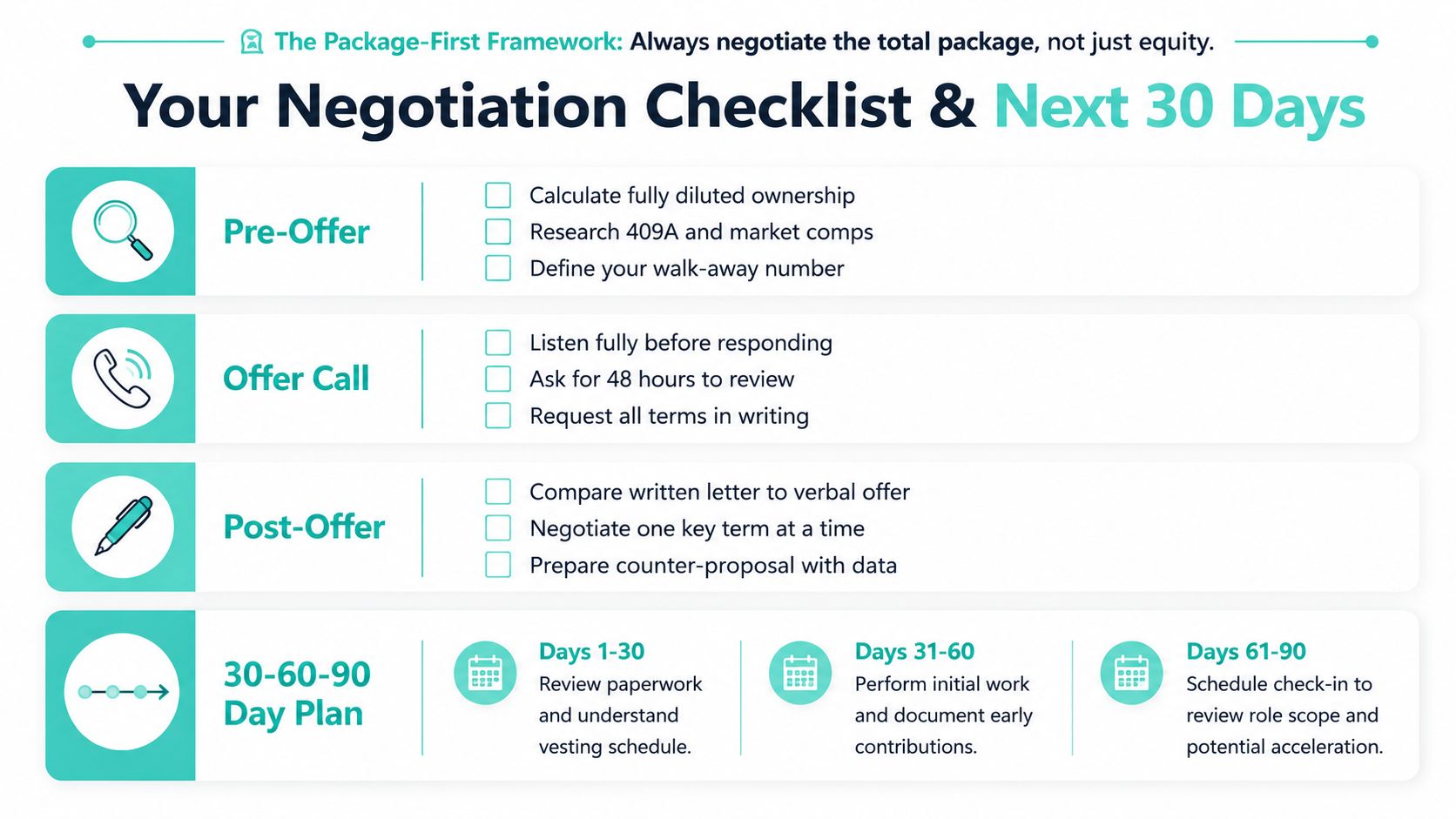
Ask for the written offer, then send a concise recap within 24 hours. Request at least 48 hours to review the documents if the company expects an immediate answer. Compare the letter with the call, and treat any missing promise as nonexistent until it's documented.
A smaller grant with stronger protections can be worth more than a larger grant with restrictive terms. Start by confirming the vesting schedule. The common structure is four-year vesting with a one-year cliff: nothing vests during the first 12 months, 25% vests at the one-year mark, and the remaining 75% vests monthly over the next 36 months. This vesting schedule guide and this explanation of how vesting schedules work cover the standard arrangement.
That structure is a baseline, not a rule. A three-year schedule, six-month cliff, or monthly vesting from the start changes how quickly you earn ownership. Challenge a back-loaded schedule or an unusually long vesting period, and ask the company to explain the business reason in writing.
Single-trigger acceleration vests some or all unvested equity when the company is acquired. Double-trigger acceleration requires a second event, typically an acquisition followed by termination without cause or a material reduction in role.
Ask for double-trigger protection first. It addresses the practical risk that a buyer eliminates your job after the transaction. Confirm the percentage that accelerates and the period covered. Use a precise request:
“I'd like partial double-trigger acceleration covering 50% of my unvested grant if the company is acquired and my role is eliminated.”
Single-trigger language can still matter for a senior hire joining shortly before a possible transaction, although a buyer may resist it because it can affect retention. Investor quality and financing history also belong in your due diligence. Use a resource to find top early-stage VCs and examine who has backed the company.
A 90-day exercise window can force you to pay to exercise quickly or lose vested options. Ask whether the company will extend it to 7 years. A longer window may affect ISO tax treatment after the original period, so have a tax professional review the result before you agree.
Ask whether early exercise is available:
“Please include the right to early-exercise and confirm that I can file an 83(b) election within 30 days.”
An 83(b) election has a strict 30-day filing window from the grant or exercise date. It lets you pay tax based on current fair market value instead of waiting until vesting, when the value may be higher. Review the 83(b) election rules before exercising, and get tax advice because early exercise can create financial and AMT exposure.
Refusal to disclose fully diluted shares, document equity promises, or explain unusual vesting is a serious warning. If the company will not provide enough information to assess the risk, stop negotiating and walk away.
The package-first framework is simple: negotiate the total economic deal, not just the equity percentage.
For tax mechanics specific to non-qualified options, keep a current NQSO tax guide for 2026 available, but don't rely on a general guide for a personal filing decision.
Days 1 to 30: Spend one hour building your target sheet. Add the offer terms, fully diluted denominator, stage benchmarks, cash needs, exercise price, and walk-away terms. Ask one trusted advisor to challenge your assumptions.
Days 31 to 60: During offer week, rehearse your opening script and prepare one written counter. After joining, document your responsibilities, early wins, and any material increase in role scope.
Days 61 to 90: Review the signed documents, confirm whether an 83(b) filing applies, and update your personal net-worth tracker with the grant, vesting dates, exercise cost, and expiration rules. Schedule a written check-in about scope and future equity review.
Book a compensation or tax advisor before signing if the grant is large, early-exercisable, or difficult to compare. One focused review can expose a denominator problem, an exercise trap, or an acceleration clause that changes the decision.
Underdog.io connects vetted tech candidates with startups and high-growth technology companies, giving you another way to compare opportunities before you negotiate an equity package. Create a profile on Underdog.io, review relevant roles, and use competing opportunities to negotiate from a stronger position.