A founder signs a Series B term sheet on Tuesday afternoon and expects the celebration to last at least a week. By Wednesday, the finance dashboard has new reporting requirements, the board wants a tighter hiring plan, and every department lead is being asked what their team will deliver before the next financing milestone.
Across town, a senior engineer is holding an offer from a 90-person company that barely resembles the business described in its interview materials. Six months ago, the team operated through Slack threads and founder decisions. Now it needs managers, operating reviews, clearer ownership, and a product roadmap that can survive scrutiny from enterprise customers.
That's the defining tension of a Series B startup. The round supplies capital, but it also changes the organization's expectations, decision-making, hiring profile, and tolerance for operational ambiguity. This guide examines the stage as an organizational transition, with practical funding data, KPI thresholds, hiring trade-offs, compensation ranges, and preparation advice for founders and candidates.
The wire clears, and the company's internal rhythm changes before the money has been allocated. The founder who once approved every product decision now has a board calendar, monthly reporting, executive hiring conversations, and department leaders asking for priorities that can survive a larger team. The company hasn't necessarily become bureaucratic, but informal coordination no longer covers every gap.
The candidate experiences the shift from the other side. An offer from a Series B company can look attractive because the business has traction, fresh capital, and room to shape important systems. It can also hide unresolved questions. Who owns architecture? Does the VP of Sales have authority over hiring? Is the product roadmap stable enough for a new PM to execute against? Will the company reward judgment, or reward people who work longest?
Practical rule: Treat the Series B announcement as the start of a new operating model, not the end of the fundraising process.
Before the round, a startup can often compensate for missing structure with proximity. Engineers sit near the founders, sales hears product objections directly, and a small group can resolve disagreements in real time. After the round, that same approach produces bottlenecks. Leaders must define decision rights, managers must communicate priorities, and teams need documentation that lets work continue without constant executive intervention.
The word “leadership” also starts appearing in hiring conversations. A senior individual contributor may be asked to mentor, interview, or own a cross-functional initiative. A first-time manager may discover that the job involves performance feedback, prioritization, and conflict resolution rather than being the strongest person on the team.
Crunchbase's review of a decade of U.S. data found that annual Series B deal counts generally clustered between 600 and 900 deals, outside the 2021 to 2022 market peak, while roughly one dollar out of every six or seven venture dollars went to Series B in most years (Crunchbase historical Series B review). That consistency explains why the stage functions as a financing bridge from product-market fit to scale.
The same source reports that the 2021 U.S. funding peak at this stage reached $347 billion, while the following year was a little more than half that level (Crunchbase historical Series B review). The lesson isn't that every company can expect a giant round. It's that Series B companies operate inside broader market cycles while being expected to build a more durable organization.
A founder needs to know what the capital can accomplish. A candidate needs to know whether the company has a credible plan for converting capital into product advantage, revenue, and a healthier operating system. The sections that follow address those decisions directly.
A Series B startup has moved beyond the earliest product-market-fit search and raised a priced financing round to support repeatable growth. Investors expect more than a promising product. They want evidence that customers buy, stay engaged, and can be reached through a sales or distribution process the company can repeat.
At this stage, the organization itself becomes part of the investment case. The product, sales process, budget, leadership team, and performance reporting must hold up as the company adds customers, employees, and operating complexity. A founder-led workaround that succeeded early may become a constraint once several departments depend on the same decision.
Seed investors generally fund discovery. The company may still be testing its market, product, pricing, and founding team's ability to execute. Series A investors usually want stronger evidence of product-market fit and a credible route to repeatable sales. Series B investors ask whether those systems can scale without costs, churn, or execution risk growing faster than revenue.
The check size is visible, but it does not define the stage. Market guides commonly place Series B fundraising around $15 million to $60 million, with post-money valuations often cited around $100 million to $300 million and dilution frequently described in the 15% to 25% range (Series B funding-stage guidance). Those figures vary by sector, market conditions, and investor demand.
The lead investor often changes as well. A Series B round is more likely to involve a growth-stage venture fund that expects department-level accountability, stronger financial controls, and a plan for the next financing milestone. The company should have a real org chart, a repeatable sales motion, retention data, and leaders who can own outcomes without routing every decision through the founders.
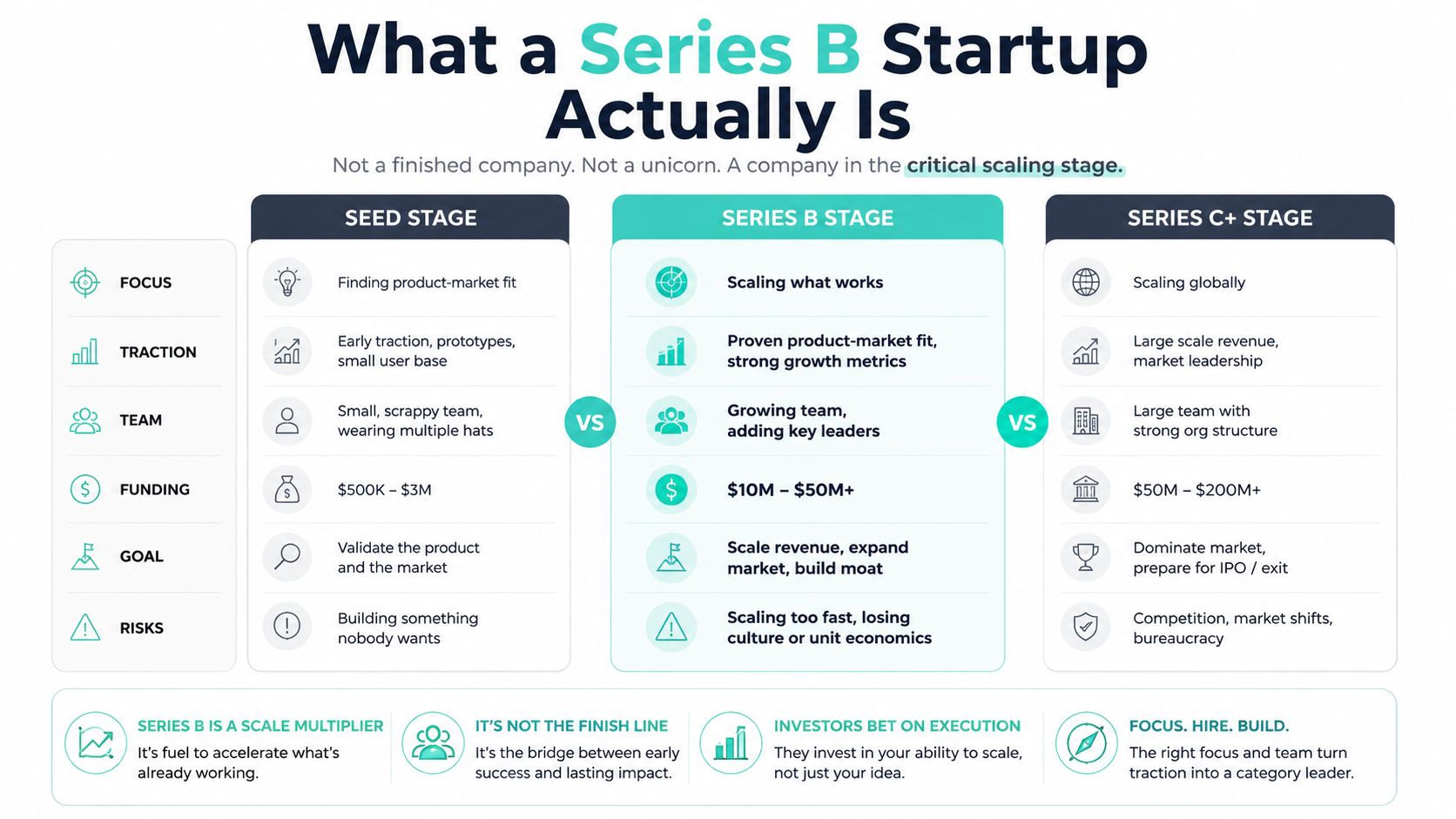
The clearest definition is a company facing a new set of operating tests:
Those questions shape hiring. Founders need managers who can set priorities, make decisions, and build processes before every function becomes overloaded. Candidates should ask how much authority comes with a role, which systems already exist, and whether the company is hiring for planned growth or repairing an unresolved gap. Founders building the people infrastructure around these needs may find PEO Metrics guidance for founders useful when evaluating payroll, benefits, compliance, and people operations for venture-funded growth.
A Series B startup has moved beyond proving that something works. It must now show that the company can make the product, sell it, and make sound decisions repeatedly.
A founder may announce a large Series B while discovering that much of the capital is already spoken for. Existing investors may exercise pro-rata rights, the company may expand its option pool, and the board may reserve cash for a longer operating horizon. Founders, employees, and candidates should focus on the capital available for new priorities, because that amount determines which teams get built and which hires can be approved.
Carta-based reporting for Q3 2025 placed the median U.S. Series B round at $29.4 million, with a median pre-money valuation of $118.9 million and $5.2 billion in total U.S. Series B dollars for the quarter (Carta-based Series B funding data). Quarter-over-quarter deal activity can move in a different direction from valuations. In that report, total dollars fell 26% year over year, while median valuations rose 16%, from $102.8 million to $118.9 million.
A separate view of the market counted 1,576 Series B rounds over the prior 24 months, including 897 rounds in the last 12 months and $75 billion in disclosed capital. It placed the median disclosed round at $30 million, with the middle-half range between $18 million and $55 million. These figures are directional, not a promise for any particular company or sector.
Carta's dilution data places median Series B dilution around 13% to 16.7%, compared with about 20.8% in earlier periods (Carta dilution data). Broader market guidance often discusses 15% to 25%, so founders should model several outcomes instead of treating one percentage as standard.
| Metric | Median | Range | Notes |
|---|---|---|---|
| Series B round size | $29.4M to $30M | $18M to $55M | Recent U.S. and disclosed-market benchmarks |
| Pre-money valuation | $118.9M | Often discussed within a wider market range | Q3 2025 U.S. median |
| Series B dilution | 13% to 16.7% | 15% to 25% in broader guidance | Terms depend on valuation and pool treatment |
| Post-money valuation | Not a single fixed median in the available data | $100M to $300M often cited | Company and sector affect the outcome |
Suppose an employee holds 0.5% before a 15% new issuance. Ignoring other cap-table changes, that stake becomes 0.425% after financing. At 22% dilution, it becomes 0.39%. The percentage declines, while the value of the remaining stake depends on the new valuation, later dilution, liquidation preferences, and whether the business reaches a meaningful exit.
An option pool refresh can reduce founder and employee ownership before the new investor's shares are calculated. Review the capitalization table, not only the term sheet. This startup cap-table guide explains share classes, option pools, and ownership mechanics.
The useful question isn't “How big is the round?” It's “How much new operating capacity remains after dilution, pool expansion, and existing investor participation?”
Founders preparing negotiations can use a founder venture capital playbook to organize fundraising preparation, investor outreach, and round mechanics. The operating model should show net new dollars, hiring commitments, runway assumptions, and the milestones that support the next raise. Those choices affect hiring plans and the roles candidates will inherit.
Series B diligence tests whether growth becomes more efficient as the company expands. Revenue growth gets attention, but investors examine the mechanics beneath it. A company can add customers quickly and still require more capital to maintain its position if acquisition costs rise and retention weakens.
Benchmark guides commonly frame Series B readiness around $5 million to $15 million in ARR, 2.5x to 3x year-over-year growth, net revenue retention around 120% or higher, gross margins near 70%, and CAC payback under 18 months (SaaS startup financial benchmarks). Another 2026 guide lists NRR above 110%, annual revenue growth above 80%, and CAC payback under 12 months as readiness indicators (Series B readiness benchmarks). These are reference points, not admission requirements. Investors will ask how the company's model, market, and sales motion explain the results.
ARR growth shows whether demand is expanding fast enough to support the financing plan. The board will compare new bookings with expansion, contraction, and churn. Fast growth built on a leaky customer base can force the company to spend heavily just to replace lost revenue.
Net revenue retention shows how much growth comes from existing customers. Strong NRR reduces dependence on new-logo acquisition. If it declines, the company must replace more lost revenue before new sales create net expansion. That raises capital needs and can weaken the valuation case for the next round.
Gross margin measures how much revenue remains after delivering the product. Software businesses often target margins near 70%, while marketplace models can be closer to 50% to 60%, depending on their operating structure (SaaS startup financial benchmarks). A marketplace may report impressive transaction volume while retaining too little contribution to support additional growth.
Burn multiple connects spending to incremental recurring revenue. It shows whether each unit of growth is becoming cheaper or more expensive. Investors may tolerate higher burn while the company proves demand, but Series B funding usually brings a stronger expectation that spending will produce durable efficiency.
| KPI | SaaS Target | Marketplace Target | Fintech Target |
|---|---|---|---|
| ARR or recurring revenue growth | Strong, sustained growth | Growth paired with liquidity and take-rate quality | Growth paired with risk and loss controls |
| Net revenue retention | Above 110%, ideally around 120% or higher | Repeat usage and account expansion | Retention with controlled credit or servicing exposure |
| Gross margin | Near 70% | Often 50% to 60% | Model-specific, with losses and servicing included |
| CAC payback | Under 12 to 18 months | Channel and cohort dependent | Must include compliance and servicing costs |
Founders should track CAC payback by acquisition channel, LTV to CAC, contribution margin by cohort, expansion revenue, and the time from first contact to contracted value. Investors will also connect those measures to hiring plans. A sales hire that increases bookings but lengthens payback may need a different territory, segment, or compensation plan.
“Path to profitability” does not require immediate profitability. It requires a model showing how hiring, sales spending, gross margin, and retention can move toward sustainable economics without assuming funding will always remain available. Clear instrumentation gives the board a basis for changing headcount or go-to-market plans before cash pressure makes the decision for them.
The popular Series B story says, “Now hire aggressively.” The better operating choice is usually selective hiring tied to measurable advantage. A 2025 layoff tracker noted that early-stage companies, especially Seed through Series B, were experiencing disproportionate workforce cuts, with core engineering and operations affected alongside recruiting and administrative roles (startup layoff tracker). That makes headcount planning a capital-allocation decision, not a celebration metric.
The org often develops in three layers. Each layer solves a different problem, and hiring them out of sequence creates friction.
The founder's job shifts from doing critical work personally to setting direction and building leaders who can do it repeatedly. A VP of Engineering or Head of Sales may join to create functional accountability, while finance becomes difficult to postpone because board reporting and forecasting now run on a tighter cadence.
The right executive hire doesn't add experience. They establish operating mechanisms, clarify priorities, and remove decisions from the founder's queue. A senior leader who needs constant rescue can cost more than the salary and equity in the offer.
Senior ICs often become first-line managers because they know the product and have earned trust. That can work when the company gives them training, clear spans of responsibility, and permission to manage differently from how they performed as ICs.
People Operations also gets a dedicated owner as hiring, benefits, performance processes, and compliance become too important to leave distributed across founders and office administrators. Skip-level meetings become routine because executives need a view of team health that doesn't depend entirely on manager summaries.
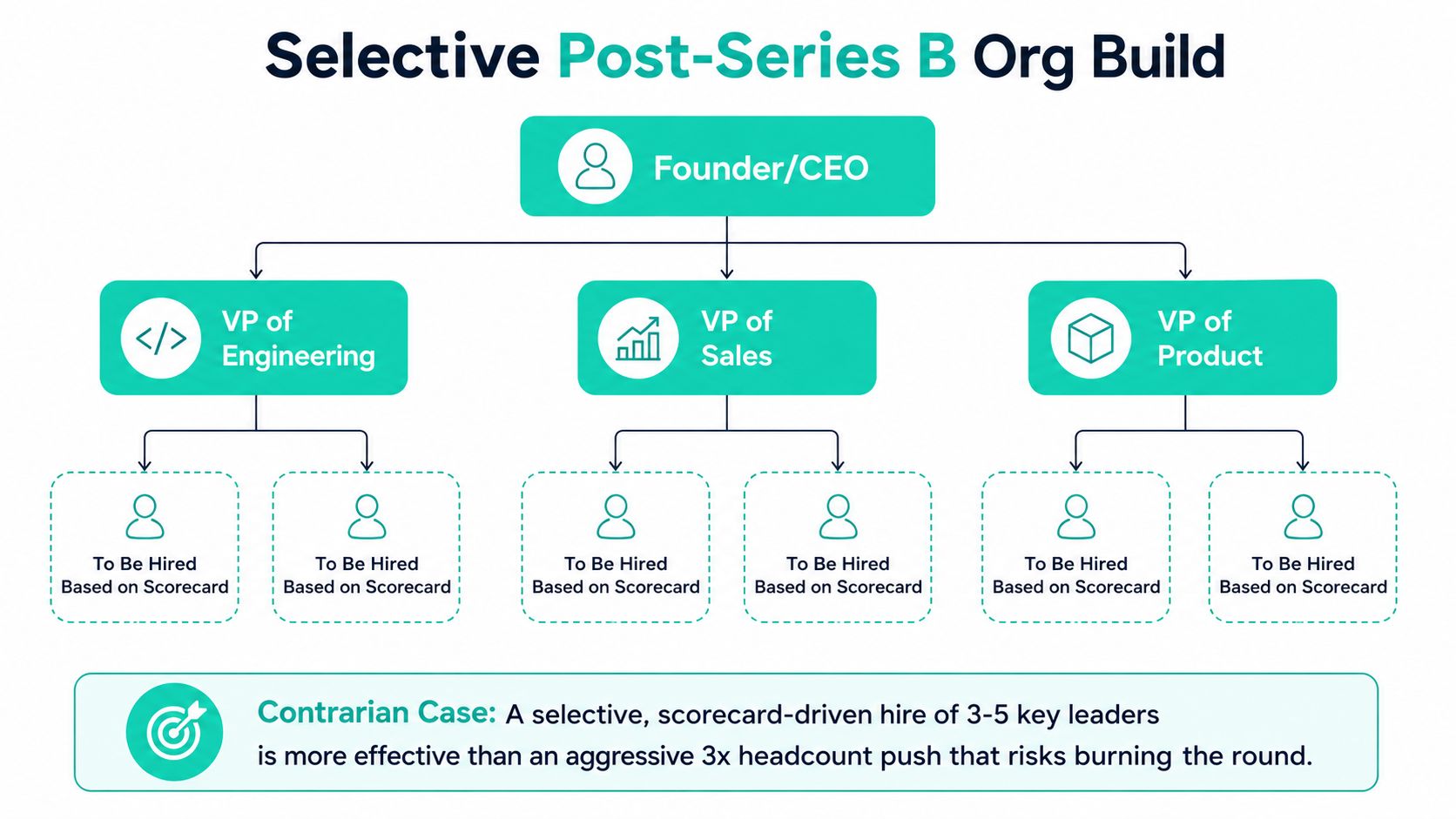
Engineering teams begin separating platform, infrastructure, and product-pod responsibilities. Go-to-market teams divide founder-led selling into SDR, AE, and CSM functions. Product and design gain clearer ownership over discovery, delivery, research, and customer feedback.
A 30-person Series A organization may become 60 to 90 people by Series C close, with roughly 40% in engineering, 30% in go-to-market, 15% in product and design, and 15% in operations and G&A. Those figures are a planning model, not a universal rule, and the right mix depends on the company's product, sales motion, and regulatory exposure.
The cultural transition is from “ship fast and figure it out” to “ship with enough process that customers, auditors, and regulators can trust the result.”
Founders should approve each requisition against a scorecard. If the role doesn't increase revenue capacity, product reliability, customer retention, or leadership capacity, it may belong later in the plan.
Candidates at Series B companies shouldn't evaluate offers from the salary line alone. The offer usually combines cash, equity, vesting terms, benefits, and the risk that the company's operating plan changes after the person joins. Founders, meanwhile, need bands that attract experienced talent without turning every hire into an oversized fixed-cost commitment.
The ranges below reflect the requested 2026 planning benchmarks for common technology roles. They're useful for framing a conversation, not for replacing location, specialization, company stage, or candidate-market analysis.
| Role and Level | Base Salary Range | Equity Grant | Sign-On Bonus |
|---|---|---|---|
| Engineering E3, mid | $150K to $180K | 0.05% to 0.15% | Role dependent |
| Engineering E4, senior | $180K to $220K | 0.10% to 0.25% | $10K to $30K common for senior hires |
| Engineering E5, staff | $220K to $275K | 0.15% to 0.40% | $10K to $30K common for senior hires |
| Engineering E6, principal | $260K to $320K | 0.25% to 0.60% | $10K to $30K common for senior hires |
| Product PM2 | $140K to $175K | 0.05% to 0.15% | Role dependent |
| Product PM3 | $170K to $210K | 0.10% to 0.25% | Role dependent |
| Product senior PM | $200K to $250K | 0.20% to 0.40% | $10K to $30K may apply for senior hires |
| Product designer | $130K to $170K | 0.05% to 0.15% | Role dependent |
| Senior designer | $160K to $200K | 0.10% to 0.25% | $10K to $30K may apply for senior hires |
Cash compensation often tracks the Series A market with an increase of 10% to 15%. Equity refresh grants typically vest over four years with a one-year cliff, and sign-on bonuses of $10,000 to $30,000 are common for senior hires competing with public-company offers.
A grant's percentage should be tied to fully diluted shares, not discussed as though it were an isolated number. Candidates should ask for the number of shares, the total share count used for the calculation, the strike price, the vesting schedule, the exercise window, and how future dilution may affect the holding.
Founders should model the employee pool before issuing offers. The provided Series B planning assumptions place total compensation around 60% to 65% of operating expenses, a pool refresh around 5% to 8%, and early-employee dilution of 15% to 25% across the Series B-to-IPO path. Those are planning norms, not promises of an outcome.
Candidates comparing offers can use this startup compensation benchmark guide to frame questions about cash, equity, and level. The strongest negotiation connects the requested package to scope, comparable offers, and the business impact the candidate expects to deliver.
Founders and candidates are solving the same problem from opposite sides. The company needs someone who can deliver a defined outcome in an evolving environment. The candidate needs enough information to decide whether the role's scope, manager, compensation, and risk match their goals.
| Process Stage | What Founders Should Do | What Candidates Should Do |
|---|---|---|
| Role definition | Write the outcome before posting the job | Ask what must be true after the first review cycle |
| Scorecard | Use four or five weighted criteria tied to the work | Map past results to each criterion |
| Interviews | Use structured interviews and shared rubrics | Prepare specific examples and case reasoning |
| References | Test trajectory, judgment, and working style | Ask what success and failure looked like for prior hires |
| Debrief | Rank against the scorecard, not against other candidates | Clarify open concerns before accepting |
| Offer | Explain scope, level, equity, and reporting line | Compare the full package and operating context |
A scorecard should distinguish skills that are essential from skills that can be learned. For a staff engineer, that might mean architecture judgment, cross-team influence, incident leadership, and the ability to simplify systems. For a senior PM, it may center on customer discovery, prioritization, commercial judgment, and execution through ambiguity.
The interview loop should test those signals in different ways. A systems case can reveal trade-offs. A product exercise can show how a candidate handles incomplete information. References should focus on trajectory, not only whether a former manager liked the person.
Candidates should decode the job description before preparing answers. Words such as “founding,” “ambiguous,” and “high ownership” can describe genuine autonomy, or they can conceal an unstaffed function with unclear authority.
Ask directly about:
Hiring mistakes become expensive at this stage. The planning guidance for this section assumes that one misaligned senior hire can consume 15% to 20% of the round, so founders should resist filling a seat because the requisition exists. Candidates should resist accepting a title that promises authority without confirming budget, decision rights, and executive support.
For teams that need a curated startup recruiting channel, recruitment support for startups offers context on structuring hiring around early-stage and growth-stage roles.
Series B rewards organizational quality more than raw headcount. The funding creates room to hire, but the company earns the benefit only when each addition improves execution, revenue capacity, product reliability, or management effectiveness.
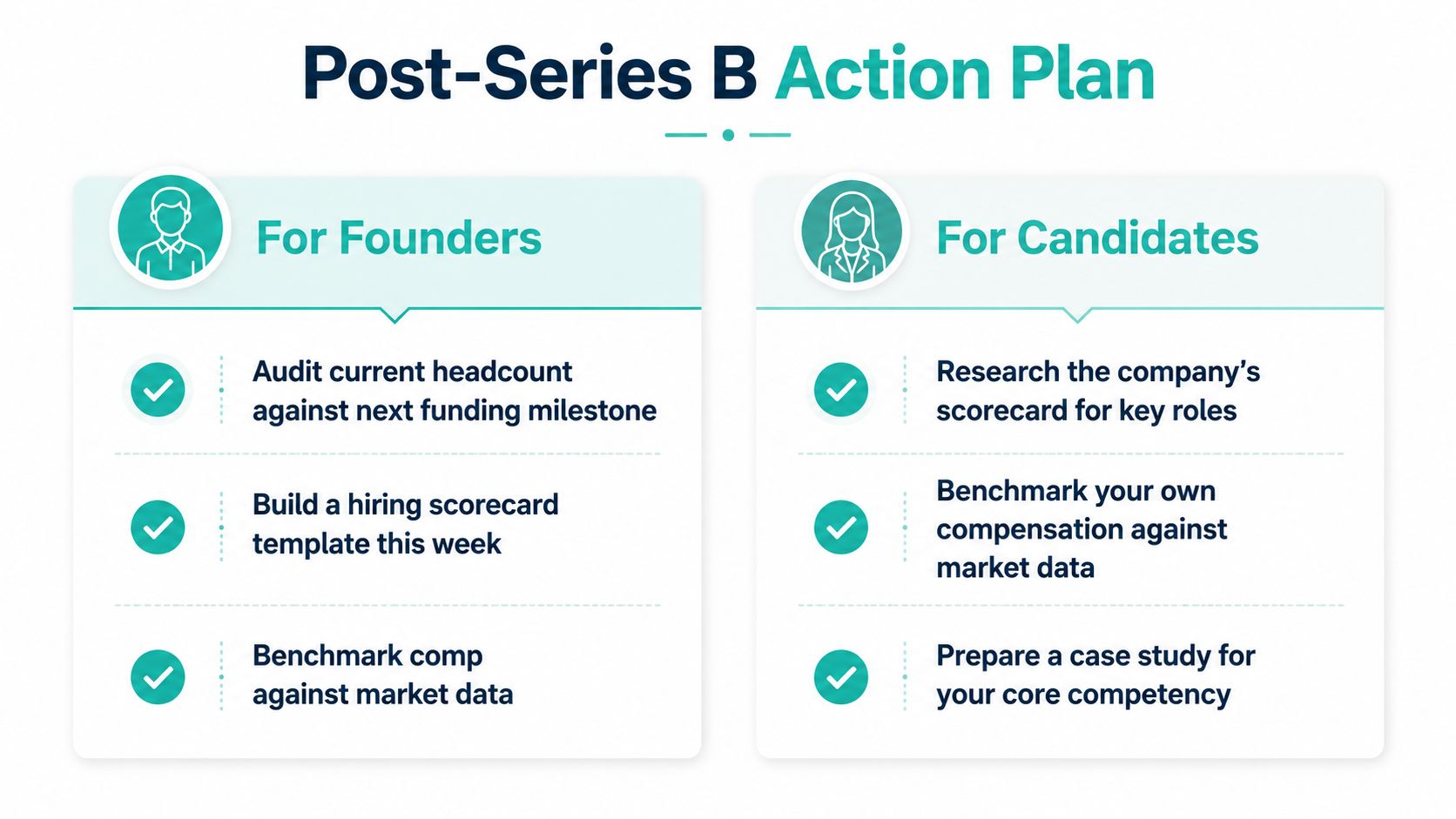
A founder should leave this process with fewer, clearer requisitions. A candidate should leave with a sharper view of whether the company's growth plan matches the role being offered.
Series B is not the point where a startup hires as many people as possible. It's the point where the company decides which people can make scale durable.
Underdog.io offers a curated hiring marketplace connecting startup candidates with high-growth technology companies, including roles across engineering, product, design, data, and go-to-market. If you're hiring for a critical Series B role or exploring a growth-stage move, visit Underdog.io and use the company or candidate path that matches your next step.