Even with the market shifting, software developer recruitment remains one of the defining challenges for any startup. You’ll see headlines suggesting a flood of available talent, but the truth on the ground is different. The elite, specialized engineers—the ones who truly drive innovation and build game-changing products—are still incredibly hard to find.
For founders and hiring managers, this means the old playbook of just posting a job and waiting is officially dead. To build a world-class team, you need a concrete, actionable plan.
The fight for top-tier developers isn’t just against other startups anymore; you're competing with the deep pockets and massive brand recognition of established tech giants. Winning this race requires a strategic framework, one that treats hiring with the same rigor you apply to product development. It’s less about filling a seat and more about architecting a process that attracts, engages, and ultimately closes the right people for your mission.
Don’t let economic cycles fool you; the fundamental need for skilled engineers is only growing. The U.S. Bureau of Labor Statistics projects a staggering 17% employment growth for software developers between 2023 and 2033. That's more than double the average for all other jobs.
This translates to an estimated 129,200 new openings every single year, a number that screams one thing: persistent, growing demand. You can dig deeper into the software engineer job market trends on mev.com.
What does this mean for you? Exceptional candidates will always have options. Always. To stand out, you need to offer more than just a competitive salary. A practical action is to create a one-page "Why Us?" document that clearly articulates your vision, the unique technical challenges you're solving, and the opportunity for a new hire to make a tangible impact. This becomes a powerful tool for your entire hiring team.
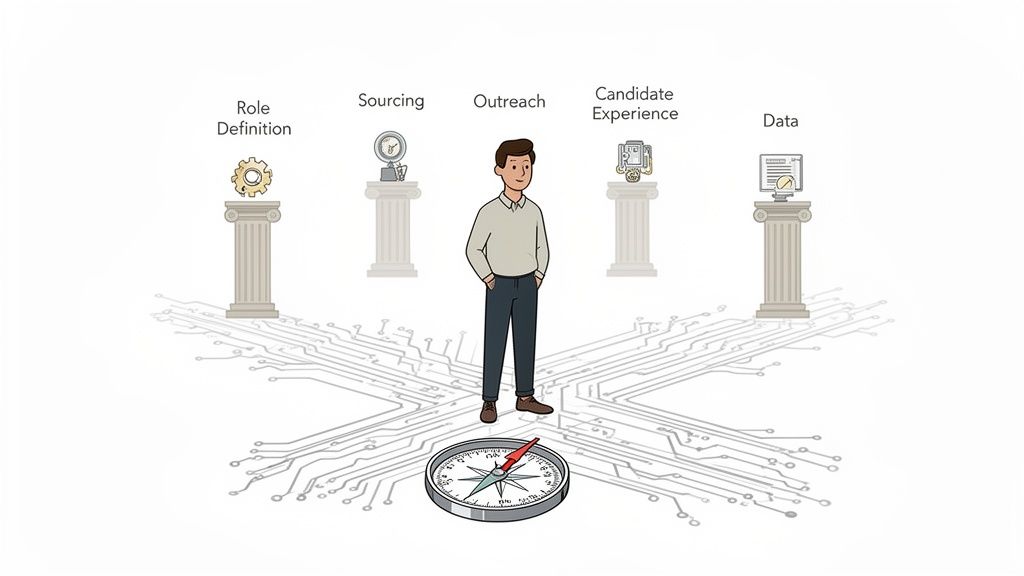
To win, you need to build your entire recruitment process on a few core pillars. Each one is a critical part of the hiring journey, from the moment you decide you need to hire to the day a new engineer accepts your offer.
At a high level, every successful engineering recruitment strategy I've seen boils down to mastering four key areas. They're not steps in a sequence, but interconnected disciplines that support each other.
Think of these pillars as the foundation of your hiring engine. They provide the structure needed to move from reactive, chaotic hiring to a proactive, strategic advantage.
By mastering these pillars, you transform hiring from a painful necessity into one of your company's greatest strengths. This is the framework that allows you to build the engineering team that won't just create your product, but will define your company's future.
A vague job description is the fastest way to get a flood of unfocused, unqualified candidates. Before you write a single line of a job post, your first and most critical task is to get crystal clear on exactly who you need and, more importantly, why.
This goes way beyond just listing a few programming languages. You have to connect this future hire directly to a pressing business goal. What specific problem will this person solve in their first six to twelve months? If you can’t answer that, you're not ready to hire.
Instead of drafting a generic laundry list of requirements, build a "success profile." This is a detailed picture of what success looks like for this role, blending technical chops with the specific behaviors and traits needed to thrive in your unique startup environment. It forces you to separate the absolute essentials from the "nice-to-haves."
Get your leadership team in a room and hash out the answers to these questions:
Answering these questions clarifies the crucial difference between hiring a "founding engineer" versus a "senior engineer." A founding engineer needs to be comfortable with chaos, rapid iteration, and wearing multiple hats. A senior engineer joining a slightly more mature team might need deep expertise in scaling a specific technology to handle 10x the traffic. Your success profile has to reflect that reality.
Once you have your success profile, translate it into a competency matrix. This simple grid becomes the backbone of your entire interview process, ensuring every conversation is intentional and every evaluation is consistent. It’s how you remove "gut feelings" and replace them with actual data.
Your matrix should list the core competencies down one side and your interview stages across the top. For each stage, you'll define which competencies you're assessing and how you'll measure them.
Here’s a practical example for a Senior Backend Engineer role:
This structured approach ensures you’re not just hiring for technical skill but for the complete package your startup needs to win. The market for experienced talent is incredibly competitive. Recent analyses show that more than half of open engineering roles in 2025 are above the senior level, as companies fight for staff-plus engineers who can handle ambiguity—the exact profile startups need. You can find more details on how the software engineer job market is evolving on Underdog.io.
By defining the role with this level of precision, you create a powerful filter. You're not just looking for a software developer; you're looking for the right developer to solve your most critical business problems, and your entire hiring process will reflect that clarity.
Alright, once you’ve defined the role with surgical precision, the real hunt begins. Let's be honest: the best software developers aren't scrolling through job boards. They're heads-down, building great products at their current companies.
Relying solely on inbound applications for a critical engineering role is like fishing in a small pond and hoping a whale swims by. It’s a strategy built on luck, not intention. Effective software developer recruitment demands that you get proactive. You have to go where the talent is, not just wait for them to find you. This means shifting your focus from passively posting jobs to actively sourcing and engaging candidates where they actually spend their time.
One of the most efficient ways to connect with high-intent, vetted candidates is through curated marketplaces. Platforms like Underdog.io were built specifically to solve the startup hiring headache by pre-screening talent that is actively or passively looking for roles in high-growth tech companies.
This approach completely flips the traditional model on its head. Instead of you sifting through hundreds of irrelevant resumes, you get access to a pool of candidates who have already been vetted for skill, experience, and an interest in the startup world. An actionable step is to dedicate one hour every Monday morning to reviewing new candidates on these platforms.
Here's a look at the Underdog.io platform, which gives you a clean interface for discovering candidates.
This dashboard-style view lets hiring managers quickly see relevant profiles, making the discovery process much more straightforward.
Beyond marketplaces, the best engineers are active in niche online communities. Finding them requires a bit of digital anthropology—you need to immerse yourself in the spaces where they share knowledge, collaborate, and talk shop.
Building a presence in these communities is a long game, but it pays off. It helps you build your employer brand and creates a warm pipeline of talent that already respects your team’s expertise. For more on this, our guide on how to build a talent pipeline offers a deeper dive into creating sustainable sourcing channels.
When you do find a promising candidate, your first message is everything. Generic, copy-pasted outreach is the fastest way to get your message deleted. Your message needs to prove you’ve done your homework in under 10 seconds.
To really attract the best people, you need a strategy. You might want to check out a modern playbook for recruiting top talent to help refine your process. A great outreach message is always personalized, concise, and respects the candidate's time.
Here’s a quick comparison of what works versus what gets ignored.
The Generic (and Ineffective) Template:
"Hi [Name], I came across your profile and was very impressed with your experience. We are hiring for a Senior Software Engineer at [Startup Name], a fast-growing company in the [Industry] space. Are you open to learning more?"
This message is all about you and gives the engineer zero specific reasons to care. It’s destined for the trash folder.
The Personalized (and Effective) Template:
"Hi [Name], I saw your recent contribution to the apollo-client-next library on GitHub—your fix for the caching issue was really clever. At [Startup Name], we're tackling a similar challenge with real-time data synchronization in our platform. Given your deep expertise in GraphQL, I thought our mission to [briefly state mission] might resonate. Would you be open to a brief, no-pressure chat about the problems we're solving?"
This one works for a few key reasons:
Your outreach goal isn't to get them to apply for a job. It's to start a conversation. Frame your message as an invitation to explore a compelling technical challenge, and you’ll see your response rates skyrocket. Remember, you're recruiting a person, not a set of keywords.
A bad interview process doesn’t just filter out the wrong people—it actively repels the right ones. Top engineers can spot a disorganized, disrespectful, or irrelevant interview loop from a mile away. Your process needs to be a direct reflection of your engineering culture: thoughtful, efficient, and focused on solving real problems.
The goal isn't to stump candidates with abstract brain teasers or algorithmic hurdles. It's to simulate your day-to-day work in a way that shows you their true problem-solving abilities, communication style, and technical depth. A structured process also guarantees every candidate gets a fair and consistent evaluation.
The first conversation should never be a technical grilling. This is your chance to sell the vision and see if there's a mutual fit. Remember, it’s a two-way street. The candidate is interviewing you just as much as you are interviewing them.
Use this 30-minute chat to cover three core areas:
This initial chat is your single best opportunity to make a human connection. A candidate who feels genuinely excited about your mission is far more likely to stay engaged through the more demanding technical stages.
Once you've established a good connection, it's time to verify technical fundamentals. But "technical screen" should not mean "whiteboard algorithm pop quiz." Instead, design a short, practical exercise that mirrors a real task a developer at your company would actually face.
For example, don't ask them to reverse a binary tree. Present a small, contained problem that's relevant to your domain.
Scenario for a FinTech Startup:
This approach is more respectful of their time and gives you a much clearer signal on their practical coding skills. It shows you how they think, not just what they've memorized. To build a robust framework, it helps to explore various 10 Key Types of Interview Question.
For candidates who pass the initial screen, a well-scoped take-home project is an excellent way to see their work in a more natural environment. The key here is respect for their time. A good take-home should take no more than 2-4 hours to complete.
Your assignment should be a microcosm of an actual project. For instance, you could provide a starter codebase with a failing test suite and ask them to fix the bug and add a small new feature. This tests their ability to understand existing code, write clean and maintainable solutions, and follow instructions. A great practical example is giving them a small, buggy React component and asking them to fix the bug and add a new state-handling feature.
The last stage should involve the broader team they'd be working with. This isn't just about final technical vetting; it's about seeing how they gel with the team. This stage usually includes two key parts.
Finally, it’s a great practice to help candidates feel prepared. Providing them with a guide to software engineer interview preparation can level the playing field and shows that you're invested in their success from the very beginning.
You've made it to the offer stage. After weeks of interviews and code reviews, this is where the real work begins. This is the moment you stop evaluating a candidate and start selling them on a future with your startup. All that hard work can unravel in an instant with a poorly crafted or communicated offer.
Think of the final offer less as a number and more as a story—a story about your company's potential and where they fit into that picture. You need to build a package that’s not just competitive, but compelling.
Let's be honest: startups can rarely compete with Big Tech on pure cash. That's fine. Your real advantage is equity, but just throwing a number of stock options at a candidate is basically meaningless. Your job is to make that equity feel real.
When you're walking them through the offer, break it down so it's impossible to misunderstand:
Your offer conversation should feel less like a transaction and more like an invitation to become a partner in building something significant. When you sell the mission and the ownership stake effectively, the base salary becomes just one part of a much larger, more exciting picture.
Top-tier engineers are going to negotiate. Expect it. A counteroffer isn't an insult; it's a sign they're genuinely interested and an opportunity for you to reinforce why your startup is the right move.
When a candidate comes back with a counter, listen. Really listen. Is it just about the base salary, or are they worried about risk, their title, or growth opportunities? Don’t just react; understand their core motivation and tailor your response. If you can’t budge much on salary, maybe a signing bonus, a faster vesting cliff, or a more senior title will get the deal done. An actionable tactic is to have a small, pre-approved "flex budget" for offers that allows you to quickly add a small signing bonus or adjust salary without needing multiple layers of approval.
The goal is always a win-win. A good negotiation ends with both of you feeling respected and excited to start working together. The candidate feels valued, and you know you've landed a key team member on terms that are fair and sustainable for the business.
Of course, you won't win them all. It’s critical to learn from every outcome. If you find yourself consistently losing candidates at this final stage, it's time to dig in and figure out why. Reading up on what to do when a candidate rejects your offer can help turn those painful moments into priceless learning opportunities.
There’s an old saying: "What gets measured gets improved." This is gospel for recruiting engineers. Without data, you’re just flying blind, relying on gut feelings to fix what is fundamentally a systems problem.
You don’t need a fancy, expensive applicant tracking system to get started. A simple spreadsheet is more than enough to start spotting patterns, identifying bottlenecks, and seeing where your hiring funnel is leaking.
Tracking just a few key metrics can completely change the game. Here's a breakdown of the essential data points every startup should be monitoring to measure and optimize their recruitment process.
By consistently reviewing this data, you can shift from a purely reactive hiring approach to a strategic, data-driven one. You'll stop guessing what’s wrong and start making targeted improvements that deliver real results, turning your recruitment process from a necessary evil into a genuine competitive edge.
Trying to recruit software developers can feel like navigating a minefield, especially when you're a founder or hiring manager under the gun. I get asked the same questions all the time, so let's get straight to the answers for the trickiest parts of the process.
This is the classic startup dilemma. The short answer? Stop playing their game.
You will not win a bidding war on salary against a public company. Instead, you have to win on everything else—the things big tech simply can't offer.
Great candidates are rarely motivated by just a paycheck. They want to build something that matters. Your offer isn't just a number; it's a story about impact, ownership, and the chance to get in on the ground floor of something huge.
Frame your entire conversation around these points:
Platforms like Underdog.io are a secret weapon here. They connect you with talent that is specifically looking for high-growth startup roles, so candidates are already sold on the startup value prop before you even speak.
This is a hot debate, but the truth is they test completely different skills. The best process often uses a bit of both.
A take-home project is your best bet for seeing how a developer works when no one is looking over their shoulder. It reveals how they structure code, approach a problem thoughtfully, and manage their time—a great simulation of actual day-to-day work.
A live coding session, on the other hand, is all about seeing how they think on their feet. It tests their real-time problem-solving process and, just as importantly, their communication skills under pressure. Can they talk through their logic while typing? Do they collaborate when they get stuck?
Here’s a practical, hybrid approach that works:
This model gives you the best of both worlds without completely burning out your candidates.
It’s everything. Full stop.
In a market this competitive, the candidate experience is a direct reflection of your company culture. Top engineers have options, and a sloppy, disrespectful, or disorganized process is the fastest way to get ghosted.
A great candidate experience means treating the process like a two-way street. You're both interviewing each other. It really comes down to:
Even the people you reject can become your biggest fans if you treat them with respect. They'll tell their friends you run a great process, and that positive reputation is priceless.
Diversity doesn't just happen by accident; it requires deliberate, sustained effort from day one. If you wait until you’re a 50-person company, the patterns are already set, and it’s ten times harder to fix.
Start with these concrete steps right now:
Diversity isn't just about optics. It's a massive strategic advantage that leads to better products, a healthier culture, and more creative problem-solving.
The primary challenges are high competition for top talent, very high costs of a mis-hire, and lengthy time-to-hire. Many developers, especially senior ones, are "passive" candidates—they aren't actively applying on job boards, making them invisible to traditional recruitment methods. Additionally, efficiently assessing technical skill and cultural fit remains a persistent hurdle.
The process has shifted from a high-volume, transactional model to a more candidate-centric, relationship-focused approach. There's a greater emphasis on creating a positive candidate experience, reducing unnecessary interview rounds, and providing clear, upfront communication. Companies are also focusing more on selling their mission, tech stack, and work culture to attract talent, not just evaluating them.
An effective process balances speed, accuracy, and a positive experience. Key elements include: a clear and compelling job description, a streamlined interview pipeline (ideally 3-4 stages), practical skills assessments (like focused take-home projects or pair programming) over abstract quizzes, and collaborative debriefs among interviewers to reduce bias. Transparency about salary ranges and the decision timeline is now expected.
Extremely important. A poor candidate experience can damage your company's brand and deter other talented developers from applying. Key aspects include respectful and timely communication, providing constructive feedback when possible, and ensuring every interaction (from the first call to the final offer) reflects your company's values and respect for the candidate's time.
These platforms, like Underdog.io, vet both companies and candidates before allowing them to join. The advantage is a significant increase in signal-to-noise ratio. For hiring managers, it means access to a pool of pre-qualified, interested candidates, reducing time spent sifting through unqualified applications. It often facilitates direct, confidential connections with passive candidates who are open to new opportunities but not actively job-seeking.
Start by auditing and rewriting your job descriptions. Remove excessive "nice-to-have" requirements, emphasize the impact of the role, and showcase your tech stack and culture. Promote roles in niche communities (like specific tech stack forums or open-source project channels) and through employee referrals, which typically yield higher-quality candidates. Using a curated platform can also automatically elevate the applicant pool.
Key metrics include Time to Fill (the total days to hire), Time to Hire (days from first interview to offer), Cost per Hire, Source of Hire (which channels bring your best candidates), Offer Acceptance Rate, and new-hire retention rates after 6 and 12 months. Tracking candidate satisfaction via short surveys can also provide invaluable feedback on your process.
Ready to connect with top-tier tech talent actively looking for startup roles? Underdog.io provides a curated marketplace of vetted candidates, flipping the script so the right people come directly to you. Find your next key hire.