A profile that only lists languages asks reviewers to take your word for it. That's a weak position when GitHub was the most popular code-documentation and collaboration tool, used by 81% of respondents, ahead of Jira and GitLab. Reviewers already live where code, issues, and pull requests can be opened. Build your software engineer portfolio there, and make every claim point to something they can inspect.
Say you're reviewing two candidates. One has a polished personal site that lists React, Node.js, PostgreSQL, AWS. The other has a plainer page, but each skill links to a repository, a merged pull request, or a short write-up explaining a decision. You don't need long to decide which one you can evaluate.
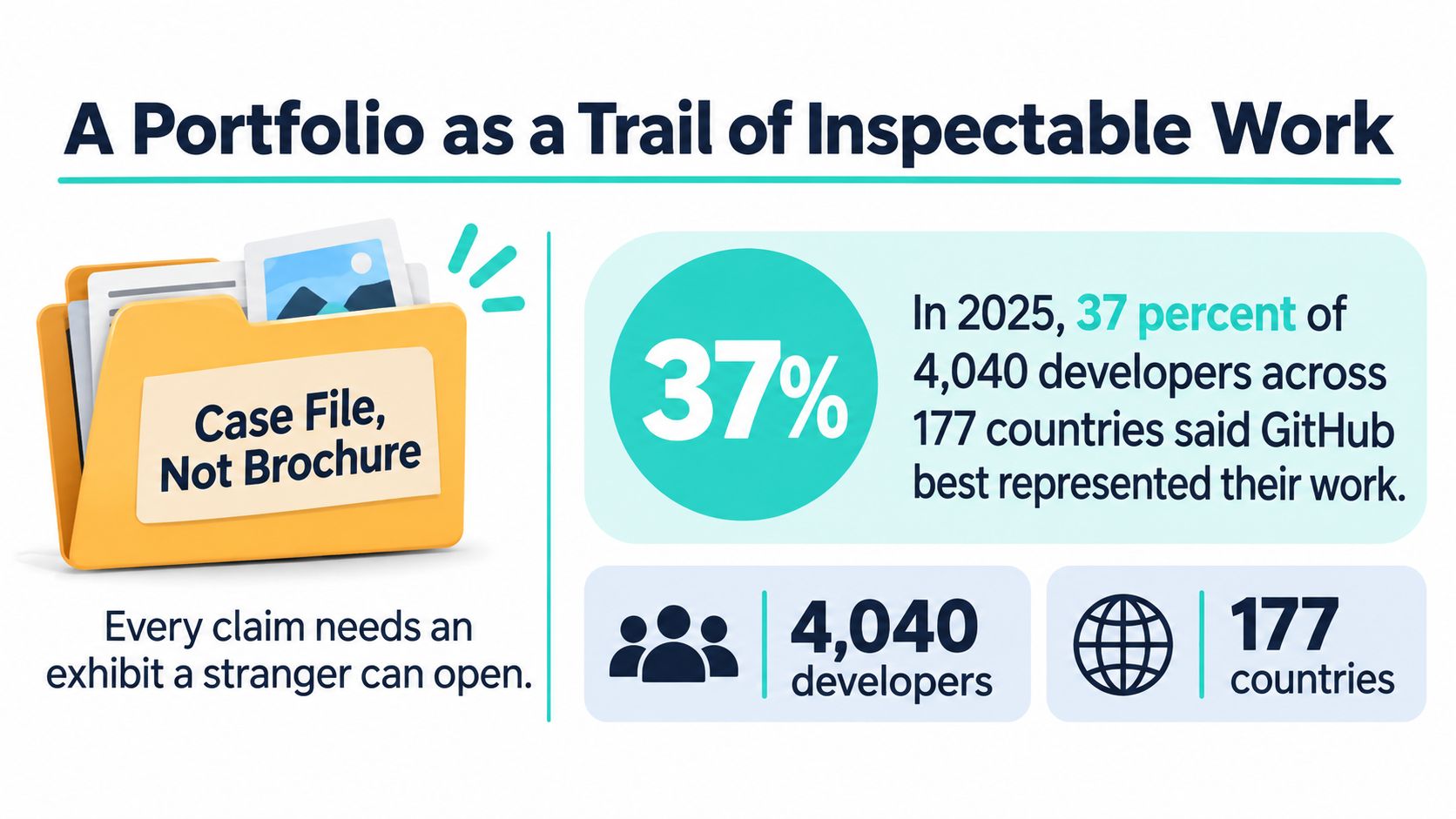
That preference shows up in the 2025 survey of 4,040 developers across 177 countries published by daily.dev, where 37% said GitHub best represented their real skills, compared with 17% for personal portfolios and 14% for LinkedIn. Your repositories are the center. A website is a useful map, but it isn't the evidence.
A good incident review works because it doesn't ask for trust. It points to a log line, a timeline, a graph, and the fix that shipped. Treat your profile the same way. If you say you improved performance, link the commit and the measurement. If you say you know a database, link the schema decision and the migration.
The trail usually includes a few kinds of exhibits:
Every claim needs an exhibit a stranger can open. If there's no artifact behind a skill, it doesn't belong on the profile yet.
This approach helps early-career and distributed engineers in a way a resume can't. Employment history is hard for a reviewer to verify without calling references. Merged work in a public codebase can be checked in five minutes, and it shows how you communicate in writing, respond to review, and work inside code you didn't write.
Run a simple test before you share the link. Pick each skill on your profile and try to click through to a commit, pull request, demo, or write-up that proves it. Cut what you can't defend, and don't let anything important depend on a single regional job site or one format a reviewer might not use.
Put two or three finished systems at the front of your profile. Not eight tutorial clones. Not a graveyard of half-built experiments. Reviewers skim, and a stack of abandoned repositories tells them you start things more easily than you finish them.
| Piece | Job it does | Weak version | Strong version |
|---|---|---|---|
| Pinned GitHub repository | Shows implementation | Tutorial clone or empty repo | README, tests, and a green CI check |
| Landing page | Maps the work | Logo wall of tools | Links to repos, demos, and decision notes |
| Live deployment | Proves it runs | Local-only setup | Public URL or one scripted launch path |
| Project README | Explains context | One-line description | Problem, setup, role, and limitations |
| Production note | Shows judgment | Feature list only | Trade-off, failure, cost, and security |
| Skills block | Signals fit | Unlinked keyword list | Each skill tied to a project above |
Read the table from left to right and the pattern is clear. Weak versions describe. Strong versions can be clicked, run, or checked. That distinction is the same habit behind evaluate projects using verified traction, where the point is to separate a claim about progress from something you can count or open.
The stakes aren't theoretical. In the Linux Foundation's 2024 Tech Talent report, 58% of technology hiring and training decision-makers said showcasing a portfolio of previous achievements was extremely or very important when evaluating candidates. The work has to be legible to people who will never meet you before that judgment happens.
A project is finished enough to feature when a reviewer can answer five questions without asking you. What's the user problem? What stack did you choose, not just list? What's one explicit trade-off you made? Can a stranger run the tests? And what's a result, such as latency, cost, coverage, or a merged fix?
Score your current pinned projects against the strong column now. Anything that fails gets demoted, archived, or fixed before you apply anywhere. If you want a closer look at what reviewers scan first, what hiring managers look for on GitHub covers the profile-level signals that sit around the code itself.
One more thing worth saying plainly. A standalone site can't carry this evidence on its own, because it only shows what you chose to render. Repositories carry the receipts, including commit history, test files, and the messy parts polished screenshots hide.
Your README is the case-study page for the project, not a one-line label. GitHub's repository best-practices guide says the README is often the first item visitors see, and it should explain what the project does, why it's useful, how users get started, where they can get help, and who maintains it. Put that context at the top. Don't bury it in a side document nobody opens.
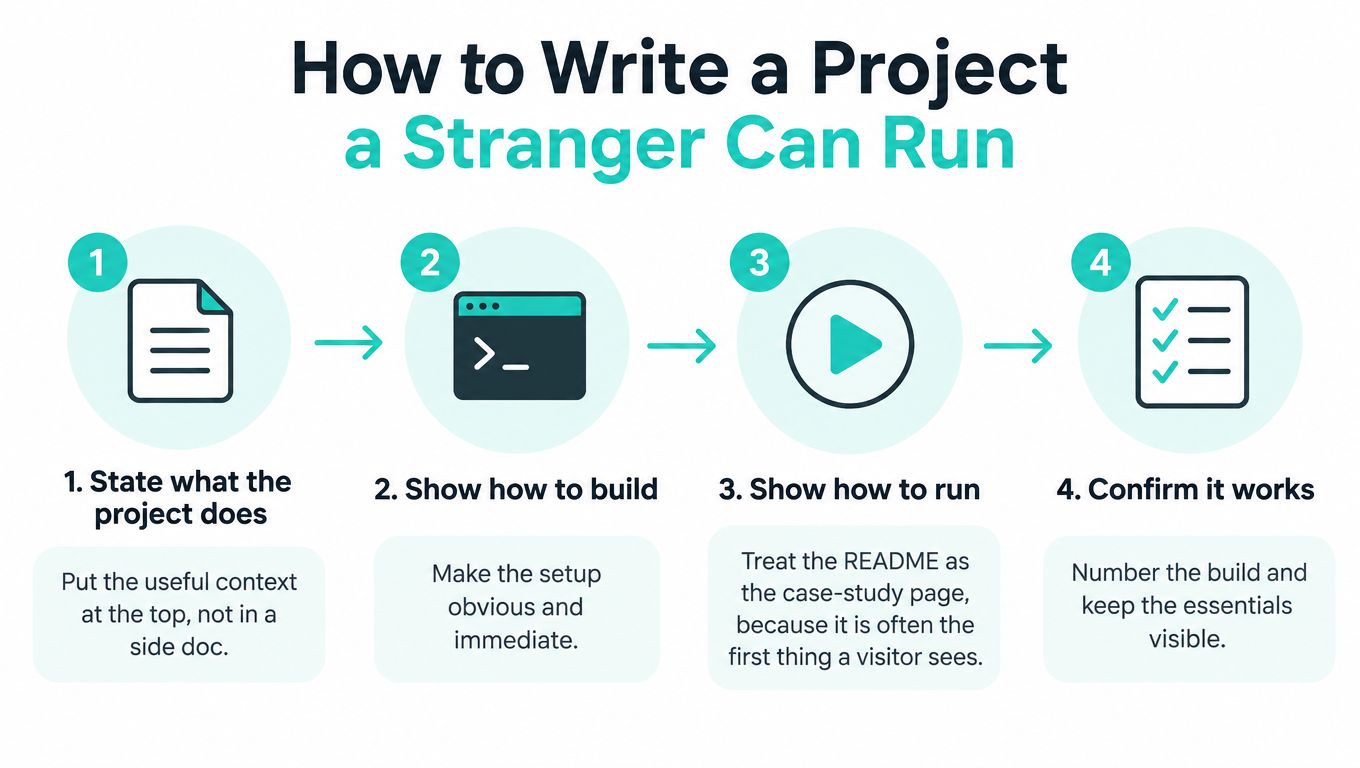
Number the build so a reviewer never has to guess the next step:
.env shape. Never paste a real secret, and check that no key lives in your commit history.The most common failure isn't bad code. It's a clever codebase that can't be started. A missing environment variable, an undocumented database step, or a test command that fails on a clean machine makes solid work look abandoned, and reviewers rarely spend their own time debugging your setup.
Do the clean-folder test: clone your own repository somewhere new, follow only the README, and fix the first command that fails. That's the exact experience you're handing a stranger.
Repeat that loop until the path from clone to visible result works without your memory filling gaps. If a step lives only in your head, it doesn't exist for anyone else.
A demo that boots proves the code runs once, on your machine, under friendly conditions. It doesn't tell a reviewer whether you'd notice a failure, contain a bad deploy, or keep costs sane. Startup teams care about that gap because the person who builds a feature is often the person who gets paged for it.
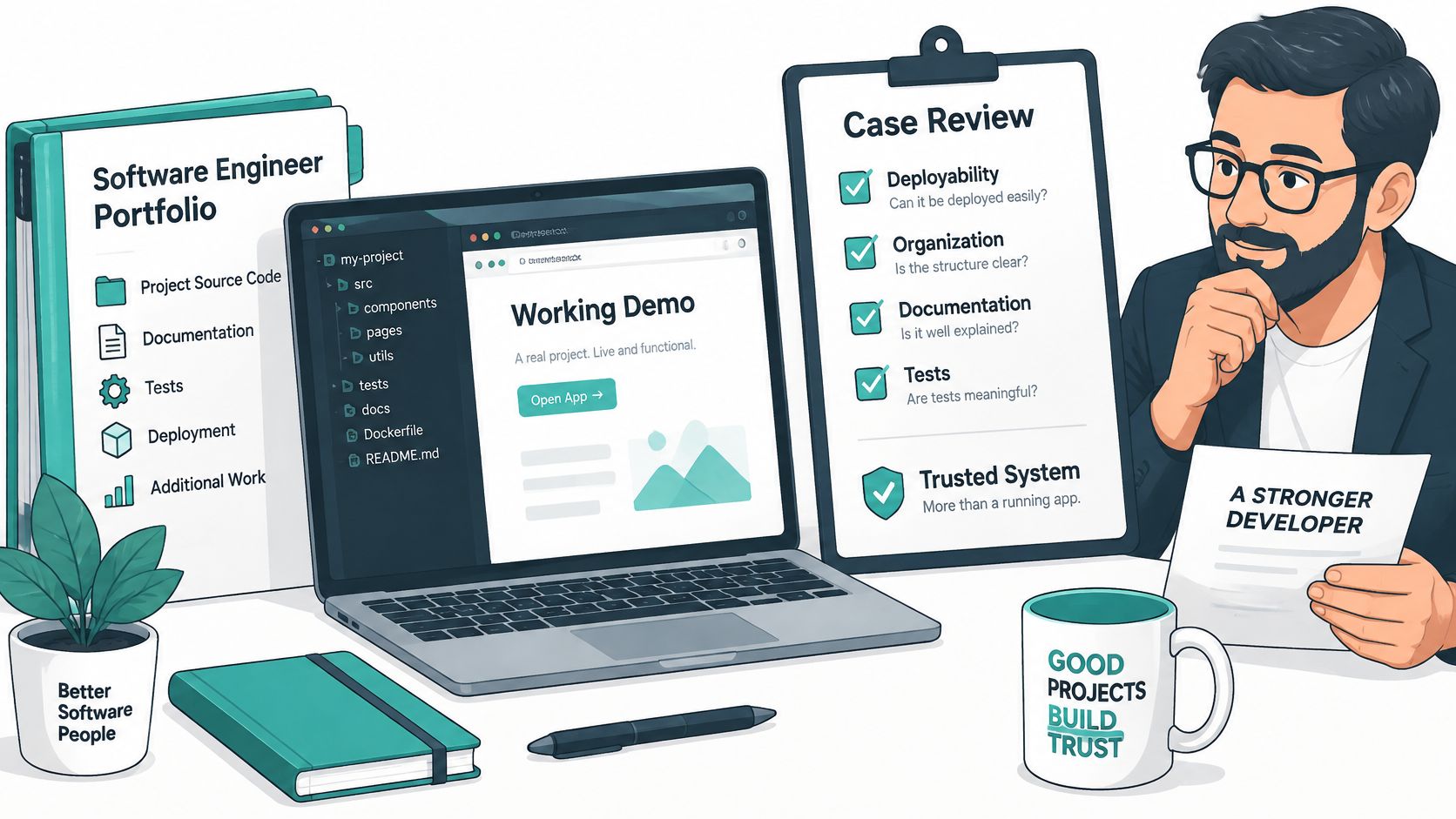
There's a directional reason to take this seriously. In a portfolio analysis using a structured rubric, structured evaluation across deployability, code organization, documentation, and test coverage correlated with six-month performance ratings at 0.44, versus 0.22 for unstructured review, and demonstrated deployability accounted for approximately 35% of predictive validity. Treat those as directional, not universal hiring constants. They still justify putting effort into deployable, documented work over another tutorial clone.
Add a brief production note to each featured project, separate from the README. The README gets a reviewer running. The note explains how the system behaves when it's stressed, misused, or scaled.
| Signal | What to record | Example of enough detail |
|---|---|---|
| Reliability | A failure you simulated | Timeout and retry when a dependency is down |
| Security | A threat and the control | Auth checks and secrets kept out of the repo |
| Observability | The signal you would page on | Error rate and latency dashboard or log query |
| Cost | A measured spend | Monthly hosting or a stated inference bill |
| Latency | Workload and measured result | p95 response time under a stated number of requests |
| Ownership | Your boundary | The part you designed versus library code |
| Scale | The ten-times change | The bottleneck you would fix first |
One believable pattern looks like this. Say your API calls a third-party service. You set a timeout, added a bounded retry so a slow dependency can't hang every request, and logged failures with enough context to find them. Secrets live in environment variables, not the repo. You ran a small load test, recorded the p95 latency and the workload behind it, then named the database query you'd fix first at ten times the traffic.
That paragraph tells a reviewer more than a feature list ever will. It also gives you defensible material for technical conversation, which is where portfolios get tested. The habit connects directly to code review standards, because reviewers in both settings are asking whether the author thought past the happy path.
Be strict about the cut. If a project can't support even three of the seven rows with honest detail, it isn't ready to be featured. Either do the work to fill the gaps, such as adding a health check or measuring one endpoint, or replace it with a project that can.
Naming ChatGPT, Copilot, or an LLM API doesn't differentiate you anymore. According to reporting on JetBrains' 2025 survey of 24,534 developers across 194 countries, 85% regularly use AI tools for coding and 62% rely on at least one AI coding assistant, agent, or code editor. Use itself is ordinary. The portfolio question is what you still controlled.
For any project where a model generated part of the implementation, add a short block that shows the human work:
Add two numbers when they exist, latency and inference cost. A feature that costs real money per call is an engineering choice with trade-offs, and stating the numbers shows you treated it that way. This block should surface testing, debugging, review, data handling, security, and performance, the skills that still matter when a draft arrives for free. It pairs naturally with thinking about how you'd present agentic AI development on your resume, where the same evidence has to survive in fewer lines.
For test generation specifically, don't claim coverage went up and leave it there. Show how you validated the generated cases, because a test that always passes proves nothing. The discipline behind real-device validation for AI-assisted QA teams is a useful reference point, since AI-written tests need the same skepticism as AI-written features.
Employed candidates often can't publish the work that best shows their judgment. Build a sanitized evidence page instead. Use synthetic data, a redacted architecture diagram, and a reproducible evaluation method that someone could rerun on their own inputs. No customer records, no proprietary code, no internal metrics you don't have permission to share.
Finish with a cleanup pass. Delete any skills line that only says a tool name. If the line can't point to a safeguard you designed or a decision you made, it's a keyword, not evidence.
The right artifact depends on where you are. Copying a senior engineer's portfolio shape when you're starting out produces thin versions of everything. Match the case closest to your seniority and do that one properly.
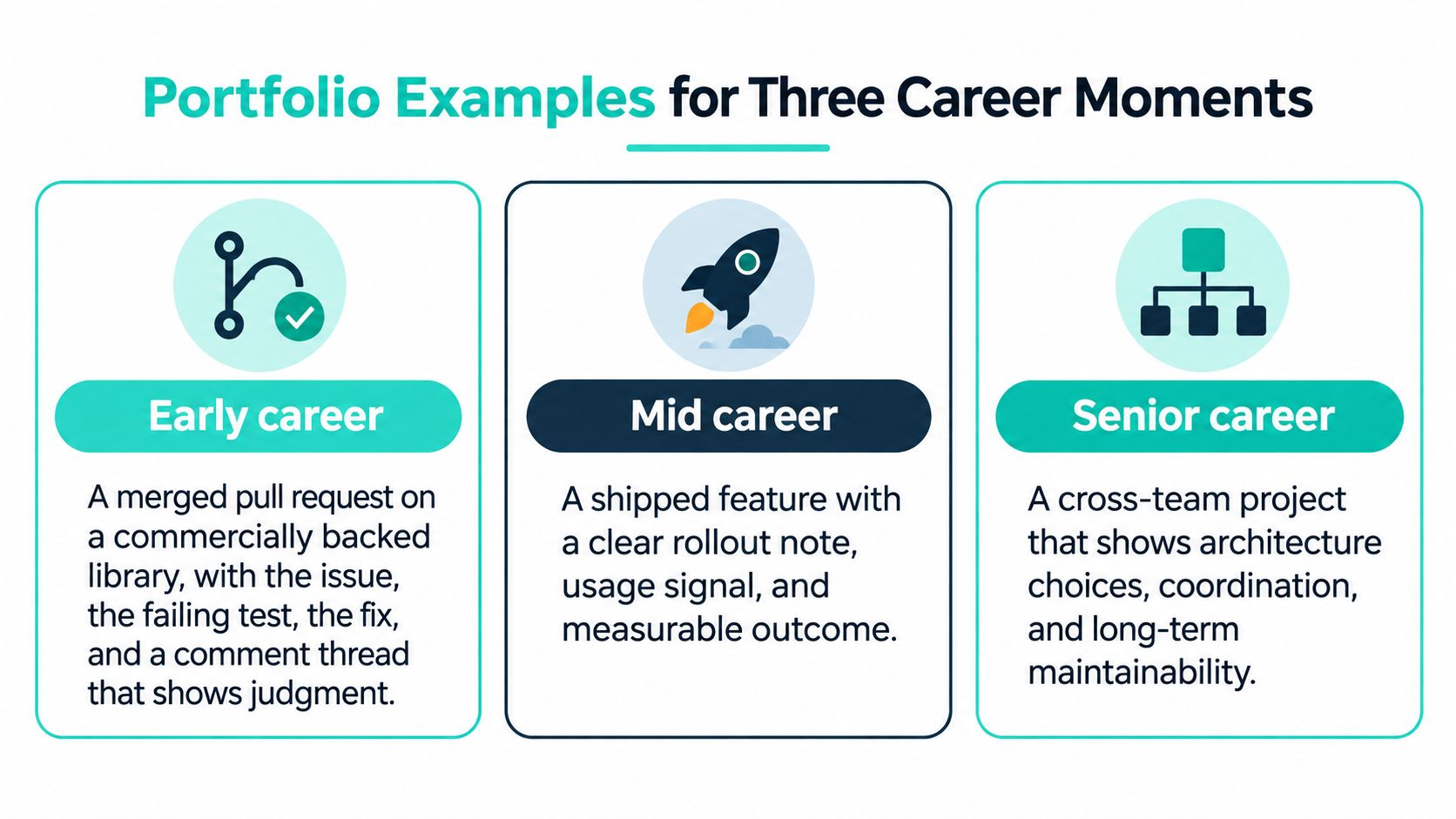
Your strongest move is a merged pull request on a commercially backed library you use. Pick an open issue, write the failing test first, submit the fix, and respond to review comments until it lands. The comment thread is the valuable part. It shows you can read unfamiliar code, accept correction without getting defensive, and communicate in writing across time zones.
Don't invent a fake consumer app to look more senior. A small, merged contribution in someone else's codebase tells a startup team you'll be productive in theirs, which is what they'll ask you to do in week one.
Now the centerpiece is a small deployed API you own end to end. It runs from a README a stranger can follow, shows a green CI badge, and includes one architecture sketch a person can understand without a legend. The accompanying production note records a cache choice and what it cost you in complexity, a measured p95 under a stated workload, and the monthly hosting bill.
The story here is shipping, not breadth. Ten frameworks listed with nothing deployed reads weaker than one service that's live, measured, and documented, including the part you'd rebuild.
Your best work is probably closed-source, so lead with a redacted incident-style write-up. Use synthetic numbers, describe the decision that got reversed and what evidence reversed it, name the alert that should have existed, and explain what changes at ten times the traffic. Pair it with one public artifact, a talk, a technical article, or a substantive open-source review, so a reviewer still has something clickable.
Contribution, runnable system, operational judgment. Those are the three stories, in that order, as seniority grows.
Pick the one that matches your current moment. Collecting all three at once spreads effort so thin that none of them hold up under questioning, which is the exact failure this whole approach exists to avoid.
You don't need a rebuild. You need one focused week on the two projects that already come closest to holding up.
When the work is ready for startup roles, Underdog.io is where a finished link gets reviewed. The initial profile needs no portfolio upload to start, but the team asks for a portfolio link or sample work during review, and Underdog reviews every profile by hand, including the portfolio. It accepts the top 5% of applicants, with portfolio and craft verified. If you're also exploring a broader staffing channel such as nexusITgroup.com, keep one public link that serves both audiences instead of maintaining two versions.
Once your two featured projects run from a clean clone and show the decisions behind them, put that link in front of people who will open it. Underdog.io reviews every profile by hand and connects verified engineers with vetted startups, so your evidence gets read by hiring teams instead of sitting in an application queue. Start your profile today at Underdog.io and let the work make the case.