You've got the offer letter open in one tab, the recruiter's email in another, and a salary number that feels solid. Then you hit the equity line, and suddenly you're staring at a grant of stock options with no clear sense of whether it's real upside or just startup decoration.
That confusion is normal. Stock options for employees can be one of the most valuable parts of startup compensation, but only if you know how to read the grant, how the taxes work, and what you're taking on when you say yes. The practical question isn't “What do options mean?” It's “What am I buying, when can I buy it, and what could go wrong?”
A startup offer rarely lands as a simple cash-and-benefits package. It often mixes salary, bonus, and equity, and the equity line can look exciting without being immediately understandable. A grant of 20,000 options sounds large until you know how many shares exist in total, what the strike price is, and whether the company ever gets liquid enough for those options to matter.
The right way to read the offer is to treat the salary as one part of the deal and the equity as a separate investment decision. That shift matters because options aren't free money. They're a chance to buy stock later at a fixed price, which means the ultimate outcome depends on the company's growth, your vesting schedule, and your personal ability to hold or exercise when the time comes.
Practical rule: Don't ask, “How many options did they give me?” Ask, “What percentage of the company does this represent, and under what conditions does it become worth anything?”
Candidates often get tripped up. A generous-sounding grant can still be modest if the company has a large share count or if later funding rounds dilute the pool. A smaller grant can be meaningful if the company is early, the valuation is reasonable, and the business has a real path to liquidity.
The goal isn't to turn you into a cap table analyst overnight. It's to help you read the grant like a practitioner, ask the right questions, and avoid assuming that every option package is equally valuable just because the number looks big.
Think of the company as a pie. The entire pie is company equity, and everyone's ownership is just a slice of it. Your option grant doesn't give you a slice today, it gives you the right to buy a slice later at a fixed price, which is why the details matter more than the headline number.
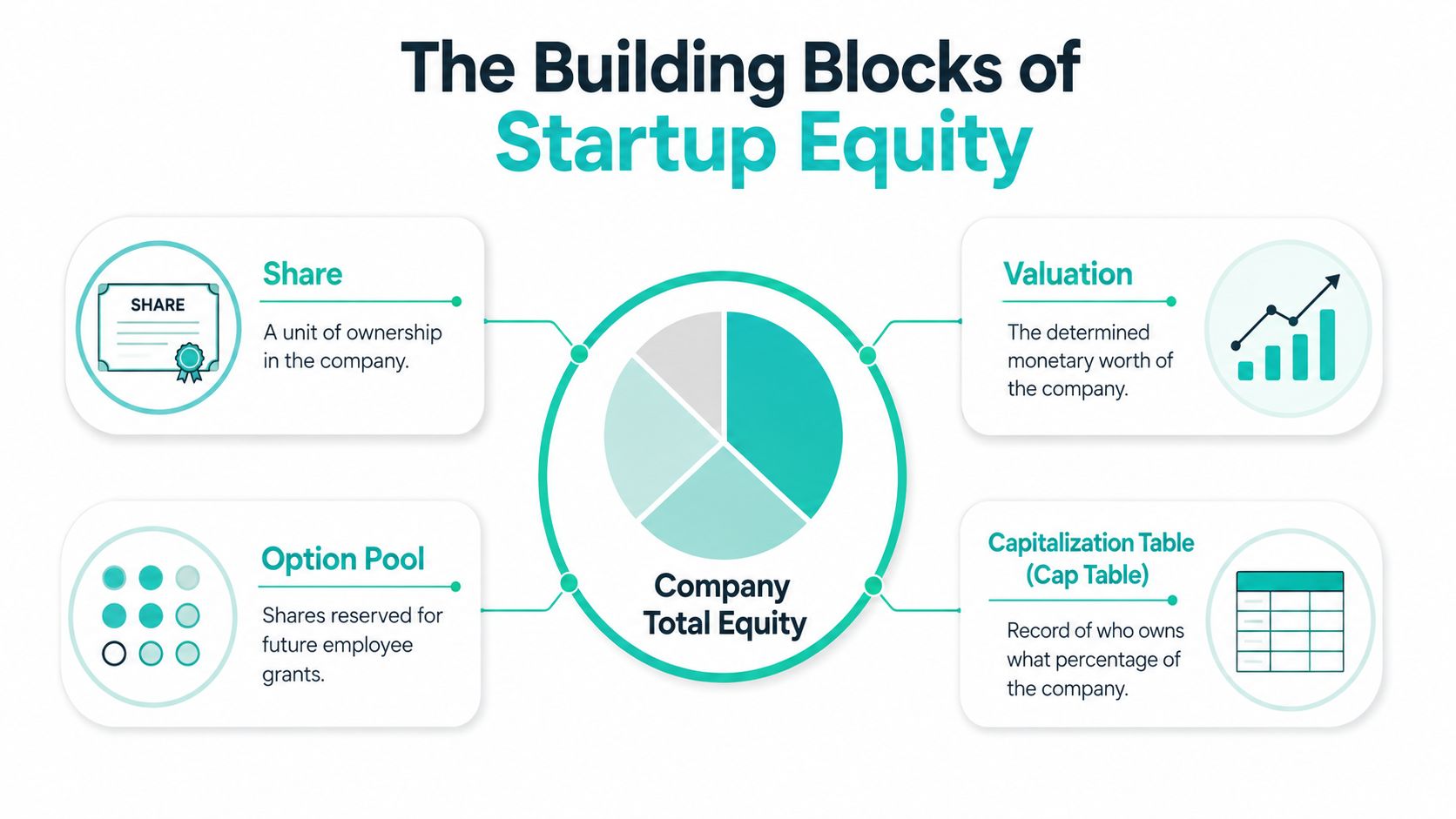
The capitalization table, or cap table, is the company's ownership record. It shows who owns what, how much has been reserved for the team, and how your grant fits into the whole. If you don't know the total share count, you can't judge the actual size of your package.
A grant is the promise, not the payoff. It tells you how many options you'll earn over time, but it doesn't mean you own those shares yet. The strike price is the amount you'll pay per share if you decide to exercise, and it's usually based on the company's private valuation framework at the time of grant.
Fair Market Value, or FMV, matters because it anchors that strike price. If the strike is far below the stock's later market price, the spread can create meaningful upside. If the company never grows past the strike price, the options can end up worthless.
Dilution means your slice can get smaller when the company issues more shares to employees or investors. That sounds negative, and sometimes it is, but it can also happen in a company that's growing fast enough to make everyone's slice more valuable in absolute terms.
For a plain-English primer on how private-company grants are usually structured, this guide on private company stock options is a useful companion read. One more thing that helps: don't confuse stock options with restricted shares. If you're comparing structures, these resale rules for restricted shares are a useful reminder that ownership and liquidity aren't the same thing.
The equity line in your offer letter should answer three questions fast, what kind of grant is it, when does tax show up, and how much risk are you taking before you can cash out. If it doesn't answer those questions clearly, ask for the equity plan documents and the grant agreement before you sign.
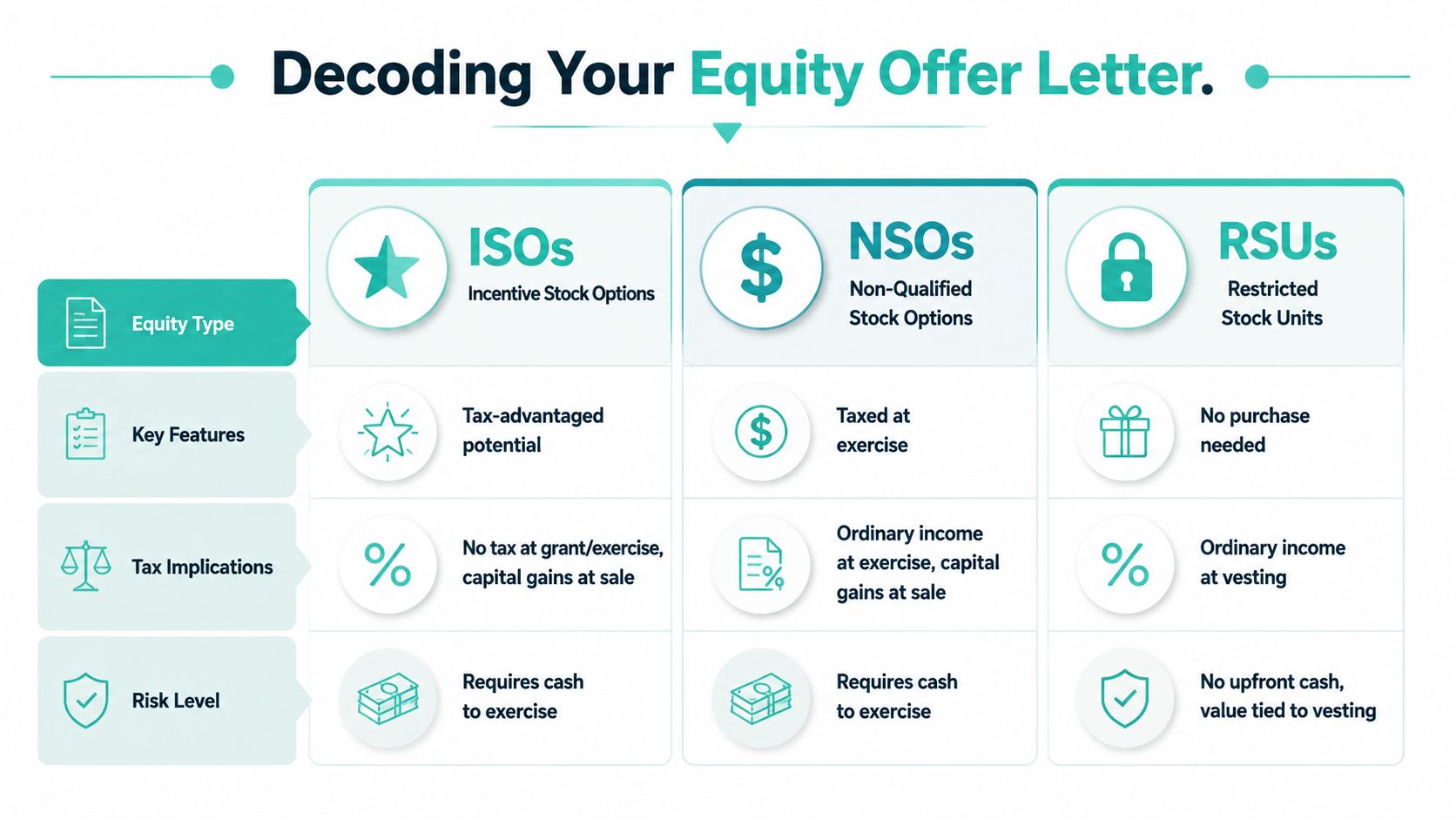
Incentive Stock Options, or ISOs, are the tax-favored version most candidates hope for. They can offer better treatment under the right conditions, but the rules are strict. The IRS notes that statutory options like ISOs generally are not taxed at grant or exercise, though they can trigger Alternative Minimum Tax, and the strike price must be at or above FMV at grant; the IRS also caps the term at 10 years, and RSM notes the $100,000 annual vesting-exercise limit measured by grant-date FMV can materially affect how much equity gets preferential treatment. IRS Topic 427, RSM's ISO overview
Non-Qualified Stock Options, or NSOs, are simpler in many ways. The tax hit usually happens at exercise rather than grant, and the IRS says nonstatutory options are generally taxed at exercise if the stock's fair market value isn't readily determinable. That makes NSOs common, but it also means you can face a tax event before you've sold anything.
Restricted Stock Units, or RSUs, feel more like a guaranteed award than an option. You don't buy them, you receive shares when they vest. That means no exercise decision, but it also means you usually owe ordinary income tax when vesting happens, not when you sell.
The biggest difference isn't terminology, it's behavior. ISOs and NSOs can leave you deciding whether to put in cash to exercise, while RSUs remove that choice but often create a tax event at vesting. The financial risk is also different, because stock options can expire unexercised if the company never grows into the strike price.
If you only remember one thing, remember this. The type of grant decides whether your risk is mostly upfront cash and tax timing, or mostly whether the stock ever becomes valuable enough to matter.
For a deeper employee-side breakdown of the mechanics, this equity guide is worth reading alongside your paperwork.
A grant date is just the starting line. The company gives you the right to earn the options over time, and that earning process is called vesting. Until vesting happens, you haven't really earned the whole grant, which is why leaving early can shrink the value of an apparently generous offer.
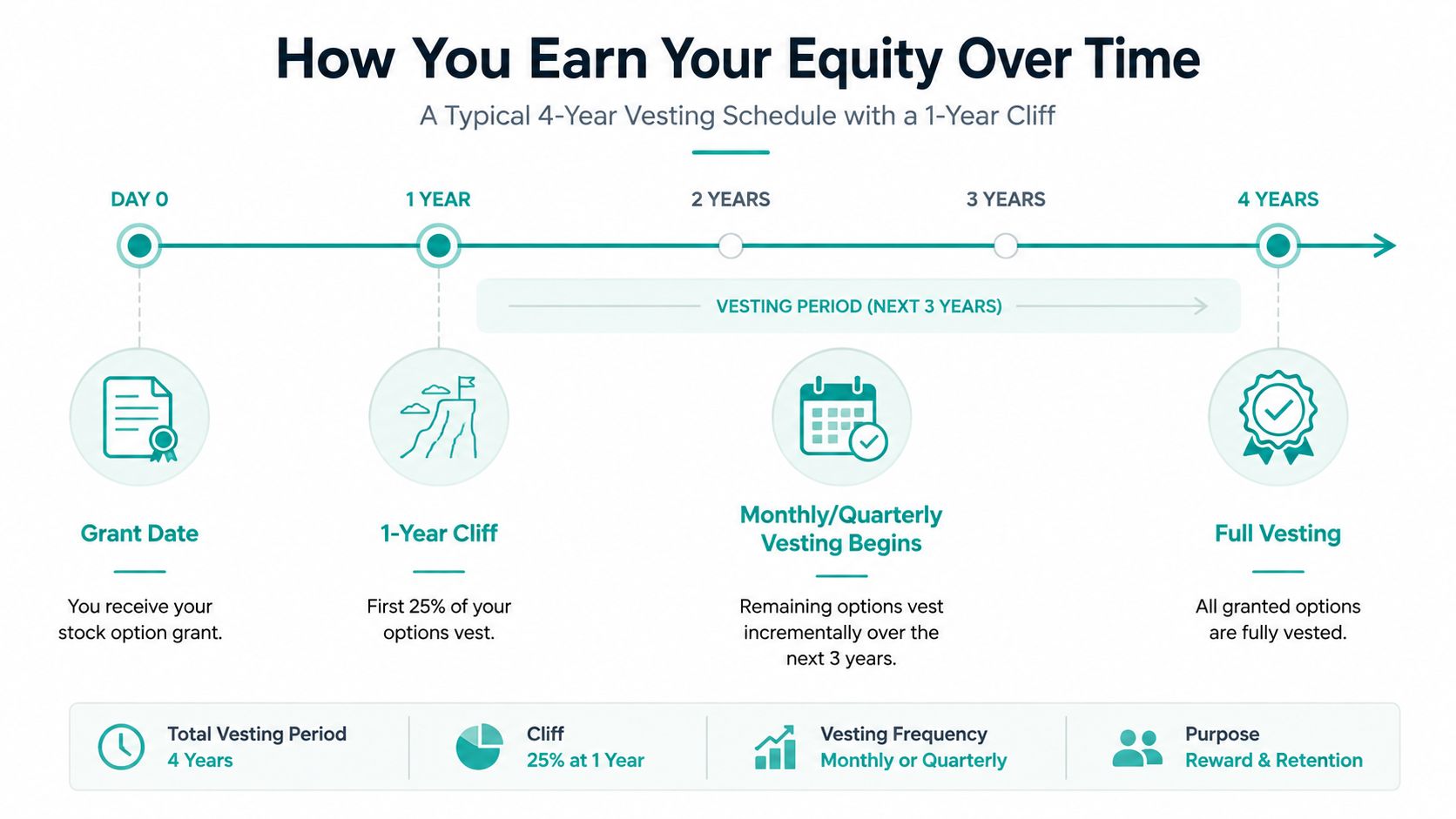
The standard startup pattern is 4-year vesting with a 1-year cliff, and Stanford's stock-option handout notes that a 10-year maximum term is also common, with your gain defined as the spread between market price and strike price at exercise. Stanford stock options overview
Here's how that plays out in practice:
Vesting and exercising are different. Vesting gives you the right to buy, while exercising is the act of paying the strike price and converting the option into stock. The catch is that your ability to wait doesn't last forever.
Most plans use a fixed term, and once that clock runs out, unexercised options expire. If you leave the company, you should also pay close attention to the post-termination exercise period, because that deadline can force a hard decision when you're already managing a job transition.
A useful mental model is simple. Vesting says “you earned it.” Exercise says “you bought it.” The two dates are often very far apart, and that gap is where employees make the costliest mistakes.
Tax is where option packages stop being theoretical. A grant that looks rich on paper can turn into a cash problem if you owe tax before you've sold a single share, and the trigger event depends on the type of equity you hold. The IRS separates statutory stock options from nonstatutory stock options, and that split controls when tax shows up. IRS Topic 427

For NSOs, exercise is the key event. The IRS says nonstatutory options are generally taxed at exercise if the fair market value of the stock isn't readily determinable, which means you can owe ordinary income tax when you turn the option into stock.
For ISOs, the picture is different. The IRS says they generally are not taxed at grant or exercise, but they can trigger AMT, and the tax benefit often depends on how long you hold the shares after exercise. That's why people who chase ISO tax treatment without planning for the cash requirement can get surprised.
For RSUs, vesting is usually the tax event. You don't need to pay to exercise, but you may still owe ordinary income tax when the shares vest, even if you keep holding them.
Ordinary income is usually taxed more heavily than long-term capital gains. That's why people chase favorable holding periods and talk about “starting the clock,” but the timing only helps if the company can support the wait and the stock survives long enough to justify it.
If you want a broader view of the tax-planning side, these practical strategies to lower tax are a useful starting point. The key thing to remember is that tax timing and liquidity timing are separate problems, and employees need to solve both before they exercise.
Practical rule: Never exercise just because the grant looks valuable. Exercise because you understand the tax event, the liquidity path, and the downside if the company stalls.
Don't treat stock options as a bonus. Treat them as a position with upside, downside, and real decision points. A classic finance study found that broad-based employee stock options can look much less attractive once high stock-price volatility, dilution, and forfeiture are part of the picture, which is why worst-case planning matters as much as upside dreaming. AEA finance study
Before you sign, ask for the total shares outstanding, the option pool size, the current 409A valuation, and the exercise price. You're trying to figure out what percentage of the company your grant represents, not just how many units you got on paper.
Also ask how the company handles future grants and refreshes. A candidate who knows whether the company tends to top up employees over time is in a much stronger position than one who accepts the first number at face value.
Early exercise can make sense in some cases, but only if you understand the trade-off. You're putting cash into shares of a company that might fail, and you may be starting a tax clock or exposing yourself to holding risk before there's any liquidity. Waiting can be safer in pure cash terms, but it can also leave you with less flexibility later if the grant terms are tight.
If the company is open to it, the meaningful levers are often the grant size, the exercise window, and whether you'll be considered for future refresh grants. An offer with a modest grant but no path for future equity can be less attractive than one with a similar initial grant plus a clear review cadence.
For a candidate-side approach to that conversation, this negotiation guide is a practical reference. One option among others for startup candidates is Underdog.io, which connects people with vetted startups and high-growth tech firms that do use equity as part of the package.
If you leave the company, vested and unvested options usually split in different directions. Unvested options generally go back to the company, while vested options may remain available only for a limited exercise window. That deadline is one of the most important details in the whole grant.
A 409A valuation is the private-company valuation used to help set the strike price for common stock grants. It matters because it helps establish the price you'd pay to exercise, and employees should always ask when that valuation was last updated.
Rule 701 is the legal reason many private companies can grant equity without full federal securities registration, as long as they stay within the relevant thresholds over a rolling 12-month period. That framework is one reason startup equity is so common in private companies, but it also means the plan has compliance boundaries the company has to respect.
Negotiation is possible, but it usually works best when you focus on a few levers instead of asking for everything. More options, a shorter vesting lag, a longer post-termination exercise period, or a refresh review after a year are all more concrete than a vague request for “better equity.”
If you're evaluating an offer right now, ask for the grant documents, check the strike price, confirm the vesting schedule, and map out what happens if you leave before a liquidity event. Then compare that package against the rest of your compensation, not just the number of options on the page.
If you're weighing a startup offer and want help finding companies that are serious about transparent equity, Underdog.io is built for candidates exploring startups and high-growth tech roles. It's a good fit when you want to compare offers with real context, not just a big option number and a recruiter pitch.