Not long ago, landing a role at an exciting, high-growth company meant you had to live in a major tech hub. That's not the world we live in anymore. The entire landscape for startups jobs remote has shifted, and innovative companies are now actively recruiting top talent from literally anywhere. This is your chance to join a fast-paced environment without uprooting your life.
The move to remote work isn't just a temporary fix for startups; it’s become a core business strategy. While established giants like Google or Amazon have been pushing for office returns, many startups are doubling down on distributed teams. Just look at companies like Shopify and Coinbase, which have built their entire operational model around a "digital by default" or "remote-first" approach.
This shift gives both companies and tech professionals a massive advantage. Startups get access to a global talent pool, letting them hire the best person for the job, period. It doesn't matter what their zip code is. For engineers, designers, and product managers, this cracks open a world of opportunity that used to be locked away in expensive cities like San Francisco and New York.
The logic behind this embrace of remote work is about more than just finding talent. There are some serious operational and cultural drivers pushing this change.
A software engineer in the Midwest can now be a key contributor to a cutting-edge fintech startup based in New York City. A few years ago, that was almost unheard of. The physical barriers are gone, putting the focus squarely on skill and impact.
This evolution has fundamentally changed how you should approach your job search. Forget sending out hundreds of applications into the void—the game is now about quality over quantity. Curated platforms that vet opportunities have become essential. They connect qualified pros directly with hiring managers at top-tier startups, turning the search from a numbers game into a strategic matching process.
To really crush it in this new era of distributed work, you need to understand how to stay effective. Implementing science-backed remote work productivity tips is a great place to start. For more on what makes these companies tick, check out our guide on building a strong remote company culture.
Stop wasting your time doom-scrolling through massive, generic job boards. Sending your application into a digital black hole alongside thousands of others is a losing strategy. If you want to land a great remote role at a high-growth startup, you need to go where the best companies are actually looking.
This means shifting your focus from high-volume, low-signal platforms to more curated channels. Think of it this way: a big job board is like a chaotic public market where anyone can shout for attention. A curated marketplace, on the other hand, is a private gallery where every opportunity is vetted for quality. For a software engineer exploring new roles, that difference is everything.
This isn't just about saving time. It's about getting in front of the right people at the right companies.
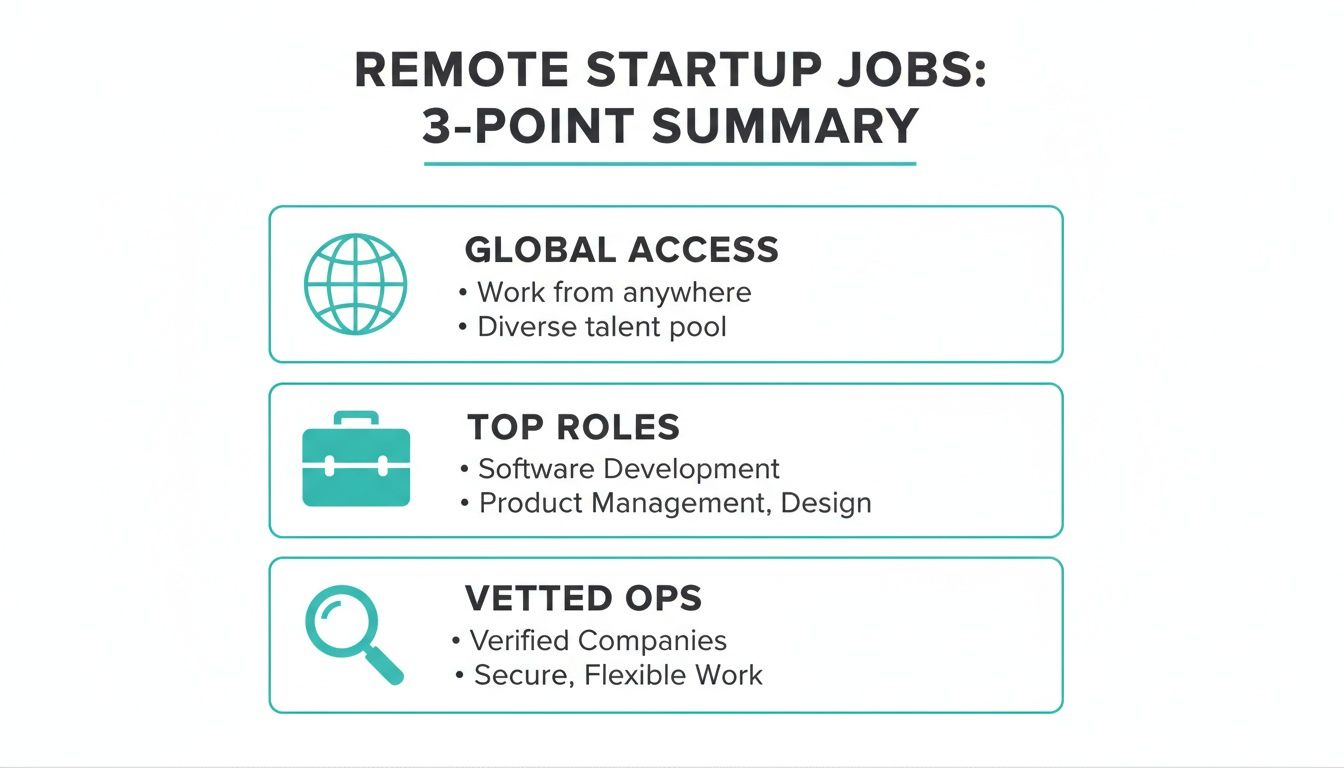
A focused search gives you a direct line to top-tier, vetted opportunities across the globe, cutting through all the usual noise.
Relying on a single source for job opportunities is a classic mistake. The best job seekers I know use a multi-channel approach that combines high-quality marketplaces with active participation in niche communities where people in their field hang out.
Here’s an actionable plan to diversify your job search:
The story of Preston Thorpe is a perfect example of this. He landed a software engineering job at a startup while incarcerated simply by contributing to their open-source project. He never sent a resume—his work got the attention of the company’s leadership directly.
This strategy completely flips the script. You stop being just another applicant and become a sought-after professional who is building a presence where your ideal employers are already looking.
Not all job search platforms are built the same, and knowing the difference helps you invest your time where it will have the most impact. Different channels offer vastly different levels of signal-to-noise.
To help you focus your efforts, here’s a quick comparison of the most common platform types.
While career pages and niche communities have their place, a curated marketplace gives you the highest leverage. You create a single profile and let the opportunities come to you, confident that the companies have already been vetted for quality and funding.
As you start seeing opportunities, you need to be selective. It’s crucial to understand which companies are truly committed to remote work versus those just dipping their toes in the water.
Some platforms do a great job of vetting the companies they feature, ensuring you only see roles from well-funded, serious startups with a real plan for remote culture. This saves you the headache of filtering out companies that aren’t a good long-term fit.
To get a better sense of who’s who in the remote world, you can learn more about the specific companies that hire remotely and see what their policies actually look like. By being thoughtful about where you search and which companies you engage with, you dramatically increase your odds of finding a role you’ll love.
When you’re applying for a remote role, your digital presence isn't just a foot in the door—it's your entire first impression. For anyone hunting for remote startup jobs, profiles on Underdog.io, LinkedIn, and even GitHub are your resume, cover letter, and initial interview rolled into one.
Hiring managers at fast-moving startups are scanning, not reading. They don’t have time to connect the dots. They need to see, in seconds, that you can deliver results from anywhere on the planet. This means you have to shift from listing what you did to proving the impact you made.
One of the most common mistakes I see is people simply describing their job. A startup hiring manager isn't looking for someone who "managed a project." They need to hire the person who drove a specific, measurable outcome.
A simple formula can transform your experience: Action + Tools + Result.
Here’s how you can translate bland responsibilities into powerful, remote-ready statements:
See the difference? These examples don't just list skills; they prove you know how to collaborate, communicate, and deliver value in a distributed environment—all without needing someone looking over your shoulder.
Beyond project wins, your profile needs to scream "remote-ready." Hiring managers are actively searching for clues that you’re a self-starter who thrives on asynchronous work and crystal-clear communication.
A crucial strategy for securing interviews is actively focusing on tailoring your resume to the job description of each remote opportunity. This ensures your most relevant remote-ready skills and achievements are front and center.
This is where you show, not just tell. A product manager can link out to a public-facing product requirements document (PRD) they wrote. A designer can build a case study that details the remote collaboration process, complete with screenshots of Figma comments, Miro boards, or Loom video walkthroughs.
For software engineers, your GitHub profile is your ultimate remote-work portfolio. Active contributions to open-source projects are one of the most powerful signals you can send. It shows you can navigate an existing codebase, collaborate with strangers through pull requests and issues, and ship quality work. These are all hallmarks of an exceptional remote teammate. To make sure your profile hits the mark, it’s worth brushing up on how to write a tech resume that truly sells your abilities.
Landing an interview for a coveted remote startup job is a huge win, but the process has its own set of unwritten rules. Success isn't just about what you say—it’s about how you project confidence, competence, and remote-readiness through a screen. You need to nail both the technical setup and the personal connection.

Think of the virtual interview as your stage. From the initial recruiter screen to a final round with the founders, every interaction is a chance to prove you’re the right fit for a distributed team. It all starts with treating your setup as seriously as you would your outfit for an in-person meeting.
A blurry, poorly lit video feed with scratchy audio sends the wrong message immediately. It suggests you aren't prepared for a professional remote environment, which is the very thing you're applying for. Before your first call, do a full tech rehearsal.
Your main goal is to create a totally distraction-free experience for the interviewer.
For engineers, designers, and product managers, the remote technical interview can be especially intimidating. Whether it's a live coding session, a system design whiteboard, or a product teardown, the absolute key is to communicate your thought process out loud.
Silence is your enemy. The interviewer can't read your mind, so you have to narrate your every move.
Think of it as a live stream for an audience of one. Explain what you're thinking, why you're choosing a particular approach, and what trade-offs you're considering. This turns the exercise from a simple test into a collaborative problem-solving session, which is exactly what hiring managers want to see.
For example, if you're a software engineer in a coding challenge, don't just start typing. Kick it off by saying, "Okay, first I want to clarify the requirements. It looks like the input is an array of integers. My initial thought is to use a hash map to track frequencies, which would be an O(n) solution. Let me start by outlining that structure."
Remember, the interview is a two-way street. You are evaluating the company just as much as they are evaluating you. This is your chance to figure out if the startup is truly remote-first or just remote-tolerant. The difference is critical for your long-term happiness and career growth.
Pay close attention to how they answer questions about their remote culture. Vague, hand-wavy responses are a major red flag.
Here's a checklist of questions to ask and what to listen for in their answers:
By digging into their real-world processes for communication, inclusion, and daily workflow, you can uncover whether remote work is a core part of their DNA or just a superficial perk. A truly remote-first company will have deliberate, thoughtful answers to these questions.
That offer letter in your inbox is a huge win. But don’t pop the champagne just yet. This is where the real work begins—the critical evaluation phase, especially when you're looking at remote startup jobs.
A startup offer is a different beast entirely, packed with financial instruments like equity that go far beyond a simple salary number. It's your job to look past the top-line figure and figure out what's really being offered. Don't be shy about asking the tough questions to get a crystal-clear picture.
First things first, you have to break the offer down into its core pieces. Base salary is the easy part. The real value—and the real variables—lie in the equity, benefits, and remote-specific perks. Getting a handle on these details is what separates a good decision from a bad one.
When it comes to the equity portion, you absolutely must ask:
Just as crucial is the company's financial stability. You need to ask about their current runway—how many months of cash they have in the bank. This single number gives you a sense of job security in the often-turbulent startup world.
Your goal is to translate abstract numbers into a concrete understanding of your potential financial outcome. An offer with a lower base salary but a more generous and clear equity package from a financially healthy startup could be far more valuable in the long run.
Beyond the numbers, you have to figure out if you're joining a true remote-first company or just one that's "remote-friendly." A remote-friendly company might let you work from home, but its culture, processes, and power dynamics are still chained to a physical office. This is a recipe for feeling like a second-class citizen.
In your final calls, dig into their day-to-day operations. Ask pointed questions about how the team handles asynchronous communication, documentation, and decision-making. A genuinely remote-first startup will have deliberate processes built around tools like Notion, Slack, and RFC (Request for Comments) docs. If you get vague answers here, consider it a major red flag.
Negotiation isn’t just about asking for more money. For a remote role, it's your chance to secure the tools and flexibility you need to actually thrive outside of an office. Think about what will genuinely improve your work life, and don't be afraid to ask for it.
Consider negotiating for perks that are unique to remote work:
Startups are often way more flexible than big corporations and might be willing to get creative to land the right person. By dissecting the offer, grilling them on their culture, and negotiating for what truly matters, you can lock in a fantastic total package that sets you up for long-term success.
As you get deeper into your remote startup job search, a few common questions always seem to pop up. Let's tackle them head-on so you can move forward with confidence.
The short answer is: it depends. That’s why you need to bring this up early in the process.
A growing number of forward-thinking startups have adopted location-agnostic pay, meaning they offer the same salary for a role regardless of where you live. However, many others still adjust compensation based on your local cost of living. There's no industry standard yet, so you have to ask.
When it comes to equity, the grant itself is rarely tied to your location. In fact, one of the biggest upsides of remote work is that it unlocks access to opportunities in major tech hubs like San Francisco or New York, no matter where you live. This can open the door to potentially larger equity packages than you might find with local companies. Always look at the total compensation—salary, equity, benefits, and any stipends—to see the full picture.
You don't need "remote" on your resume to prove you have what it takes. Instead, focus on highlighting the transferable skills that are absolutely critical for success in a distributed team.
Frame your past projects and experiences to showcase these key traits:
This isn't about having a "remote" job title. It's about proving you're a self-motivated professional who communicates clearly and takes initiative.
A remote-first startup builds its processes around the assumption that no one is in the office. Communication is primarily asynchronous and written, documentation is king, and meetings are intentional and purposeful.
In contrast, a hybrid or "remote-friendly" company might still have an office-centric culture. This can create an uneven playing field, where remote employees feel left out of key conversations or passed over for promotions. During your interviews, dig into how they really operate to gauge the culture.
Yes, significantly more so than just a few years ago. While some large tech companies have pulled employees back to the office, many startups — particularly those that were founded during or after the remote-work shift — have built their entire operating model around distributed teams. Companies like Shopify and Coinbase adopted remote-first approaches as a core business strategy, not just a temporary accommodation. For candidates with strong technical, product, and design skills, remote startup roles are genuinely plentiful, especially on curated platforms that pre-vet both companies and candidates.
The distinction matters more than most candidates realize. A remote-first startup is built from the ground up around the assumption that no one is in the same physical location. Communication is primarily asynchronous and written, decisions are documented openly, and processes are designed so that every team member — regardless of location — has equal access to information and opportunity. A remote-friendly company, by contrast, may allow employees to work from home but still has an office-centric culture where key conversations happen in person and remote employees can end up feeling like second-class citizens. When evaluating any remote role, asking pointed questions about how decisions are made, how promotions work, and how communication is structured will quickly reveal which type of company you're dealing with.
The most effective strategy combines a few channels rather than relying on a single source. Curated hiring marketplaces like Underdog.io are the highest-leverage starting point — you create one profile and get matched directly with vetted, high-growth startups that are actively hiring for remote roles. Beyond that, niche professional communities specific to your craft (Discord servers, Slack groups, specialized forums) are often where early-stage startups post roles before they're listed publicly. Following venture capital firm portfolio pages is another underused tactic: well-funded companies in a VC's portfolio are almost always hiring and actively looking for remote talent.
It depends on the company's compensation philosophy, which is why it's essential to ask early in the process. Some forward-thinking startups have adopted location-agnostic pay, offering the same salary for a role regardless of where the employee lives. Others use tiered pay bands adjusted for cost of living, meaning someone in a lower-cost city earns less than someone doing the same job in San Francisco. Equity, however, is almost never adjusted for location — which means remote startup jobs can actually unlock access to larger equity packages than you might find at local companies, particularly if you're targeting well-funded startups based in major tech hubs.
Beyond your core professional expertise, remote startup hiring managers are specifically screening for a set of traits that signal you'll thrive in a distributed environment. Self-direction and the ability to take ownership of work without close supervision are at the top of the list. Strong written communication is equally critical — since async communication replaces most in-person interaction, your ability to write clearly and concisely in Slack, Notion, or documentation carries significant weight. Comfort with the standard remote work tool stack (project management tools, video conferencing, collaborative docs) is expected, and any history of contributing to open-source projects or working on distributed teams is a meaningful differentiator.
Every bullet point on your resume and profile should be reframed around impact rather than responsibilities, using a structure of action plus tools plus result. For remote roles specifically, weave in examples that demonstrate you can collaborate and deliver across time zones without needing oversight — for example, noting that you led a distributed team, managed a project asynchronously, or improved a remote onboarding process with a measurable outcome. On LinkedIn and GitHub, active contributions to open-source projects are particularly powerful signals for remote roles, as they demonstrate you can navigate an existing codebase, collaborate through pull requests, and ship quality work with people you've never met in person.
A remote startup offer has more moving parts than a standard corporate offer, and evaluating it thoroughly requires looking beyond the base salary. Understand the equity component in full — what percentage of the company does your grant represent, what is the strike price, and what does the vesting schedule look like? Ask about the company's financial runway to gauge stability. On the remote-specific side, look for perks like a home office stipend, a professional development budget, flexible working hours, and whether the company covers coworking space memberships. Assess whether the culture is genuinely remote-first by asking how decisions are made, how promotions are determined, and how the team handles async communication before you accept.
Yes. Hiring managers understand that many strong candidates are transitioning into remote work for the first time, and a lack of a "remote" job title on your resume is not a dealbreaker. What matters is demonstrating the underlying skills that make someone effective in a distributed environment: taking initiative, communicating proactively and in writing, working independently toward clear goals, and using collaborative tools efficiently. Frame your past experiences to highlight moments where you worked autonomously, managed projects across stakeholders, or produced clear written documentation. These signals are far more persuasive than a remote job title you don't yet have.
Software engineering remains the most abundant remote role at startups by a significant margin, followed by product management, data science and analytics, UX and product design, growth marketing, and technical writing. With the surge in AI adoption, roles focused on machine learning engineering and AI product development have seen especially strong remote availability heading into 2026. Operations and finance roles have become more remote-accessible as well, though they tend to lag behind technical roles in remote availability. The widest selection of fully remote startup roles consistently sits in the engineering, product, and data disciplines.
Finding the right remote startup role is about connecting with companies that align with your career goals and work style. Underdog.io makes this process simple by matching you with hundreds of vetted, high-growth startups with a single, private profile. Let the best remote opportunities find you at https://underdog.io.