You usually notice the problem too late.
A startup makes a few strong early hires. Everyone moves fast because the team is small and the founders sit in the middle of every decision. Then headcount grows. One manager rewards speed. Another rewards caution. Product says customer empathy matters, engineering hears deadline above all, and sales promises features the team never intended to build.
Then the true signal shows up. A hire who looked great on paper creates drag in every cross-functional meeting. A candidate who loved the mission during interviews quits after a few months because the day-to-day job feels nothing like the story they were sold.
That's the point where many founders start talking about company core values. Often too late, and often in the wrong way.
The fix isn't to write a prettier values page. It's to define a small set of behaviors that help people make hard calls under pressure, then prove those behaviors in hiring, onboarding, and management. If your values don't change who you hire, how you onboard, and what behavior gets rewarded, they're decoration.
A vague culture doesn't feel vague when the company is ten people. It feels flexible. Everyone assumes they mean the same thing by “high standards,” “ownership,” or “urgency” because they've worked shoulder to shoulder and watched the founders make calls in real time.
That breaks once the company starts scaling. A product manager thinks “be proactive” means ship a rough first version and learn from users. An engineering lead thinks it means surface risks early and slow down before production breaks. Both sound reasonable. Without shared values, both people think they're defending the company.
The damage shows up in ordinary moments. Hiring panels disagree on what “good” looks like. New managers invent their own rules. Feedback gets personal because there's no agreed standard for behavior. The company starts calling every conflict a communication problem when it's really an alignment problem.
For a deeper look at how this drift reshapes a team, Underdog's piece on startup company culture gets at the practical reality founders run into as they grow.
The expensive hire usually isn't the person with weak skills. It's the person with strong skills and the wrong instincts.
They may be excellent in a structured environment but freeze when priorities change twice in a week. Or they may love speed and autonomy but ignore the documentation and handoffs your team needs to function. In both cases, the company blames execution when the failure happened much earlier. Nobody defined the behaviors that matter.
A startup without clear values asks every manager to improvise culture on the fly.
In a larger company, process can absorb some ambiguity. In a startup, ambiguity multiplies because people are making decisions with less support and less time. That's why company core values matter most when things are messy, not when everything is calm.
If your team can't answer simple questions like “What gets rewarded here?” or “What behavior breaks trust here?”, culture becomes whatever the loudest manager says it is that week.
Clear company core values do three jobs at once. They speed up decisions, reduce managerial drift, and help candidates decide whether your company is worth the risk of joining.
That's especially important in startups, where the team can't escalate every judgment call to a founder. Values give people a decision filter when there's no time for consensus and no policy manual to hide behind.
A useful value isn't “excellence.” That word is too broad to guide anybody. A useful value sounds more like “default to transparency” or “disagree and commit.” People can use those in a product review, a customer escalation, or a roadmap debate without waiting for executive interpretation.
This is also where leadership matters. Founders can't preach openness and then run major decisions through private side channels. Teams watch behavior faster than they read handbooks. If you want a practical primer on how leaders make values credible, this guide on how to drive success with authentic leadership is worth reading.
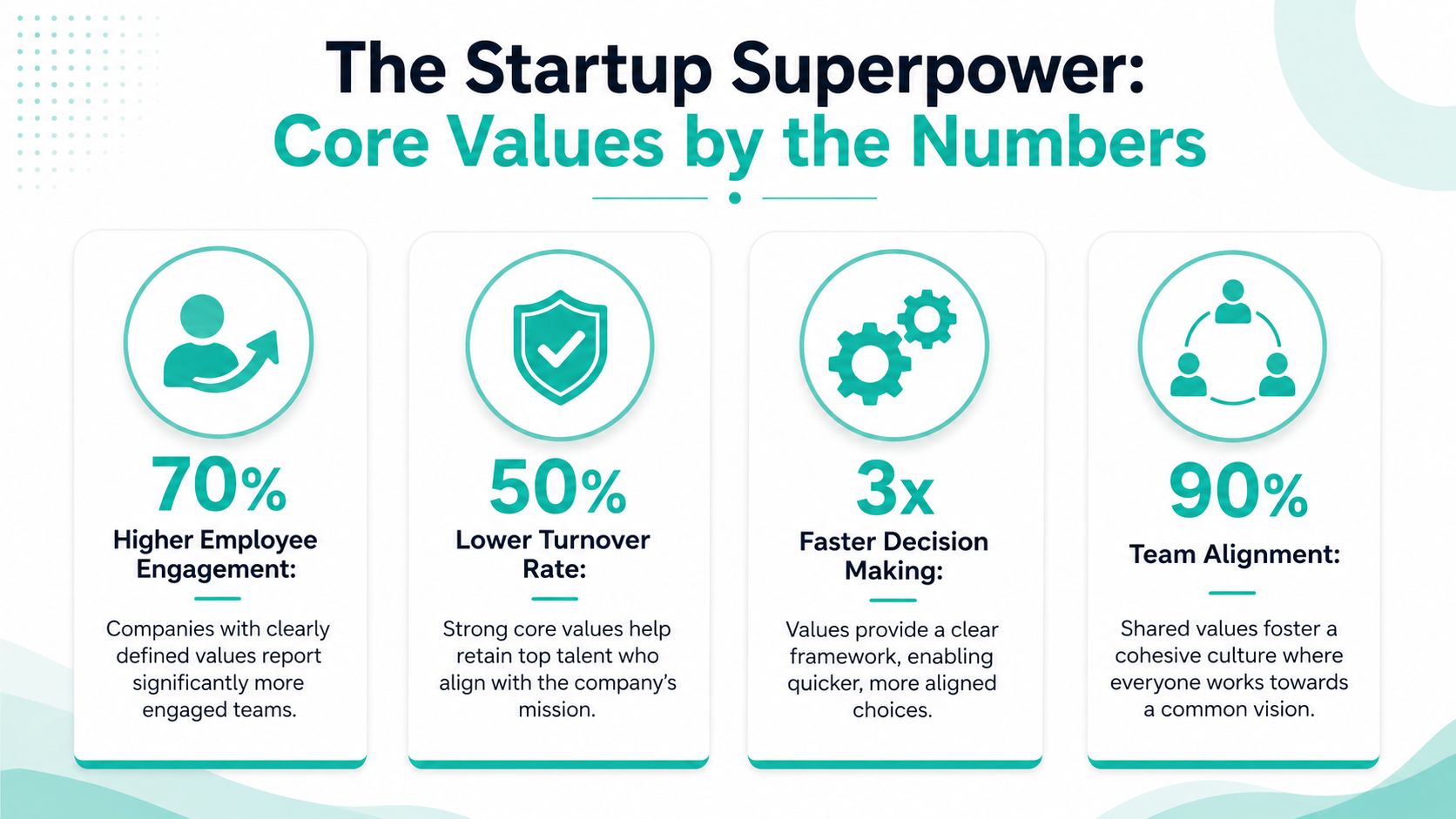
The hiring case is straightforward. According to Gallup, just 27% of employees strongly believe in their company's core values, and only 23% feel they can apply them daily. This credibility gap is a major risk, especially since Qualtrics finds over half of U.S. employees choose employers based on value alignment in Gallup's analysis of core values at work.
That combination tells you something blunt. Candidates care about values, but many employers haven't made theirs believable.
For startups, that gap is a competitive opening. You usually can't outbid a larger company on certainty, brand, or perks. You can win by being clearer about how the company works, what trade-offs it makes, and what kind of person thrives there.
Perks attract attention. Values shape trust.
A passive candidate may ignore another polished job post, but they'll pay attention if your team can explain how decisions get made, how conflict is handled, and what standards apply when the pressure is high. That level of clarity signals operational maturity.
Practical rule: If a value doesn't help someone choose between two imperfect options, it's not a value. It's branding copy.
Most startup values fail because they're harmless. Nobody objects to “integrity,” “teamwork,” or “innovation,” which is exactly the problem. If every company can say it, the phrase doesn't help anybody hire, manage, or decide.
Better values have edges. They tell people what to do when good options conflict.
| Generic Corporate Value | Actionable Startup Value | What It Looks Like in Practice |
|---|---|---|
| Integrity | Default to transparency | In a stand-up, a lead says a launch is slipping before the deadline is missed, not after. In a customer call, the team admits what isn't built yet instead of implying it's around the corner. |
| Innovation | Ship, measure, learn | Product launches a narrow first version, checks usage and feedback, then iterates. Teams avoid six-week debates over ideas no customer has touched. |
| Teamwork | Disagree and commit | In roadmap planning, people challenge assumptions hard in the meeting. Once the call is made, they stop relitigating it in side chats. |
| Accountability | Own the outcome, not just the task | An engineer doesn't stop at “my ticket is done.” They stay engaged until the feature works for users in production. |
| Respect | Give direct feedback early | A manager doesn't let frustration build for a quarter. They raise the issue when it's still fixable and specific. |
| Excellence | Raise the bar where it matters | The team doesn't gold-plate every internal tool. They spend extra effort on customer-facing workflows and reliability risks. |
| Agility | Move with context, not chaos | People act quickly, but they explain trade-offs in Slack, docs, or meetings so the rest of the org can follow the logic. |
Some of the strongest value language I've seen is short enough to survive real use:
Each one carries an operational meaning. A recruiter can use it. A manager can coach with it. A candidate can test whether the company behaves that way.
Take any draft value and run it through three questions:
If the answer to the third question is no, the value is probably too safe. Strong company core values attract the right people partly because they repel the wrong ones.
Most founders make the same mistake. They start with adjectives.
That usually produces a list pulled from memory, aspiration, or investor decks. It sounds polished and means very little. The better approach is to work backward from behavior your team already trusts.
Deep mission alignment matters here. Aligned employees tolerate growing pains 2–3× longer. Defining values through strategic questions reduces recruitment costs by 15-20% and cuts onboarding time by 30% by pre-establishing behavioral frameworks, according to Talgo's startup hiring analysis.
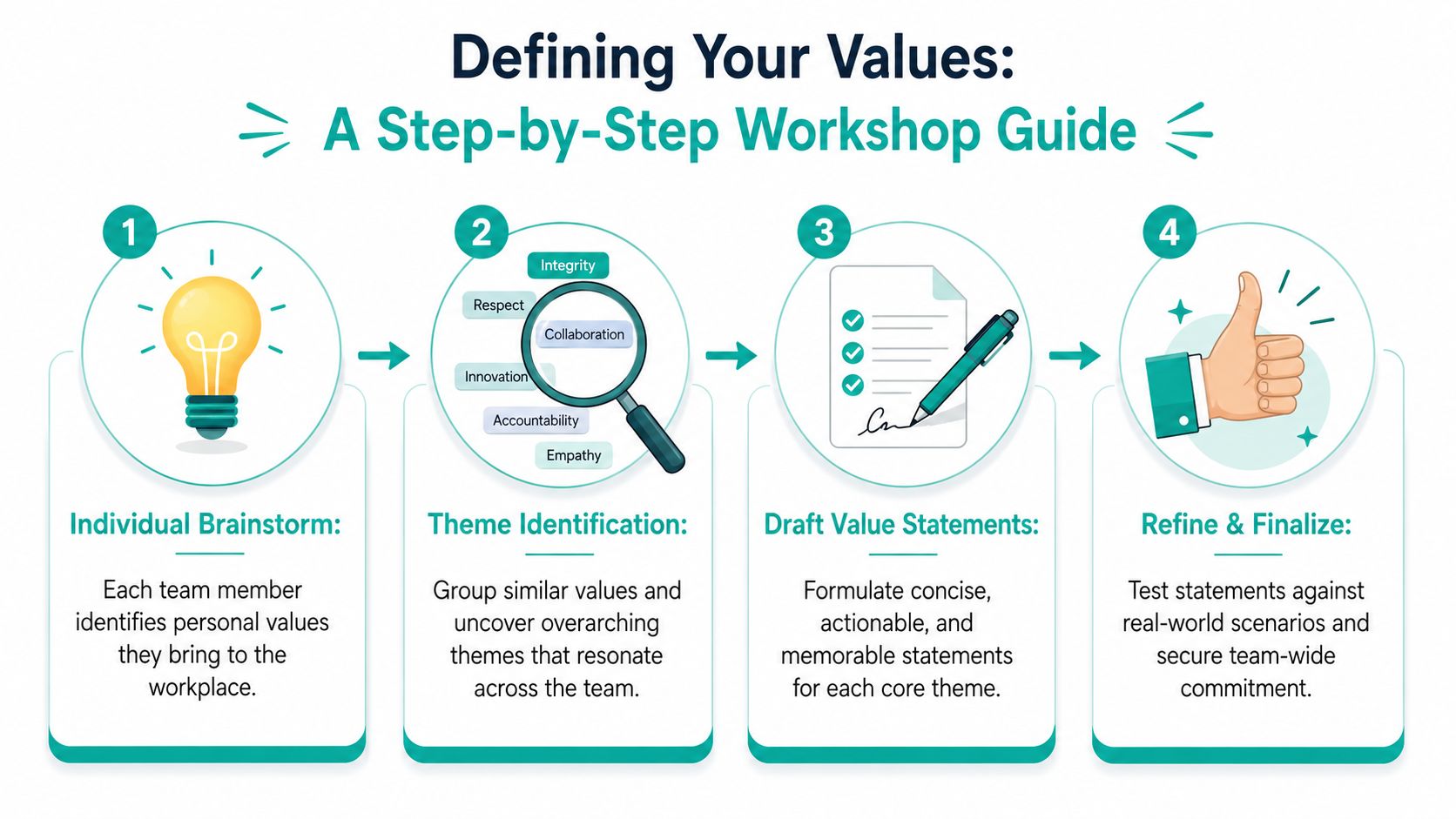
Get the founding team and a few trusted early operators in a room. Ask for specific moments, not ideals.
Use prompts like these:
Patterns will show up fast. Maybe your strongest people escalate bad news early. Maybe they write things down without being asked. Maybe they challenge leaders directly but commit once the decision is made.
That's the raw material.
Once you've got a list of behaviors, group them by theme. Don't worry about elegant wording yet. Look for repeated instincts.
You might hear versions of:
That's probably a transparency value.
Then draft the value as a behavior statement, not a moral statement. “Default to transparency” is stronger than “honesty.” “Write it down” is stronger than “communication.”
The right value feels slightly uncomfortable because it forces a trade-off your team actually faces.
If you need a slide deck to explain your values, you have too many. The practical target is 3–5 principles, because that's the range most likely to stay usable in hiring and management. That recommendation also lines up with the guidance that startups should limit values to 3-5 and embed them into real operating systems, as covered later from Climate People's hiring guidance.
Use this filter before finalizing:
If a value is aspirational, label it as an operating goal, not a core value. Mixing the two is how companies create cynicism.
At this point, most values die.
A company defines them, prints them, maybe adds them to the careers page, then runs a hiring process that ignores them completely. Candidates get assessed for skills, pedigree, and “culture fit,” which usually means interviewer instinct. Then leaders act surprised when the values never stick.
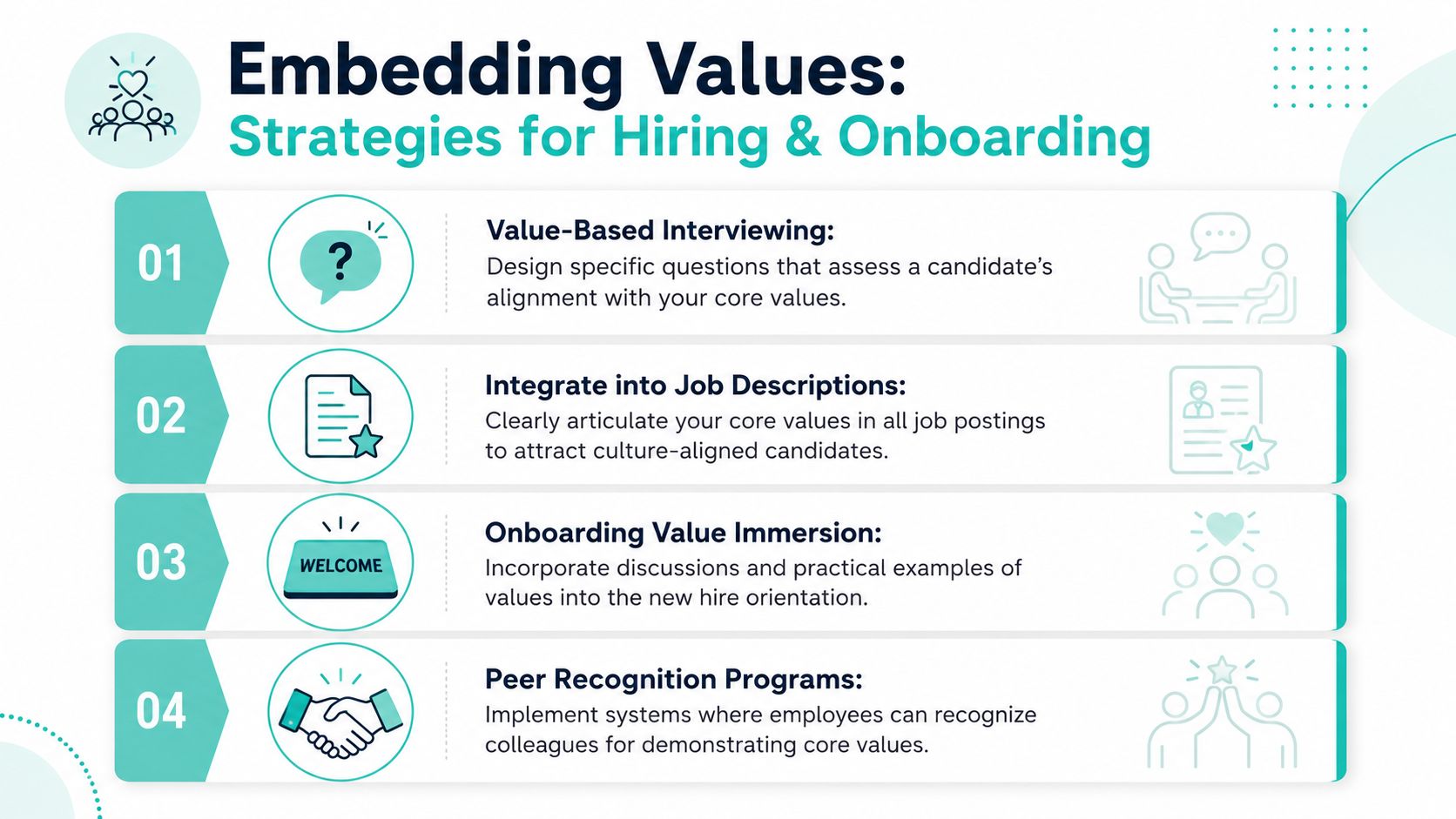
The fix is operational. Put company core values into job descriptions, interview rubrics, debriefs, and onboarding tasks. Only 38% of HR leaders believe employees can even recite their company's core values. To fix this, startups must limit values to 3-5 principles and embed them directly into hiring scripts and performance reviews to ensure they drive behavior, according to Climate People's recruiting and retention guidance.
For a broader hiring system around startup constraints, this guide to recruitment for startups complements the values piece well.
Most job descriptions hide the actual work under generic language. If your value is “move with context, not chaos,” say so in the role description.
Not like this:
Write it like this instead:
That language does two things. It attracts people who like that operating style, and it warns off candidates who don't.
Don't ask, “Do you value transparency?” Every candidate knows the right answer.
Ask for evidence. Here are examples startups can use immediately:
The key is consistency. One interviewer, one value, one scorecard. If everyone loosely checks for “culture,” you'll get bias disguised as instinct.
Ask for a real example, a specific action, and the outcome. If a candidate stays abstract, keep digging.
Most onboarding covers tools, systems, and intros. That's necessary, but it's not enough. New hires need to see how the values work under pressure.
A simple onboarding checklist might include:
This is also where founders should use exact language. Don't say, “We care about transparency.” Say, “If a deadline is slipping, we want to hear it while there's still time to help.”
Values become fluffy when nobody measures whether they changed anything.
That doesn't mean you need a complex people analytics stack. Early-stage startups can do this with a lightweight system if they're disciplined about what they track and how they interpret it.
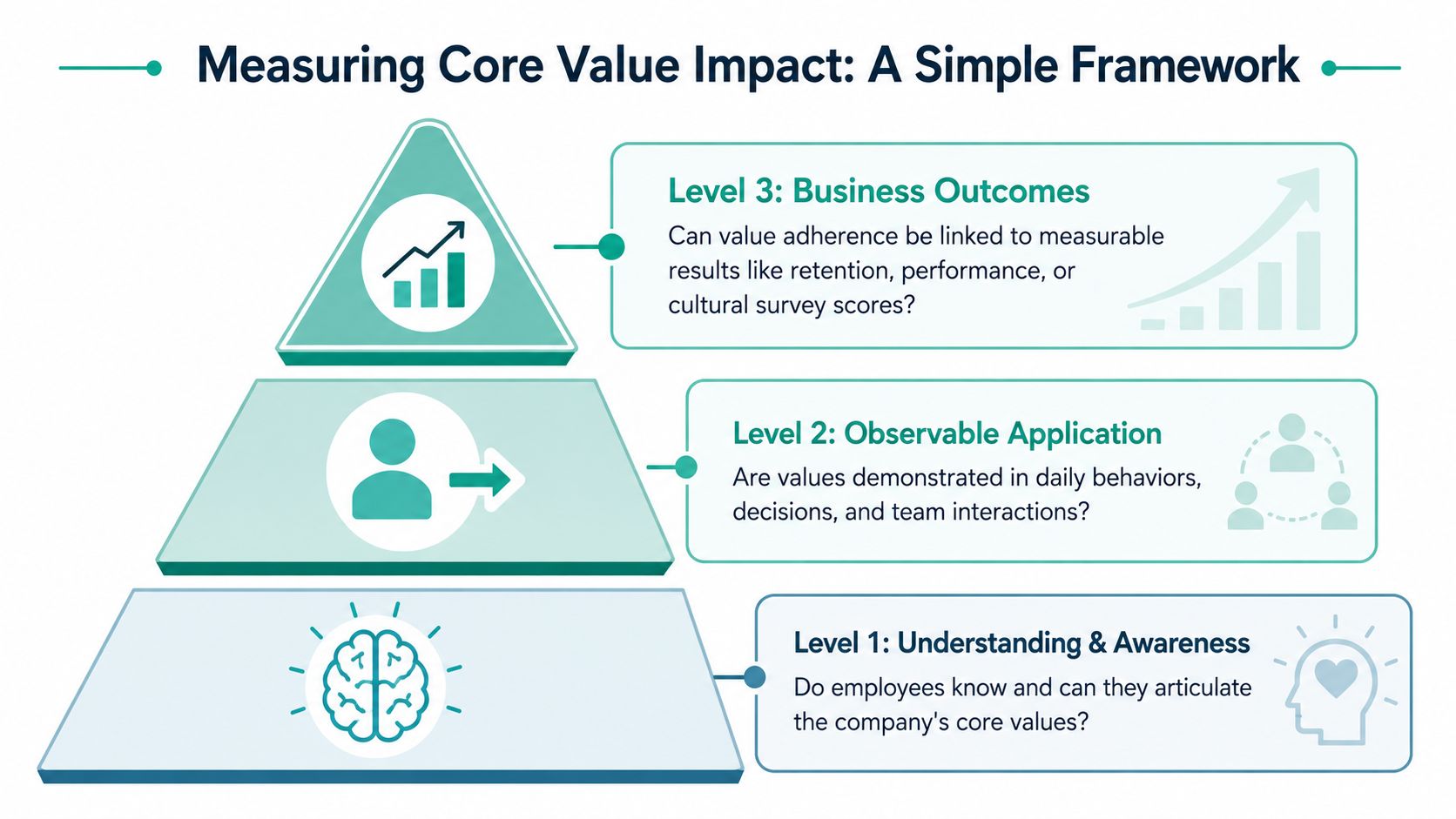
The useful frame is simple. Most content on core values fails to explain how startups can quantitatively prove they drive outcomes. Research shows that mapping values to specific actions and measuring them via retention and sentiment data is the key to increasing trust and engagement, as outlined in Built In's discussion of company core values examples.
If you're building a more rigorous scorecard, Underdog's overview of quality of hire metrics is a practical companion.
Start with the basic question. Do people know the values, and can they explain them in plain language?
You don't need a formal annual survey. Ask managers in one-on-ones. Run a short pulse check. Use onboarding checkpoints. If employees can recite the words but can't describe the behaviors, awareness is still weak.
This is the layer most companies skip.
For each value, define one or two observable actions:
Then check for those actions in:
A useful pulse question is, “How often did you see this value in action on your team this week?” That shifts the conversation from slogans to evidence.
Don't overclaim. Culture is rarely the only variable in retention, hiring speed, or performance. But you can still look for directional signals.
Use a basic framework:
The goal isn't to prove culture with perfect precision. It's to create enough evidence that leaders can improve it deliberately.
When a value isn't showing up in these places, don't rewrite the wording first. Check whether leaders are modeling it, whether managers are coaching to it, and whether hiring screens for it at all.
The most common failure isn't bad intent. It's treating values as a branding exercise instead of an operating system.
Founders borrow generic language from admired companies. Leaders launch the values once, then never use them in hiring or performance conversations. Managers get no examples, so each one interprets the values differently. Employees notice the gap and stop taking the whole thing seriously.
The toughest issue is credibility during hiring. A key problem is the Values-Application Paradox: candidates, especially passive ones, can't verify if a startup's stated values are real during the hiring process. This creates a trust gap that companies must close by demonstrating their values operationally, as described in Firstup's discussion of communicating company core values.
Run a single working session with your founders and earliest trusted operators. Block ninety minutes. Ask for stories about the team at its best, the team at its worst, and the hires you'd make again without hesitation.
From that, draft three to five behavior-based company core values. Then test each one against a real hiring question and a real management example. If you can't do both, the value isn't ready.
The companies that get this right don't have prettier posters. They make it easier for the right people to join, contribute, and stay.
If you're exploring startup roles and want a quieter, more selective process, Underdog.io is built for that. Candidates use one short application to get introduced to vetted startups, with a focus on real fit across product, engineering, design, and data. It's a useful option if you care as much about how a company operates as the title on the job description.