Your first data science offer usually arrives with a rush of relief, then confusion. You see a base salary, maybe a bonus, maybe stock options, and suddenly the question isn’t “did I get the job?” It’s “am I about to make a smart financial decision or just react to the biggest number on the page?”
Most new grads make the same mistake. They fixate on base pay and ignore the structure of the offer. That’s a problem, especially in tech, where two roles with similar titles can lead to very different outcomes depending on location, equity, team quality, and growth path.
A good first offer should do more than pay your bills. It should create an advantage for your next move. That means looking at compensation the way an investor would look at a company. What’s guaranteed? What’s upside? What’s risky? What compounds?
If you're still deciding between adjacent paths, YourAI2Day's guide to ML roles is useful because it helps separate data science from machine learning scientist work, and that distinction affects both compensation and expectations.
The phrase data scientist starting salary sounds simple. It isn’t. The offer in front of you is a package, not a number.
A large company might give you a cleaner cash-heavy deal. A startup might offer less salary but more ownership. One job might look stronger on day one, while the other could set up better career acceleration if the team is sharp and the product has traction.
That’s why you need a filter.
Don’t ask, “What’s the highest salary I can get?”
Ask these instead:
Your first offer isn’t a trophy. It’s an asset allocation decision.
A smart candidate reads an offer letter like a model. You’re comparing present cash, future upside, risk, and credibility. Once you do that, the noise drops away and the decision gets clearer.
Here’s the baseline you need. In 2025, entry-level data scientists in the United States, typically with 0 to 2 years of experience, commanded starting base salaries ranging from $80,000 to $130,000 annually, with the 25th percentile around $98,000 according to Smith Hanley’s 2025 data science salary report.
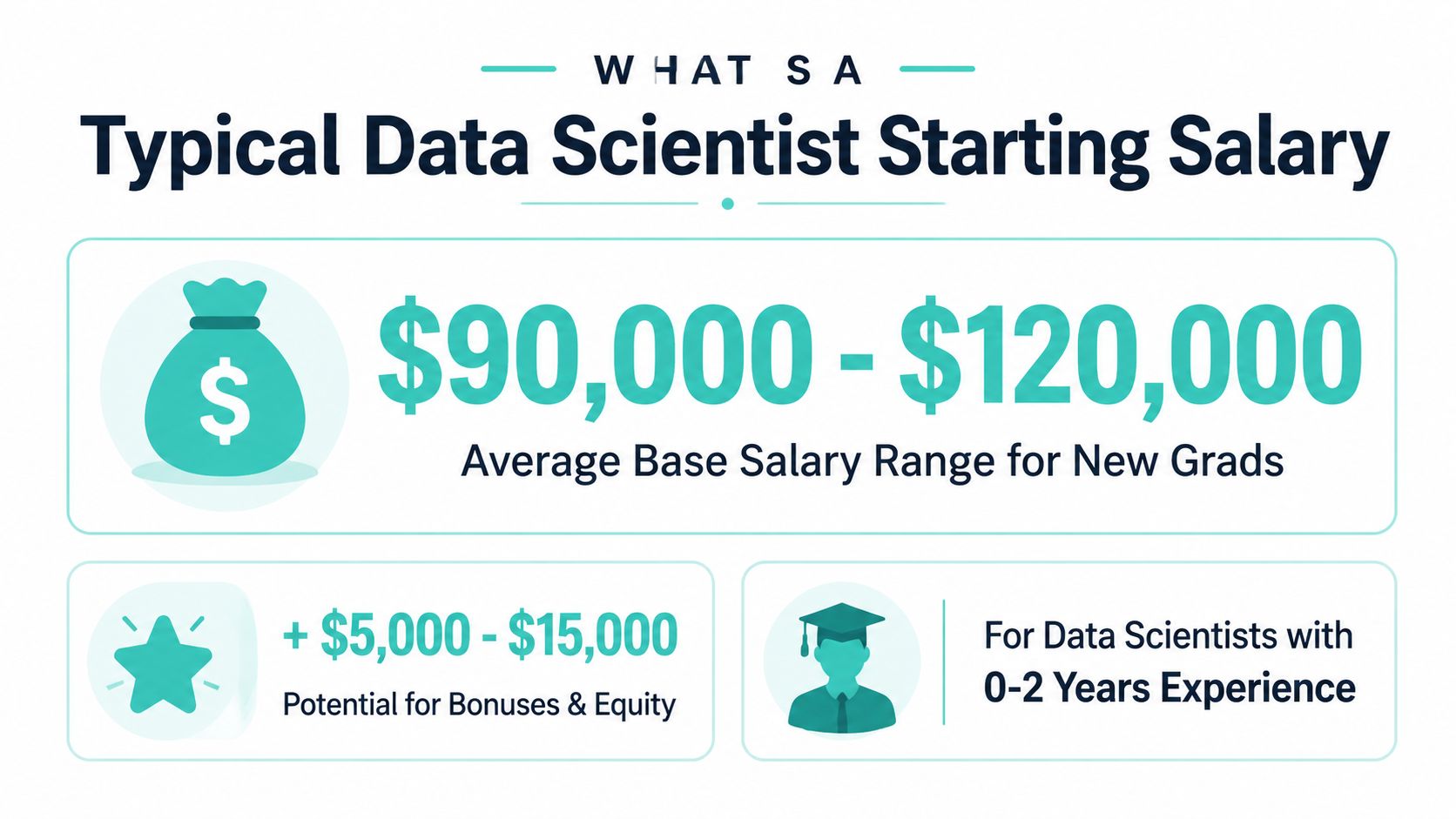
That tells you two important things immediately. First, the range is wide. Second, you shouldn’t panic if your offer doesn’t land at the very top of it.
A salary near the lower end usually signals one of these conditions:
A salary near the upper end usually reflects a stronger negotiating position:
The market range is helpful, but it’s not a verdict on your worth. It’s a snapshot of what employers are willing to pay for a specific mix of education, geography, and evidence.
Use it as a benchmark, not a target glued to your forehead.
Benchmark rule: If your offer falls inside the national range, the next step isn’t emotional. It’s analytical. You need to inspect the rest of the package.
The candidate who wins isn’t always the one with the highest starting base. It’s the one who understands what that base is buying, and what it’s giving up.
Most candidates compare offers like this: salary A versus salary B. That’s amateur math. Real offer evaluation starts with total compensation.
Think of your package as a pie. One slice is guaranteed cash. Another is variable cash. Another is future upside. If you compare only one slice, you’ll misread the whole deal.
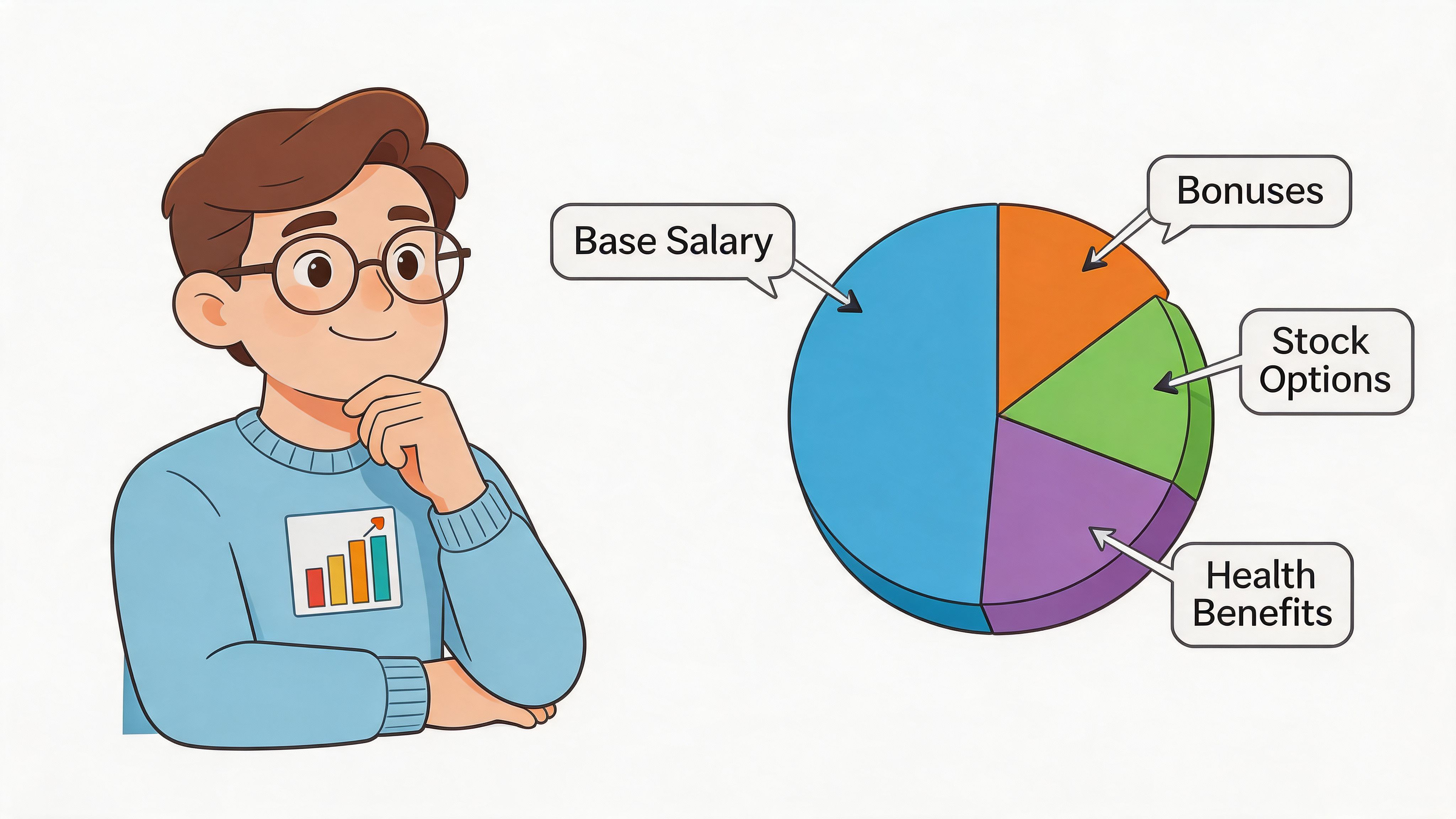
Here’s the framework I’d use for every first offer.
| Component | What it is | How to think about it |
|---|---|---|
| Base salary | Fixed annual pay | The most reliable part of your package |
| Sign-on bonus | One-time cash payment | Useful for relocation, debt, or replacing a lost bonus |
| Performance bonus | Cash tied to company or individual goals | Nice to have, but don’t treat it like guaranteed income |
| Equity | Ownership stake, usually as stock options or RSUs | Potential upside, but riskier and less liquid |
Base salary is clean. It hits your paycheck. You can budget around it. That’s why it deserves the most weight if you have loans, high rent, or a thin emergency fund.
Bonuses sit in the middle. They’re real money, but they’re conditional or one-time. A sign-on bonus helps with transition costs. An annual performance bonus can matter, but new grads often overvalue it before they understand how targets are set and paid.
Equity is where people get sloppy. They hear “ownership” and mentally spend it before it’s vested, exercised, or worth anything.
Treat startup equity as upside, not rent money.
At established public companies, equity tends to be easier to understand because the shares map to a visible market price. At startups, you’re usually getting options tied to a private company. The upside can be stronger. The uncertainty is stronger too.
When you review equity, ask practical questions:
If you need a clean primer on compensation mechanics, Underdog’s breakdown of compensation and benefits is worth reading before you sign anything.
Use a simple ranking method:
If one company offers slightly less salary but gives you direct ownership over experiments, model deployment, and stakeholder exposure, that can beat a safer role where you only clean dashboards for a year.
A strong first job should pay you and sharpen you. If it only does one, keep looking.
You can’t control the whole market, but you can control the inputs companies use to price you. That’s where salary advantage comes from.
The backdrop is favorable. The U.S. Bureau of Labor Statistics projects data scientist employment to grow 34% from 2024 to 2034, adding 82,500 jobs, according to the BLS occupational outlook for data scientists. When demand moves that fast, companies pay up for candidates who can prove they’re ready now.

Degrees matter most when they signal depth, rigor, and credibility. They matter less when they’re a substitute for actual work.
A master’s can help because it often tells employers you’ve gone deeper on statistics, machine learning, experimentation, or applied research. But if another candidate has a bachelor’s plus a serious internship and a better GitHub, the degree alone won’t save you.
What you should do:
Internships provide a salary advantage because they answer the question every employer has: can this person work on a real team?
If you’ve already shipped notebooks, written SQL against messy tables, worked with product managers, or presented findings to non-technical people, you’re easier to hire. Easier to hire usually means easier to justify at a stronger salary.
Build this evidence aggressively:
Three sharp projects beat ten shallow ones.
Your portfolio should prove range. I’d want to see one project focused on data cleaning and exploratory analysis, one on modeling, and one on communication. Put them on GitHub. Add a clean README. Include the question, dataset, method, tradeoffs, and what you’d improve.
A portfolio should answer one question fast: would I trust this person with messy data and an ambiguous problem?
Everybody says they know Python, SQL, and machine learning. Very few candidates prove they can use them under real constraints.
Strong signals include:
Don’t just list tools like Pokémon cards. Show one project where your technical choices were deliberate. That’s what raises your price.
A lot of candidates chase the highest salary number and ignore where they’ll live and what kind of company is paying them. That’s how people end up with prestige and less breathing room.
Location changes your offer more than most new grads expect. Company type changes the structure of that offer even more.
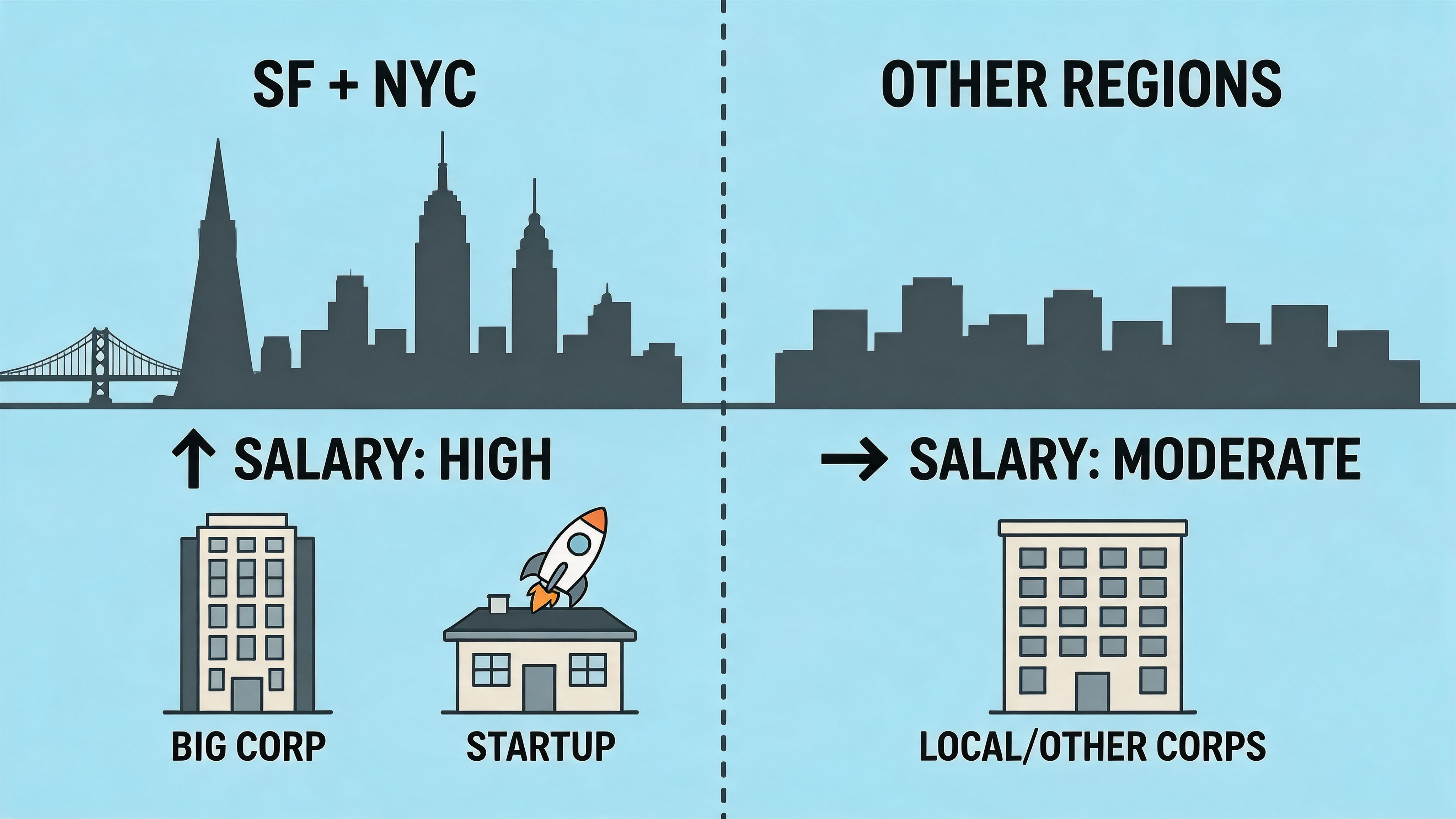
Entry-level data scientists face a $20,000 to $35,000 salary variance based on geography alone, according to TripleTen’s analysis of entry-level data scientist salary by region.
That sounds like a simple win for the higher-paying city. It isn’t.
The same source notes that salary compression at the mid-level in secondary markets means starting in a lower-cost city can improve your practical outcome, especially when equity enters the picture. Their example is straightforward: a junior data scientist in Austin with equity can end up with equivalent total compensation to a Bay Area hire with a higher base but less equity.
If you’re choosing between a major hub and a secondary market, compare these factors side by side:
| Question | High-cost hub | Lower-cost market |
|---|---|---|
| Base salary | Usually stronger | Often lower |
| Living costs | Usually much higher | Usually easier to manage |
| Network density | Strong startup and tech concentration | Growing, but more selective |
| Equity impact | Can be diluted by higher cash needs | Can feel more meaningful if your burn is lower |
The wrong move is treating salary as isolated from expenses. The right move is asking how much freedom each offer gives you after rent, taxes, and basic life costs.
Practical lens: A lower nominal salary can be the better financial choice if it lowers your burn and gives you better upside.
Company type matters because it tells you how the package is engineered.
Big tech and established firms usually offer more predictability. You’re more likely to get stronger cash compensation, more structure, and clearer ladders. That matters if you need stability.
Startups often ask for more uncertainty tolerance. In return, they may offer broader ownership, faster skill growth, and equity that can matter if the company executes.
Use Underdog’s startup compensation benchmarks if you want a clearer sense of how startup packages are usually framed.
Here’s my opinionated version of the trade-off:
Your first job should either maximize stability or maximize upside. If it does neither, it’s not a good offer.
Most new grads negotiate badly because they think negotiation means demanding more base salary and hoping nobody gets annoyed. That’s not strategy. That’s improvising.
A better approach starts with understanding where your advantage lies.
The median entry-level data scientist starting salary of $115,000 can be a 102% premium over data analyst roles, and the salary multiplier from entry-level to senior is relatively compressed compared with software engineering, according to the University of Wisconsin Extended Campus salary analysis. The practical takeaway is more important than the headline. There’s a time-sensitive window early in your career where landing the right data science role matters a lot, and the initial premium can erode within 3 to 5 years.
If the company wants you, you have room to ask questions and make requests. Use that room.
Start with evidence. Bring your project portfolio, internships, technical depth, and any competing process you’re in. Then decide what matters most to you before the call starts.
Here’s what’s reasonable to negotiate:
A smart offer evaluation should include both numbers and career signal.
Ask yourself:
If you need a structured rubric, Underdog’s guide on how to evaluate a job offer is a strong companion to that checklist.
Don’t negotiate like a student asking for a favor. Negotiate like a professional deciding where to place your first high-leverage bet.
A clearer perspective on this point is often valuable. If you’re early in your career and financially able to tolerate some risk, I think you should seriously consider strong Series A or Series B startup roles over cash-maximizing safe offers.
Why? Because the biggest long-term advantage often isn’t just the equity. It’s the combination of equity plus accelerated responsibility. If you’re doing real product-facing data science work early, you build a track record faster. That compounds.
But be selective. Don’t accept “startup upside” as a slogan. Make them earn your trust.
Look for these signals:
Take the role that gives you one of these outcomes:
Skip the offer that gives you low cash, fuzzy equity, and weak mentorship. That kind of job delays your earning power instead of building it.
Your data scientist starting salary matters, but it doesn’t define you. It’s a starting position, not a permanent ranking.
The candidates who make the best early-career decisions don’t just chase the highest number. They evaluate the whole package, understand the trade-offs between cash and equity, and choose roles that build both skill and advantage. That’s the move.
A good first job should make your next negotiation easier. It should sharpen your technical judgment, widen your ownership, and give you a better story to tell in the market. If it does that, the offer is doing its job.
Read the offer carefully. Ask harder questions. Choose the role that builds your future, not just your next paycheck.
If you want startup opportunities where employers reach out to you instead of disappearing into a job board void, Underdog.io is worth using. It’s built for tech talent who want curated intros to vetted startups and high-growth companies, which is exactly where compensation structure, equity transparency, and role quality matter most.