You're probably looking at startup data scientist roles that sound exciting on paper and suspiciously vague in practice.
The posting says you'll “drive ML strategy,” “own insights,” and “shape the data roadmap.” What it usually doesn't say is that you may spend your first months untangling event logs, rebuilding broken dashboards, defining core metrics, and explaining to a founder why a chart moved because the tracking changed, not because the product improved.
That gap between the job description and the actual job is where most candidates misfire.
Startup data work can be a great career move. The upside is real. You get direct exposure to product decisions, faster feedback loops, and more ownership than you'd usually get in a larger company. But data scientist startup jobs reward a different kind of operator than big-company data teams do. The people who do well aren't just strong modelers. They can work with messy data, handle uncertainty, and make progress before the infrastructure is ready.
The market is strong, but that doesn't mean the search should be broad or passive. Employment for data scientists is projected to grow by 34% from 2024 to 2034, creating about 23,400 new job openings each year, and Technology & Engineering accounts for 28.2% of all data science job offers according to the U.S. Bureau of Labor Statistics. That matters because startup hiring is not a side market. It's a major hiring lane for data talent.
A lot of candidates still approach startups the way they approach larger companies. They optimize for title, stack, and compensation band, then spray applications. That works poorly in startup hiring because the role itself is often still being defined. A startup rarely hires a data scientist to slot into a polished system. It hires one because something important is breaking, growing, or becoming too expensive to keep managing by instinct.
A mature company can afford specialization. A startup usually can't.
Hiring managers want evidence that you can answer questions like these:
Practical rule: In startup hiring, breadth often gets you in the door. Judgment keeps you there.
The search changes once you accept that. You're no longer applying for a fixed job. You're evaluating whether a company has the data maturity, leadership clarity, and business urgency for your work to matter.
Demand is strong, but startup demand is uneven. Some companies need a true first data scientist. Others need a product analyst with engineering instincts. Others really need a data engineer and haven't figured that out yet.
That mismatch creates opportunity for candidates who can diagnose the role better than the company can describe it. If you can read a startup job post and infer the actual problem behind it, you'll write better outreach, ask sharper interview questions, and avoid roles that look glamorous but are set up to fail.
That's the playbook shift. Don't just ask whether a startup wants a data scientist. Ask whether it's ready to use one well.
Most job seekers spend too much time hunting platforms and not enough time vetting companies. For startup roles, company selection matters more than board selection. You don't want the highest volume of postings. You want the smallest list of teams where your work will change decisions.

A startup can be exciting and still be a bad fit for a data hire.
The ideal time for a startup to hire its first data scientist is after reaching 1,000 monthly users or growing beyond 50 employees, and 68% of startups hiring before the 500-user mark fail to derive actionable insights in the first year according to First Round's guide to hiring a data scientist. That's one of the clearest signals in this market.
If a company is earlier than that, be careful. It may still be a good role, but the burden shifts. You may end up proving why data matters before you can do any meaningful data science.
A useful screen looks like this:
| Signal | Why it matters | What to ask |
|---|---|---|
| User or customer base is stable | There's enough behavior to analyze | “What recurring decisions do you want data to improve?” |
| Team size is growing | Cross-functional demand starts appearing | “Who will actually use my work weekly?” |
| Core systems already exist | You can build on something real | “Where does product and customer data live today?” |
| Leadership has a defined use case | The hire isn't purely aspirational | “What business question triggered this opening?” |
LinkedIn can work, but it's noisy. General job boards skew toward keyword matching and polished postings. Some of the best startup opportunities appear through narrower channels where companies expect more context and candidates do more homework.
Useful places to look include:
A startup with a weak brand but a concrete data problem is often a better opportunity than a famous startup with a vague analytics mandate.
I'd rather join a startup with imperfect tooling and clear decision ownership than one with a modern stack and no clue what the data team should own.
When you screen opportunities, look for signs of operational seriousness:
A high-impact startup role usually doesn't look the cleanest from the outside. It looks necessary.
Most resumes for data scientist startup jobs are too polished in the wrong way. They read like a corporate performance review. Tool-heavy, title-heavy, responsibility-heavy. Startup teams don't hire that document. They hire evidence that you can solve messy business problems with incomplete systems and limited support.
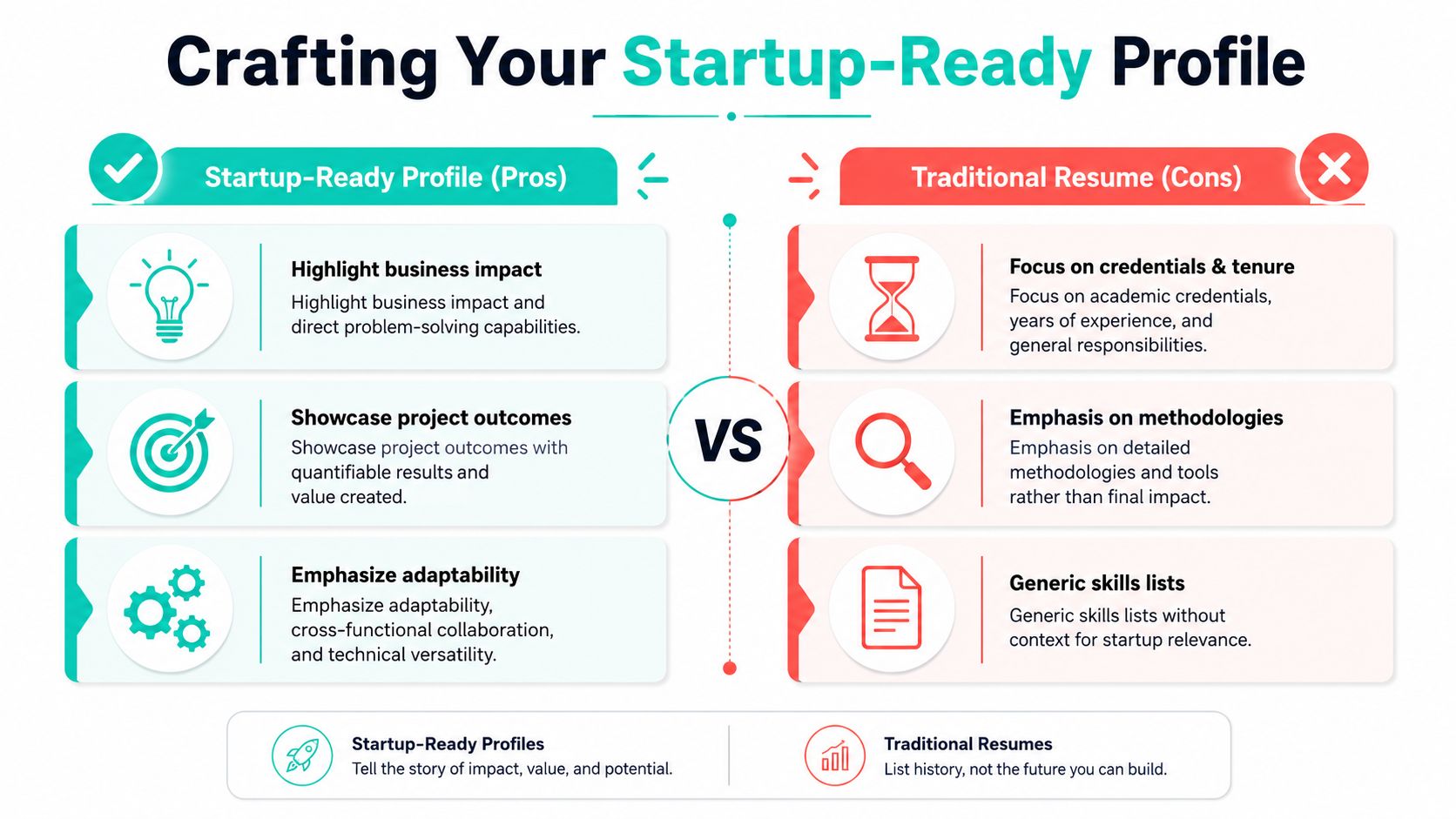
Here's the uncomfortable part. About 60 to 70% of a startup data scientist's time is spent on data cleaning, pipeline building, and stakeholder education, not glamorous model development, according to this startup data role overview. If your resume makes you look like someone who only shines when the data warehouse is perfect and the KPI definitions already exist, you'll miss the kinds of roles where startups need help.
That means your profile should highlight work many candidates bury:
Many strong corporate candidates frequently undersell themselves, mistakenly believing data cleaning sounds junior. However, in startups, it often indicates strategic value.
A startup-friendly resume doesn't just say what you built. It shows why it mattered, who used it, and what changed because it existed.
Here's the difference.
| Traditional bullet | Startup-ready rewrite |
|---|---|
| Built churn model in Python using XGBoost | Built a churn detection workflow used by customer success and product teams to prioritize intervention and investigate retention risks |
| Maintained dashboards in Tableau | Replaced inconsistent reporting with a trusted dashboard layer for weekly product and revenue decisions |
| Developed ETL pipelines in Airflow | Built and stabilized core pipelines that gave product and finance teams a single source of truth for usage and billing analysis |
Notice what changed. Less résumé theater. More operational context.
A few practical edits make a huge difference:
A startup portfolio shouldn't feel like a Kaggle archive unless the role is purely modeling-heavy, which many aren't.
Better portfolio pieces include:
What founders often want to know: “If I gave you dirty data and a vague business question next week, would you make my team smarter by Friday?”
One good project can answer that better than ten notebook demos.
If you're revising your materials, this startup resume guide is a useful reference for framing experience around startup relevance rather than chronology.
The strongest candidates usually project three things at once:
That combination is rare enough to stand out quickly. In startup hiring, the candidate who can build trust around unglamorous work usually beats the candidate with the flashier model list.
Startup interviews get easier once you stop treating them like school. They aren't trying to prove you're the smartest person in the room. They're trying to see whether you can be useful in a room where the problem is underdefined, the data is flawed, and the decision still has to get made.

The strongest format for startup technical evaluation is the Data Day. It's a 2 to 3 hour exercise where candidates solve a realistic business problem with sample data, and the expected outputs are identifying opportunities, citing evidence, and articulating data gaps, as described in Underdog's guide to hiring data scientists.
That format tells you a lot about what matters in the role. Nobody cares if you can produce the world's prettiest notebook in isolation. They care whether you can reason from imperfect evidence and explain what should happen next.
When I've seen candidates struggle, it's usually not because they lack technical ability. It's because they rush into analysis before framing the business problem.
A strong Data Day approach usually looks like this:
Before touching SQL or Python, pin down what decision the company is trying to make.
Ask questions like:
This reframes the exercise from “analyze data” to “support a decision.”
Not all available data deserves equal trust. In a startup setting, part of the job is figuring out what's solid enough to use.
I like to separate findings into three buckets:
| Bucket | What it means | How to present it |
|---|---|---|
| Reliable signal | Data seems consistent and decision-worthy | State it clearly and recommend action |
| Tentative pattern | Interesting, but may depend on assumptions | Share it with caveats |
| Missing context | Data gap blocks confidence | Call out what additional data is needed |
That third bucket is where good candidates stand out. Many people treat missing data like a failure. In startups, naming the missing piece is often the most valuable part of the analysis.
If you can explain why the data is insufficient without sounding blocked, you'll look more senior than the candidate who overclaims certainty.
The interview team doesn't want a museum tour of charts. They want a recommendation.
A practical close sounds like this:
That last point matters more than many candidates realize. In startups, every one-off analysis should ideally leave the system better than it was.
You don't need to simulate the exact company dataset. You do need to train the right muscles.
Good prep looks like:
Interview mindset: They're not hiring a benchmark score. They're hiring your judgment under friction.
If the process feels more open-ended than a large-company loop, that's a feature, not a bug. The ambiguity in the interview often mirrors the ambiguity in the role.
Compensation in startup data roles is strong enough that you should negotiate carefully, not gratefully. Many candidates still assume startup pay means a cash discount in exchange for mission and equity. Sometimes that's true. Often it isn't.
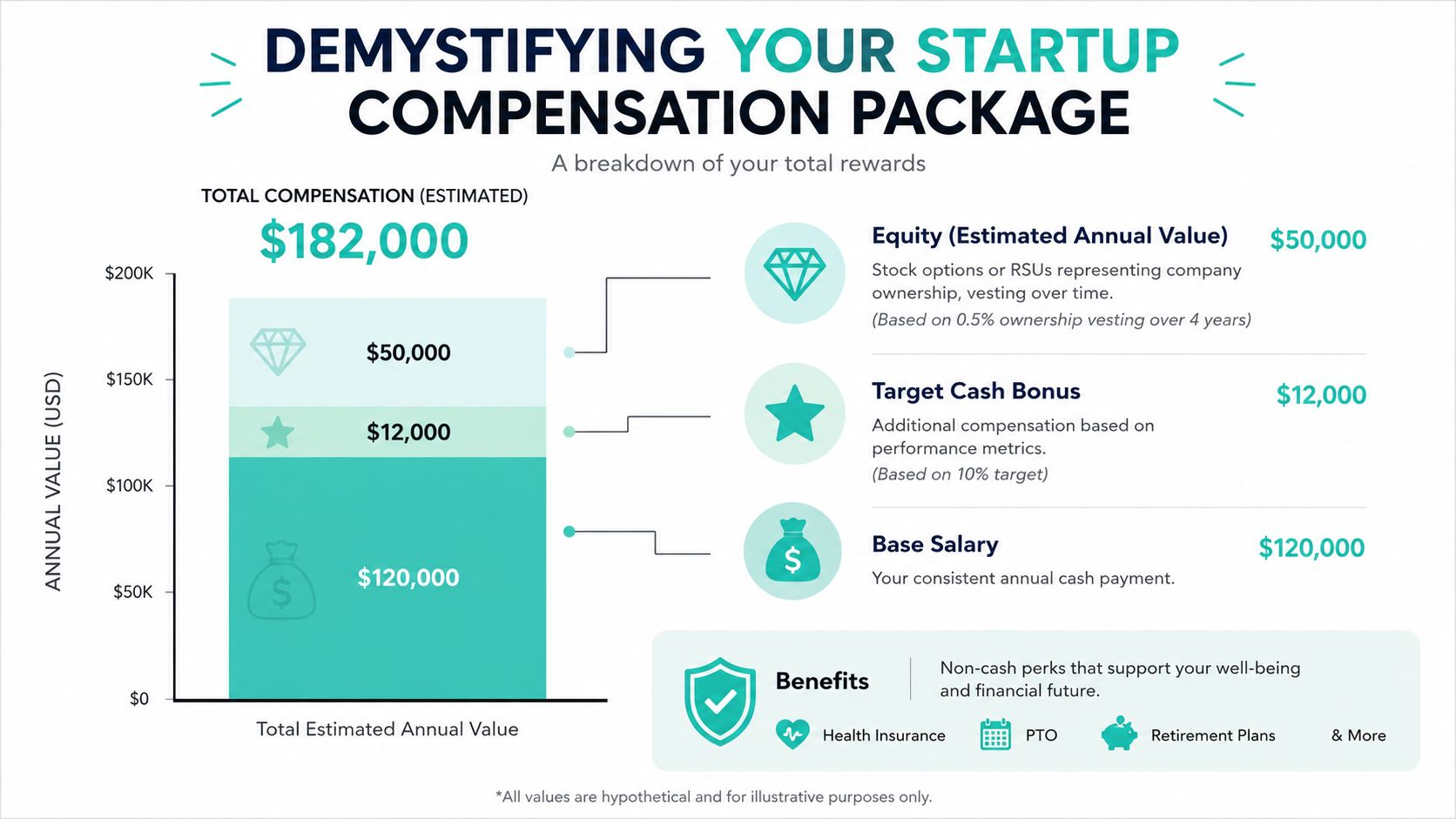
The most useful anchor here is straightforward. The median annual salary for data scientists at startups is $183,500, which is a 122% premium over the average startup salary of $82,667 for other roles, and higher than the $112,590 median for data scientists across all company types according to Wellfound's startup data scientist compensation data.
That should change how you frame the conversation. Startup data talent is expensive because founders know good data work can influence product, pricing, growth, and operational efficiency at the same time.
If you want another compensation lens while researching roles, this overview of data scientist salaries is a practical starting point.
A startup offer usually combines a few moving parts:
I've seen candidates spend the entire negotiation on salary and almost none on the terms that shape whether the equity is meaningful or whether the role is sustainable.
A startup can offer “competitive equity” and still leave you with an opaque package. Ask direct questions.
One practical warning from startup hiring is that vague equity language hurts trust. Strong candidates should ask how the company handles dilution and whether refresh grants are part of normal compensation practice. If the answer is evasive, treat that as signal.
This isn't just a scope question. It affects future influence. If the company expects you to own core metrics, partner with leadership, and shape important decisions, your package should reflect that level of responsibility.
A startup where your analysis goes directly to product, growth, and the executive team is different from one where you'll mostly fulfill dashboard requests. Same title. Different impact.
Here's a simple negotiation checklist:
| Question | Why you should ask |
|---|---|
| What is the equity grant structure? | Clarifies how ownership is awarded |
| How does the company talk about dilution? | Shows transparency and maturity |
| Are refresh grants part of the compensation philosophy? | Matters for long-term value |
| What decisions will I influence in the first year? | Connects pay to expected scope |
| Who are the main stakeholders for this role? | Reveals visibility and leverage |
| How is success evaluated? | Helps you understand future raises and growth |
Don't negotiate startup comp like you're buying a title. Negotiate like you're pricing risk, scope, and the probability that your work changes the company.
By the time an offer arrives, you should already know whether this is a real data role or a glorified reporting patch. The negotiation isn't only about money. It's your last due diligence window.
A strong package with weak role clarity can still be a bad deal. A slightly lower base with clear ownership, strong stakeholders, and thoughtful equity terms can be a much better one.
For startup data scientist jobs, compensation and role design are tightly linked. If the company wants a foundational hire, they should pay like they understand the stakes.
Startup data work is attractive for the same reason it's hard. You get more surface area, more ambiguity, and more direct business exposure than you usually get in a bigger company. If that energizes you, this market can accelerate your career fast. If you need structure, stable boundaries, and clearly defined ownership on day one, you should screen aggressively.
The practical path is simple, even if it isn't easy. Target companies that are mature enough to benefit from data. Build a profile that shows you can handle the operational reality, not just the modeling fantasy. Interview like an operator who can reason through messy business questions. Negotiate like someone who understands the unique advantage of startup data work.
For candidates still building depth, formal education can help if it sharpens applied skills rather than just adding credentials. If you're evaluating that route, it's worth taking time to explore MTech Data Science courses in India and compare how programs cover practical topics like analytics engineering, machine learning workflows, and deployment readiness.
The bigger point is this. Good startup data scientists aren't defined by one tool, one model family, or one title. They're defined by how well they turn messy inputs into decisions, systems, and trust.
That's what founders pay for.
If you want a more focused way to explore startup roles, Underdog.io is one option to consider. It's a curated marketplace where tech candidates can submit a single application and get introduced to vetted startups and high-growth companies, which can be useful if you want to avoid broad job-board volume and concentrate on startup-specific opportunities.