A lot of engineers see the same message at some point. A seed-stage founder reaches out with a sharp product idea, a small round raised, and a title that sounds bigger than a normal job: founding engineer.
That title can mean a career-defining seat at the table. It can also mean vague scope, messy equity, and founder expectations that were never made explicit. The difference usually isn't talent. It's whether both sides understand that this is a partnership negotiation, not a standard hiring loop.
In NYC, SF, and remote startup hiring, the founding engineer role sits in an awkward but powerful middle ground. You're not a co-founder in the strict Y Combinator sense of someone with 10%+ equity for Day Zero contribution, but you're also not just engineer number six inheriting a roadmap and an existing codebase. You are often the person who turns a pitch into a product, a product into a system, and a system into a team.
The title works because it compresses several ambitions into two words. Prestige. Ownership. Proximity to the founders. A shot at meaningful equity. A chance to build instead of maintain.
It also hides a lot.
Some founders use founding engineer to mean "first technical hire and thought partner." Others use it to mean "senior full-stack engineer willing to do everything." Some use it because they know strong candidates respond to the label, even when the role has little strategic influence.
That's why the first question isn't "Is this exciting?" It's "What am I signing up to own?"
Strong engineers often over-focus on the product idea. That's understandable, but a founding engineer bet lives or dies on execution conditions.
Ask yourself:
A weak answer in any one of those areas matters more than a polished pitch deck.
A valuable founding engineer role provides influence over outcomes, not just responsibility for output.
Founders often think they need "a great coder who can move fast." That's not enough. Early startup execution breaks when the first engineer lacks judgment, product sense, or the stomach for ambiguity.
The best founding engineer relationships work because both sides treat the role as long-horizon alignment. Scope, trust, decision rights, and compensation all need to reflect that from the start.
A founding engineer is the builder who turns an unfinished company into something real. They don't just write code. They set the first technical constraints, absorb product ambiguity, and establish standards that other engineers inherit later.

A normal senior engineer joins a moving system. A founding engineer creates the initial one.
That means choosing an early stack, setting up deployment, deciding what can be hacked together, and knowing what absolutely can't. In practice, that often includes backend, frontend, infra, analytics, and support workflows all at once.
If you're evaluating tools in that environment, a practical list like AI tools for early-stage SaaS startups can be useful because early teams don't have time for bloated software decisions.
Founders often communicate in outcomes. "Users should feel trust." "The demo should feel magical." "We need something investors can understand."
A founding engineer converts that into shipped behavior. They decide what version one must include, what can wait, and what technical shortcuts are acceptable. That's not passive implementation. It's product judgment.
Many experienced big-company engineers struggle in this aspect. They may be excellent in a mature org and still underperform in a startup because they expect cleaner requirements, narrower ownership, and more support functions around them.
Early engineering culture isn't values on a Notion page. It's what the first technical hire tolerates, documents, reviews, and escalates.
That includes:
Historical analysis of founding engineer roles points to how much that early influence matters. At Improbable, early technical hires were among the first 50 employees, and the company scaled to 650 headcount over 4 years while those engineers helped build MVPs, dashboards for key metrics, and customer relationships, as described by Pragmatic Engineer.
The role isn't "first person to code." It's "first person accountable for making the company executable."
That distinction matters.
Y Combinator uses 10%+ equity as a marker for co-founders contributing at Day Zero, which separates true company formation risk from the founding engineer role described in the market. A founding engineer usually joins after the company concept exists and takes on execution risk rather than inception risk.
That doesn't make the role smaller. It makes it different.
A typical founding engineer offer creates the first true tension in the relationship.
The founder needs someone who will take startup risk without co-founder ownership. The candidate needs enough upside to justify a lower cash package, messy scope, and a strong chance that the company never reaches a meaningful exit. Treat the offer that way. It is a partnership negotiation with uneven information, not a standard job application.
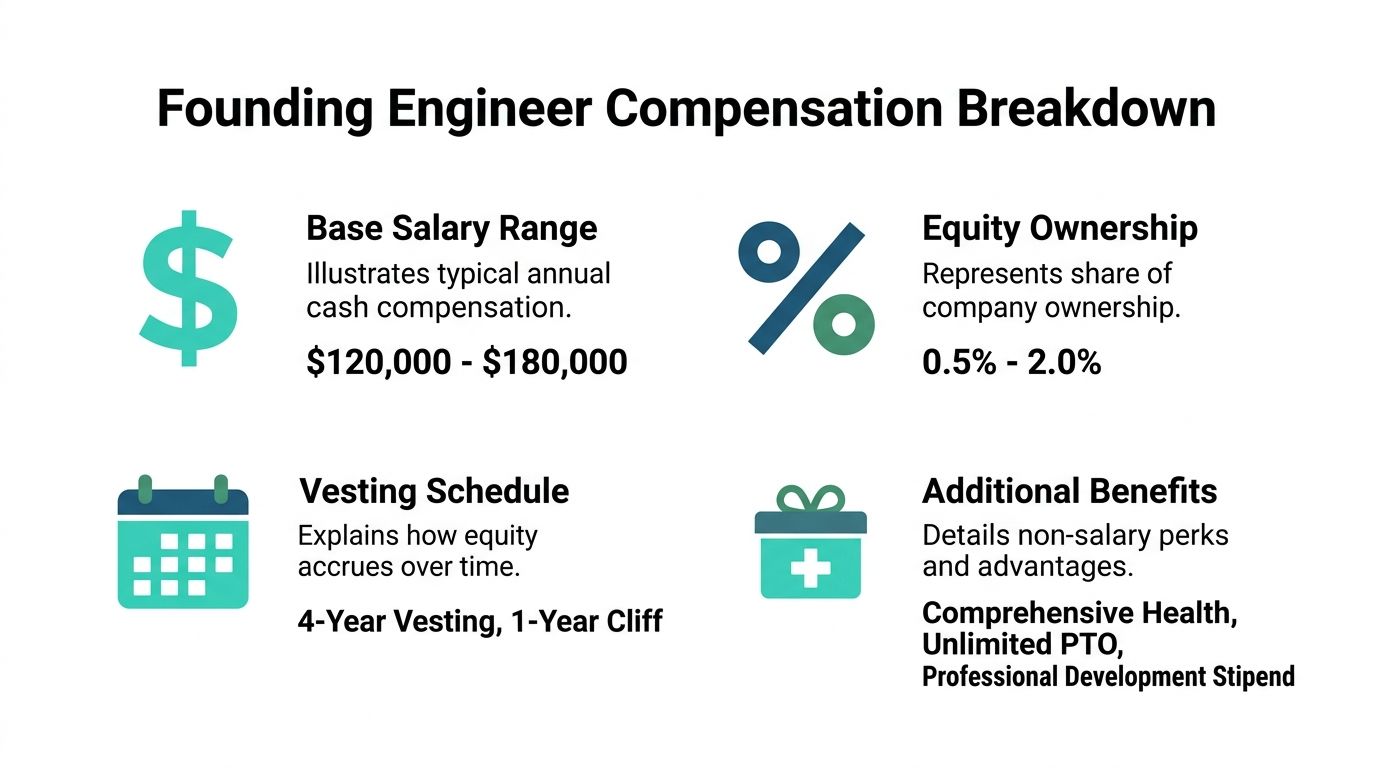
One useful market reference is Fonzi's summary of Pave data, which cites data from more than 8,500 tech companies. It puts founding engineer equity in a broad range of 0.1% to 2%, shows pre-Series A first engineers clustering higher than later early hires, reports Tier 1 cash benchmarks, notes that many candidates accept roughly 50% to 80% of big-tech cash comp, and points out that later dilution can take 10% to 25% per round.
| Percentile | Base Salary | Equity Grant | Typical Stage |
|---|---|---|---|
| 50th | $187k cash | 0.33% equity | Early startup in US Tier 1 markets |
| 75th | $215k cash | 0.62% equity | Stronger early-stage package |
| 90th | $235k cash | 1.24% equity | Top-end package for scarce talent |
Those numbers are a starting point, not a price list.
A candidate building the first production system, handling incidents, talking to users, and interviewing future hires should not be paid like engineer number four with a narrower brief. The founder is buying speed, judgment, and trust under uncertainty. That has a price.
In NYC and SF, founders usually know the market even if they present the offer as if every term is bespoke. Early-stage candidates should assume the company has seen enough comparable offers to know whether it is being aggressive, fair, or opportunistic.
For NYC, I see more variation in cash because companies compete with both venture-backed startups and strong mid-market employers. In SF, candidates often push harder on equity because everyone has seen what a small ownership difference means by the Series B stage. In remote searches, cash bands get noisier fast. Some companies still peg salary to hub markets, some localize, and some use remote hiring to compress pay while keeping the same expectations. That is why equity, refresh promises, and scope clarity matter more than title.
The practical question is simple. Does the package match the work?
If the founder wants you to own architecture, ship product, carry on-call risk, meet customers, and help build the team, a token grant with a polite promise to revisit comp after the next round is not a serious founding engineer offer.
Headline equity is the start of the conversation.
The true value depends on the stock type, strike price, vesting start date, exercise window, acceleration terms, and how much the company plans to raise. I have seen candidates negotiate hard for headline percentage and then miss the terms that determine outcome.
Focus on these points:
A good way to pressure-test the offer is to run a few scenarios through a startup equity calculator for dilution and exit outcomes. Do it before you negotiate, not after you sign.
Founders and candidates both waste time by pretending vague terms are generous. They are not.
Be careful with offers that include any of the following:
Strong founding engineers know exactly what they are giving up. In NYC and SF, that often means a more predictable package elsewhere with less personal downside. In remote markets, it can mean several competing startup offers with similar titles but very different economics.
If you want a strategic partner, write an offer that admits what you are asking for. Clear ownership, clean paperwork, and a defensible cash-equity mix build trust early. Anything fuzzy gets priced as risk, and good candidates will either ask for more or walk.
This role offers influence, not comfort.
Some engineers become dramatically better after a year as a founding engineer because they finally own the full system. Others burn out fast because they mistake chaos for autonomy and title for influence.

The upside isn't only financial.
You often get direct access to founders, product shaping power, and a compressed learning loop across engineering, hiring, support, analytics, and go-to-market. That can be career-changing if you want to become a startup CTO, founder, or operator with broad range.
The role also creates a specific incentive structure. Founding engineers take on execution risk after funding, not the pre-revenue risk founders carry, and that alignment is exactly why equity is part of the package. Paraform notes that strong founding engineers who build scalable systems and engineering culture can become force multipliers, enabling 3-5x faster feature delivery as teams grow in its role overview.
The stress isn't abstract.
You'll work through unclear priorities, founder disagreements, missing process, and product uncertainty. You may be the on-call engineer, technical PM, recruiter, and customer escalation path in the same week.
The hard part for many people isn't the workload. It's the lack of clean edges around the work.
A practical screening tool is a startup due diligence checklist, because the downside usually comes from avoidable unknowns, not from the existence of risk itself.
| You may love this role if... | You should hesitate if... |
|---|---|
| You want broad ownership and can make decisions with incomplete information. | You need stable scope, well-defined ladders, and clear separation between functions. |
| You enjoy switching between coding, product tradeoffs, and customer context. | You want to stay primarily in deep implementation work. |
| You can tolerate uncertainty and delayed payoff. | You need predictable compensation and lower variance. |
| You want to shape hiring and engineering culture early. | You'd rather join once the team, stack, and process are already established. |
Joining as a founding engineer makes sense when uncertainty energizes you more than it drains you.
These jobs rarely behave like standard tech hiring. The best ones are often filled through founder networks, warm referrals, operator communities, and curated marketplaces before they ever look like a public search.
That means your job isn't just to look available. It's to look credible in a specific way.
A resume that says "Senior Backend Engineer" won't do enough on its own.
Founders look for evidence that you can own a messy surface area. Your profile should show some mix of product intuition, technical judgment, user empathy, and willingness to operate without support layers.
Useful signals include:
A serious founding engineer process usually tests for judgment more than puzzle-solving.
You may be asked how you'd scope a first release, what stack you'd choose under constraints, how you'd handle a founder's unrealistic request, or what you'd do if users hated the onboarding flow. Those are better signals than generic coding trivia.
The strongest candidates answer with tradeoffs. Not "I'd use X framework because it's modern," but "I'd use X because hiring for it is feasible, it reduces early operational drag, and the product doesn't yet justify a more complex setup."
Generic job boards produce noise. Founder-intro communities, operator networks, and startup-specific marketplaces are usually more useful.
If you're actively looking, how to get a job at a startup is a practical starting point because startup hiring works differently from larger company recruiting.
One more angle is worth keeping in mind. The role can become a platform for much more than your next title. The path from operator to investor is becoming more visible, and Hustle Fund notes that AngelList data from a recent quarter showed a substantial rise in software engineer LPs in seed funds. Candidates who can articulate a long-term view of startup building and evaluation often stand out in founder interviews.
Hiring a founding engineer isn't filling an engineering seat. You're choosing a partner in execution who will shape product quality, engineering culture, and the next several hires.
Founders often miss by writing the wrong brief. They post a stack laundry list when what they need is someone who can create clarity under pressure.

A weak job description says:
A useful one says what success looks like. For example:
If you want examples of a more structured process, this step-by-step playbook for hiring engineers is useful as a framing reference, even though a founding engineer search needs more partnership assessment than a standard data engineering hire.
The best interviews test behavior under ambiguity, not textbook knowledge.
Ask questions like:
| Interview prompt | What you're testing |
|---|---|
| "Tell me about a time requirements were incomplete and you still had to ship." | Comfort with ambiguity |
| "What would you optimize for in our first six months?" | Product and business judgment |
| "When have you deliberately chosen a less elegant solution?" | Pragmatism |
| "How do you know when to rewrite versus live with a compromise?" | Technical maturity |
| "What kind of founders do you work best with?" | Self-awareness and communication |
Some candidates are strong engineers and still wrong for this job.
Watch for:
A great founding engineer doesn't just increase output. They reduce founder uncertainty.
Top candidates have alternatives.
If your company is pre-product-market fit, say so. If the roadmap is unstable, say so. If the role includes customer calls, recruiting, and cleanup work nobody else wants, say so.
You won't lose the right candidate by being direct. You'll lose the wrong one earlier, which is cheaper.
Many candidates negotiate a founding engineer offer too narrowly. They talk about salary and maybe equity, then stop.
That's not enough. This isn't just comp negotiation. It's a conversation about power, accountability, and how the company will use your judgment.
You should ask about:
The sharpest negotiation angle is simple. You're absorbing a serious opportunity cost. As Build Tech Career argues, a founding engineer may give up $200K+ in total compensation from big tech for a role where the equity ends up worthless in over 90% of cases. That is a legitimate reason to negotiate for more initial equity, especially when future dilution will reduce ownership further.
Don't negotiate like a buyer haggling over a used car. Negotiate like a future partner reducing ambiguity.
A good line is: "If I'm taking on this level of execution risk and expected scope, I want the package and role definition to match that from day one."
That keeps the discussion grounded in alignment, not ego.
If you're exploring founding engineer roles in NYC, SF, or remote startup teams, Underdog.io is one way to get in front of vetted startups through a curated marketplace where companies reach out after a short application. It's useful if you want startup-specific opportunities without sorting through broad job board noise.