You're staring at two offer letters on a Thursday night, trying to decide whether the startup's giant share count is a real opportunity or just a polished distraction. One recruiter keeps saying “equity upside,” another keeps talking about cash and certainty, and neither one is helping you answer the only question that matters: what is this grant worth to you?
Stop treating startup equity like a mystery. It's a small math problem, not a vibes problem, and the winning move is to convert the offer into fully diluted ownership, then judge it as a risk-adjusted expected payoff. If the company won't give you the numbers you need, that's already information.
The worst mistake candidates make is obsessing over the headline number in the offer letter. 100,000 options sounds huge until you learn what fraction of the cap table that buys, how much of it vests, and what gets left standing after the next financing round.
A real offer conversation should feel less like a celebration and more like a quick diligence pass. Ask what percentage you're buying exposure to, not how many shares you're getting. That shift matters because modern startup compensation analysis has moved from “how many shares?” to “what fraction of the cap table, on a fully diluted basis, am I buying exposure to?” Aption's equity evaluation guide makes the same point directly.
A big share count can still mean a tiny stake. Startups use that number as a marketing device because it feels concrete, while the actual value depends on dilution, exit timing, and whether preferred investors get paid first. That's why you should always translate the grant into ownership percentage before you compare it to anything else.
Practical rule: if the company won't tell you the fully diluted share count, treat the offer as incomplete until they do.
The right mental model is simple. You're not buying a pile of shares, you're buying a sliver of a future outcome that may or may not arrive. If you compare offers without that lens, you'll overrate the big share count, underrate slow vesting, and miss how much the company's financing plan can shrink your piece later.
That's the gap most candidates fall into, and it's the gap the rest of this article closes.

The only share count that matters is the company's fully diluted share count. That includes the current outstanding shares, the option pool, and convertible instruments that are expected to convert. Once you have that denominator, the math is just division, your shares divided by total fully diluted shares.
A simple example shows why this matters. If you get 40,000 shares in a company with 10 million fully diluted shares, your stake is 0.4%. If the option pool expands in the next round and the fully diluted count becomes 15 million, that same grant drops to 0.27%. The offer letter didn't change, but your ownership did.
What is the fully diluted share count?
This is the first number that matters, because everything else depends on it.
How big is the current option pool?
Pool size tells you how much future dilution is already planned.
How much of the pool is still unallocated?
If a large chunk is reserved but ungranted, your stake can be squeezed further in the next round.
A recruiter or founder should be able to answer those questions directly. If they dodge them, they're not being transparent about what you're buying. The better firms answer cleanly because they know candidates who understand cap table math are harder to mislead.
Stage benchmarks help too. For senior engineers, the ranges commonly cited in the field compress fast by stage, from Seed, 0.3–1.0%, to Series A, 0.15–0.5%, to Series B, 0.05–0.2%, and Series C+, 0.01–0.1% Recruiting from Scratch's equity benchmark guide. Use those as a sanity check, not gospel. If an offer is far outside that lane, you should ask why.
Options are what most private startups use because they're flexible and they keep cash compensation down. You get the right to buy shares later at a strike price, which is usually tied to the company's current fair market value. That sounds simple, but it introduces tax timing, exercise cost, and a deadline problem when you leave.
RSUs are cleaner on paper. You receive the shares when they vest, and they're usually taxed as ordinary income at vest. They're easier to understand, but private startups usually reserve them for later-stage companies because the company has to be comfortable with the accounting and the tax treatment.
SAFEs are not employee equity. If somebody tries to hand you a SAFE as compensation, walk away. That's an investment instrument for investors, not a grant that gives an employee direct ownership rights.
| Equity Instrument | What You Get | Tax Trigger | When Startups Offer It |
|---|---|---|---|
| Options | Right to buy shares at a strike price | Usually when you exercise, then again when you sell depending on type | Most private startups |
| RSUs | Actual shares that vest over time | At vesting, usually as ordinary income | Late-stage private companies, some pre-IPO firms |
| SAFEs | A contractual right tied to future financing, not employee ownership | Not an employee compensation grant | Investors, not hires |
My opinion is blunt. Options are worth serious attention if the company is real and the terms are clean. RSUs are better when the company is late-stage and liquidity is closer. SAFEs in a hiring conversation are a bad sign, because they signal confusion or sloppiness about compensation.
If the paper doesn't clearly say whether you have ISO or NSO treatment, what the strike price is, and how vesting works, the offer isn't finished yet. For a deeper document-level read, the AI contract review software from LegesGPT can help you surface missing terms before you sign, especially when the agreement is long and the legal language is doing a lot of hiding.
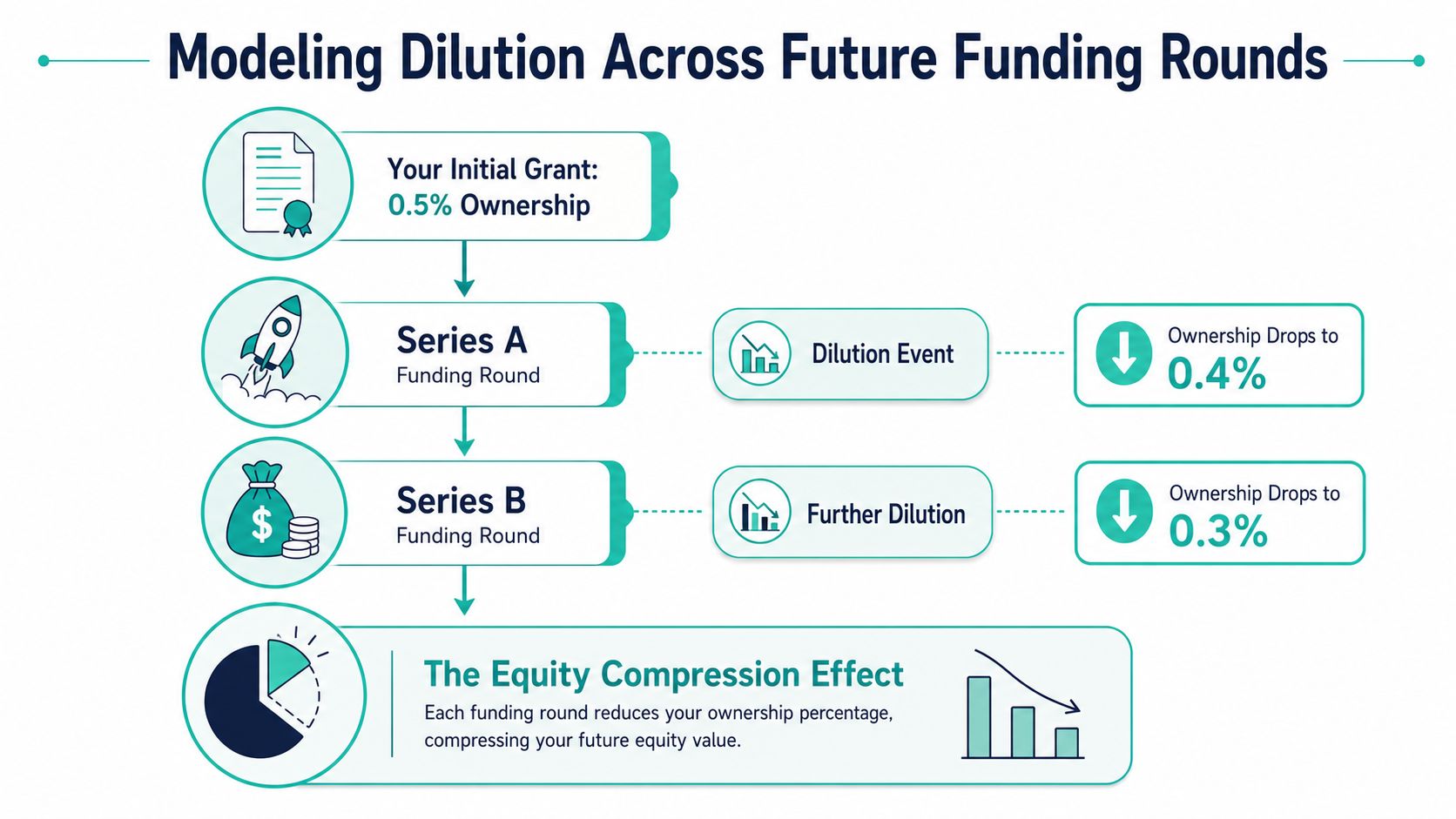
Your ownership percentage is not static. Every new round can shrink it, and the company doesn't need your approval to do that. That's why a grant that looks solid on day one can become much thinner by the time the company is worth something.
Modeling dilution means stress-testing your stake across two or three more rounds. That's the minimum. If you only model today's grant, you're pretending the company will never raise again, which is not how startups work.
A simple scenario makes the point. A 0.4% Series A stake can slide to 0.22% after a down round with a new pool, then to 0.11% after a Series B. The headline number didn't vanish, but the equity compression is real. If you want a calculator to play with the math, the Underdog equity dilution calculator is useful for sanity-checking how fast ownership can fade.
Dilution is not a theoretical risk. It is the default path of venture-backed companies that keep raising capital.
You also need to ask about the 409A strike price, the most recent preferred share price, and the total liquidation preference stack. Those numbers tell you whether your shares are likely to receive anything in a modest exit, or whether preferred investors are paid first and common holders get leftovers.
The reason this matters is simple. Early-stage equity is path dependent. The company might be valued highly on paper, but if it takes too long to exit, or if the exit valuation is weak relative to the preference stack, your common shares can be economically thin. That's exactly why a research-based framework says that across early-stage startups, equity often ends up worth only about 10% of the original grant's headline value after dilution, probability of success, and time to exit JobsByCulture's startup equity guide.
My recommendation is harsh because the math is harsh. If the company can't explain dilution, prefs, and the likely financing path in plain English, don't assume your grant is valuable. Assume it's speculative until proven otherwise.
Two identical grants can produce very different outcomes because taxes hit at different times. The first question is whether you're getting ISO treatment or NSO treatment. ISOs usually have better tax treatment if you manage them correctly, while NSOs typically create ordinary income when you exercise.
That's the stuff people ignore, then regret later. You also need to know whether early exercise is allowed, because that determines whether an 83(b) election might be on the table, and whether the exercise timing can shift your tax burden. If you don't understand the timing, you can end up with a tax bill before you've seen any liquidity.
Ask for the strike price, the vesting schedule, the exercise window, and whether early exercise is allowed. That's not paperwork trivia. It determines how much cash you need, how long you have after leaving, and whether you can manage the grant in a tax-smart way. A standard exercise window is often described as 90 days JobsByCulture's startup equity guide, and that deadline is one of the most common ways people lose vested equity.
Do not sign before you know the exercise window. A short window can turn a decent grant into dead paper if you can't afford to exercise in time.
The decision that matters most is simple. Know whether the grant is ISO or NSO, and compare the strike price to the company's 409A. If the strike is high relative to the 409A, your downside risk rises fast because you're putting cash in before you know whether the company will ever produce liquidity. If the company offers complicated terms, that's the moment to pay for tax advice instead of guessing.
For a plain-language walkthrough of option mechanics, the engineer's guide to stock options is a practical starting point. The point isn't to become a tax specialist overnight. The point is to stop signing equity grants blind.

Startup equity commonly uses a four-year vesting schedule with a one-year cliff, which means you usually earn nothing until your first anniversary and then vest gradually afterward YouTube explanation of startup vesting. That's not a footnote. That's the company protecting itself from short-timers while making sure the grant only becomes real if you stay.
If you leave before the cliff, you walk away with zero vested shares. If you stay just past it, you start earning into the grant. That's why timing matters so much, especially if you're joining a young company and don't know how long you'll want to stay.
There are three clauses worth pushing on. Early exercise can help if the strike price is low and the company allows it. Acceleration on change of control can protect you if the company gets acquired before your grant has fully vested. Extended post-termination exercise windows can keep vested equity alive after you leave.
If you want a practical benchmark for clause language, the equity vesting schedule guide is a useful reference point. If you're reading a dense offer packet, the AI contract review software can also help surface whether the vesting language is standard or subtly punishing.
My rule is simple. If the company expects you to take startup risk, it should give you clear vesting language and a fair chance to keep earned equity. If it won't negotiate anything, that tells you exactly how much influence you have.
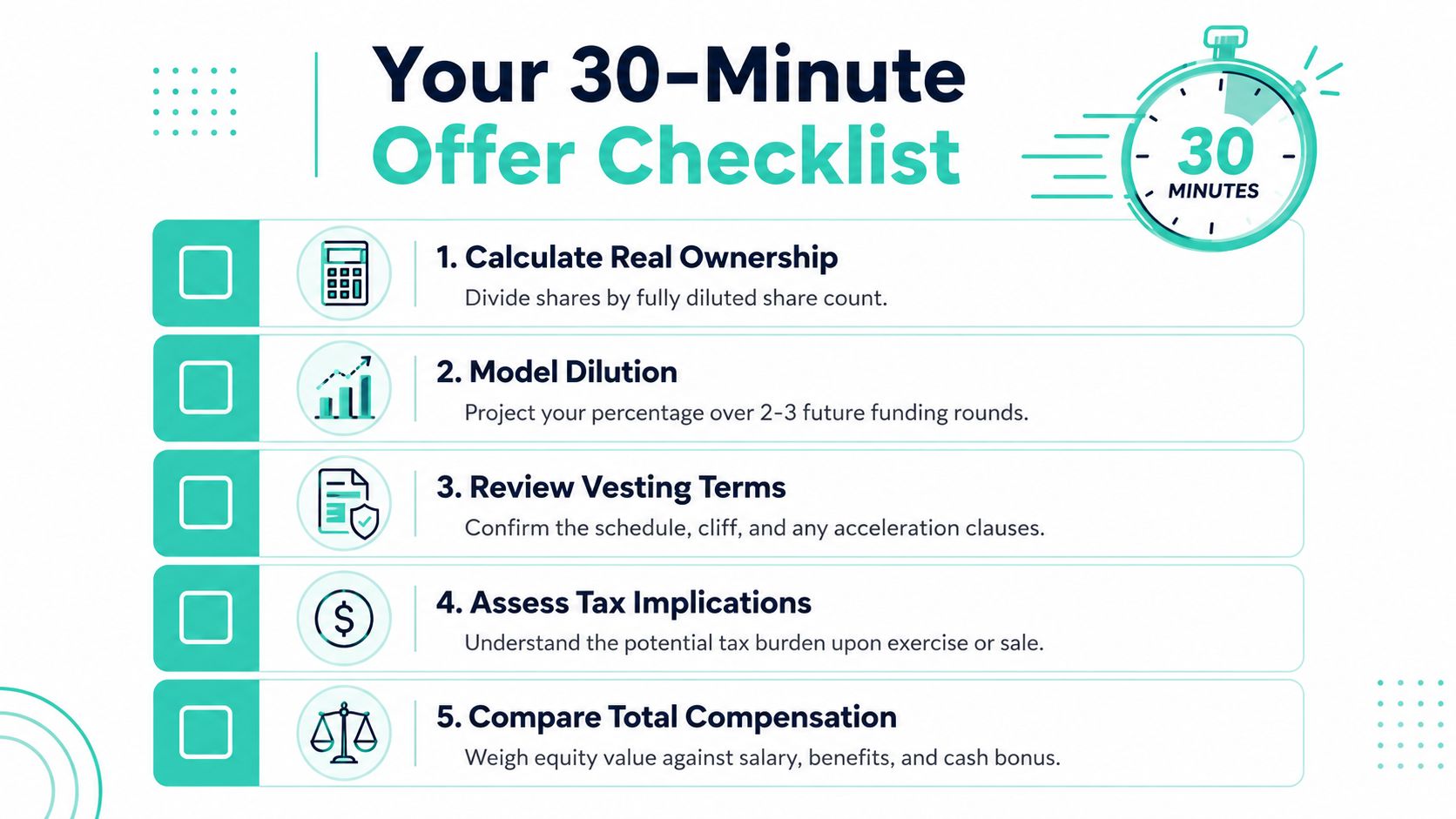
Take thirty minutes and do this in order. First, convert the grant into ownership percentage using the fully diluted share count. Second, model what happens after two or three future rounds. Third, check the vesting, cliff, strike price, and exercise window. Fourth, estimate the tax hit if you have to exercise or sell. Fifth, compare the expected outcome against your salary and the opportunity cost of taking the job.
The key payout formula is simple. Multiply your fully diluted ownership at exit by a realistic exit valuation, subtract the liquidation stack, and then discount for the chance the company gets there. For Series A companies, that success probability is usually well under 50% JobsByCulture's startup equity guide. If that makes the grant look less exciting, good. That means you're finally seeing it clearly.
The move from “how many shares?” to “what fraction of the cap table, on a fully diluted basis, am I buying exposure to?” is the single biggest upgrade you can make in startup comp judgment.
If a company can't answer those questions cleanly, the offer isn't strong enough to excuse the risk. If it can, then you're dealing with something you can evaluate instead of something you have to hope about. That's the whole game.
Underdog.io helps tech candidates compare startup roles with real context, not just title and base pay. If you're weighing equity-heavy offers and want a faster way to surface vetted startup opportunities, visit Underdog.io and use the platform as part of your search before you sign the next offer letter.