Read Time: 9 min read
Landing a software engineering job, especially at a startup, is less about blasting your resume into the void and more about a calculated approach. It's a journey that involves sharpening the right skills, telling a compelling story with your resume, being smart about where you look, acing the interview gauntlet, and knowing your worth when the offer letter arrives. In short, it’s about proving you can deliver real value from day one.
Before you even touch your resume, the first real step is building a set of skills that a fast-moving startup can't ignore. Forget the generic advice. Thriving in this world means picking up abilities that directly tackle the chaotic, high-speed problems startups face every single day.
This all starts with an honest, hard look at what you can actually do.
The name of the game is closing the gap between what you know now and what a hiring manager at a Series A company desperately needs. Startups don’t hire for potential; they hire for immediate impact.
Look, a solid grasp of data structures and algorithms is table stakes—that’s non-negotiable. But the specific technologies you master are what will really make or break your job search. Certain languages and frameworks are perennial favorites in the startup scene for a reason: they’re scalable, have massive support systems, and let developers build things fast.
Your learning path needs to be laser-focused on the tech being used to build modern products right now. A great strategy is to zero in on a mix of these high-demand areas:
Engineers who are "T-shaped"—meaning they have deep expertise in one area (like backend) and a broad, functional knowledge of others (like frontend and databases)—are incredibly valuable to a small, scrappy team.
At a startup, your job title is just a suggestion. You're not just writing code in a silo. Engineers are expected to wear a lot of different hats, and that means your skills need to bleed over into operations and infrastructure. This is where knowing your way around the cloud and DevOps practices becomes a huge advantage.
The candidates who really stand out aren't just the ones who can code a feature. They're the ones who understand how to ship, monitor, and maintain that feature in a live production environment.
Hiring managers are looking for people who operate with a sense of ownership over the entire software lifecycle. This isn't about having a bunch of certifications; it's about having real, hands-on experience.
You don't need to be a certified cloud guru, but you do need to be comfortable working in a modern cloud environment. That means getting your hands dirty with one of the big providers.
Here’s a practical plan to get started:
Dockerfile for your weather app to containerize it.Finally, in today's world, writing code without thinking about security is a non-starter. Understanding modern threats is a huge plus for any startup engineer. It's worth looking into some foundational cybersecurity awareness training to build out a more well-rounded profile. It shows you're thinking about the product's integrity, not just its features. Weaving these skills into your portfolio projects is how you prove you're ready to make a real contribution from your very first day.
Once your skills are ready to go, the next mission is turning them into a compelling story. Your resume and portfolio aren't just documents; they're your primary marketing tools in a crowded market. You have seconds to grab a recruiter’s attention and prove to a hiring manager that you’re the answer they've been looking for.
The tech job market is a bit of a paradox right now. On one hand, a massive IT skills shortage is expected to impact over 90% of organizations by 2026, which sounds like endless opportunity. You can read more about these tech job market statistics on TechTarget. But on the other hand, recent hiring slowdowns mean the competition is fiercer than ever. Plenty of new grads are firing off hundreds of applications into the void.
A generic resume is a one-way ticket to the digital trash bin. Your job is to stop thinking like a historian listing tasks and start thinking like a marketer selling results.
This is the single biggest mistake I see engineers make on their resumes: they describe what they did instead of what they achieved. Startups don't hire people to "work on features" or "participate in code reviews." They hire engineers to solve real problems and move the business forward.
It’s a simple mental shift, but it’s critical. Every single bullet point on your resume needs to answer the question, "So what?"
For example, don't just say:
Reframe it to show the impact:
See the difference? One is a task. The other is a solution. For a deeper dive on this, check out our guide on how to write a powerful tech resume.
Numbers are your best friend. They cut through the noise and speak a language every hiring manager understands: results. Metrics prove your code serves a purpose beyond its own elegance. Go back through your projects and find anything you can measure.
Your resume is not a list of job duties. It is a highlight reel of your greatest impacts, backed by data. It should scream, "I don't just write code; I deliver measurable results."
Don’t have precise data? That’s okay. You can often make credible, good-faith estimates. Think about performance boosts, time saved, efficiency gains, or user engagement spikes. Actionable Step: Review your last three projects. For each, write down one metric you improved (e.g., page load time, API response latency, manual work automated).
Here’s a quick look at how you can transform bland statements into powerful, metric-driven achievements.
This table shows exactly how to shift your mindset. You're not just listing technologies; you're demonstrating how you used those technologies to create tangible value.
For any software engineer, your GitHub profile is way more than just a place to store code—it's your living, breathing portfolio. Hiring managers will look at it, and a well-tended profile can absolutely be the tiebreaker that lands you an interview.
It’s not about the quantity of repos. It’s about showcasing quality and genuine passion.
README.md that explains what the project is, why you built it, and how to get it running. Actionable Step: Write a README.md for your best project that includes a live demo link, setup instructions, and a short GIF showing it in action.By focusing on impact-driven metrics and treating your GitHub as a dynamic portfolio, you create an application that doesn't just list skills—it proves you can deliver. That’s how you get noticed.
Alright, you've got a resume that screams "impact" and a portfolio that proves you can actually code. So, what's next? If your first instinct is to shotgun your application across every job board known to humanity, stop right there. The "spray-and-pray" method is a one-way ticket to burnout.
Landing a great software engineering role, especially in the startup world, is a game of precision, not volume. It’s time to stop being a reactive applicant and start thinking like a strategic job seeker. That means getting smart about navigating the startup landscape to find a company where you’ll actually want to work.
Your resume and portfolio are the foundation. Now, it's time to build on them with a targeted, profile-driven strategy.
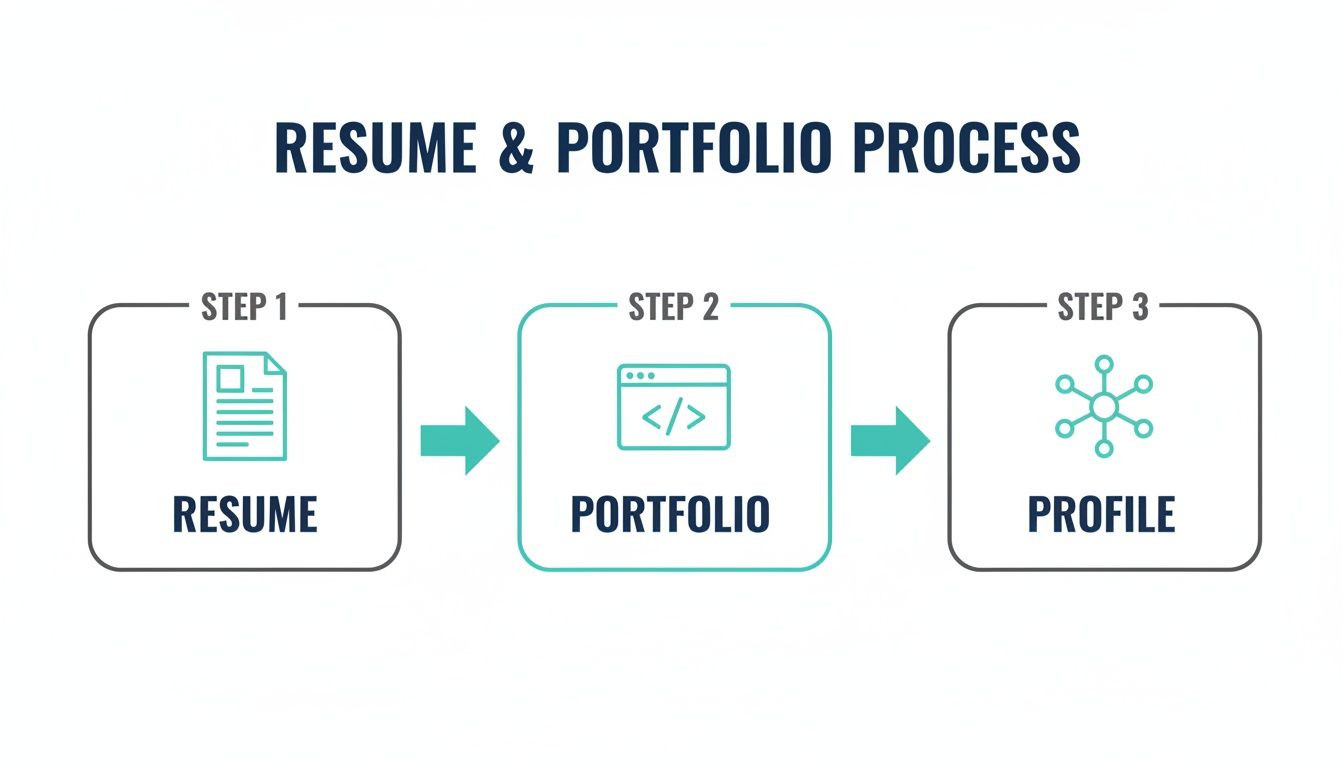
This isn’t just about applying for jobs; it's about positioning yourself to be found by the right jobs.
Let's be clear: not all startups are the same. The experience at a five-person, seed-stage company is worlds away from a 100-person Series B scale-up. Jumping into the wrong environment is a recipe for a bad time, so you need to figure out what you’re actually looking for.
Before you even start browsing, ask yourself about a few key things:
Nailing this down first helps you cut through the noise and focus your energy on opportunities that genuinely align with what you want out of your career. Actionable Step: Create a simple spreadsheet with columns for Company Name, Funding Stage, Team Size, and Your Interest Level (1-5). Use this to track 5-10 target companies.
The traditional application process often feels like shouting into the void. You send your resume into a digital black hole and cross your fingers. But what if you could flip the script? That’s exactly what curated job marketplaces are for.
Instead of you chasing companies, the right companies chase you. This fundamentally changes the power dynamic, turning your job search from a game of volume to a game of quality.
Platforms like Underdog.io are built on this idea. They connect pre-vetted tech talent (that’s you) with high-growth startups that are actively hiring. The model is genius in its simplicity: create one killer profile, and if you’re accepted, companies apply to you.
This approach saves you countless hours of tailoring applications and gets your profile directly in front of hiring managers who are serious about finding someone with your exact skills. It's especially useful if you're already employed and want to test the waters without plastering your resume all over public job sites.
The software engineering job market is projected to grow by 15% over the next decade, which sounds great on paper. In reality, the market feels incredibly competitive, especially after the hiring frenzy of the past few years.
To break into a top startup, you need more than a good resume—you need a strategy that gets you noticed. This is where a targeted, marketplace-driven approach really shines. For example, platforms like Underdog.io are highly selective, accepting only about 5% of applicants and then manually matching them with vetted companies. For an engineer, this means a single, 60-second profile puts them on the radar of key decision-makers. It’s no wonder so many passively employed engineers use it to explore their options confidentially. You can read more about what the current software engineering job market on FinalRoundAI looks like.
This curated model lets you bypass the initial HR filters and connect directly with companies that are a strong potential match. It's all about working smarter, not harder, to find your perfect fit in the startup world.
Landing a job at a startup isn't just about acing a coding test. The entire interview process is a marathon designed to see if you have the right mix of technical skill, problem-solving ability, and cultural vibe for their team. It's less about finding a single "right" answer and more about showing them how you think.
This is a multi-stage gauntlet, and each step has a purpose.
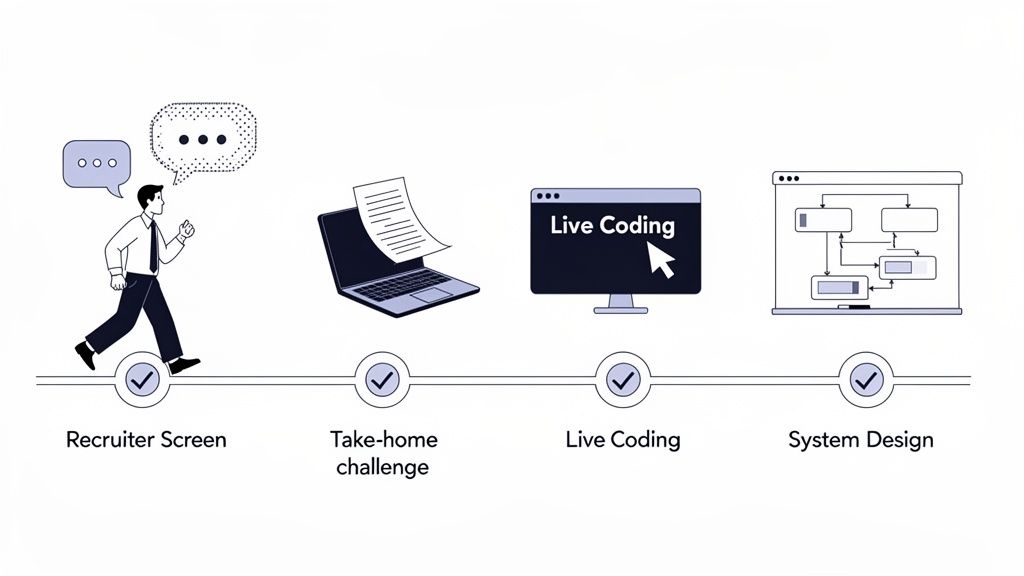
From the first recruiter call to the final system design challenge, they're building a complete picture of who you are as an engineer. Knowing what's coming is your biggest advantage.
Your journey almost always starts with a chat with a recruiter or someone on the talent team. Don't write this off as a formality. It’s a critical first gate where they check your basic qualifications, salary expectations, and genuine interest in the role.
Your goal here is simple: sound like a sane, motivated person who’s actually done their homework.
To nail this call, you need to:
Honestly, this screen is as much about your communication skills as your tech background. A clear, confident conversation gets you to the next round.
Many startups will give you a take-home assignment to see your practical coding skills in a more natural setting. They want to see how you tackle a real-world problem when no one is looking over your shoulder.
This is your chance to really show off. Don't just get the right answer—deliver a piece of production-quality work. That means a clean README.md, well-commented code, and a solid set of tests. Treat it like you're shipping a feature.
This is where things get real. But remember, the live coding session isn't about reciting algorithms you memorized. It's a collaborative exercise where your thought process is way more important than the final code.
The single most important thing you can do in a live coding interview is think out loud. An engineer who silently types out a perfect solution is far less impressive than one who explains their approach, discusses trade-offs, and works with the interviewer.
Narrate your decisions as you go. "I'm using a hash map here because I need O(1) lookups." or "I need to consider what happens if this input is null." If you get stuck, say so and explain why you're stuck. This turns a test into a pair-programming session—which is what the job is actually like.
For any mid-level or senior role, this is often the make-or-break stage. You'll get a broad, open-ended prompt like, "Design a URL shortener," or "Design the Instagram feed." This isn't about code; it's about architectural thinking and how you handle ambiguity.
A great system design interview always follows a clear path:
You’re trying to prove you can think about a system from end to end. If you want to go deeper, our complete guide to software engineer interview preparation has a ton of actionable tips for every stage.
Finally, the behavioral questions. Startups need engineers who can handle a fast-paced, sometimes chaotic environment. They’ll ask things like, "Tell me about a time you disagreed with a coworker," or "Describe a complex project you owned."
The best way to tackle these is with the STAR method:
Using this framework helps you tell a compelling, concrete story that proves you have the mindset to succeed on their team. By preparing for each of these stages, you'll walk into every interview with the confidence to show them you're the right hire.
You made it. You survived the interviews, navigated the coding challenges, and now there’s an offer sitting in your inbox. It's a huge moment, but don't pop the champagne just yet. What you do next—negotiating the offer and hitting the ground running—can set the tone for your entire tenure at the company.
For startup roles, an offer is rarely just a salary. It's a whole package, often a mix of base pay, equity (stock options), and maybe some unique perks. To get the best possible outcome, you need to understand what every single piece of that package is worth.
Before you can even think about negotiating, you have to know what you’re looking at. Think of a startup offer as a blend of immediate cash and potential future wealth. Don't be afraid to ask for clarification until you're crystal clear on every line item.
Your first move? Research. Jump on Glassdoor, Levels.fyi, and talk to your network to figure out the market rate for your role, experience level, and city. This data is your best friend in a negotiation. It lets you ground your counter-offer in reality, not just what you want.
When you're ready to counter, you can say something professional and direct, like:
"Thank you so much for the offer. I'm really excited about the opportunity to join the team. Based on my research for similar roles at Series A startups in this market, the competitive salary range is slightly higher. Would you be open to discussing a base salary closer to [Your Target Number]?"
Equity is where things get really tricky. The number of stock options they offer you is almost meaningless without more context.
You need to ask a few more questions:
Asking these kinds of questions signals that you’re a serious candidate who thinks about the long term, not just the immediate paycheck. For a deeper dive into this crucial step, our article on how to properly accept a job offer has some more great tips.
Once the offer is signed, the next challenge begins: going from the new hire to a trusted member of the team. The first three months are your prime opportunity to build that foundation. Having a rough 30-60-90 day plan is a great way to stay focused.
This isn't some formal document you need to present to your manager. It’s more of a personal roadmap to guide your energy and make sure you're hitting the right milestones.
Your main goal in month one is to be a sponge. Soak up everything you can about the people, the processes, and the product.
With a month of learning under your belt, it's time to shift from absorbing to contributing. Use that newfound knowledge to start tackling more substantial work. The goal here is to deliver your first real piece of value.
Maybe that means shipping a small feature, making a noticeable performance improvement, or squashing a particularly nasty bug. This is a great time to pair-program with a more senior engineer. You’ll learn faster and get instant feedback on your code and thought process. As you get ready for a new role, knowing how to work well in various settings is key. Getting familiar with remote work best practices will help you collaborate effectively, no matter where you are.
By the end of your third month, you should be moving from reactive to proactive. You’re not just grabbing tickets from the backlog anymore; you're starting to spot problems and suggest solutions.
Now is the time to take full ownership of a small-to-medium-sized feature, seeing it through from the initial planning stages all the way to deployment. You should feel like a fully integrated member of the team, adding your voice to sprint planning meetings and technical debates. Nail these first 90 days, and you'll prove without a doubt that they made the right call in hiring you.
Breaking into a startup as a software engineer is a different beast than climbing the corporate ladder. The rules are different, the pace is faster, and the questions you should be asking are unique. Let's tackle some of the most common ones I hear from engineers trying to navigate this world.
Honestly? Probably not. While a CS degree never hurts, startups are obsessed with one thing: can you build what they need, right now? Your ability to solve real problems and ship code is what gets you in the door, not your diploma.
A killer portfolio with complex, interesting projects and a strong GitHub presence are your real credentials here. If you’re self-taught or came from a bootcamp, your public work is your proof. Make sure it’s polished and clearly demonstrates that you’ve got a solid handle on things like system design and core data structures.
For an early-stage startup, versatility is everything. That’s why full-stack developers are often treated like gold. When you're on a tiny team, having one person who can take a feature from the database all the way to the user's screen is a massive advantage.
As the company finds its footing and raises more money, you'll start to see more specialized frontend and backend roles pop up.
My advice is to become "T-shaped." Go deep on one side of the stack—maybe you're a wizard with Python on the backend—but make sure you have a solid, practical understanding of the other side, like React and modern CSS. This gives you the best of both worlds and makes you a compelling hire for startups at any stage.
Remember, an interview is a two-way street. You're evaluating them just as much as they're evaluating you. Be on the lookout for a few warning signs that could point to bigger problems under the hood.
A disorganized, chaotic interview process is often a mirror of the company's internal culture. If the people you talk to can't give you a straight answer about the company's vision, how it makes money, or what specific problems your role is supposed to solve, that's a huge red flag.
Listen closely to how they talk about the work:
While a CS degree is a common and valuable path, it is not strictly required. Many successful engineers come from bootcamps, are self-taught, or have transitioned from other fields. Employers primarily look for demonstrable skills, problem-solving ability, and a strong portfolio of projects. However, a degree can provide a structured foundation in theory and open more doors early on.
Start with one language deeply before adding others. High-demand, beginner-friendly choices include Python (versatile for web, data, automation) and JavaScript (essential for web development). Core skills to focus on are data structures, algorithms, version control (Git), and basic web technologies (HTML/CSS). Build a solid understanding of programming fundamentals rather than chasing every new framework.
A portfolio is critical, especially without a traditional degree or work experience. It proves you can build real things. Include 3-5 substantial projects: one could be a full-stack web app, another might solve a specific problem, and a third could contribute to an open-source project. Deploy them live, document your code on GitHub, and write clear README files explaining the project and your process.
Beyond personal projects, seek out collaborative experience. Contribute to open-source projects on GitHub, take on freelance or volunteer work to build something for a real "client," or participate in hackathons. This experience teaches you to work with existing codebases, collaborate with others, and understand real-world constraints, which is highly attractive to employers.
Interview preparation is a separate skill. You must practice coding problems on platforms like LeetCode to master data structures and algorithms. Learn to explain your thought process aloud. Study system design basics and prepare stories for behavioral questions using the STAR method. Mock interviews with peers are invaluable for building confidence.
Cast a wide net. Apply to roles on job boards like LinkedIn, Indeed, and specialized tech platforms. Don't overlook smaller startups, which can offer more responsibility and learning opportunities. Leverage your network—attend meetups, connect with people on LinkedIn, and ask for referrals. A curated hiring platform can also match your profile with companies looking for emerging talent.
The timeline varies widely based on your starting point, learning pace, and the job market. For someone learning full-time, it might take 6-12 months of dedicated study and building to become job-ready. For those learning part-time, it could take 1-2 years. Persistence, consistent project building, and active networking are key to shortening the timeline.
Ready to stop sending your resume into the void and let top startups come to you? At Underdog.io, we flip the script. Create one profile, get seen by hundreds of vetted tech companies, and find a job you'll love. Join our curated marketplace for free at https://underdog.io.