You've posted the AI engineer role twice, adjusted the title, added “production experience” to the requirements, and still your pipeline is full of people who can build impressive notebooks but can't explain how they'd monitor a model after launch. Meanwhile, the strongest candidates disappear after a slow second round.
That failure usually starts before sourcing. The company hasn't decided what kind of AI engineer it needs, so every downstream decision becomes vague, from outreach and interviews to compensation and onboarding. If you're learning how to hire AI engineers, start by treating the problem as role decomposition first, recruiting second.
A founder asks for “an AI engineer,” and the hiring manager turns that request into a checklist: Python, PyTorch, cloud experience, LLMs, data pipelines, MLOps, perhaps research. The job description now spans several distinct jobs. Candidates with mismatched backgrounds enter the process, while interviewers lack a shared standard for judging who can deliver.
The hidden assumption, that AI engineer is one job, is wrong. An applied ML engineer may spend the week improving features, training models, and evaluating prediction quality. An LLM application engineer may focus on retrieval, orchestration, prompt and tool workflows, and product integration. An MLOps engineer may prioritize deployment, observability, rollback, and infrastructure reliability over model architecture.
The hiring market makes that ambiguity expensive. LinkedIn reported that AI Engineering hiring grew by more than 25% year over year in 2025, while overall software engineering hiring declined 7%, as summarized by LinkedIn's AI engineer demand analysis. The same update said AI engineering talent hiring growth outpaced overall hiring growth by nearly 30%. A vague requisition gives scarce candidates little reason to choose your process and gives recruiters a weak basis for finding them.
Practical rule: If the hiring panel can't name the first production outcome this person owns, the role isn't ready to source.
Look closely at candidates who sound strong in theory but cannot describe a system they operated. A UK government-backed survey found that 35% of businesses had AI vacancies they considered hard to fill. Among those hard-to-fill openings, 31% cited lack of work experience as the leading reason, according to the UK AI Labour Market Survey executive summary. Credentials create interest. Shipped systems create confidence.
The practical sequence is clear: define the work, select the sub-role, write a scorecard around evidence, source where that evidence appears, run a short high-signal process, and connect the offer to the candidate's actual scope. Research such as this analysis of how AI has changed recruiting adds useful context, but the hiring decision still begins with the role. You can't compensate for an undefined role with more outreach.
Begin with the next two quarters, not with a list of fashionable technologies. Ask what the company needs shipped, who will use it, what data it depends on, and what can fail in production. Then map that work to one primary role.
Applied ML engineer. This person turns business or product problems into predictive systems. A day-one deliverable might be a recommendation model, a fraud classifier, or a demand forecast connected to a real data pipeline. Look for feature design, model evaluation, experimentation, data quality judgment, and evidence that the candidate has supported a model after launch.
LLM application engineer. This role builds useful product behavior on top of foundation models. The first deliverable could be a retrieval-augmented support workflow with an evaluation set, source attribution, and clear fallback behavior. Screen for API integration, retrieval design, tool use, evaluation methodology, latency and cost awareness, and the ability to make uncertain model output safer for users.
MLOps or platform engineer. This engineer makes AI systems repeatable and reliable. Their first project might be a deployment pipeline, model registry, monitoring layer, or rollback process. Strong evidence includes ownership of CI/CD for models, cloud deployment, observability, versioning, incident response, and operational trade-offs.
AI infrastructure or research engineer. This is the right profile when the company needs training infrastructure, large-scale experimentation, model optimization, or close collaboration with research. A day-one deliverable might be improving training throughput, building distributed evaluation infrastructure, or operationalizing a new model architecture. Prioritize systems depth, distributed computing, performance reasoning, and research-to-production judgment. Don't add this profile to an ordinary product integration requisition.
A practical overview of machine-learning hiring trends in LATAM can help hiring teams compare adjacent titles and avoid treating them as interchangeable.
Your brief should fit on one page and include:
Avoid credential-first language. A degree can be relevant for a research-heavy role, but it shouldn't substitute for evidence of production capability when the job is applied engineering. The brief should let every interviewer answer the same question: what evidence would convince us this person can own the work?
A hiring team can spend a week collecting applicants and still lack one credible candidate for the role it defined. The problem usually starts with the sub-role. A retrieval engineer, an MLOps owner, and an applied researcher will respond to different messages and appear in different places.
Build the channel plan around that distinction. Warm referrals and evidence-based outreach usually produce stronger conversations than passive inbound, while job postings help capture candidates already searching.
Warm introductions from engineers often provide the strongest initial fit because the referrer can describe the technical problem accurately. Ask for names connected to a specific sub-role, such as someone who has shipped and monitored a retrieval system. “Who is good at AI?” creates noise. A focused request gives the conversation a clear starting point.
Curated startup marketplaces can reach candidates who understand early-stage ambiguity. They reduce some of the noise found on general job boards, though the hiring team still needs to verify role fit and production evidence. Underdog.io connects startups with curated technology candidates, including AI engineering profiles, through a matching process rather than an unrestricted applicant stream.
Niche communities work when the message fits the group. MLOps Slack groups, LLM Discord servers, technical meetups, and follow-ups with authors of relevant arXiv papers can surface people who are not actively applying. The cost is manual effort. Participate in the community, explain the specific problem, and invite a technical conversation instead of dropping a job link.
Targeted outbound should begin with shipped work on GitHub, Hugging Face, technical blogs, conference talks, or public system discussions. Mention the work specifically, connect it to the sub-role, and explain the production problem the candidate would own. A practical passive candidate sourcing guide can help recruiters structure this outreach without generic messaging.
Paid postings belong at the top of the funnel. They establish market presence and capture active candidates, but they rarely fill a specialized search on their own. Guidance on channel selection and candidate experience is also available in recruiting guidance from Chicago Brandstarters.
| Channel | Time to First Qualified Candidate | Typical Cost | Best For |
|---|---|---|---|
| Engineer referrals | Fast when the network is relevant | Low direct cost | Specialized roles with trusted technical referrers |
| Curated marketplaces | Fast to moderate | Success-based or marketplace fee | Startups needing filtered, startup-oriented talent |
| Niche communities | Moderate | Low direct cost | MLOps, LLM, research, and infrastructure specialists |
| GitHub and Hugging Face outbound | Moderate | Recruiter time | Passive candidates with visible shipped work |
| Paid job postings | Variable | Posting or advertising spend | Active candidates and additional top-of-funnel reach |
Run the first four channels in parallel during the opening week, adjusting the mix to the sub-role. Track qualified replies and interview conversions rather than applicant volume. A channel that produces many profiles without evidence of the required work is consuming recruiter time. Pause it quickly, even if the channel is familiar.
A candidate can present an impressive model demo and still struggle with production ownership. Screening should test production-ready capability through a short, role-specific funnel. Begin with resume and portfolio triage, then use an asynchronous scenario, one structured system-design interview, and one practical coding or evaluation exercise.
Long take-homes remove strong engineers from the process. Unstructured conversations create a different problem: each interviewer rewards a different personality trait, making debriefs difficult to compare.
Review evidence against the sub-role you need. Look for concrete ownership:
A polished portfolio offers limited signal without follow-up. Ask what broke, what changed after launch, which decision they would revisit, and what they would redesign. For a research-oriented hire, give more weight to experimental judgment. For an applied or infrastructure hire, press harder on deployment, observability, reliability, and incident response.
A useful asynchronous prompt is: “A model performs well offline but generates poor results for a meaningful group of users after release. Describe how you'd investigate the issue, what data you'd inspect, how you'd evaluate a fix, and how you'd roll back if the fix made things worse.”
Strong answers separate data quality, distribution shift, evaluation design, product behavior, and operational controls. They include a staged rollout or rollback path and acknowledge uncertainty. Weak answers jump directly to retraining or changing the model without establishing whether the data, metrics, or serving environment caused the problem.
For system design, ask: “Design an AI feature that must serve customer requests reliably. How would you choose the architecture, monitor it, control cost and latency, and handle degraded model performance?” Score the response on problem framing, data judgment, evaluation, reliability, and communication. The candidate does not need to choose your preferred vendor.
Share the dimensions before the interview:
| Dimension | Strong signal | Weak signal |
|---|---|---|
| Problem framing | Clarifies users, constraints, and success criteria | Starts with tools or model names |
| Data judgment | Checks quality, leakage, coverage, and bias risks | Assumes the dataset is trustworthy |
| Evaluation | Defines offline and production measures | Relies on demos or intuition |
| Operational thinking | Plans monitoring, rollback, and failure handling | Treats deployment as the final step |
| Communication | Explains trade-offs clearly | Uses jargon without decisions |
Structured technical evaluation can support this approach when configured around role type, skills, difficulty, and integrity controls. Scoring for accuracy, depth, communication, and problem solving is described in HackerRank's explanation of AI-assisted technical interviews.
Keep practical work bounded and tied directly to the role. A focused evaluation exercise produces more useful signal than an elaborate assignment asking candidates to build an entire platform for free. The assessment should resemble the decisions the hire will make after joining, with enough context to reveal judgment and enough limits to respect the candidate's time.
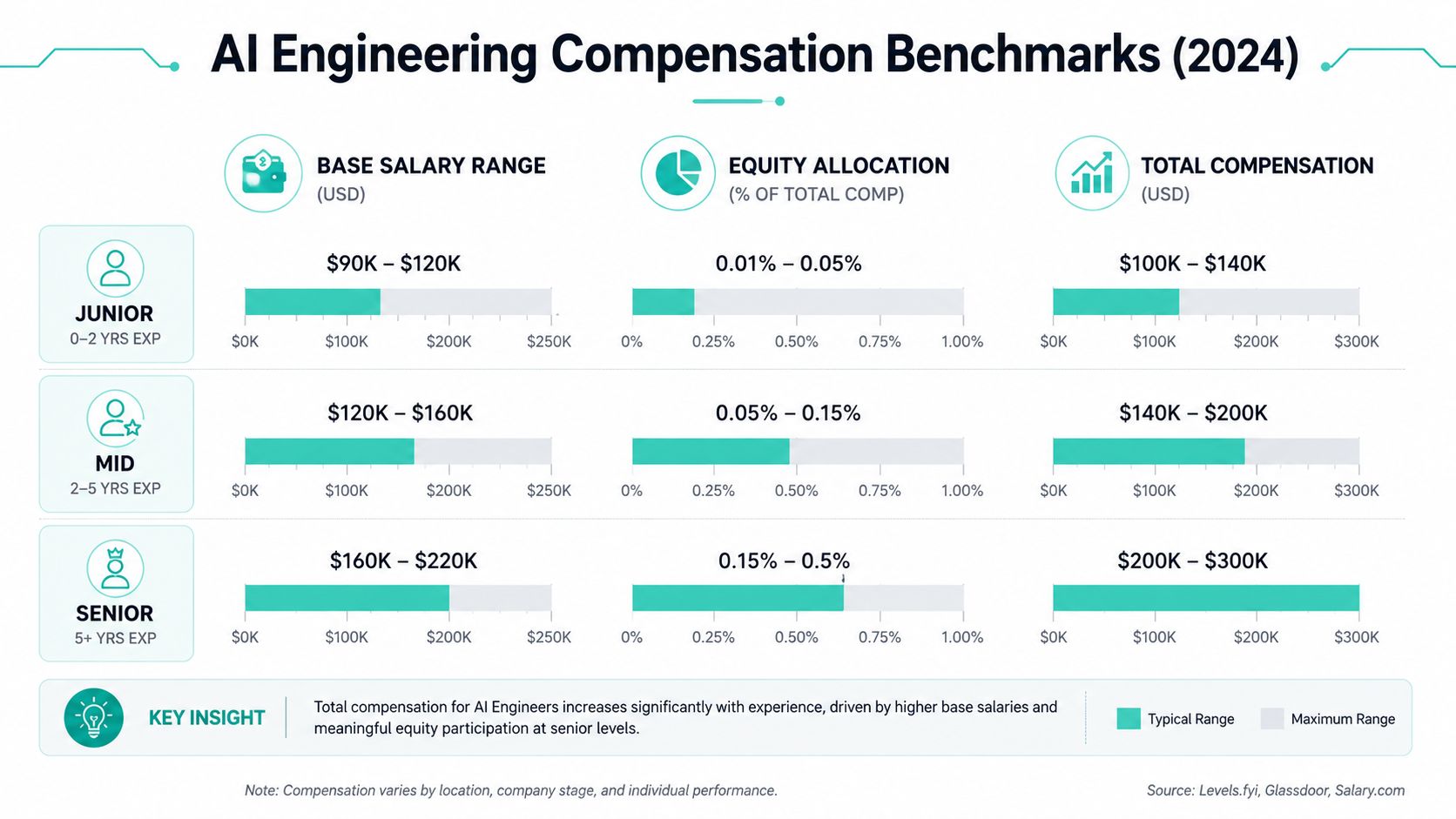
Compensation should follow the sub-role you need, not the broad label “AI engineer.” An applied engineer integrating models into a product carries a different scope from an infrastructure specialist responsible for model serving, observability, and reliability. Pay bands, equity, and the offer narrative should reflect that distinction.
Salary summaries show the cost of using one generic range. One U.S. summary reports an average machine-learning engineer salary of $166,000, with a range of $126,000 to $221,000. Another reports a median total annual salary of $169,000 and a total pay range of $134,000 to $215,000, as compiled by 365 Data Science's machine-learning engineer skills guide. A separate summary places junior total pay near $133,000 and senior total pay around $233,000. Scope and seniority account for much of that spread.
Production-heavy roles often command more because the engineer owns problems after launch. A 2026 industry summary reports mid-level U.S. roles commonly paying about $150,000 to $180,000, with senior MLOps-focused roles exceeding $200,000. The cited skills include cloud deployment, troubleshooting, observability, and reliability, according to this machine-learning engineer demand analysis.
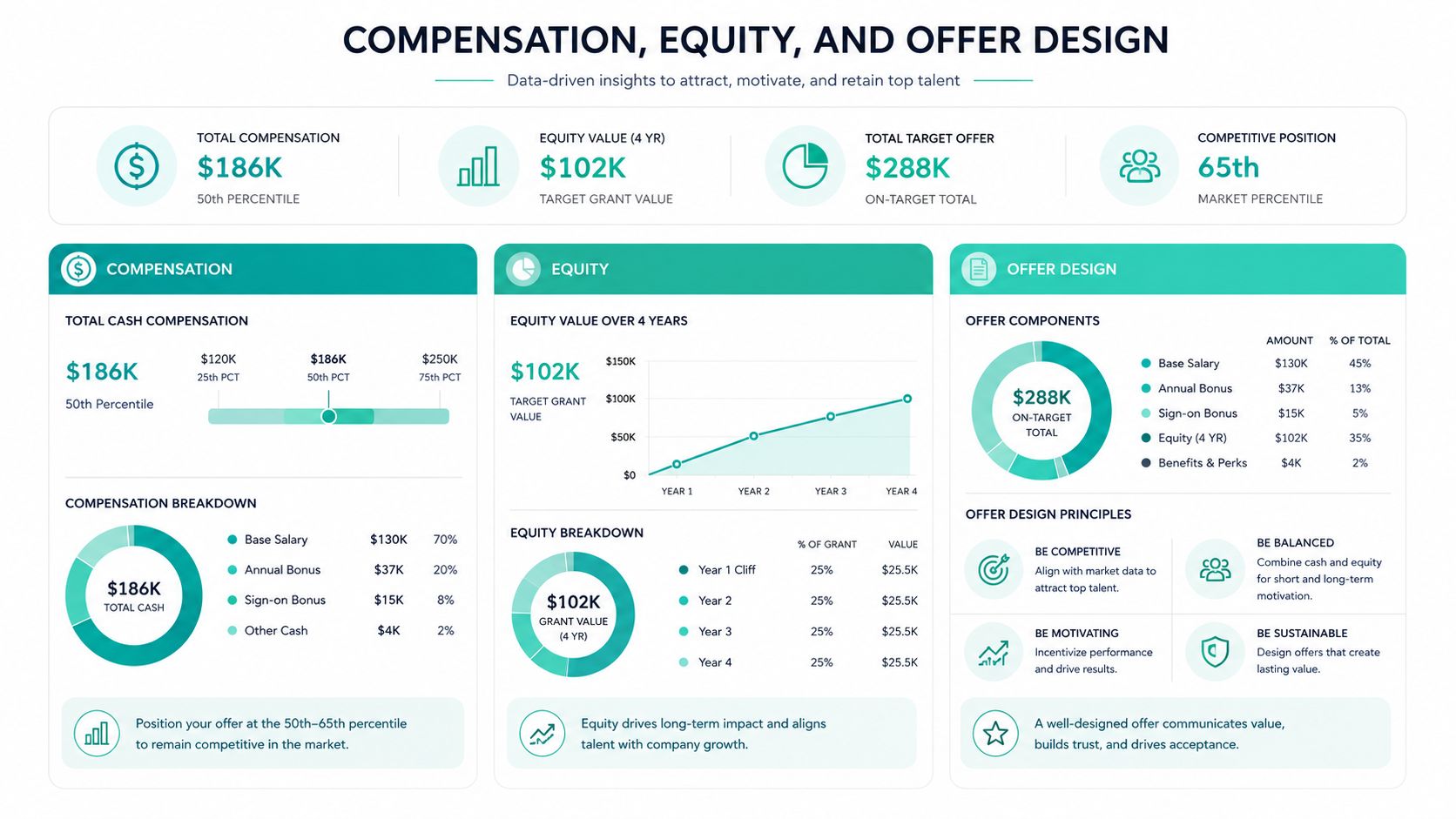
Base salary needs to make the offer credible for the role, market, location, and seniority. Equity should be explained in plain language: vesting, dilution risk, exercise mechanics where relevant, and the ownership level attached to the position. A signing bonus can cover a specific transition cost, but it should not conceal a weak long-term package.
Use startup compensation benchmarks to create an internal framework, then adjust it for the sub-role and production responsibility. Candidates also judge whether the package matches the authority they will receive. A senior engineer expected to own reliability will question an offer designed for an execution-only role.
The period after verbal acceptance still affects the outcome. Confirm the candidate's decision factors, ask about competing offers without turning the conversation into an interrogation, and schedule a substantive discussion with the future manager. If a counteroffer appears, return to the reasons the candidate considered leaving and connect your role to the work they want to own.
Market reporting estimates 1,550 new U.S. AI engineering roles per week, with postings concentrated toward mid-level and senior individual contributors. Another 2026 report places senior AI and ML time to hire at 8 to 12 weeks and estimates that roughly 70% of accepted offers face a counteroffer, as reported by Axial Search's AI engineering hiring guidance. Prepare approvals and decision-makers before the offer stage, because delays give competing employers room to act.
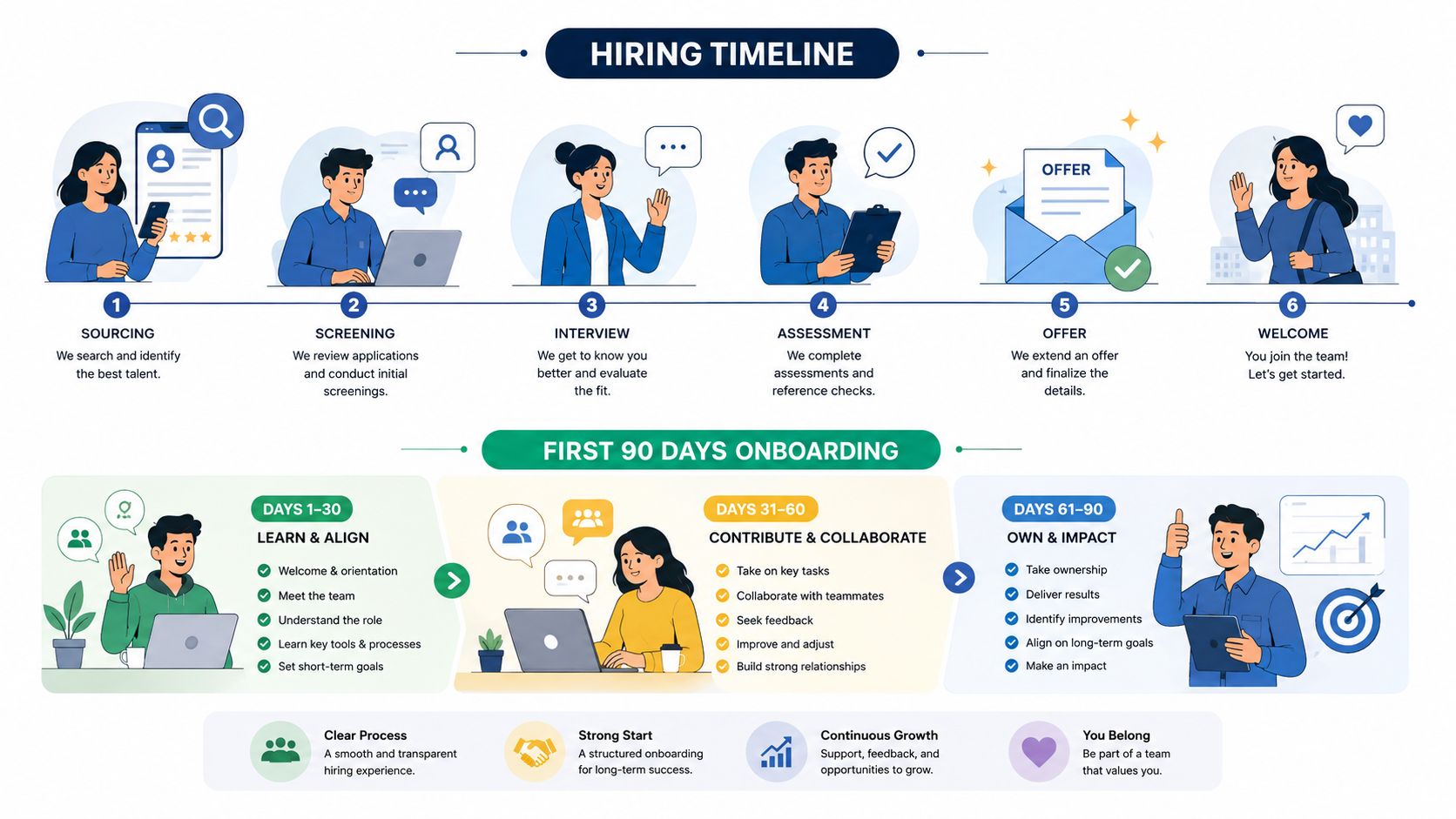
A signed offer can still fail if the new hire spends the first weeks waiting for access, context, or a meaningful problem. AI engineers need an early view of the data, evaluation standards, deployment environment, and decision-makers who control product scope.
Use a compressed process with explicit owners:
One 2026 hiring guide reports a market average time to hire of roughly 25 days, according to Kore1's AI engineer hiring guide. Treat that as a reason to remove internal delay, not as permission to reduce evaluation quality.
During week one, provide repository access, cloud permissions, dashboards, documentation, and introductions to the people who own data and product decisions. Give the engineer a technical walkthrough that includes known failures, not just the polished architecture diagram.
By weeks two through four, assign a bounded deliverable such as improving an evaluation set, tracing an inference bottleneck, or making a pipeline reproducible. The work should create useful context without placing the new hire on a critical incident before they understand the system.
During months two and three, move toward ownership of a production outcome. Hold frequent manager one-on-ones early, review progress against the role brief, and ask directly where the employee lacks access or clarity. The common disengagement point is not always technical difficulty. It's often discovering that the advertised ownership doesn't exist.
Before publishing the role, confirm these decisions:
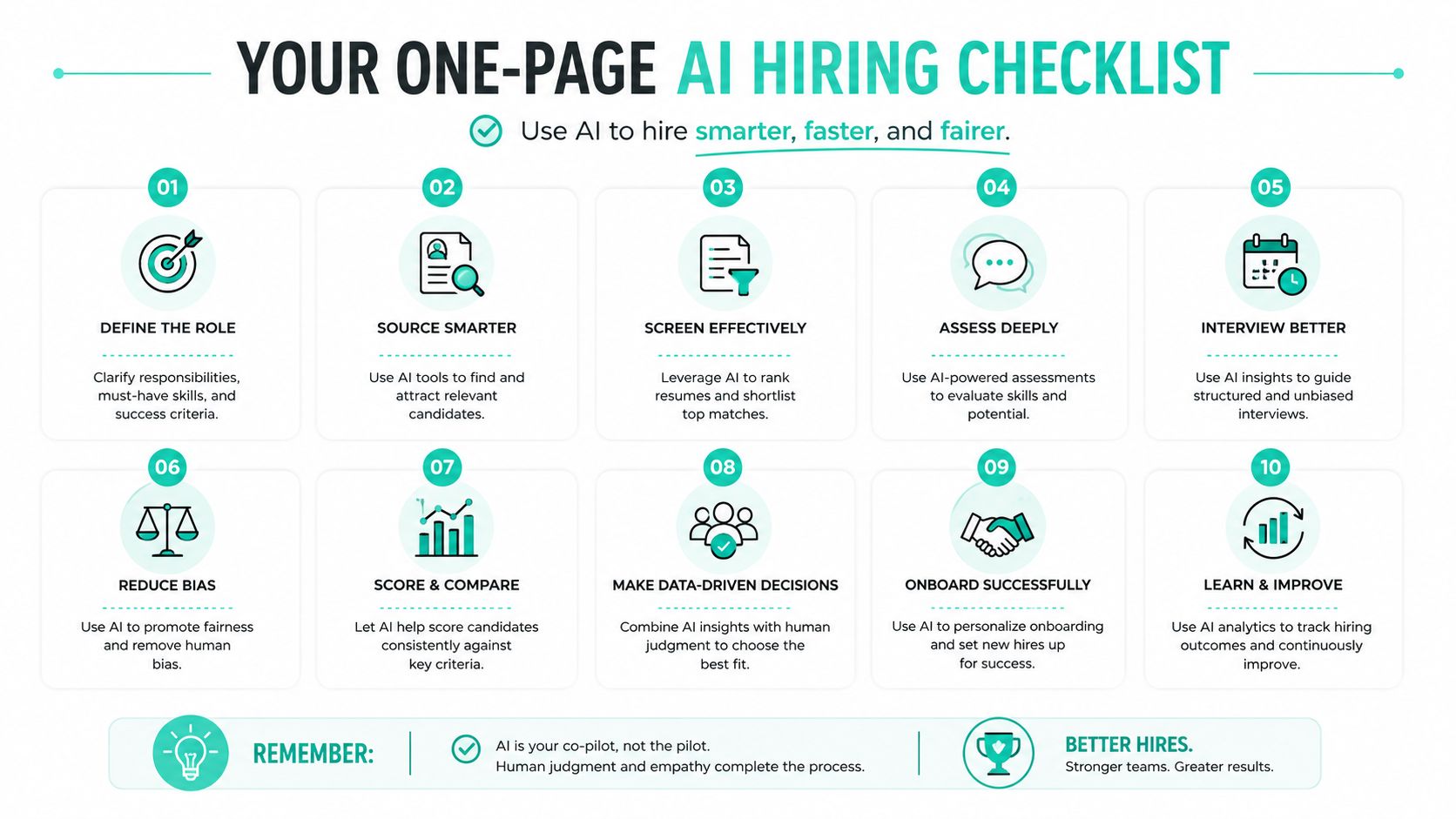
Watch for three failure modes. A vague requisition produces a mixed pipeline. Slow debriefs let candidates accept elsewhere. Generic onboarding leaves a specialist wondering whether the promised work was real. Teams building a specialized healthtech engineering team can use the same checklist, especially when domain constraints make production context as important as technical depth.
The best hiring process is not the one with the most sourcing volume or the most difficult interview. It's the one where the role, evidence, decision process, offer, and first 90 days all point to the same outcome.
Underdog.io helps startups connect with curated, pre-screened AI engineers who have production experience across LLM, ML, and applied AI work. If you want a more focused pipeline without relying on generic job-board volume, visit Underdog.io and create a role around the specific capability you need to ship.