A senior engineer resigns on a Monday. By Tuesday, the founder is deciding whether to promote a promising developer who knows the product inside out or search externally for someone who has already led a similar team. One choice protects continuity and rewards performance. The other may bring skills, perspective, and leadership the startup doesn't yet have.
That decision affects more than the open seat. It shapes compensation, morale, delivery risk, manager capacity, and whether employees believe they can build a career inside the company. Internal vs external recruiting works best when hiring managers treat each vacancy as a business problem, not as a loyalty test or a race to collect resumes.
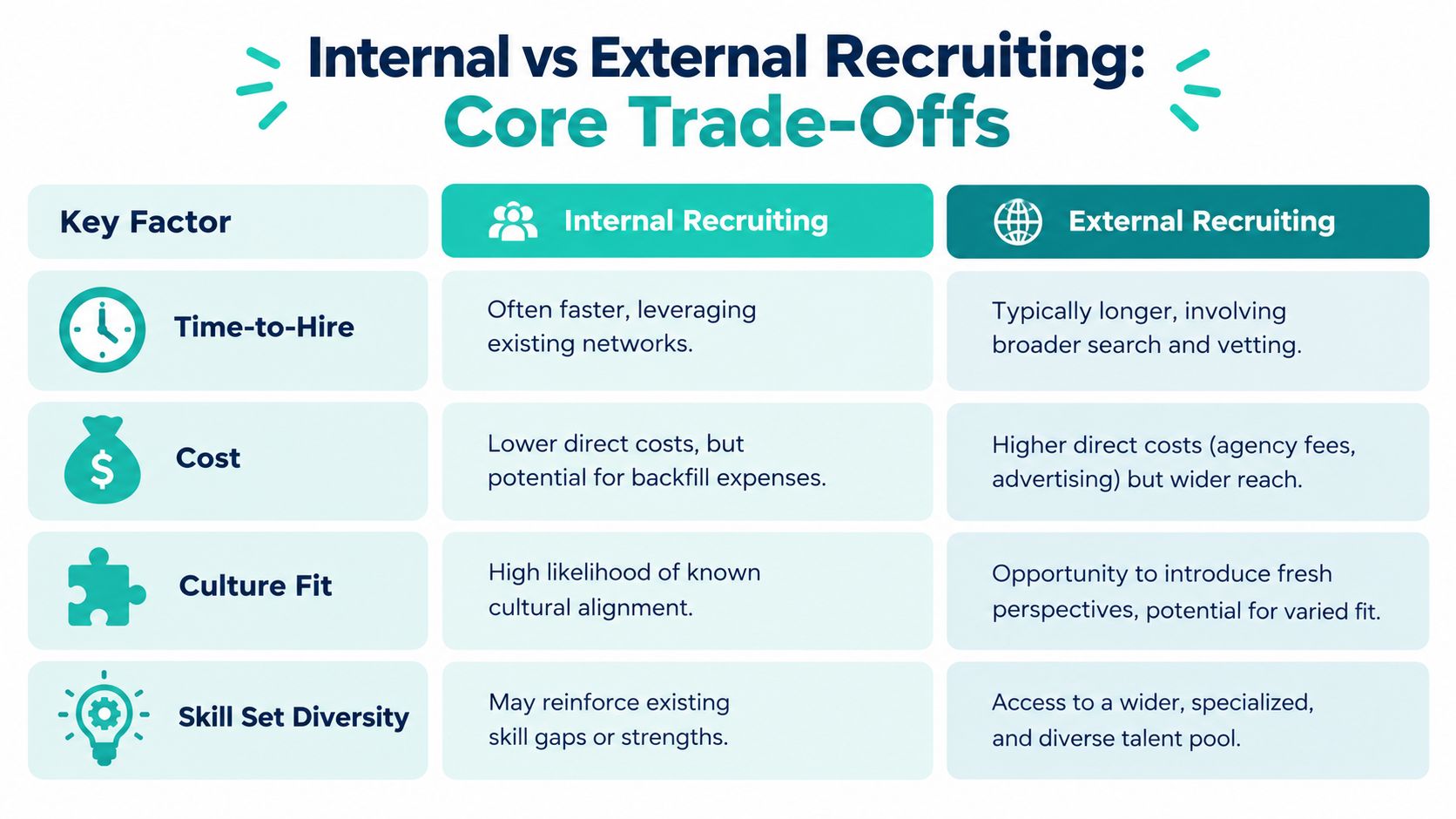
| Factor | Internal recruiting | External recruiting |
|---|---|---|
| Candidate source | Current employees, through promotions, transfers, lateral moves, or upskilling | Candidates from the wider market, including direct sourcing, marketplaces, referrals, and staffing firms |
| Cost profile | Usually lower direct recruiting costs, with a possible backfill requirement | Often higher direct costs from advertising, agencies, sourcing, and broader evaluation |
| Speed | Can move quickly because performance and context are already visible | May take longer because the company must source, assess, and validate an unknown candidate |
| Cultural evidence | Existing behavior provides stronger evidence of day-to-day fit | Offers a chance to add different perspectives, with more uncertainty about fit |
| Skills | Builds on capabilities already inside the company | Expands access to specialized or missing capabilities |
| Main risk | Reinforcing existing gaps or creating a vacancy behind the promoted employee | Paying more for a candidate whose performance in the new environment remains unproven |
The obvious answer is often wrong. A junior developer may understand the product better than an impressive outsider, but may need support before taking ownership of architecture, hiring, or incident response. An external engineering leader may have the required experience, yet still need time to learn the codebase, customer context, decision-making norms, and the founder's operating style.
Startups usually feel four pressures at once:
The mistake is reducing the decision to “internal is cheaper” or “external brings fresh ideas.” Both statements can be directionally true, but neither answers the role-level question. A startup should ask what the position must accomplish, what evidence already exists about available candidates, and what risk the company can absorb while the person ramps.
Practical rule: Decide whether the role needs known context or new capability before deciding where to search.
A product operations role embedded in complex internal workflows usually rewards company knowledge. A first security leader, international sales executive, or specialist infrastructure hire may require external experience. The answer can also change with company stage. A small startup might lack enough internal depth for a leadership promotion, while a growing company can uncover strong candidates through lateral mobility and deliberate development.
The most reliable process starts with a short internal audit, followed by an external search if the internal slate doesn't meet the role's written requirements. That approach keeps opportunity visible without allowing an urgent vacancy to become an excuse for an unstructured appointment.
Internal recruiting means filling a role with someone already employed by the company. Promotion is one path, but it isn't the whole system. A practical internal talent ecosystem includes:
This distinction matters because internal mobility isn't limited to the top of the hierarchy. A labor-market summary reports that external horizontal moves represented 33% of new job entries, while internal promotions accounted for 25% and internal horizontal moves for 27%. Together, those internal paths represented more than half of job entries, showing that lateral movement is a major part of how organizations allocate talent, not a niche succession practice. See the labor-market summary of hiring and promotion trends for the underlying distribution.

External recruiting covers any search that reaches beyond the current workforce. Posting a job is only one channel. A startup might source directly through professional networks, build an inbound pipeline with employer branding, use employee referrals, work with a curated marketplace, or engage a specialized staffing firm such as nexusITgroup.com for a defined technical need.
An internal process fails when employees hear about openings through informal conversations or discover that a manager has already chosen a successor. Publish the role, define the required outcomes, explain eligibility, and use the same evidence-based evaluation standards that would apply to an external candidate.
Upskilling also needs a business connection. Training someone on a tool isn't an internal recruiting strategy unless the company can explain which future role that capability supports and how managers will evaluate readiness.
External sourcing creates reach, but reach isn't quality by itself. Job descriptions should identify the outcomes, constraints, decision rights, and technical context of the role. Direct sourcing, referrals, curated marketplaces, and specialized partners can then be selected according to the type of candidate required, rather than added randomly to a checklist.
The internal vs external recruiting decision becomes clearer when the hiring team compares the same four criteria for both paths: cost, speed, quality, and culture.
Internal hiring normally avoids many external sourcing expenses, but “free” is the wrong label. The promoted employee leaves a vacancy behind, and the company may need to recruit or redistribute work for that original position. Managers also spend time assessing candidates, preparing the transition, and supporting the new role.
External hiring can add advertising, agency fees, sourcing work, relocation, compensation negotiation, and onboarding costs. A useful comparison starts with cost-per-hire, calculated by adding internal and external recruiting costs and dividing the total by the number of hires in the period, as defined in this HR metrics reference. For agency economics specifically, hiring teams can use this analysis of recruitment agency costs to identify which fees belong in the calculation.
Internal candidates may move faster because the company already has evidence about their work, relationships, and operating habits. That advantage disappears when promotion criteria are unclear or the employee needs substantial preparation for the new scope.
External hiring requires a broader search and more validation. A staffing placement can operate on a much faster cycle than standard corporate recruiting, with one industry source citing a range of 4 to 14 days and a median of 9 days for staffing placements. That benchmark applies to staffing placements, not every permanent technology hire, so don't use it to promise a standard external search timeline. The staffing-placement cycle reference provides the relevant context.
External candidates can present stronger credentials at the point of hire, particularly when the company is seeking a capability that doesn't exist internally. Credentials still don't prove that someone will perform well inside a particular product, culture, or decision system.
External hires may look stronger on paper while producing weaker early performance in the new environment.
Research summarized by Wharton reports that external hires received lower performance evaluations during their first two years, exited faster, and earned about 18% to 20% more than comparable internal promotions. That creates a real trade-off between visible credentials and early performance, compensation, and retention risk. The Wharton analysis of external and internal hires details that comparison.
Internal candidates offer more observable evidence about collaboration, judgment, and company norms. That evidence lowers uncertainty, but it can also preserve habits the startup needs to challenge.
External hires introduce experience from other environments. They can question assumptions, add specialized knowledge, and widen the team's perspective. The cost is that the company must test cultural fit through structured interviews and work samples rather than rely on reputation alone.
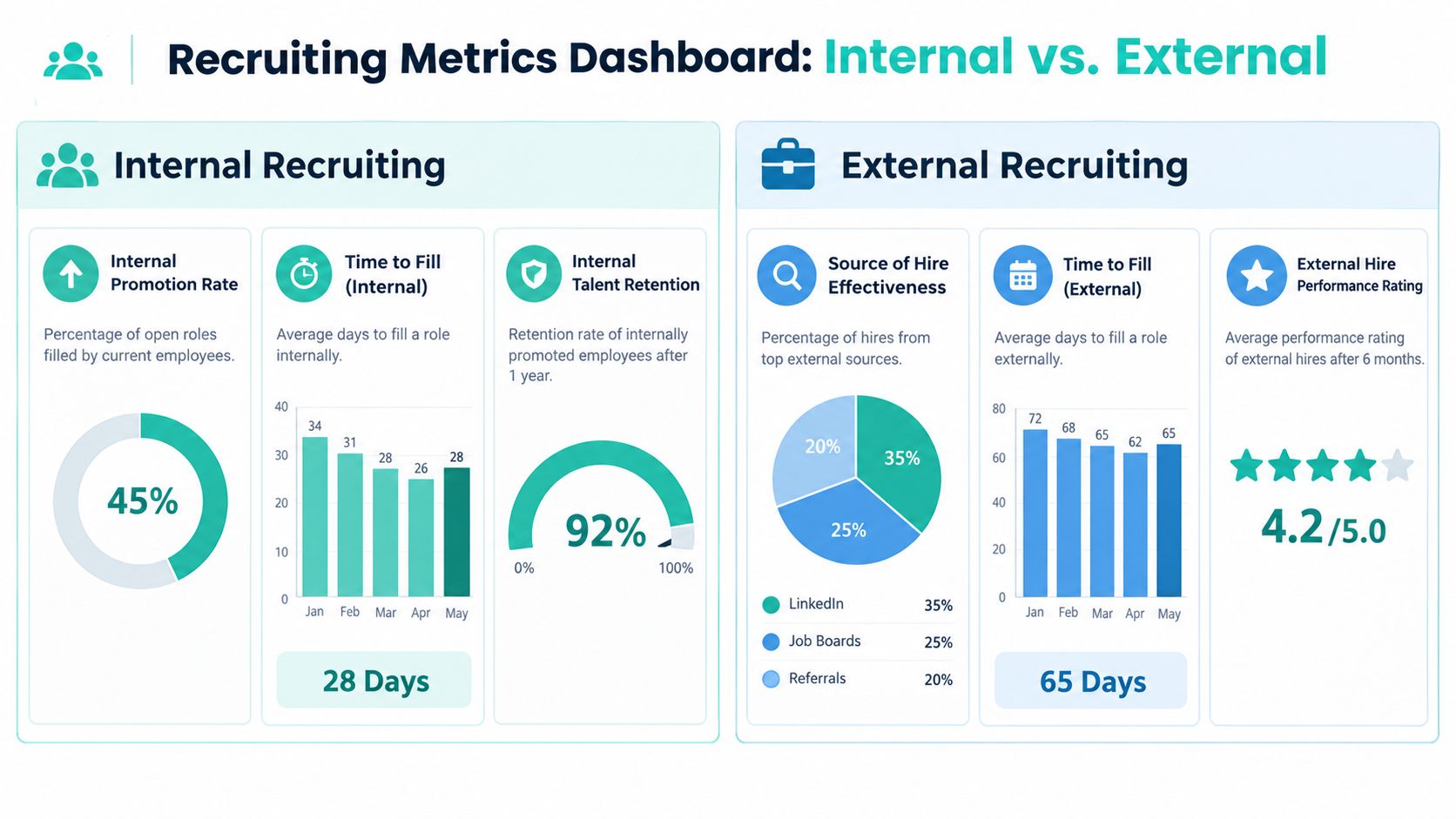
A filled requisition is only the starting point. Measure whether the hire reached the intended outcomes, how much risk the process created, and where internal or external recruiting performs better. Keep the results separate by source so a fast internal move does not hide an expensive external search, or vice versa.
Define time-to-fill as calendar days from requisition approval to candidate acceptance of the offer. Exclude background checks and onboarding, and apply the same definition to every recruiting channel. The technology-sector median is 42 days, according to the technology recruiting benchmark. For calculation guidance, use these time-to-hire metrics.
Break the measure out by promotions, lateral moves, referrals, direct sourcing, curated marketplaces, and agencies. A single blended figure can hide the actual constraint. If internal candidates move quickly but approvals drag, sourcing is not the problem. If external candidates stall after the first interview, clarify evaluation criteria and tighten scheduling.
Apply one formula to both paths. Count recruiter time, advertising, sourcing tools, agency fees, interview hours, relocation where applicable, and transition costs created when an internal candidate leaves another role. A low reported cost means little if it excludes the vacancy or disruption left behind.
Separate recurring recruiting-program costs from costs tied to one hire. An internal skills inventory or mobility platform can support multiple searches, while an agency fee usually belongs to a particular assignment. For a startup, this distinction shows whether a repeatable internal process or a curated external marketplace is improving hiring economics.
Review outcomes at defined checkpoints, such as the first meaningful delivery review and the first annual review. Avoid a universal target. Compare internal and external cohorts in equivalent roles, while accounting for role complexity, manager, level, and company stage.
Track:
A useful dashboard changes hiring decisions. If external hires bring missing skills but struggle during onboarding, improve early support. If internal promotions perform well but leave critical gaps behind, build succession depth before approving another move. That comparison helps startups choose between internal mobility, external sourcing, or a deliberate hybrid approach.
Use a role scorecard before opening a search. Write the outcomes, required knowledge, missing capabilities, urgency, and consequences of a poor appointment. Then assess internal candidates against the same standard used for external candidates.
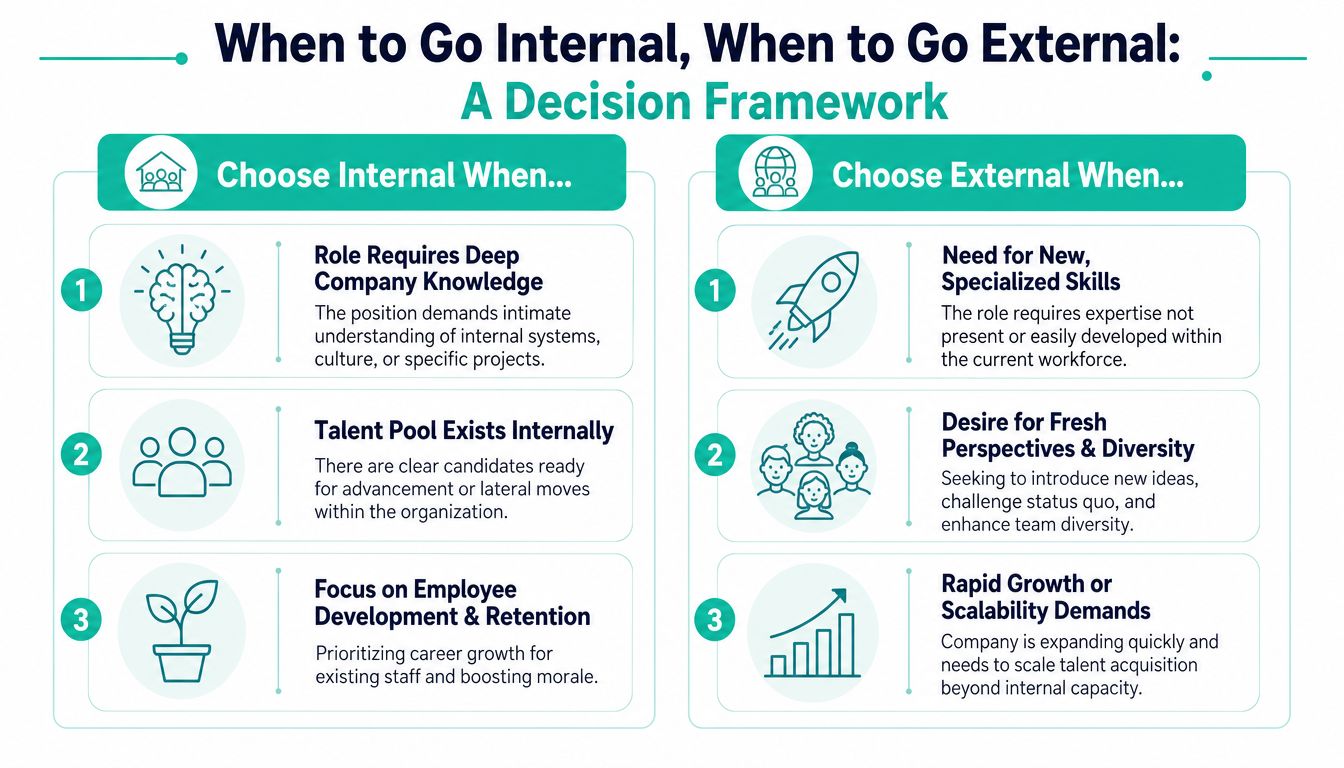
Choose internal recruiting when success depends on understanding proprietary systems, customer history, informal decision paths, or relationships that take time to build. This is especially useful for roles embedded in complex internal hierarchies, where coordination matters as much as technical ability.
Managers are more likely to favor internal promotion when the cost of a hiring mistake is high or when firm-specific knowledge is essential to success. The research on promotion and external hiring decisions supports that structural logic.
Internal hiring also makes sense when:
Don't promote someone solely because they've been reliable in a narrower role. Test whether they can perform the new work, manage the new relationships, and handle the increased ambiguity.
External recruiting is the better path when the role requires expertise that isn't present or can't be developed within the required timeframe. This includes new technical domains, unfamiliar markets, specialized compliance work, or leadership experience the current team hasn't yet gained.
Look outside when:
The practical answer is often sequential. Review internal talent first, make the criteria explicit, then open an external search if the evidence doesn't support a move. That preserves fairness without confusing employee tenure with readiness.
A startup shouldn't choose between internal mobility and external sourcing as permanent identities. It should maintain both channels and decide which one leads for each role.
Start with an internal talent map. Record skills, career interests, recent achievements, development needs, and possible next roles. Managers should update it through regular career conversations, not only when a vacancy appears. Employees can't pursue opportunities they can't see, and leaders can't make credible mobility decisions from memory alone.
The external channel should be curated rather than indiscriminate. For difficult technology searches, Underdog.io can give employers access to a marketplace where candidates apply once and are introduced to vetted startups, while employers review profiles and contact relevant candidates directly. A company can also use a specialized staffing firm such as nexusITgroup.com when it needs focused technical expertise or temporary capacity.
A workable hybrid process looks like this:
The external default is more common than many startup leaders assume. SHRM reported that only 7% of nonexecutive roles were filled internally in 2025, indicating that most firms still look outside for these positions. That creates an opportunity for startups that make internal mobility visible and credible, as documented in SHRM's 2025 recruiting insights.
Building an intentional talent pipeline helps the company avoid starting from zero every time. The point isn't to force an internal hire. It's to ensure that internal employees and carefully selected external candidates enter a fair process before urgency makes the decision for you.
Make the process operational. A hiring strategy only matters if managers can use it during a busy week, with a resignation, customer escalation, or product deadline competing for attention.
The strongest internal vs external recruiting systems don't promise that every role will be filled from within or outside. They create a repeatable way to make the choice, measure the outcome, and improve the next search.
Underdog.io connects startups with a curated marketplace of technology candidates and lets hiring teams review relevant profiles and reach out directly. Visit Underdog.io to add a focused external channel to your internal mobility strategy and build a more flexible pipeline for critical roles.