When researchers submitted 7,287 fictitious applications to real job openings on ZipRecruiter, Glassdoor, and Indeed between July 2019 and January 2020, only 10.7% of applications without a cover letter received a callback within 30 days, as reported in 22skills' analysis of application tailoring. Generic cover letters nudged that rate to 12.5%, while customized letters reached 16.4%, a 53% relative increase over sending no letter at all. Nearly nine out of ten standard submissions went completely quiet, even when the candidate fit the role on paper.
That silence feels personal when you're refreshing your inbox. It rarely is.
Job seekers widely report frustration with employer communication, and Robert Walters findings cited in FindMeJobs' breakdown of silent applications showed that 86% of UK job hunters had experienced applications being ignored. The mechanics explain most of it. Startups run small recruiting teams, or rely on founders and hiring managers reviewing applicants between product launches, fundraising, and customer escalations. Your resume competes for attention against whatever broke that morning.
Understanding why your startup applications disappear (and how to get a reply) requires treating silence as an operational clue rather than a verdict on your background. Strong engineers, designers, and operators routinely sit unread at the bottom of an overfilled queue because of timing, formatting, or channel choice, none of which say anything about their ability to do the job. Some of those threads deserve a follow-up. Others deserve a closed tab. The difference lies in where exactly your application stalled: a quiet inbox seven days after submission means something entirely different from a hiring manager who asked for your availability and then vanished. Match each type of silence to its stage before you decide what, if anything, to send next.
You send ten applications to promising seed and Series A companies over a weekend. Two weeks pass, and your inbox holds nothing but automated confirmation receipts. Without visibility into the company's hiring workflow, you can't tell whether your resume missed the mark, the role paused, or nobody opened your file.
Application volume makes non-response structurally likely before a human ever reads your background. CareerPlug's benchmark covering more than 60,000 small businesses, detailed in Geekflare's ATS statistics guide, found that employers received an average of 180 applications per hire, with only about 3% of applicants reaching an interview and 27% of interviewees getting hired. At those ratios, a startup hiring manager sorting through inbound applications can't send individual feedback to the vast majority of candidates who never reach the interview stage.
Silence isn't one uniform problem. An application that draws zero response seven days after submission sits in a completely different bucket from a hiring manager who requested your interview availability and then vanished.
Before you rewrite your resume or send another email, read the exact signal in your inbox. Each stage of a startup hiring funnel produces a distinct pattern of silence and calls for a different next move.
| Stage of silence | Signal you see | Most likely cause | Next move |
|---|---|---|---|
| No acknowledgment after 7 days | Application only, no email | Unreviewed in a high-volume queue | Wait for the follow-up window, then send one note |
| Automated rejection within days | Generic rejection email | Failed screen or keyword mismatch | Fix the resume for this role type before reapplying |
| Availability requested, then silence | Scheduling request with no reply | Role on hold or candidate deprioritised | One follow-up with specific availability dates |
| Interview completed, then silence | Interview held, no decision | Internal delay or a change in hiring stage | Send a close-the-loop note after 5 to 7 business days |
| Posting still live, no reply after months | Job remains open | Stale requisition or role filled through referrals | Move to a different channel |
Notice how sending the same check-in message to all five rows wastes your effort. A quick automated rejection within 48 hours usually means a knockout question or a skills mismatch filtered you out early, so following up with the recruiter won't reopen the screen. On the other hand, silence after a scheduling email often happens because an internal stakeholder paused the search or a coordinator dropped a thread, where one clean note with fresh dates can restart momentum.
Diagnose the stage before you react. Treating an unreviewed queue the same way you treat a stalled post-interview decision leads to noisy follow-ups where silence wasn't the real barrier.
Start by sorting your active applications into those five buckets once a week. That single habit stops you from chasing dead postings while letting you act quickly on warm threads that need a nudge.
Many candidates assume an applicant tracking system acts like a robot bouncer that auto-rejects resumes on sight. In reality, a 2025 study of 25 recruiter interviews published by The AI Journal found that 92% of participants said their ATS did not automatically reject applicants based on resume format or content. However, 92% of those same recruiters identified structural clarity and scannability as important when deciding whether to advance a candidate.
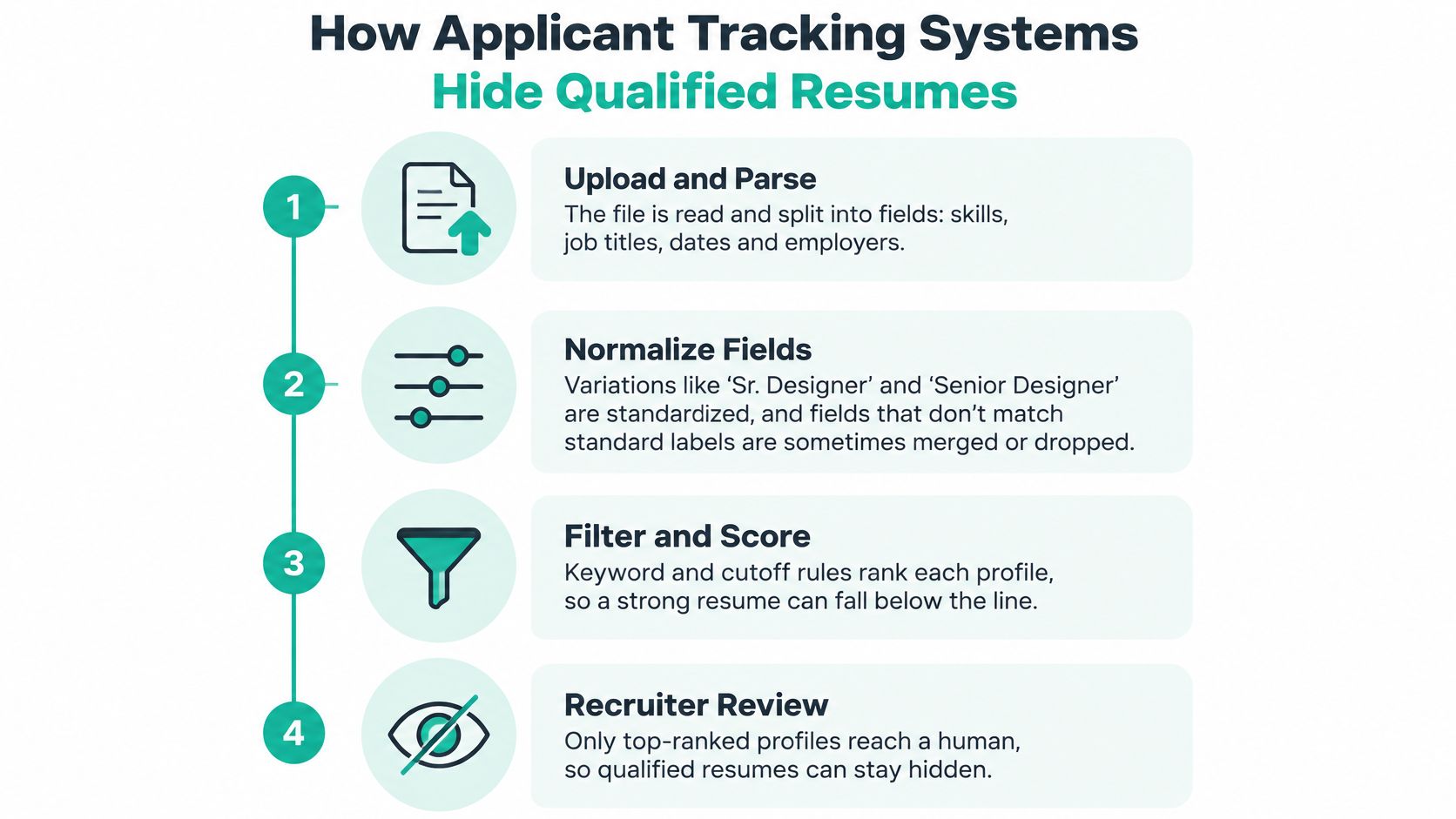
If the software rarely auto-rejects people outright, how do qualified applicants still vanish? The answer sits in information retrieval. Research on automated resume screening published in Multimedia Tools and Applications on Springer shows that applicant tracking systems break resumes into structured fields like skills, titles, dates, and employers, then search or rank them through keyword retrieval, rules, or semantic similarity, where inaccurate data extraction, nonstandard criteria, and keyword mismatch frequently hide strong profiles.
The four-step path below shows where a strong resume drops out of view before a recruiter ever reads it.
Treat your resume like an indexable technical document rather than a design poster. Avoid these common habits that break parsers and slow down human review:
Pair clean structure with concrete proof that satisfies both search tools and human reviewers. Rewrite the top third of your resume around the employer's highest-priority needs, and embed explicit technologies directly inside measurable results. For example, writing "reduced p95 API latency 38% through Redis caching and query optimization" gives a search query exact technical terms while showing a hiring manager real business impact. For a deeper walkthrough on structuring sections and bullets, use our guide on how to write a tech resume.
When an early-stage application disappears without a reply, don't immediately assume you aren't competitive for the role. Often, the breakdown happened at parsing, normalization, or ranking long before anyone evaluated your actual work.
Most job seekers react to silence by switching from one mega-board to another. The numbers show why that swap barely moves the needle. In Huntr's 2025 Annual Job Search Trends Report, an analysis of 598,627 applications found that the vast majority of submissions on major job boards produced no reply at all.
| Job board | Response rate | Source |
|---|---|---|
| 3.1% | Huntr 2025 analysis | |
| Indeed | 4.5% | Huntr 2025 analysis |
| ZipRecruiter | 2.8% | Huntr 2025 analysis |
Look at how narrow the gap is across those three platforms. Moving your entire search from ZipRecruiter to Indeed shifts your baseline odds by less than two percentage points. If you send 100 cold applications through a large board at those averages, you should realistically expect only three to five responses, even with a solid background.
Broad boards reward ease of clicking, which floods every public listing with hundreds of loosely matched resumes. Narrower, domain-focused boards can reduce some of that noise when your specialty fits a specific ecosystem, such as exploring Web3 opportunities for designers and marketers on Blockchain Jobs instead of competing in generic marketing feeds. If you want a broader look at which platforms work best for startup roles, our breakdown of the best tech job boards compares where engineering, product, and design listings concentrate.
Board-wide averages tell you what happens in public queues, not what happens when you add referrals or direct outreach. Instead of guessing which source works for your role level, build a five-column spreadsheet and track your own reply rates:
Once you have logged 20 to 30 applications across two or three channels, calculate your reply rate for each column. If cold board submissions return near-zero responses while direct careers-page applications or niche listings convert at double or triple that pace, stop feeding the lowest-performing channel. Your own 30-application sample will beat generic advice every time.
Cold applications fail largely because of incomplete information. A startup recruiter staring at a stack of generic resumes has to guess whether you want their problem space or just clicked apply on forty tabs before lunch. Two levers change how that recruiter evaluates your file: targeted tailoring and internal trust signals.

A hiring-data summary citing a Wellfound study in OneHour's resume statistics overview reported that candidates who adapted their resume to each job received a 78% higher response rate than candidates who reused the same resume for every application. You don't need to rewrite your entire work history from scratch for every opening. Keep one stable master resume containing all your projects and metrics, then adjust only three areas before submitting: the opening summary, the top accomplishments under your most recent roles, and the skills block so it reflects the employer's actual stack and priorities.
Half an hour of tailoring beats a week of blind volume.
A polished resume improves how your file reads once opened, while a referral changes how your file gets routed in the first place. QuietHire Pulse's 2026 tracked study of technology applications reported a 22% response rate within two weeks for average applications, compared with 34% for resumes customized to the job description and 67% for referral-based submissions. The operational lesson holds even if your own numbers land lower: an internal vouch puts you in a smaller, trusted lane where a human is obligated to look at what arrives.
That obligation is the whole mechanism. Recruiters triage cold inboxes by keyword and gut feel, but a referral forwarded by a working engineer lands on the hiring manager's desk with a name attached to it. Someone internally has staked a small amount of credibility on you, and ignoring the file means slighting a colleague rather than skipping a stranger.
When you reach out to an engineer, alumni contact, or community peer for a referral, make it effortless for them to say yes. Send a compact verification packet instead of a vague request to catch up:
Internal recruiter outreach can also work when a company's talent partner actively posts about a role on LinkedIn or X, provided you send that same concrete proof instead of a generic connection request.
Not every opening justifies an hour of networking. Match your effort to how closely the role fits your background and what contacts you realistically have.
| Route | Effort | What to send | Best used when |
|---|---|---|---|
| Cold apply on a job board | Low | Standard resume | Volume test on a broad role |
| Tailored apply on company site | Medium | Role-specific resume and summary | Role closely matches your experience |
| Referral via engineer or alumni | Medium to high | Verification packet and a specific ask | A real contact exists at the company |
| Direct message to hiring manager | High | Short note with one proof point | Team publishes its hiring lead or a relevant project |
Never ask a contact for an introduction before you have proven role fit. Give them the exact two sentences and link they can paste straight into Slack for the hiring manager.
Say you're a senior frontend engineer eyeing two openings: a broad product role at a company where you know nobody, and a design-systems role where a former teammate works on the platform team. Spend ten minutes tailoring your summary and skills for the first company's careers page, and invest your energy building a full verification packet for the former teammate at the second. The first application enters a queue you cannot influence. The second enters a conversation that already has your name in it, and that difference in routing is worth more than any amount of resume polish applied to the cold lane.
Standard job boards run on a one-sided dynamic: you initiate every application, tailor your materials in the dark, and wait in a crowded queue hoping a recruiter spots your name. Even when you do everything right, you still carry all the upfront effort while the employer holds all the filtering power.
Curated hiring marketplaces flip that sequence. Rather than applying individually to dozens of job postings, candidates submit a single vetted profile and let hiring teams reach out when there is a real match.

Take Underdog.io as one example of how the reverse model works in practice. For design roles, designers create one profile and do not apply to job postings; startups contact them directly. Every Monday, founders and PMs at vetted startups contact designers directly, with salary ranges included, and designers decide which startup conversations are worth their time. Across engineering, product, design, and business roles, applying takes 60 seconds with no cover letter and no retyping of your full work history, and we turn away more than 50% of the companies that apply to join the platform.
A curated marketplace isn't a magic fix for every job search, and it comes with clear trade-offs compared with open job boards.
| Model | Who starts contact | Reply odds and volume | Trade-off |
|---|---|---|---|
| Mass job board | Candidate applies and waits in queue | 2.8% to 4.5% response rates across major boards | More chances to apply, most go silent |
| Curated marketplace | Startup contacts the candidate directly | Fewer, more specific introductions | Less visibility until selected, but salary ranges are shown before time is spent |
Look closely at the selectivity trade-off on both sides. On a curated platform, you won't browse thousands of public listings, and selection gates apply upfront: Underdog.io only responds to candidates when they are selected for an Underdog.io cohort. If you are making a sharp career pivot or want to target one very specific niche company outside a marketplace's partner network (which spans pre-seed, seed, Series A through C, and high-growth tech companies in New York City, San Francisco, and remote roles), direct applications and referrals remain essential.
Where a curated pool shines is eliminating guesswork once you're inside. Because the hiring manager initiates contact with compensation details on the table, you aren't wondering whether the role is real, funded, or actively moving. Before committing your search to either model, check whether your target stage and role align with the marketplace's focus, and apply the exact same stage-based silence test if an employer goes quiet after an initial introduction.
A quiet startup is not automatically a disorganized one. Look at the inbound pressure on their teams first. According to Ashby's startup hiring talent trends report, remote startup jobs received 42% more inbound applications than comparable in-office roles, while 66% of recruiters said applications per requisition increased during the prior year. Independent reporting cited in that startup hiring coverage documents single startups receiving 1,700 applicants in 15 hours and 23,000 applications across eight roles.
At that intake speed, early silence after a cold application usually reflects bandwidth limits rather than contempt. The frustration is still real and widely shared: CPA Practice Advisor's coverage of ghost job polling reports that 55% of U.S. job seekers identified receiving no response after an application as a major frustration. The friction runs both ways. Employer-side research in the same report shows 51.6% of employers view unresponsive candidates as a major recruiting challenge, which means neither side reads the other's silence accurately.
Silence is data, but only once you know which stage produced it. Before deciding whether a company deserves more of your time, run it through three questions:
The answers sort silence into two categories. Volume silence, the kind that follows a cold application to an overloaded team, is structural and says little about how the company operates internally. Post-interview silence is behavioral, and it tells you something the interview itself could not.
If the answers point to an active role at a company you still want to join, one sharp, targeted follow-up is justified. If the role looks stale or the team vanished after interviews, close the tab, note the company's name in your log so you do not invest time there again, and put your energy toward employers whose communication you have already tested.
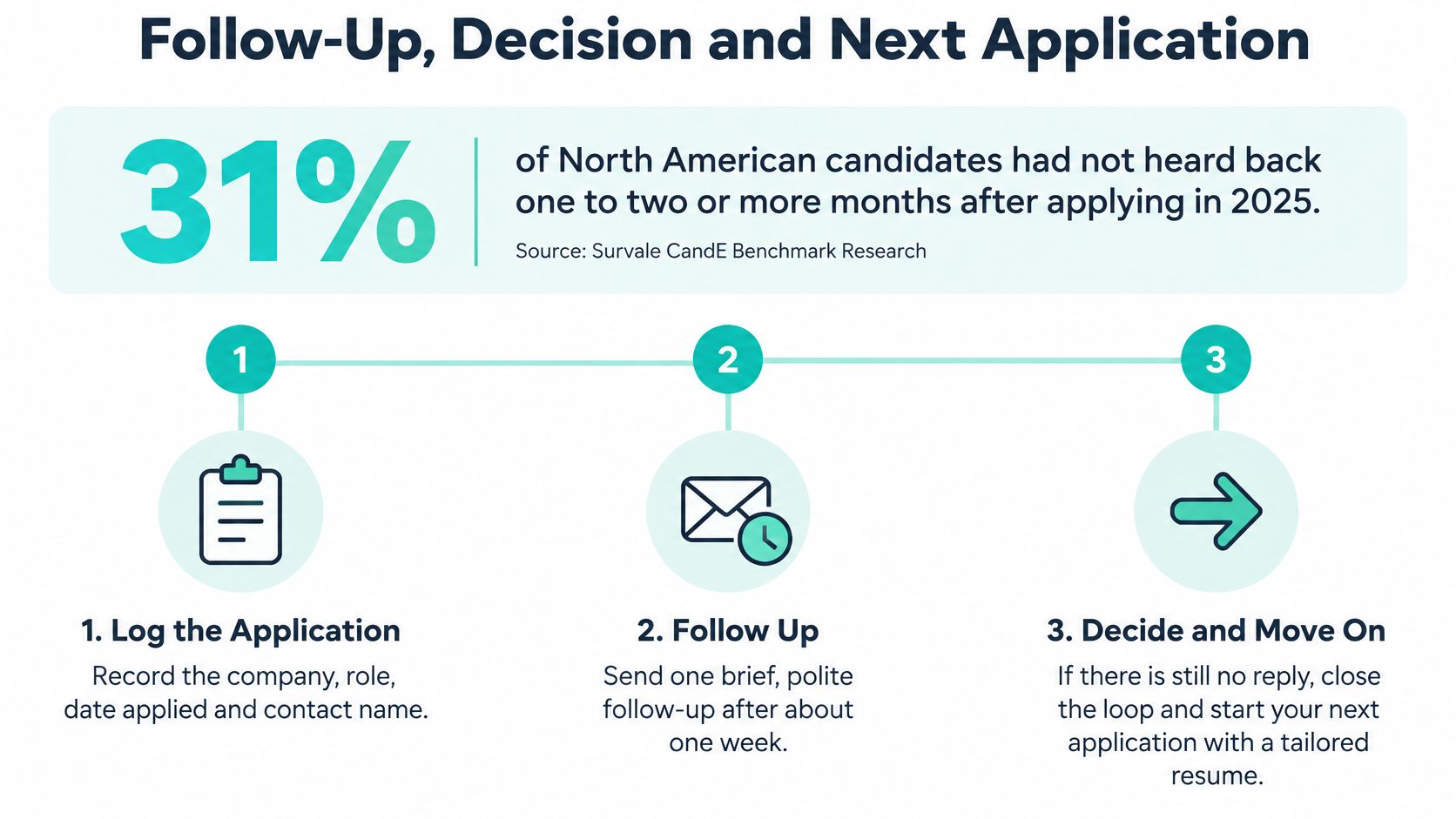
Waiting weeks for a status update is far more common than most candidates realize. In 2025, 31% of North American candidates said they had not heard back from an employer one to two or more months after applying, according to Survale's CandE Benchmark Research. Without a strict cutoff rule, those open loops drain your focus and trick you into thinking your pipeline is fuller than it is.
The workflow below turns vague waiting into a fixed three-phase cycle: log the submission, follow up once with purpose, and move on cleanly.
A productive job search doesn't require a yes from every company. A fast reply, a clear rejection, or a dated next step are all useful outcomes because each one lets you allocate your next hour wisely.
Before submitting your next startup application, run through five quick checks so you don't repeat avoidable silence traps:
Pick one high-fit startup role today, choose the best channel you can access for it, set your follow-up date in your log, and get that single focused application out this week.
If you'd rather skip crowded job-board queues and let vetted startup founders and hiring managers come to you, Underdog.io flips the process with a single 60-second profile. Accepted candidates get direct introductions from high-growth startups in New York City, San Francisco, and remote teams, complete with clear role details and salary ranges before you spend time interviewing. Visit Underdog.io to submit your profile and let startups reach out to you.