You're probably looking at a stable senior role, decent money, and a calendar full of architecture reviews, then wondering why the next move still feels hard. The answer is usually not a lack of skill. It's that the market for jobs for senior software engineer has become narrower, more selective, and more specialized, so the old “apply everywhere and hope” approach stops working.
A lot of senior engineers I've seen move fastest share the same pattern. They stop chasing generic listings, focus on startup and growth-company roles where impact is obvious, and tailor how they search, present themselves, and negotiate. That matters in a market where senior and specialized engineers are still in demand, while employers increasingly prioritize cloud, security, ML, data, and platform depth over broad but shallow experience, and where software engineering postings rose 18% after the 2025 inflection point in one LinkedIn market analysis, signaling a selective recovery rather than a broad hiring wave (market coverage on the post-2025 shift).
A senior engineer leaving a larger company is often trying to escape slow decision cycles, narrow scope, and the feeling that impact gets diluted across layers of process. At startups, especially the right ones, you can own architecture, ship quickly, and see whether your work moved the product without waiting months for a committee to notice.
That does not mean startups are easier. They usually put more pressure on ambiguity, and they expect people who can work through incomplete specs, make trade-offs, and keep delivery moving even if the plan changes. That is exactly why they fit experienced engineers who have already built a judgment muscle.
The market data supports aiming for roles with real ownership. U.S. software-developer occupations are projected by the Bureau of Labor Statistics to grow 15% from 2024 to 2034, which points to continued demand for experienced engineering talent rather than a one-time hiring spike. The UK salary picture also stays strong, the median Senior Software Engineer salary was £75,000 based on vacancies posted in the six months leading to 22 July 2026, which shows how experienced engineers are still valued in competitive hiring markets.
Practical rule: target companies where the role description sounds like ownership, not just coding. If the posting asks for architecture judgment, cross-functional work, and delivery accountability, it is closer to the kind of role that rewards seniority.
Curated startup marketplaces make that search more efficient. A platform like Underdog.io can reduce noise because it surfaces engineers to startups through screening instead of forcing you into dozens of cold applications, and a broader comparison of software engineer job search sites can help you decide where to spend your time.
Startups also force clarity. If you can explain how you reduced risk, improved systems, or unblocked product delivery, you will do well in environments where output matters more than pedigree. For many senior engineers, that is the main draw. You get closer to the decisions, the trade-offs are visible, and equity becomes part of the conversation instead of an afterthought.
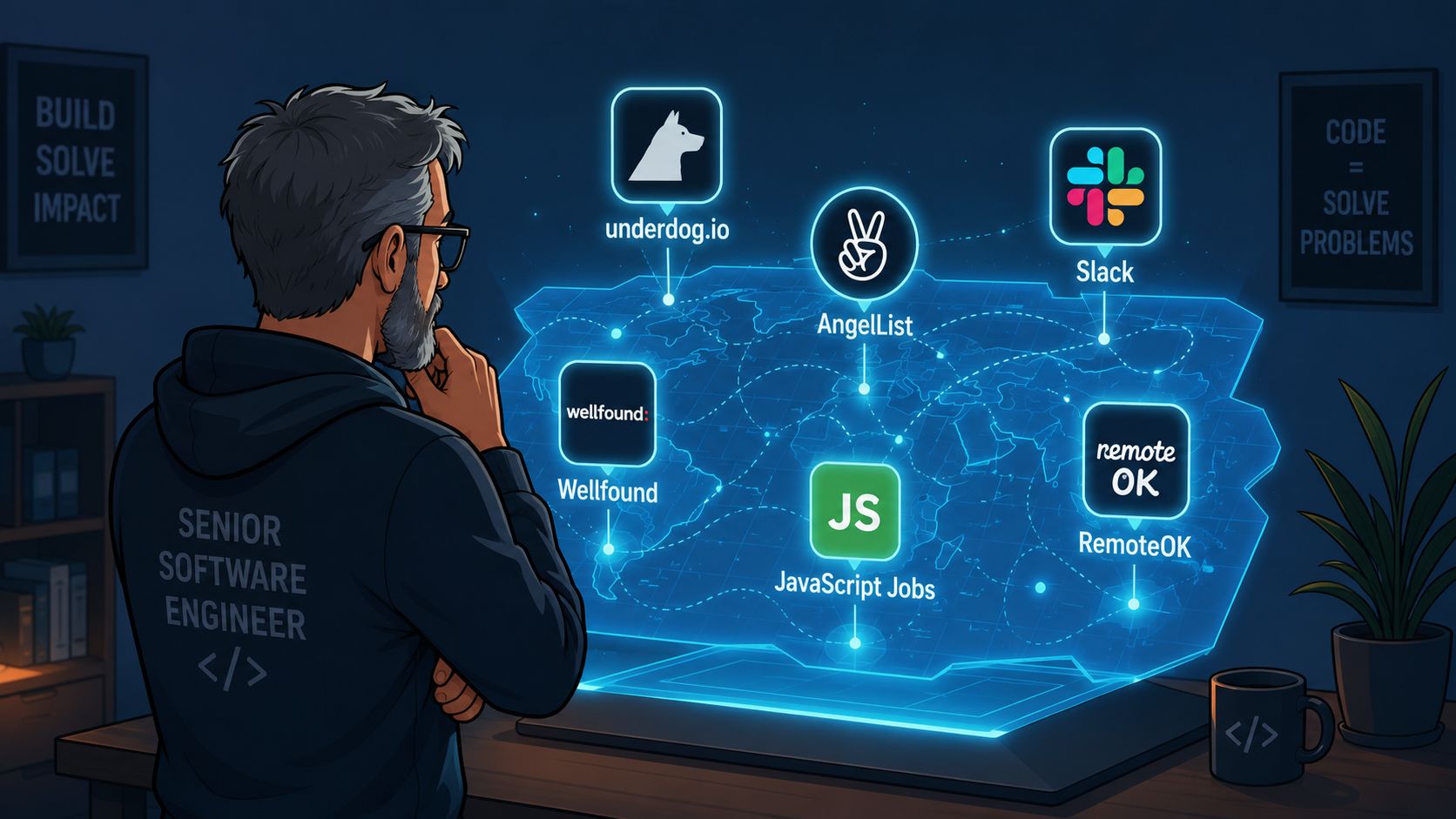
The best source is rarely one source. Senior roles show up in broad job boards, startup marketplaces, referral networks, and company career pages, but they don't all behave the same way. Passive marketplaces can save time because employers come to you, while active channels reward persistence and timing.
A curated marketplace is worth considering if you're trying to avoid resume black holes. Underdog.io is one option in that category, and it uses a short application flow with profile screening so candidates can get surfaced to startups without blasting dozens of cold applications. For a longer breakdown of how engineer-focused job sites compare, this guide to software engineer job search sites is a useful companion.
Remote listings are still out there, but the bar is higher. Current remote senior roles skew toward people who can self-manage, own architecture end to end, and work comfortably with cloud platforms, CI/CD, and legacy modernization (remote senior role requirements). That makes remote boards useful, but only if you already match the autonomy profile.
Here's how I'd split the search:
Warm introductions usually beat cold applications because they carry context. A recruiter can ignore a form, but a hiring manager tends to look twice when a respected engineer sends a name.
The timing also matters. If you're applying to startups, try to do it when they're actively hiring for the function you can own, not when they've posted a vague evergreen role. Senior jobs for software engineer candidates often disappear into general pipelines unless the company is hungry for immediate impact.

Senior resumes fail when they read like a task list. If your bullets mostly say “built,” “worked on,” and “helped,” you sound mid-level even when your experience is deep. The document has to make one thing obvious fast, you own systems, not just tickets.
The strongest pattern is impact first, then scope, then tooling. If a project touched architecture, reliability, release management, or a cross-functional launch, say so plainly. That matches what senior postings ask for, since recent listings emphasize communication, documentation, CI/CD, and domain-specific experience like healthcare or regulated-industry work, which shows that screening is about systems ownership as much as coding depth (Indeed senior software engineer postings).
Your headline should tell recruiters what kind of senior engineer you are, not just that you exist. “Senior Software Engineer, Platform and Distributed Systems” is better than “Software Engineer.” On LinkedIn, your about section should echo the kinds of problems you solve, for example cloud migrations, developer tooling, observability, or regulated workflows.
Your bullets should carry evidence of ownership. A good structure is:
That structure works because it maps to how senior roles are evaluated. Employers want to know whether you can work across teams, document decisions, and keep systems moving through release. A quick scan should also reveal your comfort with CI/CD, incident handling, and collaboration with product or IT.
If you need examples of phrasing and layout, these software engineer resume examples are worth studying for structure, not for copying line by line. The trick is to make every bullet feel like a compressed engineering story, not a generic accomplishment.
One more detail matters more than people admit. Your profile keywords need to match the work you want, but they should still read like a human wrote them. Recruiters and ATS tools both react better when the language is specific, grounded, and consistent with the roles you're targeting.

Networking at senior level works best when it's narrow and respectful. You're not asking everyone you know for a job, you're asking a few people for context, timing, or a referral to a role that fits your background. That's a very different ask, and it gets a better response.
The cleanest workflow is simple. Find one person at the company who's close enough to the hiring function to know the full scope, then send a short message that asks for a quick perspective, not a favor. If they respond, keep the first conversation focused on the role, the team's tech stack, and what senior success looks like there.
A good cold DM has three parts. You introduce yourself in one line, explain why you're reaching out, and make the ask small. Something like this works better than a long pitch:
Hi, I'm a senior engineer with experience in platform and backend systems. I saw your team is hiring and wanted to ask whether the role leans more toward architecture ownership or delivery execution. If you're open to it, I'd appreciate 10 minutes of context.
That kind of message gets easier to send when you stop treating it like a performance. Most engineers know the search is a grind, and many are willing to help if you're specific and concise. Alumni groups and former teammates are especially useful because the trust is already there.
Follow-up timing should stay light. One reminder after a few days is fine. After that, move on unless the person signals interest. The goal is to create a referral pipeline, not to chase one contact until it turns awkward.
Senior candidates also benefit from reverse networking. Instead of only asking for referrals, share useful signals, like your current search focus, the domains you know, or the types of systems you want to own. That helps people remember where to place you when a fitting role comes up.
Most senior loops test two things at once, whether you can design systems under uncertainty and whether you can lead without becoming territorial. That's why the interview feels different from mid-level screens. You're being evaluated as someone who can carry responsibility across the full delivery path.
Many postings describe that scope directly. A senior engineer is often expected to design new systems, maintain existing ones, collaborate with IT management and development teams, and drive release management, which makes the role operational as much as technical (Betterteam senior software engineer description). If you ignore that and only prep for algorithms, you'll miss half the loop.
For design interviews, open with requirements, not architecture. Ask about scale, availability, latency, data retention, and failure modes before sketching boxes. Then walk through trade-offs out loud so the interviewer can see how you think when the solution isn't obvious.
A simple framework helps:
That's the part many candidates skip. Senior interviewers care less about fancy terms than they do about whether you'll make a decision, defend it, and adjust when the constraints change.
For practice, use this interview prep guide for software engineers to tighten your story bank and system-design rhythm. The best mock interviews are live, uncomfortable, and specific, because that's what the actual loop feels like.
Behavioral prep should sound like engineering leadership, not polished slogans. Talk about disagreements, incident ownership, mentoring, and how you kept product and engineering aligned when a release was at risk. If you can explain a hard trade-off clearly, you already sound senior.
Offer evaluation gets messy because the visible number isn't the whole offer. Base salary is only one part, and equity can matter a lot if the company is early, growing fast, or still figuring out its compensation bands. The problem is that many candidates negotiate from instinct instead of comparing the full package.
Location still moves pay meaningfully. Microsoft's posted U.S. base pay range for Senior Software Engineering IC4 is $119,800 to $234,700, and it rises to $158,400 to $258,000 in the Bay Area and New York City metropolitan area, which shows how much location premium still exists even at the same level (Microsoft IC4 pay range).
| Location | Base Salary Range | Equity Range (%) |
|---|---|---|
| San Francisco Bay Area | Higher location-adjusted ranges are common for the same level | Varies by company and stage |
| New York City | Higher location-adjusted ranges are common for the same level | Varies by company and stage |
| Other major U.S. hubs | Usually below Bay Area and NYC ranges for identical level designations | Varies by company and stage |
| Remote roles | Often benchmarked against a company-wide band rather than a city premium | Varies by company and stage |
I'm keeping the equity column qualitative on purpose, because the exact grant depends on stage, dilution, refresh policy, and title mapping. That's where candidates get misled. A startup with a higher paper salary can still be weaker on upside than a lower-salary offer with a cleaner equity story.
Ask for the comp philosophy, not just the number. You want to know how the company prices senior scope, how often they refresh equity, and whether they've adjusted bands for remote hires.
Negotiation works best when you tie your ask to scope and market fit, not need. If a role expects architecture ownership, mentorship, and release accountability, say that your experience maps to that scope and you'd like the package to reflect it. Keep the tone calm. The strongest negotiators sound like they're solving for fit, not fighting over points.
The first 90 days should not be about proving you can code. They should be about proving you can learn the system, make good calls, and remove friction for the team. If you rush straight into large refactors, you usually create political debt before you've earned trust.
A useful benchmark for senior software engineers is 4 to 7 years of related experience, often while leading a 3–5 engineer team and owning features from architecture through shipping (Jooble senior software engineer benchmark). That's a good reminder that seniority is measured by impact, not just years.
In the first 30 days, learn the product, the release process, and the failure history. Sit in design reviews, read past incident docs, and learn where the team still depends on tribal knowledge. Your goal is to become safe and useful.
By day 60, make one visible improvement that reduces pain for others. It could be a cleaner runbook, a deployment fix, or a system cleanup that removes recurring friction. Don't chase heroic scope before you understand the actual bottleneck.
By day 90, you should be able to own a project end to end and explain the trade-offs behind it. If you're managing people, start with clear expectations and feedback loops, not status theater. If you're not managing people, lead through clarity, documentation, and consistency.
Keep a private log of wins, blockers, and decisions. That makes performance reviews, promotion conversations, and equity discussions much easier later, because you won't be relying on memory to reconstruct your impact.
If you're actively searching for jobs for senior software engineer candidates at startups, spend a few minutes on Underdog.io, compare the roles against your current scope, and use the search process to test where your profile fits best.